# Anti-Defensive Writing
### Calibrated Assertiveness & Positive Scope for Academic and Technical Prose
[](SKILL.md)

[](LICENSE)
[](https://learn.chatgpt.com/docs/build-skills#where-codex-loads-local-skills)
[](https://code.claude.com/docs/en/skills#choose-where-skills-load)

[](#quickstart)

[](#)

Abstract •
Core Principles •
Comparative Analysis •
Rewrite Pipeline •
Quickstart •
Agent Interface •
Case Studies •
BibTeX
English | 简体中文
---
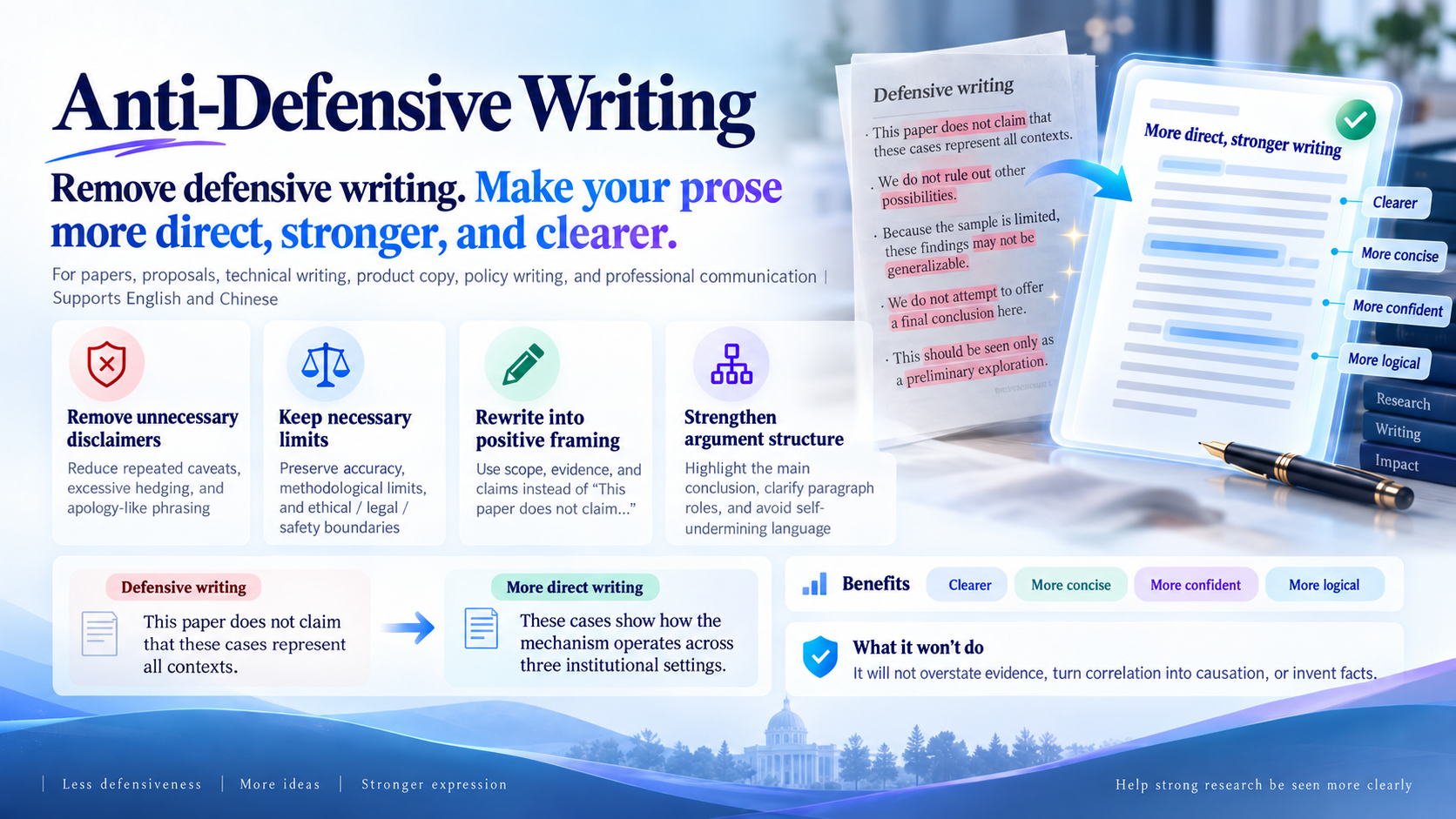
Figure 1: The Anti-Defensive Writing Paradigm. Systematically removing premature apologies, redundant disclaimers, and layered hedges while rigorously anchoring empirical scope and methodological boundaries.
---
## Abstract
> **Abstract** — Scholarly and technical communication is frequently weakened by *defensive writing*: an authorial posture characterized by pre-emptive apologies, repetitive disclaimers, stacked modal hedges, and negative self-deprecation. While intended to ward off hypothetical criticism, defensive habits dilute the empirical strength of claims and obscure core scientific contributions.
>
> **Anti-Defensive Writing** introduces an agentic skill specification that systematically diagnoses and eliminates defensive cognitive overhead while strictly preserving methodological validity, empirical scope, and ethical/legal boundaries. By replacing defensive disclaimers with positive scope definitions and calibrating uncertainty to observed evidence, this framework enables researchers and professionals to communicate findings with authoritative clarity, structural focus, and maximum signal-to-noise ratio.
The complete operational rulebook and multilingual instructions are codified in [**SKILL.md**](SKILL.md) (comprising English Core Rules, English Extended Guidelines, Chinese Core Rules, and Chinese Extended Guidelines).
---
## Core Principles
The framework establishes four fundamental pillars for rigorous, claim-forward academic communication:
| Pillar | Academic Posture | Operational Directive |
| :--- | :--- | :--- |
| **🎯 Claim-Forward Articulation** | Assertive & Direct | Lead paragraphs and contribution sections with empirical discoveries and theoretical arguments, rather than defensive preambles. |
| **📐 Positive Scope Delimitation** | Constructive & Bounded | Define boundaries by stating what the investigation *does* analyze, test, and explain—abandoning reflexive *"We do not claim that..."* formulations. |
| **⚖️ Calibrated Uncertainty** | Rigorous & Precise | Differentiate between legitimate empirical limits and timid hedge stacking (*"may potentially suggest"*); anchor uncertainty directly to concrete design constraints. |
| **🏗️ Structural Separation of Concerns** | Modular & Cohesive | Place necessary methodological limitations in dedicated sections (Methods, Discussion, Limitations), preventing dilution of abstracts, introductions, and conclusions. |
---
## Technical Plans and SOPs
In Chinese technical plans, SOPs, reports, and presentations:
Remove redundancy and admonitory tone while preserving technical meaning, applicability conditions, prohibitions, and operational purpose. Do not change the operation to make the text sound more concise or specialized.
- **State the plan directly:** Give the procedure, parameters, prerequisites, and findings. Remove commentary about the writing only when it adds no substantive information. Keep phrases such as “用于阐明机制” when they state a real research purpose.
- **Name technical prerequisites:** Replace vague wording such as “在条件允许时” with concrete prerequisites supported by the draft, for example, “标定前提:……”. Keep necessary conditions expressed by “仅在……时” or “若欲……需要……”, or rewrite them equivalently. Do not replace them with an unconditional action; identify missing conditions when they are unspecified.
- **Use operational language:** State the required handling directly and remove admonitory wording such as “切记”, while retaining necessary prohibitions and technical conclusions. Keep “不可互相替代” when it expresses a real restriction. Use “两者独立记录并平行分析” only when the procedure calls for it; this does not convey non-interchangeability.
- **Choose precise verbs:** Simplify redundant phrasing such as “进行……的测量” to “测量……”. “测量” and “表征” are valid technical verbs. Use “标定”, “解耦”, “淬灭”, or “钳定” only when they describe the actual operation; do not substitute a different operation to sound more specialized.
The [Chinese guide](README.zh-CN.md#中文技术写作与-sop) includes the Chinese rules and examples.
---
## Comparative Analysis
The table below contrasts conventional defensive drafts against revisions generated under the **Anti-Defensive Writing** paradigm across standard scholarly contexts.
| Rhetorical Dimension | Conventional Defensive Draft (❌) | Anti-Defensive Paradigm (✅) | Cognitive & Rhetorical Gain |
| :--- | :--- | :--- | :--- |
| **Introduction & Hook** | *"Although it is beyond the scope of this modest preliminary inquiry to resolve platform governance debates, it might tentatively be suggested..."* | *"Algorithmic content moderation significantly reshapes user participation in online communities."* | **Immediate Empirical Focus**: Commands reader attention by stating observed phenomena without evasive preamble. |
| **Scope Delimitation** | *"We do not claim that our sample is representative of all municipal governance systems across regions."* | *"The analysis focuses on urban governance cases across three institutional jurisdictions from 2015 to 2023."* | **Positive Boundary Definition**: Conveys exact empirical boundaries without defensive self-deprecation. |
| **Uncertainty Calibration** | *"These experimental outcomes could potentially indicate that variable $X$ might possibly influence metric $Y$."* | *"The evidence indicates that $X$ influences $Y$ under the examined observational conditions."* | **Elimination of Hedge Stacking**: Replaces multi-layered modal qualifiers with calibrated, evidence-bounded assertion. |
| **Metric & Trade-off Framing** | *"The model achieved lower accuracy (89% vs. 90%), indicating clear performance shortcomings."* | *"The method reduces inference latency from 100 ms to 60 ms with 89% accuracy (compared to 90% for the baseline)."* | **Objective Trade-off Exposure**: States system trade-offs neutrally without pathologizing valid Pareto frontiers. |
| **Authorial Modesty** | *"This study merely attempts to take a minor exploratory step toward understanding..."* | *"This study establishes an empirical baseline for analyzing..."* | **Professional Authorial Posture**: Replaces ritual modesty with calm, objective scientific authority. |
---
## Rewrite Pipeline
Revising text with Anti-Defensive Writing follows a formal 5-stage transformation pipeline:
```
┌────────────────────────────────────────────────────────┐
│ Input: Defensive Academic Draft │
└───────────────────────────┬────────────────────────────┘
│
▼
┌────────────────────────────────────────────────────────┐
│ Stage 1: Functional Diagnosis │
│ Classify defensive units: Unnecessary Disclaimer vs. │
│ Necessary Scope vs. Methodological Constraint │
└───────────────────────────┬────────────────────────────┘
│
▼
┌────────────────────────────────────────────────────────┐
│ Stage 2: Disclaimer Pruning │
│ Strip uninformative disclaimers and preemptive │
│ apologies that contribute no empirical value │
└───────────────────────────┬────────────────────────────┘
│
▼
┌────────────────────────────────────────────────────────┐
│ Stage 3: Positive Projection │
│ Convert negative denials ("Not X") into │
│ explicit positive definitions ("Focuses on Y") │
└───────────────────────────┬────────────────────────────┘
│
▼
┌────────────────────────────────────────────────────────┐
│ Stage 4: Uncertainty Calibration │
│ Collapse stacked modal hedges ("may potentially"); │
│ ground uncertainty in concrete observational limits │
└───────────────────────────┬────────────────────────────┘
│
▼
┌────────────────────────────────────────────────────────┐
│ Stage 5: Structural Realignment │
│ Anchor paragraphs with decisive topic sentences; │
│ isolate true constraints to dedicated sections │
└───────────────────────────┬────────────────────────────┘
│
▼
┌────────────────────────────────────────────────────────┐
│ Output: Assertive, High-Signal Paper │
└────────────────────────────────────────────────────────┘
```
---
## Quickstart
### Deployment Footprint
The installation is engineered to be **minimal, hermetic, and zero-overhead**. Only a single specification file is deployed into your target skills environment:
```text