#  /pkg/rpc
[`cd /`](/README.md)
> [!NOTE]
> **asyncmachine-go** is a declarative execution model based on AOP, actor model, and state machines.
**aRPC** is a transparent RPC for state machines implemented using [asyncmachine-go](/). It's
clock-based and features many optimizations, e.g. having most of the API methods executed locally (as state changes are
regularly pushed to the client). It's built on top of [cenkalti/rpc2](https://github.com/cenkalti/rpc2) (fork of `net/rpc`),
and [soheilhy/cmux](https://github.com/soheilhy/cmux) with optional overlay via [tmc/go-iroh](https://github.com/tmc/go-iroh).
Check out the [dedicated example](/examples/arpc), [gRPC benchmark](/examples/benchmark_grpc), and an
[integration tests tutorial](/pkg/rpc/HOWTO.md).
## Support
- state checking YES
- state mutations YES
- state waiting YES
## Features
- clock pushes (after a mutation and periodically)
- remote state contexts
- multiplexing
- reconnect / fail-safety
- state source machine sending payloads to the client
- [REPL and CLI](/tools/cmd/arpc/README.md)
- queue ticks and machine ticks support
- initial optimizations
- WebSockets with auth
- checksums
- [iroh overlay](https://docs.iroh.computer/what-is-iroh)
- UDP (HTTP3 QUIC)
- ACLs via public keys
- encryption
- relays and NAT bypass
Not implemented (yet):
- `WhenArgs`
- chunked payloads
- JSON encoding
Each RPC server can handle 1 RPC client at a time, but 1 state source (asyncmachine) can have many RPC servers attached
to itself (via [Tracer API](https://pkg.go.dev/github.com/pancsta/asyncmachine-go/pkg/machine#Tracer)).
Additionally, remote RPC network-machines can also have RPC servers attached to themselves, creating a tree structure
(see [/examples/benchmark_state_source](/examples/benchmark_state_source)).
## Components
### Network State Source
Any state machine can be exposed as an RPC state source, as long as it implements [`/pkg/rpc/states/StateSourceSchemaDef`](/pkg/rpc/states/ss_rpc.go).
This can be done either manually, or by using state helpers ([SchemaMerge](https://pkg.go.dev/github.com/pancsta/asyncmachine-go/pkg/machine#Machine.SchemaMerge),
[SAdd](https://pkg.go.dev/github.com/pancsta/asyncmachine-go/pkg/machine#SAdd)), or by generating a schema file with
[am-gen](/tools/cmd/am-gen/README.md). It's also required to have the states verified by [Machine.VerifyStates](https://pkg.go.dev/github.com/pancsta/asyncmachine-go/pkg/machine#Machine.VerifyStates).
Network Machine can send data to the client via the `SendPayload` state.
- [schema file](/pkg/rpc/states/ss_rpc.go)
```go
import (
am "github.com/pancsta/asyncmachine-go/pkg/machine"
arpc "github.com/pancsta/asyncmachine-go/pkg/rpc"
ssrpc "github.com/pancsta/asyncmachine-go/pkg/rpc/states"
)
// ...
// inherit from RPC network machine
schema := am.SchemaMerge(ssrpc.StateSourceSchema, am.Schema{
"Foo": {Require: am.S{"Bar"}},
"Bar": {},
})
name := am.SAdd(ssrpc.StateSourceStates.Names(), am.S{"Foo", "Bar"})
// init
netMach := am.New(ctx, schema, nil)
netMach.VerifyStates(name)
// ...
// send data to the client
netMach.Add1(ssrpc.StateSourceStates.SendPayload, arpc.Pass(&arpc.A{
Name: "mypayload",
Payload: &arpc.ArgsPayload{
Name: "mypayload",
Source: "network machine1",
Data: []byte{1,2,3},
},
}))
```
#### Network Machine Schema
State schema from [/pkg/rpc/states/ss_rpc.go](/pkg/rpc/states/ss_rpc.go).
```go
type NetMachStatesDef struct {
ErrProviding string
ErrSendPayload string
SendPayload string
}
```
### Server
Each RPC server can handle 1 client at a time. Both client and server need the same network machine states definition (structure
map and ordered list of states). After the initial handshake, the server will be pushing **local machine time changes**
every [PushInterval](https://pkg.go.dev/github.com/pancsta/asyncmachine-go/pkg/rpc#Server), while state changes made by
an RPC client are delivered synchronously. Server starts listening on either [Addr](https://pkg.go.dev/github.com/pancsta/asyncmachine-go/pkg/rpc#Server),
[Listener](https://pkg.go.dev/github.com/pancsta/asyncmachine-go/pkg/rpc#Server), or [Conn](https://pkg.go.dev/github.com/pancsta/asyncmachine-go/pkg/rpc#Server).
Basic ACL is possible via [AllowId](https://pkg.go.dev/github.com/pancsta/asyncmachine-go/pkg/rpc#Server).
The server doesn't emit mutation arguments, use [state piping](/pkg/rpc/states) from state source to an
[RPC client Network Machine](#client) to receive arguments over the network. Server can listen on a WebSocket, including
relayed TCP-over-WebSocket listening (useful for WASM).
- [schema file](/pkg/rpc/states/ss_rpc.go)
```go
import (
amhelp "github.com/pancsta/asyncmachine-go/pkg/helpers"
am "github.com/pancsta/asyncmachine-go/pkg/machine"
arpc "github.com/pancsta/asyncmachine-go/pkg/rpc"
ssrpc "github.com/pancsta/asyncmachine-go/pkg/rpc/states"
)
// ...
var addr string
var netMach *am.Machine
// init
s, err := arpc.NewServer(ctx, addr, "server", sourceMach, &arpc.ServerOpts{
Parent: machParent,
})
if err != nil {
panic(err)
}
// start
s.Start()
err = amhelp.WaitForAll(ctx, 2*time.Second,
s.Mach.When1(ssrpc.ServerStates.RpcReady, ctx))
if ctx.Err() != nil {
return
}
if err != nil {
return err
}
// react to the client
<-netMach.When1("Foo", nil)
print("Client added Foo")
netMach.Add1("Bar", nil)
```
#### Server Schema
State schema from [/pkg/rpc/states/ss_rpc.go](/pkg/rpc/states/ss_rpc.go).
### Client
Each RPC client can connect to 1 server and needs to know network machine's machine schema and order. Data send by a
network machine via `ServerPayload` will be received by a [Consumer machine](https://pkg.go.dev/github.com/pancsta/asyncmachine-go/pkg/rpc/states#ConsumerStatesDef)
(passed via [ClientOpts.Consumer](https://pkg.go.dev/github.com/pancsta/asyncmachine-go/pkg/rpc#ClientOpts)) as an Add
mutation of the `ServerPayload` state (see a [detailed diagram](/docs/diagrams.md#rpc-getter-flow)). Client supports
fail-safety for both connection (eg [ConnRetries](https://pkg.go.dev/github.com/pancsta/asyncmachine-go/pkg/rpc#Client),
[ConnRetryBackoff](https://pkg.go.dev/github.com/pancsta/asyncmachine-go/pkg/rpc#Client)) and calls (eg [CallRetries](https://pkg.go.dev/github.com/pancsta/asyncmachine-go/pkg/rpc#Client),
[CallRetryBackoff](https://pkg.go.dev/github.com/pancsta/asyncmachine-go/pkg/rpc#Client)).
After the client's `Ready` state becomes active, it exposes a remote **network machine** at `client.NetMach`. Remote
network machine implements most of the
[Machine](https://pkg.go.dev/github.com/pancsta/asyncmachine-go/pkg/machine#Machine)'s methods, many of which
are evaluated locally (like [Is](https://pkg.go.dev/github.com/pancsta/asyncmachine-go/pkg/rpc#NetMach.Is), [When](https://pkg.go.dev/github.com/pancsta/asyncmachine-go/pkg/rpc#NetMach.When),
[NewStateCtx](https://pkg.go.dev/github.com/pancsta/asyncmachine-go/pkg/rpc#NetMach.NewStateCtx)). See [machine.Api](https://pkg.go.dev/github.com/pancsta/asyncmachine-go/pkg/machine#Api)
for a full list.
Time diffs received by the RPC cliebt are merged (contain multiple mutations in one diff), but can be split
per-mutation using `opts.SyncMutations`. Client can connect to WebSockets (useful for WASM).
- [schema file](/pkg/rpc/states/ss_rpc.go)
```go
import (
amhelp "github.com/pancsta/asyncmachine-go/pkg/helpers"
am "github.com/pancsta/asyncmachine-go/pkg/machine"
arpc "github.com/pancsta/asyncmachine-go/pkg/rpc"
ssrpc "github.com/pancsta/asyncmachine-go/pkg/rpc/states"
)
// ...
var addr string
// network machine state schema
var schema am.Schema
// network machine state names
var names am.S
// consumer
consumer := am.New(ctx, ssrpc.ConsumerSchema, nil)
// init
c, err := arpc.NewClient(ctx, addr, "clientid", schema, &arpc.ClientOpts{
Consumer: consumer,
})
// start
c.Start()
err := amhelp.WaitForAll(ctx, 2*time.Second,
c.Mach.When1(ssrpc.ClientStates.Ready, ctx))
if ctx.Err() != nil {
return
}
// use the remote network machine
c.NetMach.Add1("Foo", nil)
<-c.NetMach.When1("Bar", nil)
print("Server added Bar")
```
#### Client Schema
State schema from [/pkg/rpc/states/ss_rpc.go](/pkg/rpc/states/ss_rpc.go).
### Multiplexer
Because 1 server can serve only 1 client (for simplicity), it's often required to use a port multiplexer. It's very
simple to create one using [NewMux](https://pkg.go.dev/github.com/pancsta/asyncmachine-go/pkg/rpc#NewMux) and a callback
function, which returns a new server instance.
- [schema file](/pkg/rpc/states/ss_rpc.go)
```go
import (
amhelp "github.com/pancsta/asyncmachine-go/pkg/helpers"
arpc "github.com/pancsta/asyncmachine-go/pkg/rpc"
ssrpc "github.com/pancsta/asyncmachine-go/pkg/rpc/states"
)
// ...
var ctx context.Context
// new server per each new client (optional)
var newServer arpc.MuxNewServer = func(mux *arpc.Mux, id string, conn net.Conn) (*Server, error) {
s, err := mux.NewDefaultServer(id)
if err != nil {
return nil, err
}
srv.Conn = conn
srv.Start(e)
return s, nil
}
// start cmux
mux, err := arpc.NewMux(ctx, t.Name(), newServer, nil)
mux.Listener = listener // or mux.Addr := ":1234"
mux.Start()
err := amhelp.WaitForAll(ctx, 2*time.Second,
mux.Mach.When1(ssrpc.MuxStates.Ready, ctx))
```
#### Multiplexer Schema
State schema from [/pkg/rpc/states/ss_rpc.go](/pkg/rpc/states/ss_rpc.go).
## Selective Distribution

Every state-machine can be partially distributed over the network and updated on a different granularity level.
Synchronization scenarios:
- full sync (state names, schema, machine time)
- no schema (state names, machine time)
- selected states (state names, schema, selective ticks)
- shallow clocks (state names, schema, binary ticks)
Synchronization granularity:
- 1 clock diff per N mutations
- N clock diffs per N mutations


Scenarios can be mixed with each other to a certain degree (eg shallow clocks for selected states). **Selective
Distribution** is like [state piping](/pkg/states/README.md#piping), but over the network and utilizes all other aRPC
optimizations.
## Network Handlers
Locally piped Network Machine can then run local handlers (via a local [`/pkg/machine.Machine`](https://pkg.go.dev/github.com/pancsta/asyncmachine-go/pkg/machine#Machine)
instance) and mutate itself, which will effectively mutate the Network Source. Combining network handlers with selective
distribution can lead to large network coverage (number of hosts) consuming a tiny bandwidth usage. The structure of the
network has to be fixed, unlike in case of [`/pkg/pubsub`](/pkg/pubsub/README.md).
By combining **Network Handlers** with **Selective Distribution** received by a redundant number of clients (per state),
we can create multidimensional graphs. Those could be developed further with "voting receivers" (vote-based firewalls)
to create more organic systems.

## Implementation details
- schema is always full-or-nothing
- state indexes and time slices are always source-bound
- unless there's no schema sync, then client-bound
- time sum is always client-bound for checksums
- from a binary time slice for shallow clocks
- aRPC mutations don't have arguments - hash `am.Time` and machine IDs to create a remote address for payloads
**aRPC** implements several optimization strategies to achieve the results:
- `net/rpc` method names as runes
- binary format of `encoding/gob`
- index-based clock
- `[0, 100, 0, 120]`
- diff-based clock updates
- `[0, 1, 0, 1]`
- debounced server-mutation clock pushes
- `[0, 5, 2, 1]`
- partial clock updates
- `[[1, 1], [3, 1]]`
## Documentation
- [api /pkg/rpc](https://code.asyncmachine.dev/pkg/github.com/pancsta/asyncmachine-go/pkg/rpc.html)
- [godoc /pkg/rpc](https://pkg.go.dev/github.com/pancsta/asyncmachine-go/pkg/rpc)
- [Example - Setup](/examples/arpc)
- [Example - Tree State Source](/examples/tree_state_source)
- [diagrams](/docs/diagrams.md#arpc)
## Debugging
`/pkg/rpc` is immune to `AM_DBG_ADDR` env-based debugging, unless special variables are **also** active. This is to
avoid noise, but sometimes it's useful to check for network errors (which should actually be [piped](/pkg/states/README.md#piping)
to parent machines). Refer to [/docs/env-configs.md](/docs/env-configs.md) for details.
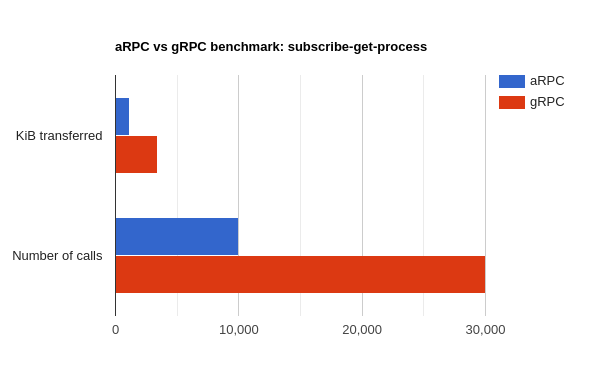
## Benchmark: aRPC vs gRPC
Results for version `v0.7.0` (outdated).
A simple and opinionated benchmark showing a `subscribe-get-process` scenario, implemented in both gRPC and aRPC. See
[/examples/benchmark_grpc](/examples/benchmark_grpc) for details and source code.
```text
> task benchmark-grpc
...
BenchmarkClientArpc
client_arpc_test.go:136: Transferred: 609 bytes
client_arpc_test.go:137: Calls: 4
client_arpc_test.go:138: Errors: 0
client_arpc_test.go:136: Transferred: 1,149,424 bytes
client_arpc_test.go:137: Calls: 10,003
client_arpc_test.go:138: Errors: 0
BenchmarkClientArpc-8 10000 248913 ns/op 28405 B/op 766 allocs/op
BenchmarkClientGrpc
client_grpc_test.go:117: Transferred: 1,113 bytes
client_grpc_test.go:118: Calls: 9
client_grpc_test.go:119: Errors: 0
client_grpc_test.go:117: Transferred: 3,400,812 bytes
client_grpc_test.go:118: Calls: 30,006
client_grpc_test.go:119: Errors: 0
BenchmarkClientGrpc-8 10000 262693 ns/op 19593 B/op 391 allocs/op
BenchmarkClientLocal
BenchmarkClientLocal-8 10000 434.4 ns/op 16 B/op 1 allocs/op
PASS
ok github.com/pancsta/asyncmachine-go/examples/benchmark_grpc 5.187s
```
## API
**aRPC** implements `/pkg/machine#Api`, which is a large subset of `/pkg/machine#Machine` methods. Below the full list,
with distinction which methods happen where (locally or on remote).
```go
// TODO update
// A (arguments) is a map of named arguments for a Mutation.
type A map[string]any
// S (state names) is a string list of state names.
type S []string
type Time []uint64
type Clock map[string]uint64
type Result int
type Schema = map[string]State
// Api is a subset of Machine for alternative implementations.
type Api interface {
// ///// REMOTE
// Mutations (remote)
Add1(state string, args A) Result
Add(states S, args A) Result
Remove1(state string, args A) Result
Remove(states S, args A) Result
AddErr(err error, args A) Result
AddErrState(state string, err error, args A) Result
Toggle(states S, args A) Result
Toggle1(state string, args A) Result
Set(states S, args A) Result
// Traced mutations (remote)
EvAdd1(event *Event, state string, args A) Result
EvAdd(event *Event, states S, args A) Result
EvRemove1(event *Event, state string, args A) Result
EvRemove(event *Event, states S, args A) Result
EvAddErr(event *Event, err error, args A) Result
EvAddErrState(event *Event, state string, err error, args A) Result
EvToggle(event *Event, states S, args A) Result
EvToggle1(event *Event, state string, args A) Result
// Waiting (remote)
WhenArgs(state string, args A, ctx context.Context) <-chan struct{}
// ///// LOCAL
// Checking (local)
Err() error
IsErr() bool
Is(states S) bool
Is1(state string) bool
Any(states ...S) bool
Any1(state ...string) bool
Not(states S) bool
Not1(state string) bool
IsTime(time Time, states S) bool
WasTime(time Time, states S) bool
IsClock(clock Clock) bool
WasClock(clock Clock) bool
Has(states S) bool
Has1(state string) bool
CanAdd(states S, args A) Result
CanAdd1(state string, args A) Result
CanRemove(states S, args A) Result
CanRemove1(state string, args A) Result
Transition() *Transition
IsLocal() bool
ErrInternal() <-chan error
// Waiting (local)
When(states S, ctx context.Context) <-chan struct{}
When1(state string, ctx context.Context) <-chan struct{}
WhenNot(states S, ctx context.Context) <-chan struct{}
WhenNot1(state string, ctx context.Context) <-chan struct{}
WhenTime(states S, times Time, ctx context.Context) <-chan struct{}
WhenTime1(state string, tick uint64, ctx context.Context) <-chan struct{}
WhenTicks(state string, ticks int, ctx context.Context) <-chan struct{}
WhenNextActive(state string, ctx context.Context) <-chan struct{}
WhenQuery(query func(clock Clock) bool, ctx context.Context) <-chan struct{}
WhenErr(ctx context.Context) <-chan struct{}
WhenQueue(tick Result) <-chan struct{}
// Getters (local)
StateNames() S
ActiveStates(states S) S
Tick(state string) uint64
Clock(states S) Clock
Time(states S) Time
QueueTick() uint64
MachineTick() uint32
QueueLen() uint16
NewStateCtx(state string, e ...*Event) context.Context
Export() (*Serialized, Schema, error)
Schema() Schema
Switch(groups ...S) string
Groups() (map[string][]int, []string)
Index(states S) []int
Index1(state string) int
// Misc (local)
Id() string
ParentId() string
ParseStates(states S) S
Tags() []string
Context() context.Context
ContextParent() context.Context
String() string
StringAll() string
Log(msg string, args ...any)
SemLogger() SemLogger
Inspect(states S) string
HandlersBind(handlers any, opts ...BindOpts) (string, error)
HandlersBindMaps(negotiations map[string]HandlerNegotiation,
finals map[string]HandlerFinal, opts ...BindOpts) (string, error)
HandlersDetach(bindingId string) error
Handlers() []string
StatesVerified() bool
Tracers() []Tracer
TracerDetach(id string) error
TracerBind(tracer Tracer) (string, error)
AddBreakpoint(added S, removed S, strict bool)
AddBreakpoint1(added string, removed string, strict bool)
Dispose()
WhenDisposed() <-chan struct{}
IsDisposed() bool
OnDispose(fn HandlerDispose)
}
```
## Tests
**aRPC** passes the [whole test suite](/pkg/rpc/rpc_machine_test.go) of [`/pkg/machine`](/pkg/machine/machine_test.go)
for the exposed methods and provides a couple of [optimization-focused tests](/pkg/rpc/rpc_test.go) (on top of tests for
basic RPC).
## Status
Testing, not semantically versioned.
## monorepo
- [`/docs/wasm.md`](/docs/wasm.md)
- [`/examples/arpc`](/examples/arpc)
- [`/examples/tree_state_source`](/examples/tree_state_source)
- [`/examples/wasm`](/examples/wasm)
- [`/pkg/rpc/HOWTO.md`](/pkg/rpc/HOWTO.md)
- [`/examples/benchmark_grpc`](/examples/benchmark_grpc)
- [`/tools/cmd/arpc`](/tools/cmd/arpc/README.md)
[Go back to the monorepo root](/README.md) to continue reading.
/pkg/rpc
[`cd /`](/README.md)
> [!NOTE]
> **asyncmachine-go** is a declarative execution model based on AOP, actor model, and state machines.
**aRPC** is a transparent RPC for state machines implemented using [asyncmachine-go](/). It's
clock-based and features many optimizations, e.g. having most of the API methods executed locally (as state changes are
regularly pushed to the client). It's built on top of [cenkalti/rpc2](https://github.com/cenkalti/rpc2) (fork of `net/rpc`),
and [soheilhy/cmux](https://github.com/soheilhy/cmux) with optional overlay via [tmc/go-iroh](https://github.com/tmc/go-iroh).
Check out the [dedicated example](/examples/arpc), [gRPC benchmark](/examples/benchmark_grpc), and an
[integration tests tutorial](/pkg/rpc/HOWTO.md).
## Support
- state checking YES
- state mutations YES
- state waiting YES
## Features
- clock pushes (after a mutation and periodically)
- remote state contexts
- multiplexing
- reconnect / fail-safety
- state source machine sending payloads to the client
- [REPL and CLI](/tools/cmd/arpc/README.md)
- queue ticks and machine ticks support
- initial optimizations
- WebSockets with auth
- checksums
- [iroh overlay](https://docs.iroh.computer/what-is-iroh)
- UDP (HTTP3 QUIC)
- ACLs via public keys
- encryption
- relays and NAT bypass
Not implemented (yet):
- `WhenArgs`
- chunked payloads
- JSON encoding
Each RPC server can handle 1 RPC client at a time, but 1 state source (asyncmachine) can have many RPC servers attached
to itself (via [Tracer API](https://pkg.go.dev/github.com/pancsta/asyncmachine-go/pkg/machine#Tracer)).
Additionally, remote RPC network-machines can also have RPC servers attached to themselves, creating a tree structure
(see [/examples/benchmark_state_source](/examples/benchmark_state_source)).
## Components
### Network State Source
Any state machine can be exposed as an RPC state source, as long as it implements [`/pkg/rpc/states/StateSourceSchemaDef`](/pkg/rpc/states/ss_rpc.go).
This can be done either manually, or by using state helpers ([SchemaMerge](https://pkg.go.dev/github.com/pancsta/asyncmachine-go/pkg/machine#Machine.SchemaMerge),
[SAdd](https://pkg.go.dev/github.com/pancsta/asyncmachine-go/pkg/machine#SAdd)), or by generating a schema file with
[am-gen](/tools/cmd/am-gen/README.md). It's also required to have the states verified by [Machine.VerifyStates](https://pkg.go.dev/github.com/pancsta/asyncmachine-go/pkg/machine#Machine.VerifyStates).
Network Machine can send data to the client via the `SendPayload` state.
- [schema file](/pkg/rpc/states/ss_rpc.go)
```go
import (
am "github.com/pancsta/asyncmachine-go/pkg/machine"
arpc "github.com/pancsta/asyncmachine-go/pkg/rpc"
ssrpc "github.com/pancsta/asyncmachine-go/pkg/rpc/states"
)
// ...
// inherit from RPC network machine
schema := am.SchemaMerge(ssrpc.StateSourceSchema, am.Schema{
"Foo": {Require: am.S{"Bar"}},
"Bar": {},
})
name := am.SAdd(ssrpc.StateSourceStates.Names(), am.S{"Foo", "Bar"})
// init
netMach := am.New(ctx, schema, nil)
netMach.VerifyStates(name)
// ...
// send data to the client
netMach.Add1(ssrpc.StateSourceStates.SendPayload, arpc.Pass(&arpc.A{
Name: "mypayload",
Payload: &arpc.ArgsPayload{
Name: "mypayload",
Source: "network machine1",
Data: []byte{1,2,3},
},
}))
```
#### Network Machine Schema
State schema from [/pkg/rpc/states/ss_rpc.go](/pkg/rpc/states/ss_rpc.go).
```go
type NetMachStatesDef struct {
ErrProviding string
ErrSendPayload string
SendPayload string
}
```
### Server
Each RPC server can handle 1 client at a time. Both client and server need the same network machine states definition (structure
map and ordered list of states). After the initial handshake, the server will be pushing **local machine time changes**
every [PushInterval](https://pkg.go.dev/github.com/pancsta/asyncmachine-go/pkg/rpc#Server), while state changes made by
an RPC client are delivered synchronously. Server starts listening on either [Addr](https://pkg.go.dev/github.com/pancsta/asyncmachine-go/pkg/rpc#Server),
[Listener](https://pkg.go.dev/github.com/pancsta/asyncmachine-go/pkg/rpc#Server), or [Conn](https://pkg.go.dev/github.com/pancsta/asyncmachine-go/pkg/rpc#Server).
Basic ACL is possible via [AllowId](https://pkg.go.dev/github.com/pancsta/asyncmachine-go/pkg/rpc#Server).
The server doesn't emit mutation arguments, use [state piping](/pkg/rpc/states) from state source to an
[RPC client Network Machine](#client) to receive arguments over the network. Server can listen on a WebSocket, including
relayed TCP-over-WebSocket listening (useful for WASM).
- [schema file](/pkg/rpc/states/ss_rpc.go)
```go
import (
amhelp "github.com/pancsta/asyncmachine-go/pkg/helpers"
am "github.com/pancsta/asyncmachine-go/pkg/machine"
arpc "github.com/pancsta/asyncmachine-go/pkg/rpc"
ssrpc "github.com/pancsta/asyncmachine-go/pkg/rpc/states"
)
// ...
var addr string
var netMach *am.Machine
// init
s, err := arpc.NewServer(ctx, addr, "server", sourceMach, &arpc.ServerOpts{
Parent: machParent,
})
if err != nil {
panic(err)
}
// start
s.Start()
err = amhelp.WaitForAll(ctx, 2*time.Second,
s.Mach.When1(ssrpc.ServerStates.RpcReady, ctx))
if ctx.Err() != nil {
return
}
if err != nil {
return err
}
// react to the client
<-netMach.When1("Foo", nil)
print("Client added Foo")
netMach.Add1("Bar", nil)
```
#### Server Schema
State schema from [/pkg/rpc/states/ss_rpc.go](/pkg/rpc/states/ss_rpc.go).
### Client
Each RPC client can connect to 1 server and needs to know network machine's machine schema and order. Data send by a
network machine via `ServerPayload` will be received by a [Consumer machine](https://pkg.go.dev/github.com/pancsta/asyncmachine-go/pkg/rpc/states#ConsumerStatesDef)
(passed via [ClientOpts.Consumer](https://pkg.go.dev/github.com/pancsta/asyncmachine-go/pkg/rpc#ClientOpts)) as an Add
mutation of the `ServerPayload` state (see a [detailed diagram](/docs/diagrams.md#rpc-getter-flow)). Client supports
fail-safety for both connection (eg [ConnRetries](https://pkg.go.dev/github.com/pancsta/asyncmachine-go/pkg/rpc#Client),
[ConnRetryBackoff](https://pkg.go.dev/github.com/pancsta/asyncmachine-go/pkg/rpc#Client)) and calls (eg [CallRetries](https://pkg.go.dev/github.com/pancsta/asyncmachine-go/pkg/rpc#Client),
[CallRetryBackoff](https://pkg.go.dev/github.com/pancsta/asyncmachine-go/pkg/rpc#Client)).
After the client's `Ready` state becomes active, it exposes a remote **network machine** at `client.NetMach`. Remote
network machine implements most of the
[Machine](https://pkg.go.dev/github.com/pancsta/asyncmachine-go/pkg/machine#Machine)'s methods, many of which
are evaluated locally (like [Is](https://pkg.go.dev/github.com/pancsta/asyncmachine-go/pkg/rpc#NetMach.Is), [When](https://pkg.go.dev/github.com/pancsta/asyncmachine-go/pkg/rpc#NetMach.When),
[NewStateCtx](https://pkg.go.dev/github.com/pancsta/asyncmachine-go/pkg/rpc#NetMach.NewStateCtx)). See [machine.Api](https://pkg.go.dev/github.com/pancsta/asyncmachine-go/pkg/machine#Api)
for a full list.
Time diffs received by the RPC cliebt are merged (contain multiple mutations in one diff), but can be split
per-mutation using `opts.SyncMutations`. Client can connect to WebSockets (useful for WASM).
- [schema file](/pkg/rpc/states/ss_rpc.go)
```go
import (
amhelp "github.com/pancsta/asyncmachine-go/pkg/helpers"
am "github.com/pancsta/asyncmachine-go/pkg/machine"
arpc "github.com/pancsta/asyncmachine-go/pkg/rpc"
ssrpc "github.com/pancsta/asyncmachine-go/pkg/rpc/states"
)
// ...
var addr string
// network machine state schema
var schema am.Schema
// network machine state names
var names am.S
// consumer
consumer := am.New(ctx, ssrpc.ConsumerSchema, nil)
// init
c, err := arpc.NewClient(ctx, addr, "clientid", schema, &arpc.ClientOpts{
Consumer: consumer,
})
// start
c.Start()
err := amhelp.WaitForAll(ctx, 2*time.Second,
c.Mach.When1(ssrpc.ClientStates.Ready, ctx))
if ctx.Err() != nil {
return
}
// use the remote network machine
c.NetMach.Add1("Foo", nil)
<-c.NetMach.When1("Bar", nil)
print("Server added Bar")
```
#### Client Schema
State schema from [/pkg/rpc/states/ss_rpc.go](/pkg/rpc/states/ss_rpc.go).
### Multiplexer
Because 1 server can serve only 1 client (for simplicity), it's often required to use a port multiplexer. It's very
simple to create one using [NewMux](https://pkg.go.dev/github.com/pancsta/asyncmachine-go/pkg/rpc#NewMux) and a callback
function, which returns a new server instance.
- [schema file](/pkg/rpc/states/ss_rpc.go)
```go
import (
amhelp "github.com/pancsta/asyncmachine-go/pkg/helpers"
arpc "github.com/pancsta/asyncmachine-go/pkg/rpc"
ssrpc "github.com/pancsta/asyncmachine-go/pkg/rpc/states"
)
// ...
var ctx context.Context
// new server per each new client (optional)
var newServer arpc.MuxNewServer = func(mux *arpc.Mux, id string, conn net.Conn) (*Server, error) {
s, err := mux.NewDefaultServer(id)
if err != nil {
return nil, err
}
srv.Conn = conn
srv.Start(e)
return s, nil
}
// start cmux
mux, err := arpc.NewMux(ctx, t.Name(), newServer, nil)
mux.Listener = listener // or mux.Addr := ":1234"
mux.Start()
err := amhelp.WaitForAll(ctx, 2*time.Second,
mux.Mach.When1(ssrpc.MuxStates.Ready, ctx))
```
#### Multiplexer Schema
State schema from [/pkg/rpc/states/ss_rpc.go](/pkg/rpc/states/ss_rpc.go).
## Selective Distribution

Every state-machine can be partially distributed over the network and updated on a different granularity level.
Synchronization scenarios:
- full sync (state names, schema, machine time)
- no schema (state names, machine time)
- selected states (state names, schema, selective ticks)
- shallow clocks (state names, schema, binary ticks)
Synchronization granularity:
- 1 clock diff per N mutations
- N clock diffs per N mutations


Scenarios can be mixed with each other to a certain degree (eg shallow clocks for selected states). **Selective
Distribution** is like [state piping](/pkg/states/README.md#piping), but over the network and utilizes all other aRPC
optimizations.
## Network Handlers
Locally piped Network Machine can then run local handlers (via a local [`/pkg/machine.Machine`](https://pkg.go.dev/github.com/pancsta/asyncmachine-go/pkg/machine#Machine)
instance) and mutate itself, which will effectively mutate the Network Source. Combining network handlers with selective
distribution can lead to large network coverage (number of hosts) consuming a tiny bandwidth usage. The structure of the
network has to be fixed, unlike in case of [`/pkg/pubsub`](/pkg/pubsub/README.md).
By combining **Network Handlers** with **Selective Distribution** received by a redundant number of clients (per state),
we can create multidimensional graphs. Those could be developed further with "voting receivers" (vote-based firewalls)
to create more organic systems.

## Implementation details
- schema is always full-or-nothing
- state indexes and time slices are always source-bound
- unless there's no schema sync, then client-bound
- time sum is always client-bound for checksums
- from a binary time slice for shallow clocks
- aRPC mutations don't have arguments - hash `am.Time` and machine IDs to create a remote address for payloads
**aRPC** implements several optimization strategies to achieve the results:
- `net/rpc` method names as runes
- binary format of `encoding/gob`
- index-based clock
- `[0, 100, 0, 120]`
- diff-based clock updates
- `[0, 1, 0, 1]`
- debounced server-mutation clock pushes
- `[0, 5, 2, 1]`
- partial clock updates
- `[[1, 1], [3, 1]]`
## Documentation
- [api /pkg/rpc](https://code.asyncmachine.dev/pkg/github.com/pancsta/asyncmachine-go/pkg/rpc.html)
- [godoc /pkg/rpc](https://pkg.go.dev/github.com/pancsta/asyncmachine-go/pkg/rpc)
- [Example - Setup](/examples/arpc)
- [Example - Tree State Source](/examples/tree_state_source)
- [diagrams](/docs/diagrams.md#arpc)
## Debugging
`/pkg/rpc` is immune to `AM_DBG_ADDR` env-based debugging, unless special variables are **also** active. This is to
avoid noise, but sometimes it's useful to check for network errors (which should actually be [piped](/pkg/states/README.md#piping)
to parent machines). Refer to [/docs/env-configs.md](/docs/env-configs.md) for details.
## Benchmark: aRPC vs gRPC
Results for version `v0.7.0` (outdated).
A simple and opinionated benchmark showing a `subscribe-get-process` scenario, implemented in both gRPC and aRPC. See
[/examples/benchmark_grpc](/examples/benchmark_grpc) for details and source code.
```text
> task benchmark-grpc
...
BenchmarkClientArpc
client_arpc_test.go:136: Transferred: 609 bytes
client_arpc_test.go:137: Calls: 4
client_arpc_test.go:138: Errors: 0
client_arpc_test.go:136: Transferred: 1,149,424 bytes
client_arpc_test.go:137: Calls: 10,003
client_arpc_test.go:138: Errors: 0
BenchmarkClientArpc-8 10000 248913 ns/op 28405 B/op 766 allocs/op
BenchmarkClientGrpc
client_grpc_test.go:117: Transferred: 1,113 bytes
client_grpc_test.go:118: Calls: 9
client_grpc_test.go:119: Errors: 0
client_grpc_test.go:117: Transferred: 3,400,812 bytes
client_grpc_test.go:118: Calls: 30,006
client_grpc_test.go:119: Errors: 0
BenchmarkClientGrpc-8 10000 262693 ns/op 19593 B/op 391 allocs/op
BenchmarkClientLocal
BenchmarkClientLocal-8 10000 434.4 ns/op 16 B/op 1 allocs/op
PASS
ok github.com/pancsta/asyncmachine-go/examples/benchmark_grpc 5.187s
```
## API
**aRPC** implements `/pkg/machine#Api`, which is a large subset of `/pkg/machine#Machine` methods. Below the full list,
with distinction which methods happen where (locally or on remote).
```go
// TODO update
// A (arguments) is a map of named arguments for a Mutation.
type A map[string]any
// S (state names) is a string list of state names.
type S []string
type Time []uint64
type Clock map[string]uint64
type Result int
type Schema = map[string]State
// Api is a subset of Machine for alternative implementations.
type Api interface {
// ///// REMOTE
// Mutations (remote)
Add1(state string, args A) Result
Add(states S, args A) Result
Remove1(state string, args A) Result
Remove(states S, args A) Result
AddErr(err error, args A) Result
AddErrState(state string, err error, args A) Result
Toggle(states S, args A) Result
Toggle1(state string, args A) Result
Set(states S, args A) Result
// Traced mutations (remote)
EvAdd1(event *Event, state string, args A) Result
EvAdd(event *Event, states S, args A) Result
EvRemove1(event *Event, state string, args A) Result
EvRemove(event *Event, states S, args A) Result
EvAddErr(event *Event, err error, args A) Result
EvAddErrState(event *Event, state string, err error, args A) Result
EvToggle(event *Event, states S, args A) Result
EvToggle1(event *Event, state string, args A) Result
// Waiting (remote)
WhenArgs(state string, args A, ctx context.Context) <-chan struct{}
// ///// LOCAL
// Checking (local)
Err() error
IsErr() bool
Is(states S) bool
Is1(state string) bool
Any(states ...S) bool
Any1(state ...string) bool
Not(states S) bool
Not1(state string) bool
IsTime(time Time, states S) bool
WasTime(time Time, states S) bool
IsClock(clock Clock) bool
WasClock(clock Clock) bool
Has(states S) bool
Has1(state string) bool
CanAdd(states S, args A) Result
CanAdd1(state string, args A) Result
CanRemove(states S, args A) Result
CanRemove1(state string, args A) Result
Transition() *Transition
IsLocal() bool
ErrInternal() <-chan error
// Waiting (local)
When(states S, ctx context.Context) <-chan struct{}
When1(state string, ctx context.Context) <-chan struct{}
WhenNot(states S, ctx context.Context) <-chan struct{}
WhenNot1(state string, ctx context.Context) <-chan struct{}
WhenTime(states S, times Time, ctx context.Context) <-chan struct{}
WhenTime1(state string, tick uint64, ctx context.Context) <-chan struct{}
WhenTicks(state string, ticks int, ctx context.Context) <-chan struct{}
WhenNextActive(state string, ctx context.Context) <-chan struct{}
WhenQuery(query func(clock Clock) bool, ctx context.Context) <-chan struct{}
WhenErr(ctx context.Context) <-chan struct{}
WhenQueue(tick Result) <-chan struct{}
// Getters (local)
StateNames() S
ActiveStates(states S) S
Tick(state string) uint64
Clock(states S) Clock
Time(states S) Time
QueueTick() uint64
MachineTick() uint32
QueueLen() uint16
NewStateCtx(state string, e ...*Event) context.Context
Export() (*Serialized, Schema, error)
Schema() Schema
Switch(groups ...S) string
Groups() (map[string][]int, []string)
Index(states S) []int
Index1(state string) int
// Misc (local)
Id() string
ParentId() string
ParseStates(states S) S
Tags() []string
Context() context.Context
ContextParent() context.Context
String() string
StringAll() string
Log(msg string, args ...any)
SemLogger() SemLogger
Inspect(states S) string
HandlersBind(handlers any, opts ...BindOpts) (string, error)
HandlersBindMaps(negotiations map[string]HandlerNegotiation,
finals map[string]HandlerFinal, opts ...BindOpts) (string, error)
HandlersDetach(bindingId string) error
Handlers() []string
StatesVerified() bool
Tracers() []Tracer
TracerDetach(id string) error
TracerBind(tracer Tracer) (string, error)
AddBreakpoint(added S, removed S, strict bool)
AddBreakpoint1(added string, removed string, strict bool)
Dispose()
WhenDisposed() <-chan struct{}
IsDisposed() bool
OnDispose(fn HandlerDispose)
}
```
## Tests
**aRPC** passes the [whole test suite](/pkg/rpc/rpc_machine_test.go) of [`/pkg/machine`](/pkg/machine/machine_test.go)
for the exposed methods and provides a couple of [optimization-focused tests](/pkg/rpc/rpc_test.go) (on top of tests for
basic RPC).
## Status
Testing, not semantically versioned.
## monorepo
- [`/docs/wasm.md`](/docs/wasm.md)
- [`/examples/arpc`](/examples/arpc)
- [`/examples/tree_state_source`](/examples/tree_state_source)
- [`/examples/wasm`](/examples/wasm)
- [`/pkg/rpc/HOWTO.md`](/pkg/rpc/HOWTO.md)
- [`/examples/benchmark_grpc`](/examples/benchmark_grpc)
- [`/tools/cmd/arpc`](/tools/cmd/arpc/README.md)
[Go back to the monorepo root](/README.md) to continue reading.