
Distributed agent framework for production-grade AI systems






Quick Start • Features • Agent Example • Tool Example • Dashboard
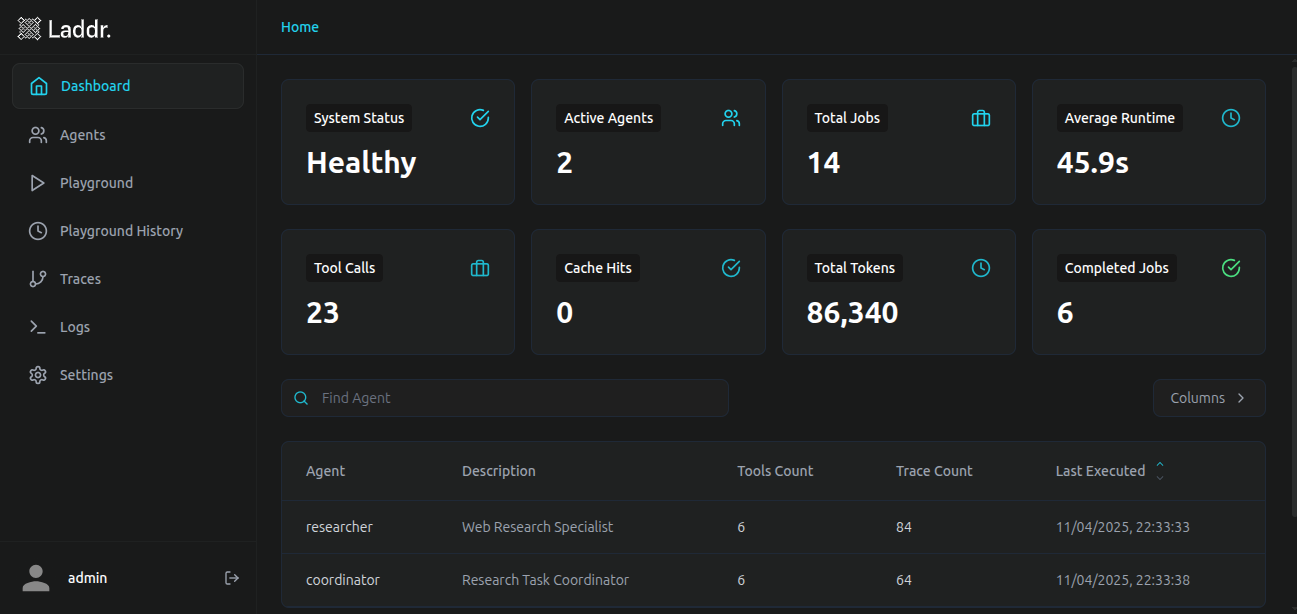
Table of Contents
- What is Laddr?
- Features
- Quick Start
- Agent Example
- Tool Example
- FastAPI Runtime
- Dashboard & Observability
- Architecture
- License
What is Laddr?
Laddr is a python framework for building multi-agent systems where agents communicate, delegate tasks, and execute work in parallel. Think of it as a microservices architecture for AI agents — with built-in message queues, observability, and horizontal scalability.
Two Operating Modes
Coordinator-Orchestrator Mode
Dynamic, autonomous workflows where a coordinator agent analyzes tasks, delegates to specialist agents, and synthesizes results. The coordinator makes real-time decisions about routing and orchestration.
Sequential Deterministic Workflow Mode
Pre-defined, predictable pipelines where tasks flow through agents in a fixed sequence. Each step is explicitly defined with inputs, outputs, and dependencies.
Features
Scalability & Performance
- Horizontal scaling — Scale each agent independently based on workload
- Multi-worker support — Run multiple workers per agent for high throughput
- Automatic load balancing — Redis Streams distribute tasks across workers
- Fault tolerance — Worker failures don't stop the system
Observability & Monitoring
- Complete tracing — Every agent action automatically logged (SQLite/PostgreSQL)
- Langfuse integration — Optional external tracing with automatic span creation
- Real-time metrics — Job status, duration, success rates, queue depth
- Interactive dashboard — Beautiful UI to monitor agents, traces, batches, and logs
- Playground — Test agents interactively with live streaming responses
Developer Experience
- Clean CLI — Minimal, modern interface for project management
- Hot reload — Code changes reflect instantly in development mode
- Type safety — Full Python type hints throughout the codebase
- Simple setup — One command (
laddr init) to scaffold complete projects
AI-Optimized Architecture
- Built-in delegation — Agents can delegate tasks to other agents seamlessly
- Batch operations — Execute multiple tasks in parallel with full tracking and WebSocket monitoring
- Parallel execution — Process multiple independent tasks simultaneously
- Context management — Automatic artifact storage for large payloads (>1MB)
- Smart retries — Configurable retry logic and timeout handling per agent
Production Ready
- Docker native — Everything runs in containers with docker-compose
- Queue-based messaging — Redis Streams for reliable, distributed communication
- Artifact storage — MinIO/S3 for handling large files and documents
- REST API — FastAPI server with auto-generated OpenAPI documentation
- API security — Optional API key authentication for all endpoints
Extensibility
- Custom tools — Add any Python function as an agent tool with
@tooldecorator - Override system tools — Extend delegation and storage with your own implementations
- LLM agnostic — Works with Gemini, OpenAI, Anthropic, Groq, Ollama, and local models
- Pluggable backends — Swap Redis, PostgreSQL, or storage providers easily
Quick Start
Installation
pip install laddrCreate Your First Project
# Initialize a new project
laddr init my-agent-system
cd my-agent-system
Configure API Keys
Edit .env file:
# Required for web search tools
SERPER_API_KEY=your_serper_api_key  # Get from https://serper.dev

# LLM API Keys (choose one or more)
GEMINI_API_KEY=your_gemini_key      # Get from https://aistudio.google.com
OPENAI_API_KEY=your_openai_key      # Get from https://platform.openai.com

# Or use Ollama for local models (free, private, offline)
# Install: curl -fsSL https://ollama.ai/install.sh | sh
# Then: ollama pull gemma2:2b
OLLAMA_BASE_URL=http://localhost:11434
LLM_BACKEND=ollama  # Use local models instead of cloud APIs

# Optional: API key authentication
LADDR_API_KEY=your_api_key_here  # Protect API endpoints

# Optional: Langfuse external tracing
LANGFUSE_PUBLIC_KEY=your_public_key
LANGFUSE_SECRET_KEY=your_secret_key
LANGFUSE_HOST=https://cloud.langfuse.com
💡 Using Ollama? See the Ollama Integration Guide for complete setup instructions including Docker configuration.
Start the System
# Start all services (API, workers, database, Redis, MinIO)
laddr run dev
This starts:
- ✅ API Server at
http://localhost:8000 - ✅ Dashboard at
http://localhost:5173 - ✅ SQLite for traces and job history (default, or PostgreSQL if configured)
- ✅ Redis for message queue
- ✅ MinIO for artifact storage
- ✅ 2 agents:
coordinator(orchestrator) andresearcher(specialist)
Test Your Agents
Open the dashboard at http://localhost:5173/playground or use the API:
curl -X POST http://localhost:8000/api/jobs \
  -H "Content-Type: application/json" \
  -d '{
    "agent_name": "coordinator",
    "inputs": {
      "query": "What are the best hotels in Shimla?"
    }
  }'
Agent Example
Agents are defined in simple Python files. Here's what laddr init generates:
"""
Coordinator agent - orchestrates research tasks
"""
from laddr import Agent
from laddr.llms import gemini

coordinator = Agent(
    name="coordinator",
    role="Research Task Coordinator",
    goal="Coordinate research tasks by delegating to specialist agents",
    backstory="""You are a research coordinator who manages information
    gathering tasks. You delegate specific queries to researcher agents
    and compile their findings into comprehensive summaries.""",

    llm=gemini("gemini-2.0-flash"),

    # Coordinator can delegate to other agents
    is_coordinator=True,
    available_agents=["researcher"],

    # Behavior settings
    max_iterations=15,
    max_tool_calls=50,
    timeout=600,

    # Built-in delegation tools provided automatically
    tools=[],

    instructions="""
    ## Your workflow:
    1. Receive user query
    2. Delegate research to 'researcher' agent using system_delegate_task
    3. Wait for results (use wait_for_response=true)
    4. Synthesize findings into comprehensive answer
    5. Return final result to user

    ## Delegation format:
    {
      "type": "tool",
      "tool": "system_delegate_task",
      "params": {
        "agent_name": "researcher",
        "task": "Search for best hotels in Shimla with reviews",
        "wait_for_response": true,
        "timeout_seconds": 90
      }
    }
    """
)
Key Features:
- Coordinators delegate work to specialists
- Specialists use tools to complete tasks
- LLM-powered decision making
- Configurable behavior and limits
- Clear instructions guide agent behavior
Tool Example
Tools are Python functions that agents can call. Here's a web search tool from the template:
"""
Web search tool using Serper.dev API
"""
from typing import Dict
import os
import requests
from laddr import tool

@tool(
    name="web_search",
    description="Search the web using Serper.dev API. Returns title, URL, and snippet for each result.",
    parameters={
        "type": "object",
        "properties": {
            "query": {
                "type": "string",
                "description": "Search query (be specific for better results)"
            },
            "max_results": {
                "type": "integer",
                "description": "Maximum number of results (1-10, default 5)",
                "default": 5
            }
        },
        "required": ["query"]
    }
)
def web_search(query: str, max_results: int = 5) -> Dict:
    """
    Search the web and return structured results.

    Returns:
        {
            "query": str,
            "results": [
                {
                    "title": str,
                    "link": str,
                    "snippet": str,
                    "site": str
                },
                ...
            ],
            "count": int,
            "status": "success" | "error"
        }
    """
    api_key = os.getenv("SERPER_API_KEY")
    if not api_key:
        return {
            "status": "error",
            "error": "SERPER_API_KEY not set"
        }

    response = requests.post(
        "https://google.serper.dev/search",
        headers={
            "X-API-KEY": api_key,
            "Content-Type": "application/json",
        },
        json={"q": query, "num": max_results},
        timeout=15,
    )
    response.raise_for_status()
    data = response.json()

    results = []
    for item in data.get("organic", [])[:max_results]:
        results.append({
            "title": item.get("title", ""),
            "link": item.get("link", ""),
            "snippet": item.get("snippet", "")[:500],
            "site": item.get("domain", "")
        })

    return {
        "query": query,
        "results": results,
        "count": len(results),
        "status": "success"
    }
Features:
- @tool decorator — Automatic registration
- JSON Schema — Parameters defined with validation
- Structured output — Consistent return format
- Fast — 15 second timeout
- Error handling — Graceful failures
FastAPI Runtime & REST API
Laddr includes a production-ready FastAPI server with comprehensive REST endpoints:
Core Endpoints
| Method | Endpoint | Description |
|---|---|---|
POST | /api/jobs | Submit a job to an agent |
GET | /api/jobs/{job_id} | Get job status and result |
GET | /api/jobs | List all jobs with filters |
POST | /api/jobs/{job_id}/replay | Replay a failed job |
GET | /api/agents | List all available agents |
GET | /api/agents/{agent_name}/tools | Get agent's tools |
GET | /api/agents/{agent_name}/chat | Interactive chat with agent |
POST | /api/agents/{agent_name}/batch | Submit multiple tasks in parallel (batch) |
GET | /api/batches | List all batch operations |
GET | /api/batches/{batch_id} | Get batch status and results |
POST | /api/batches/{batch_id}/add-tasks | Add tasks to existing batch |
Observability Endpoints
| Method | Endpoint | Description |
|---|---|---|
GET | /api/traces | Get execution traces for jobs |
GET | /api/traces/grouped | Get traces grouped by job |
GET | /api/traces/{trace_id} | Get specific trace details |
GET | /api/metrics | Get system metrics (jobs, latency, success rate) |
GET | /api/logs/containers | List Docker containers |
GET | /api/logs/containers/{name} | Stream container logs |
Playground Endpoints
| Method | Endpoint | Description |
|---|---|---|
POST | /api/prompts | Create interactive prompt session |
GET | /api/prompts/{prompt_id} | Get prompt status and messages |
GET | /api/prompts | List all prompt sessions |
POST | /api/prompts/{prompt_id}/cancel | Cancel running prompt |
Example: Submit a Job
curl -X POST http://localhost:8000/api/jobs \
  -H "Content-Type: application/json" \
  -d '{
    "agent_name": "researcher",
    "inputs": {
      "query": "Latest AI trends 2025"
    }
  }'

# Response:
{
  "job_id": "job_abc123",
  "status": "queued",
  "created_at": "2025-01-15T10:30:00Z"
}
Example: Submit Batch Tasks
Execute multiple tasks in parallel:
curl -X POST http://localhost:8000/api/agents/researcher/batch \
  -H "Content-Type: application/json" \
  -d '{
    "tasks": [
      {"query": "What is Python?"},
      {"query": "What is JavaScript?"},
      {"query": "What is Rust?"}
    ],
    "wait": false
  }'

# Response:
{
  "batch_id": "batch-abc-123",
  "agent_name": "researcher",
  "status": "submitted",
  "task_count": 3,
  "job_ids": ["job-1", "job-2", "job-3"]
}
API Authentication (Optional)
Set LADDR_API_KEY environment variable to enable API key authentication:
# Using header
curl -H "X-API-Key: your-api-key" http://localhost:8000/api/agents

# Using Bearer token
curl -H "Authorization: Bearer your-api-key" http://localhost:8000/api/agents

# Using query parameter (WebSocket)
ws://localhost:8000/ws/prompts/{prompt_id}?api_key=your-api-key
Example: Get Job Result
curl http://localhost:8000/api/jobs/job_abc123

# Response:
{
  "job_id": "job_abc123",
  "status": "completed",
  "result": {
    "answer": "Based on my research, the top AI trends in 2025 are...",
    "sources": [...]
  },
  "agent_name": "researcher",
  "created_at": "2025-01-15T10:30:00Z",
  "completed_at": "2025-01-15T10:31:45Z",
  "duration_seconds": 105
}
Interactive API Documentation
Full OpenAPI documentation available at:
http://localhost:8000/docs — Swagger UI
Dashboard & Observability
Laddr includes a beautiful React dashboard with real-time monitoring:
Dashboard Features
Playground
- Test agents interactively
- Live streaming responses
- Token usage tracking
- Save and replay sessions
Traces
- Complete execution history
- Tool calls and results
- LLM interactions
- Delegation flows
- Filter by job, agent, or time range
- Job ID filtering for focused trace views
Batches
- View all batch operations
- Real-time batch progress monitoring
- Detailed batch execution traces
- Task result aggregation
- WebSocket streaming for live updates
Metrics
- System health overview
- Jobs per agent (success/failed)
- Average latency per agent
- Queue depth monitoring
- Worker status
Logs
- Real-time container logs
- Filter by agent or service
- Error highlighting
- Download logs
Agents
- List all agents and their tools
- Agent configuration viewer
- Worker scaling controls
- Health status
Access the Dashboard
# Start the system
laddr run dev

# Open dashboard in browser
open http://localhost:5173
Views:
/— Dashboard home with metrics/playground— Interactive agent testing/traces— Execution traces and history/batches— Batch operations management/agents— Agent management/logs— Container logs viewer/settings— Configuration
Architecture
Message Bus (Redis Streams)
Laddr uses Redis Streams for reliable, distributed messaging:
- Agent Queues — Each agent has a dedicated stream (
laddr:agent:{name}) - Response Streams — Temporary streams for delegation responses
- Consumer Groups — Multiple workers consume from the same stream
- Automatic Load Balancing — Redis distributes tasks across workers
- Persistence — Messages persisted until acknowledged
- Backpressure — Queue depth monitoring prevents overload
Example flow:
API → Redis Stream → Worker 1, Worker 2, Worker 3
                      ↓
                    Process task
                      ↓
                 Store result in Postgres
Trace Storage (SQLite/PostgreSQL)
All agent executions are automatically traced to the database:
- Default: SQLite — Simple, file-based storage (no setup required)
- PostgreSQL option — Use
DB_BACKEND=postgresfor production scale - Complete history — Every tool call, LLM interaction, delegation
- Structured data — JSON traces with metadata
- Fast queries — Indexed by job_id, agent_name, timestamp
- Langfuse integration — Optional external tracing (automatic span creation)
- Smart storage — Traces disabled with Postgres when Langfuse is enabled
Trace data includes:
- Tool calls and results
- LLM prompts and responses
- Delegation events
- Error stack traces
- Token usage
- Latency breakdown
Langfuse Setup:
# Optional: Enable Langfuse external tracing
LANGFUSE_PUBLIC_KEY=your_public_key
LANGFUSE_SECRET_KEY=your_secret_key
LANGFUSE_HOST=https://cloud.langfuse.com
Artifact Storage (MinIO/S3)
Large payloads are automatically stored in object storage:
- Automatic threshold — Messages >1MB stored as artifacts
- S3-compatible — MinIO (local) or AWS S3 (production)
- Efficient messaging — Only artifact reference sent via Redis
- Retrieval on demand — Workers fetch artifacts when needed
- Configurable — Set size threshold, retention, bucket names
Benefits:
- Reduces Redis memory usage
- Prevents message size limits
- Enables large document processing
- Supports binary data (images, PDFs, etc.)
Custom System Tools
Laddr allows you to override built-in system tools (delegation, artifact storage) with your own custom implementations:
from laddr import override_system_tool, TaskDelegationTool

@override_system_tool("system_delegate_task")
async def custom_delegation(
    agent_name: str,
    task_description: str,
    task: str,
    task_data: dict = None,
    timeout_seconds: int = 300,
    _message_bus=None,
    _artifact_storage=None,
    _agent=None
):
    """Custom delegation with logging and metrics."""

    # Add your custom logic (logging, rate limiting, etc.)
    logger.info(f"Delegating to {agent_name}: {task_description}")

    # Reuse base tool for actual delegation
    delegation_tool = TaskDelegationTool(_message_bus, _artifact_storage, _agent)
    result = await delegation_tool.delegate_task(
        agent_name=agent_name,
        task_description=task_description,
        task=task,
        task_data=task_data,
        timeout_seconds=timeout_seconds
    )

    logger.info(f"Delegation completed: {result}")
    return result
Available base tools:
TaskDelegationTool— Single-task delegationParallelDelegationTool— Parallel multi-task delegationArtifactStorageTool— Artifact storage and retrieval
System tools you can override:
system_delegate_task— Single task delegationsystem_delegate_parallel— Parallel task delegationsystem_store_artifact— Store data artifactssystem_retrieve_artifact— Retrieve data artifacts
Learn more: See the Custom System Tools Guide for complete documentation with advanced patterns like rate limiting, circuit breakers, retries, and metrics.
FAQ
General
What is Laddr? Laddr is a Python framework for building multi-agent systems where agents communicate, delegate tasks, and execute work in parallel. Think of it as a microservices architecture for AI agents — with built-in message queues, observability, and horizontal scalability.
How is Laddr different from LangGraph or CrewAI? Laddr is designed for production-grade distributed systems with queue-based messaging (Redis Streams), horizontal scaling, and a built-in observability dashboard. It supports both autonomous coordinator-orchestrator workflows and deterministic sequential pipelines.
What license does Laddr use? Laddr is open-source under the Apache 2.0 License.
Setup & Configuration
How do I install Laddr?
pip install laddr
laddr init my-project
cd my-project
What are the system requirements?
- Python 3.10+
- Redis 7.0+ (for queue-based messaging)
- PostgreSQL 15+ (optional, for trace storage)
- Docker & Docker Compose (recommended for production)
Can I run Laddr without Docker? Yes. Docker is optional. You can run agents directly with Python, though Docker Compose is recommended for production deployments with Redis and PostgreSQL.
Architecture
What are the two operating modes?
- Coordinator-Orchestrator Mode: Dynamic, autonomous workflows where a coordinator agent analyzes tasks, delegates to specialists, and synthesizes results in real-time.
- Sequential Deterministic Workflow Mode: Pre-defined pipelines where tasks flow through agents in a fixed sequence with explicit inputs, outputs, and dependencies.
How do agents communicate? Agents communicate via Redis Streams, providing reliable, distributed message queuing with automatic load balancing across workers.
What is the Dashboard? Laddr includes an interactive web dashboard for monitoring agents, traces, batches, and logs in real-time. It also features a playground for testing agents with live streaming responses.
Scalability
How does Laddr handle horizontal scaling? Each agent can be scaled independently with multiple workers. Redis Streams automatically distribute tasks across workers with built-in load balancing and fault tolerance.
Can agents delegate tasks to other agents? Yes. Built-in delegation allows agents to seamlessly route tasks to other agents, enabling complex multi-step workflows.
Observability
What tracing options are available?
- Built-in tracing with SQLite (dev) or PostgreSQL (prod) storage
- Optional Langfuse integration for external tracing with automatic span creation
- Real-time metrics: job status, duration, success rates, queue depth
Troubleshooting
Redis connection fails
Ensure Redis 7.0+ is running and accessible. Check your REDIS_URL environment variable and network connectivity.
Agent not starting
Verify Python 3.10+ is installed, dependencies are installed (pip install -r requirements.txt), and API keys are configured in .env.
Dashboard not loading Ensure the FastAPI runtime is running. The dashboard is served on the default port — check for port conflicts.
Batch jobs stuck Check the dashboard for queue depth and worker status. Ensure Redis Streams are healthy and workers are not overloaded.
License
Apache License 2.0 - see LICENSE for details.
🔗 Links
- Visit us at AgnetLabs: https://agnetlabs.com
- Documentation: https://laddr.agnetlabs.com
- GitHub: https://github.com/AgnetLabs/Laddr
- Issues: https://github.com/AgnetLabs/Laddr/issues
Built for production. Designed for scale. Made transparent.
⭐ Star us on GitHub if Laddr helps you build better agent systems!