ThreadRace
A C++ Concurrency Telemetry Framework & Execution Speed Tester



Time is a non-renewable, precious human resource. ThreadRace is designed to measure, analyze, and visualize the performance differential between sequential and parallel execution paradigms.
Philosophy • Demonstration • Architecture • Workflow • Repository Structure • Build & Run • Contributing
Philosophy
In daily human life, tasks are split and executed simultaneously to conserve time-cooking while listening to audio, or thinking about future plans while walking. ThreadRace is an engineering reflection of this fundamental human urge: the quest for concurrency.
By comparing Typical (Sequential) execution with Threaded (Parallel) execution, ThreadRace measures the efficiency of digital cooperation. The Ackermann Function-a deeply recursive mathematical operation-is utilized as a benchmark task to represent high-complexity, processor-intensive operations that demand efficient thread synchronization and compute optimization.
Visual Showcase & Demonstration
ThreadRace provides high-precision CLI timing telemetry alongside a 60 FPS Native C++ SDL2 + OpenGL Hardware-Accelerated Visualizer Suite (bin/ackermann_visualizer).
Visualizer Suite Modes
Mode 1: Quantum Branching Network (2D/3D Force Tree)
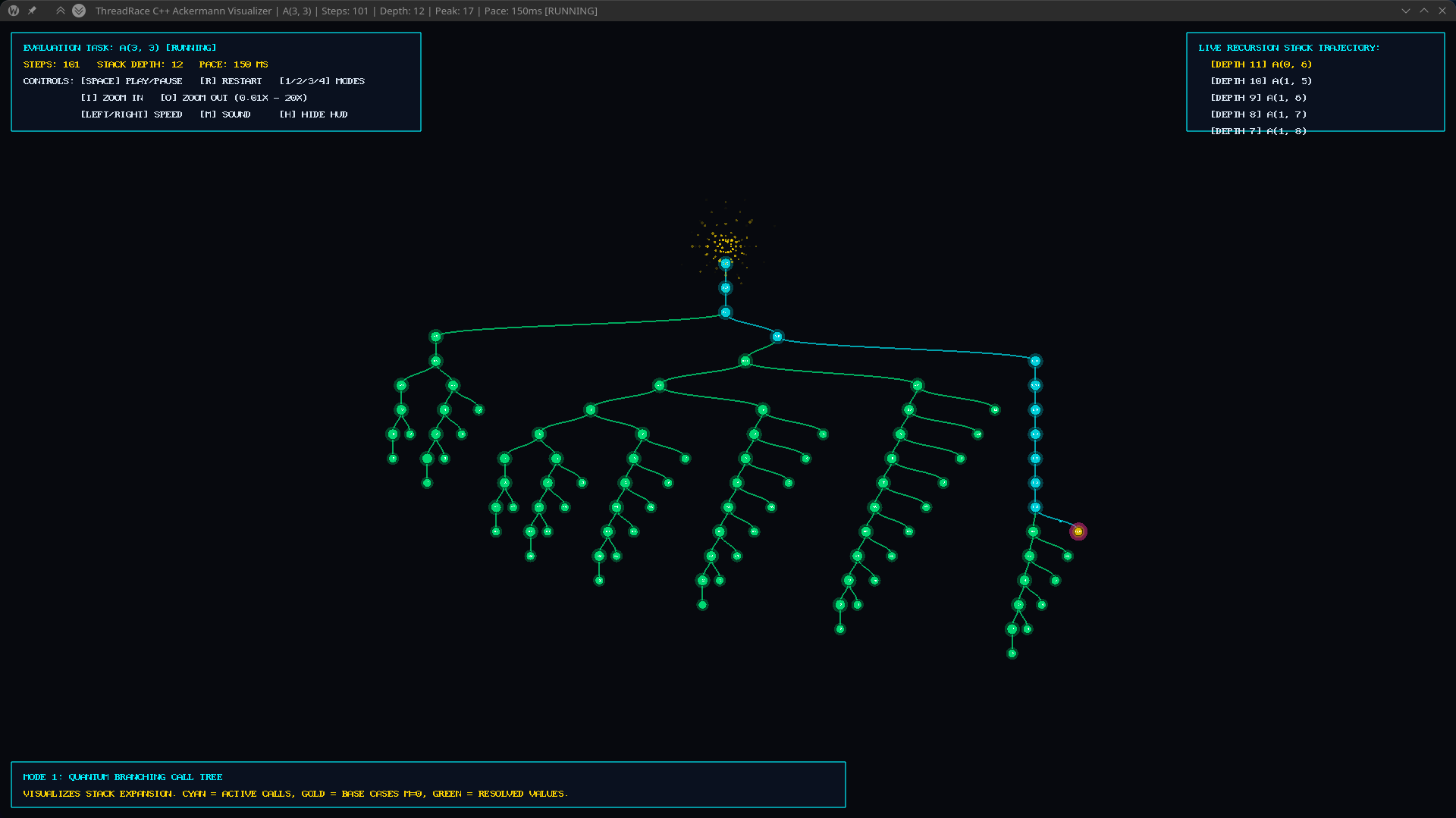
Displays the dynamic recursive execution tree with glowing OpenGL nodes, Bezier branch curves, starburst particles on base-case evaluations, and real-time camera tracking.
Mode 2: Hyper-Logarithmic 3D Landscape (OpenGL Terrain Height Map)
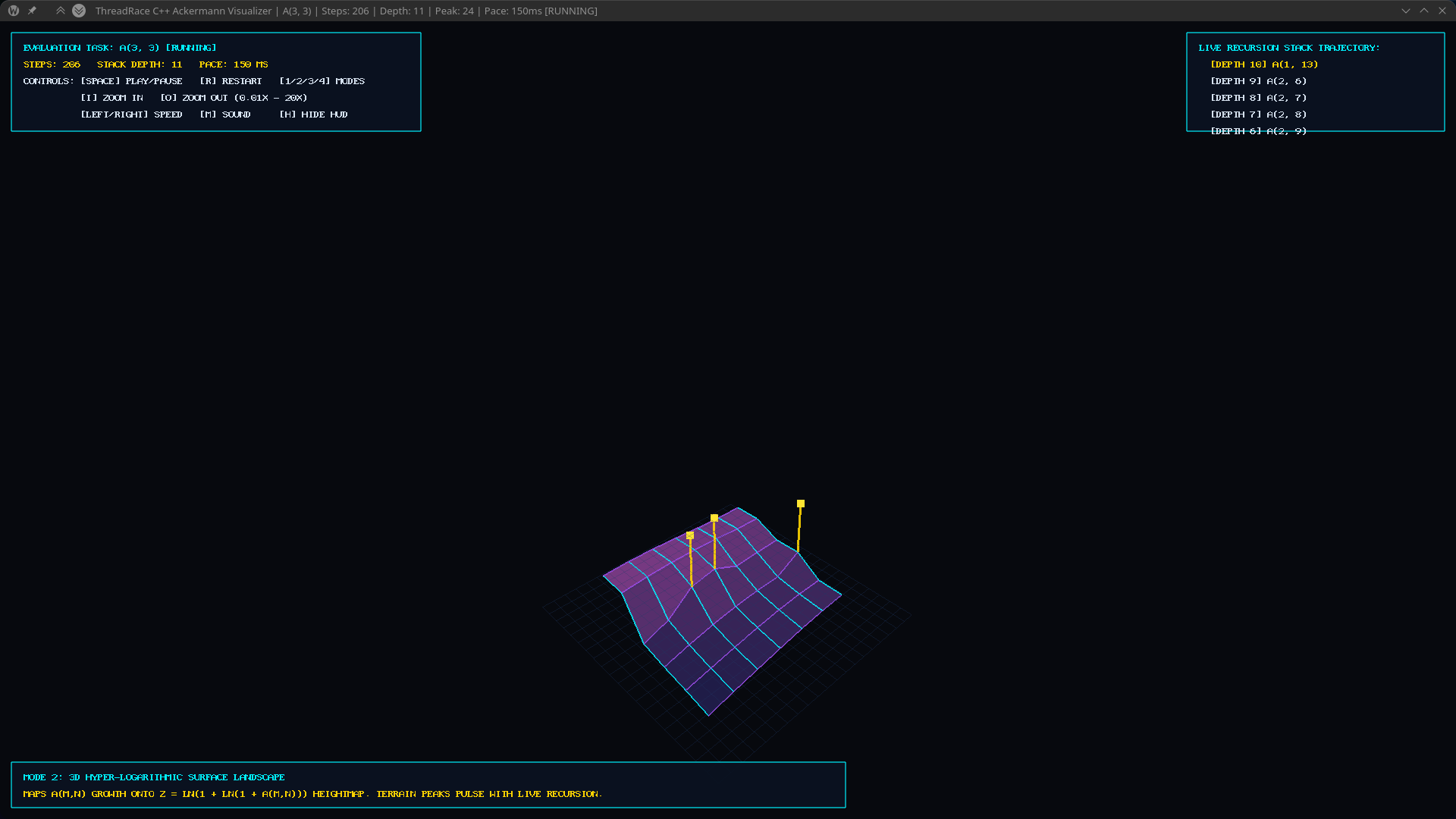
Visualizes Ackermann growth $A(m, n)$ on a 3D height field terrain log-compressed using $Z(m, n) = \ln(1 + \ln(1 + A(m, n)))$.
Mode 3: Golden Spiral Phase Orbit
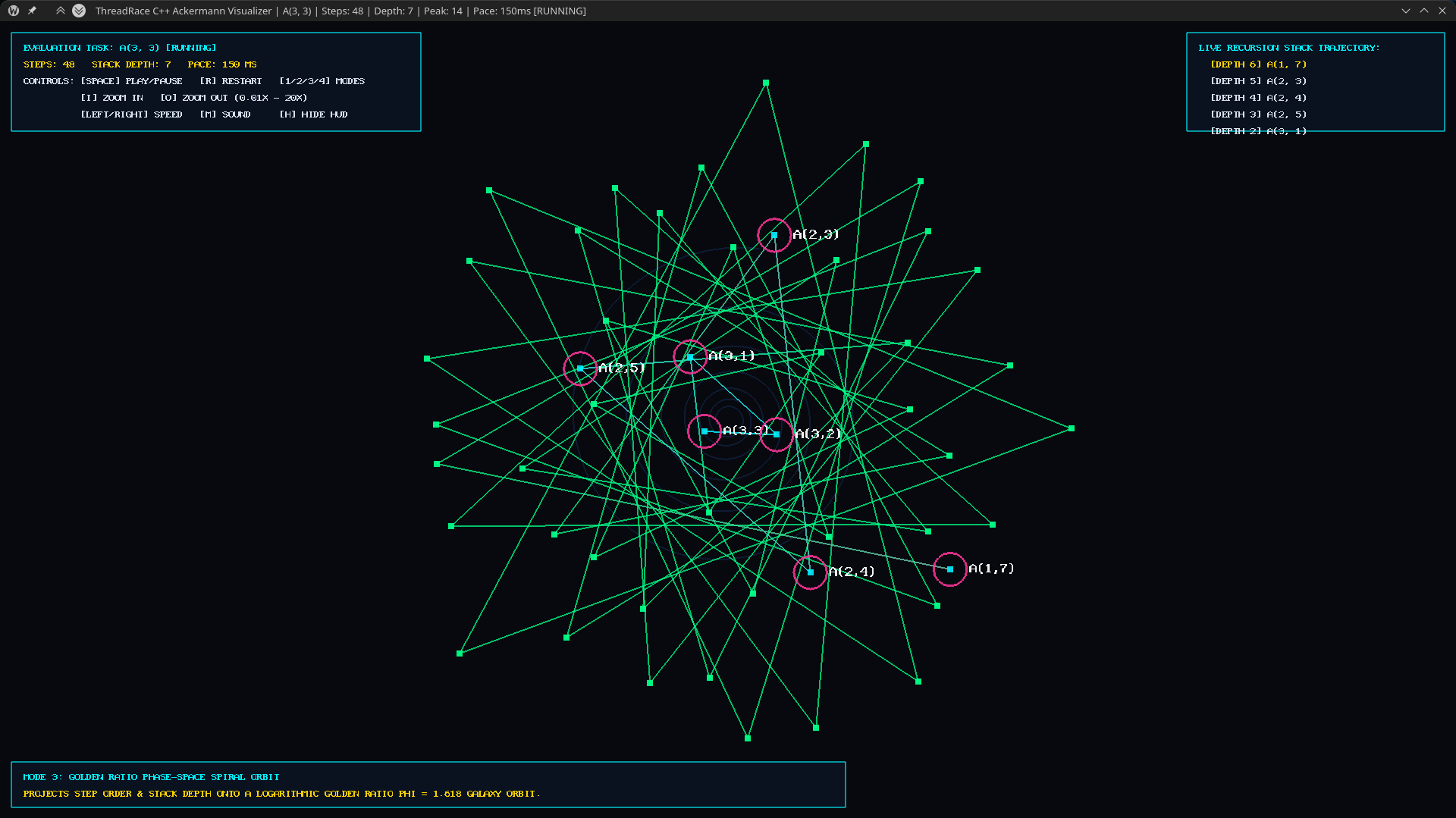
Maps call stack depth and frame steps onto a logarithmic golden ratio $\phi$ particle galaxy with glowing orbit trails and depth rings.
Mode 4: Head-to-Head Thread Race Arena
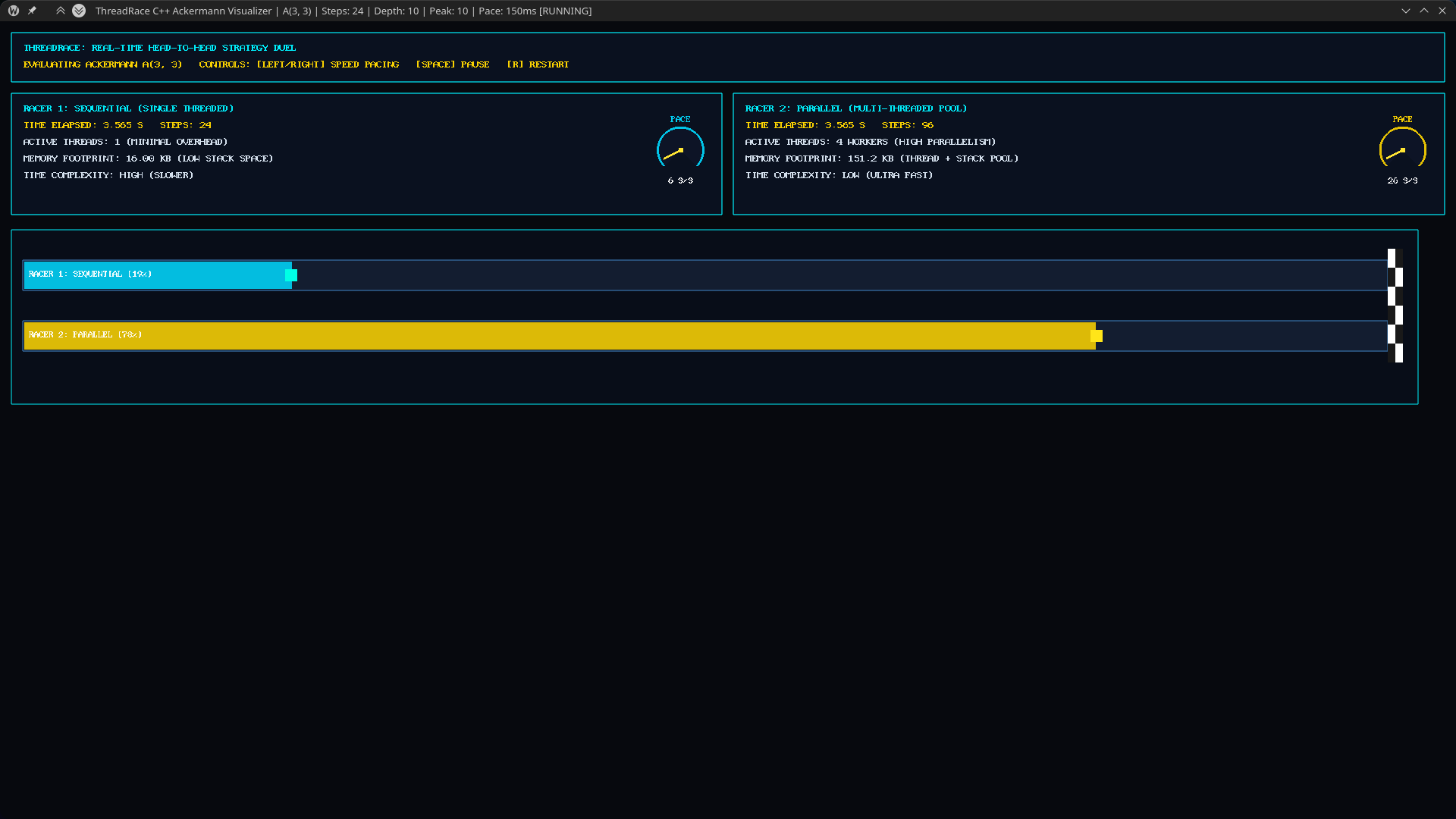
Direct side-by-side competition comparing Sequential (1 Thread) vs. Parallel Execution, showing active threads, memory footprint, speedup telemetry, step progress bars, and finish line detection.
Execution Benchmark CLI Outputs
Regular Execution Benchmark Output
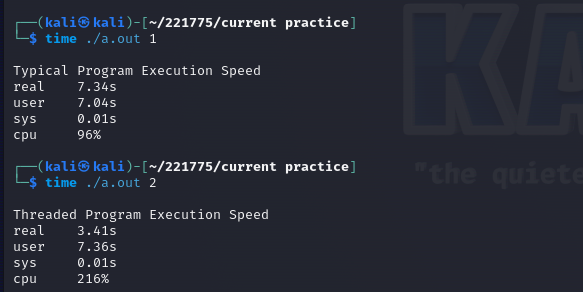
Ackermann Function Benchmark Telemetry (m=4, n=1)
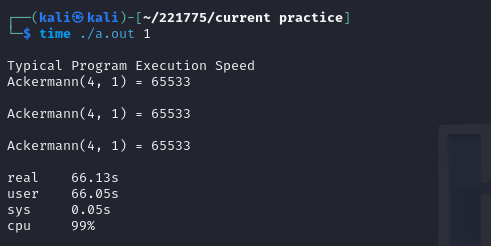
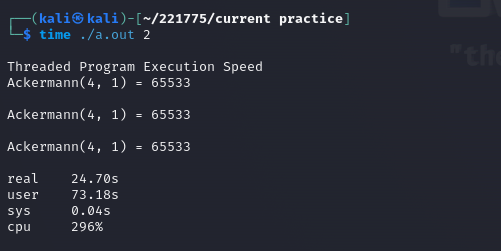
Native C++ Ackermann Visualizer Suite
The native visualizer suite (bin/ackermann_visualizer) bridges pure math, real-time audio synthesis, OpenGL graphic rendering, and threading telemetry into an immersive interactive application.
Key Features:
- Mode 1 — Quantum Branching Network (2D/3D Force Tree): Interactive visual trace of recursive call stacks with animated pulse propagation, base-case starbursts, organic Bezier connectors, and target camera focus.
- Mode 2 — Hyper-Logarithmic 3D Landscape: Renders exponential mathematical functions on a dynamic 3D surface grid compressed via hyper-logarithmic functions.
- Mode 3 — Golden Spiral Phase Orbit: Orbital phase-space visualization based on the golden ratio ($\phi$) mapping stack depth to radial velocity and particle emissions.
- Mode 4 — Head-to-Head Thread Race Arena: Side-by-side execution race between single-threaded and multi-threaded worker pools with live progress bars, memory meters, and speedup ratios.
- Polyphonic Audio Sonification: Real-time SDL2 audio callback synthesizing C-major pentatonic harmonic notes as recursive stacks push and resolve.
- Demystifier HUD Overlay & Trajectory Tracking: Live parameter feedback, active stack depth counters, call count statistics, and control key legend.
Build & Run Native C++ Visualizer:
make all
./bin/ackermann_visualizer [m] [n]
Keyboard & Mouse Controls:
1/2/3/4: Switch Render Modes (1: Quantum Tree, 2: 3D Landscape, 3: Golden Spiral Orbit, 4: Thread Race Arena)SPACE/P: Play / Pause simulation evaluationS: Single Step forward (when paused)R: Reset / Restart simulation[/]: Adjust $m$ parameter value-/+: Adjust $n$ parameter valueLEFT/RIGHT: Adjust step delay (ms per iteration step)I/O: Zoom In / Zoom Out camera view (0.01x - 20x)M: Toggle Real-time Audio Sonification ON/OFFH: Toggle On-Screen Demystifier HUD Overlay- Mouse Drag / Scroll Wheel: Pan camera position & Smooth zoom controls
ESC/Q: Quit visualizer suite
Architecture Overview
The codebase uses clean object-oriented patterns isolating telemetry capture, computational task definitions, execution strategies, and visual rendering modules.
Static Structure (Class Relationships)
classDiagram
    class ITask {
        <<interface>>
        +execute()*
        +getName()* string
    }

    class IExecutionStrategy {
        <<interface>>
        +run(ITask, iterations)*
        +getStrategyName()* string
    }

    class AckermannTask {
        -int m
        -int n
        +execute()
        +getName() string
        -ackermann(m, n) int
    }

    class SequentialStrategy {
        +run(ITask, iterations)
    }

    class ThreadedStrategy {
        +run(ITask, iterations)
    }

    class Benchmarker {
        -IExecutionStrategy strategy
        +runBenchmark(ITask, iterations)
    }

    class AckermannStackEngine {
        -int m
        -int n
        +step()
        +getNodes()
        +getMetrics()
        +setEventCallback()
    }

    class RaceEngine {
        -int m
        -int n
        -int parallelWorkers
        +step(stepDelayMs, isPlaying)
        +getSequentialTelemetry()
        +getParallelTelemetry()
    }

    class AudioSynthesizer {
        +init()
        +playNote(depth, isResolve)
        +playComplete()
    }

    class QuantumTreeRenderer {
        +render(engine, camera)
        +spawnStarburst(x, y, r, g, b)
    }

    class Landscape3DRenderer {
        +render(m, n, camera)
    }

    class SpiralOrbitRenderer {
        +render(engine, camera)
    }

    class RaceArenaRenderer {
        +render(raceEngine, fontRenderer)
    }

    ITask <|-- AckermannTask : implements
    IExecutionStrategy <|-- SequentialStrategy : implements
    IExecutionStrategy <|-- ThreadedStrategy : implements
    Benchmarker --> IExecutionStrategy : uses
    IExecutionStrategy ..> ITask : executes
    RaceEngine --> AckermannStackEngine : uses
    QuantumTreeRenderer ..> AckermannStackEngine : renders
    Landscape3DRenderer ..> AckermannStackEngine : renders
    SpiralOrbitRenderer ..> AckermannStackEngine : renders
    RaceArenaRenderer ..> RaceEngine : renders
    AckermannStackEngine ..> AudioSynthesizer : triggers audio events
Internal Module Structure
%%{init: {'flowchart': {'curve': 'ortho'}}}%%
flowchart TD
    subgraph CoreAbstractions ["Core Abstractions & Drivers"]
        ITask["ITask Interface"]
        IExecutionStrategy["IExecutionStrategy Interface"]
        Benchmarker["Benchmarker Telemetry"]
        Main["main.cpp (time_tester)"]
    end

    subgraph StrategiesAndTasks ["Strategies & Benchmark Tasks"]
        AckermannTask["AckermannTask"]
        SequentialStrategy["SequentialStrategy"]
        ThreadedStrategy["ThreadedStrategy"]
    end

    subgraph VisualizerSuite ["Native C++ OpenGL/SDL2 Visualizer Suite"]
        VisMain["visualizer_main.cpp (ackermann_visualizer)"]
        StackEngine["AckermannStackEngine"]
        RaceEngine["RaceEngine"]
        AudioSynth["AudioSynthesizer (SDL Audio Callback)"]
        FontRenderer["FontRenderer (Bitmap Text HUD)"]

        TreeRender["QuantumTreeRenderer (Mode 1)"]
        LandRender["Landscape3DRenderer (Mode 2)"]
        OrbitRender["SpiralOrbitRenderer (Mode 3)"]
        ArenaRender["RaceArenaRenderer (Mode 4)"]
    end

    AckermannTask -.-> ITask
    SequentialStrategy -.-> IExecutionStrategy
    ThreadedStrategy -.-> IExecutionStrategy
    Benchmarker --> IExecutionStrategy
    Main --> Benchmarker

    VisMain --> StackEngine
    VisMain --> RaceEngine
    VisMain --> AudioSynth
    VisMain --> FontRenderer
    VisMain --> TreeRender
    VisMain --> LandRender
    VisMain --> OrbitRender
    VisMain --> ArenaRender
System Workflow & Request Lifecycle
When a run is initiated via the command line, the execution flows through parsing, strategy instantiation, timed processing, and telemetry reporting.
sequenceDiagram
    participant User as Terminal CLI
    participant Main as main.cpp
    participant Bench as Benchmarker
    participant Strategy as IExecutionStrategy
    participant Task as ITask

    User->>Main: Execute program with mode & iterations
    Main->>Strategy: Instantiate (Sequential or Threaded)
    Main->>Task: Instantiate AckermannTask(4, 1)
    Main->>Bench: Instantiate with selected Strategy
    Main->>Bench: runBenchmark(Task, iterations)

    rect rgb(28, 30, 36)
        Note over Bench, Task: Telemetry Capture Span
        Bench->>Bench: Start high_resolution_clock timer
        Bench->>Strategy: run(Task, iterations)

        loop For each Iteration
            Strategy->>Task: execute()
            Task->>Task: Compute Ackermann value
            Task-->>Strategy: Return Result (65533)
        end

        Strategy-->>Bench: Return Control
        Bench->>Bench: Stop high_resolution_clock timer
    end

    Bench-->>User: Output timings (Real, User, System, CPU%)
Concurrency and Telemetry Specifications
- Parallelism Engine: Standard C++11 Threads (
std::thread) are used to coordinate concurrent thread launches. - Telemetry precision: High-resolution timing is driven by
std::chrono::high_resolution_clockwith nanosecond precision capability. - Memory Management: Automatic resource cleanup is enforced via modern C++ smart pointers (
std::shared_ptr).
Data & Request Lifecycle Flow
The parameters and runtime performance data flow through the framework as detailed below:
%%{init: {'flowchart': {'curve': 'ortho'}}}%%
flowchart LR
    Args[CLI Arguments] --> Parse[main.cpp Parse]
    Parse -->|Config Object| Strategy[Strategy Config]
    Parse -->|Parameters| Task[Task Config]

    subgraph TelemetryContext ["Telemetry & Performance Evaluation"]
        Strategy --> RunStrategy[Execute Strategy::run]
        Task --> RunStrategy

        RunStrategy --> Timer[Start Chrono Clock]
        Timer --> CoreComputation[Task::execute Iterations]
        CoreComputation --> TimerStop[Stop Chrono Clock]
    end

    TimerStop --> Metrics[Compute Telemetry Metrics]
    Metrics --> Terminal[Format & Output Terminal Report]
Repository Structure
The physical layout isolates public include headers, logic implementations, graphics assets, and compiled targets:
ThreadRace/
├── .editorconfig
├── .gitignore
├── CODE_OF_CONDUCT.md
├── CONTRIBUTING.md
├── LICENSE
├── Makefile
├── README.md
├── SECURITY.md
├── assets/
│   ├── Visualization1.png    # Mode 1: Quantum Tree Screenshot
│   ├── Visualization2.png    # Mode 2: 3D Landscape Screenshot
│   ├── Visualization3.png    # Mode 3: Spiral Orbit Screenshot
│   ├── Visualization4.png    # Mode 4: Thread Race Arena Screenshot
│   ├── ack-1.png             # Sequential Ackermann CLI Output
│   ├── ack-2.png             # Threaded Ackermann CLI Output
│   └── reg.png               # Regular Benchmark CLI Output
├── docs/
│   ├── architecture.md       # High-Level Design & Visualizer System Architecture
│   └── development.md        # Build Instructions & Test Protocols
├── include/
│   ├── Benchmarker.hpp
│   ├── core/
│   │   ├── IExecutionStrategy.hpp
│   │   └── ITask.hpp
│   ├── strategies/
│   │   ├── SequentialStrategy.hpp
│   │   └── ThreadedStrategy.hpp
│   ├── tasks/
│   │   └── AckermannTask.hpp
│   └── visualizer/
│       ├── AckermannStackEngine.hpp
│       ├── AudioSynthesizer.hpp
│       ├── FontRenderer.hpp
│       ├── Landscape3DRenderer.hpp
│       ├── QuantumTreeRenderer.hpp
│       ├── RaceArenaRenderer.hpp
│       ├── RaceEngine.hpp
│       └── SpiralOrbitRenderer.hpp
├── bin/                      # Compiled Executables (time_tester, ackermann_visualizer)
├── obj/                      # Compiled Object Files
└── src/
    ├── Benchmarker.cpp
    ├── main.cpp
    ├── strategies/
    │   ├── SequentialStrategy.cpp
    │   └── ThreadedStrategy.cpp
    ├── tasks/
    │   └── AckermannTask.cpp
    └── visualizer/
        ├── AckermannStackEngine.cpp
        ├── AudioSynthesizer.cpp
        ├── FontRenderer.cpp
        ├── Landscape3DRenderer.cpp
        ├── QuantumTreeRenderer.cpp
        ├── RaceArenaRenderer.cpp
        ├── RaceEngine.cpp
        ├── SpiralOrbitRenderer.cpp
        └── visualizer_main.cpp
Build & Execution Pipeline
The compilation process is managed by a POSIX-compliant Makefile, compiling C++ files with production optimizations (-O2).
%%{init: {'flowchart': {'curve': 'ortho'}}}%%
flowchart TD
    SrcMain["src/main.cpp"] -->|g++ -c| ObjMain["obj/main.o"]
    SrcBench["src/Benchmarker.cpp"] -->|g++ -c| ObjBench["obj/Benchmarker.o"]
    SrcStrat["src/strategies/*.cpp"] -->|g++ -c| ObjStrat["obj/*.o"]
    SrcTasks["src/tasks/*.cpp"] -->|g++ -c| ObjTasks["obj/*.o"]

    ObjMain -->|g++ Linker| Bin["bin/time_tester"]
    ObjBench -->|g++ Linker| Bin
    ObjStrat -->|g++ Linker| Bin
    ObjTasks -->|g++ Linker| Bin
Compilation
Compile the source code using the provided Makefile:
make allRunning Benchmarks
Run the binary with execution strategy modes and iteration count:
| Command | Execution Model | Description |
|---|---|---|
./bin/time_tester 1 | Sequential (Typical) | Tasks run sequentially in a single execution thread. |
./bin/time_tester 2 | Parallel (Threaded) | Tasks run concurrently across multiple threads. |
Custom iterations can be appended as a trailing argument (defaults to 3):
# Execute threaded strategy with 5 iterations
./bin/time_tester 2 5
Development Workflow
Contributors are welcome to submit improvements or add new performance benchmarks. The following pipeline ensures stability:
1. Functional Verification
Ensure the core Ackermann output calculation remains functional and math-accurate:
Ackermann(4, 1)must return65533.
2. Concurrency Stress Testing
Verify stability under threaded loads:
- Execute mode 2 with a high number of iterations to test against thread leaks or runtime race conditions.
3. CI/CD Integration
On every push or pull request to the main branch, a GitHub Action is triggered to:
- Configure a clean Ubuntu runner.
- Validate system compilation with
make. - Execute regression benchmarks with
make test.
Credits & Dedication
ThreadRace was created and engineered by Ahmad Hassan (B-Ted).
Dedicated to the beauty and clarity of highly efficient, low-overhead systems.