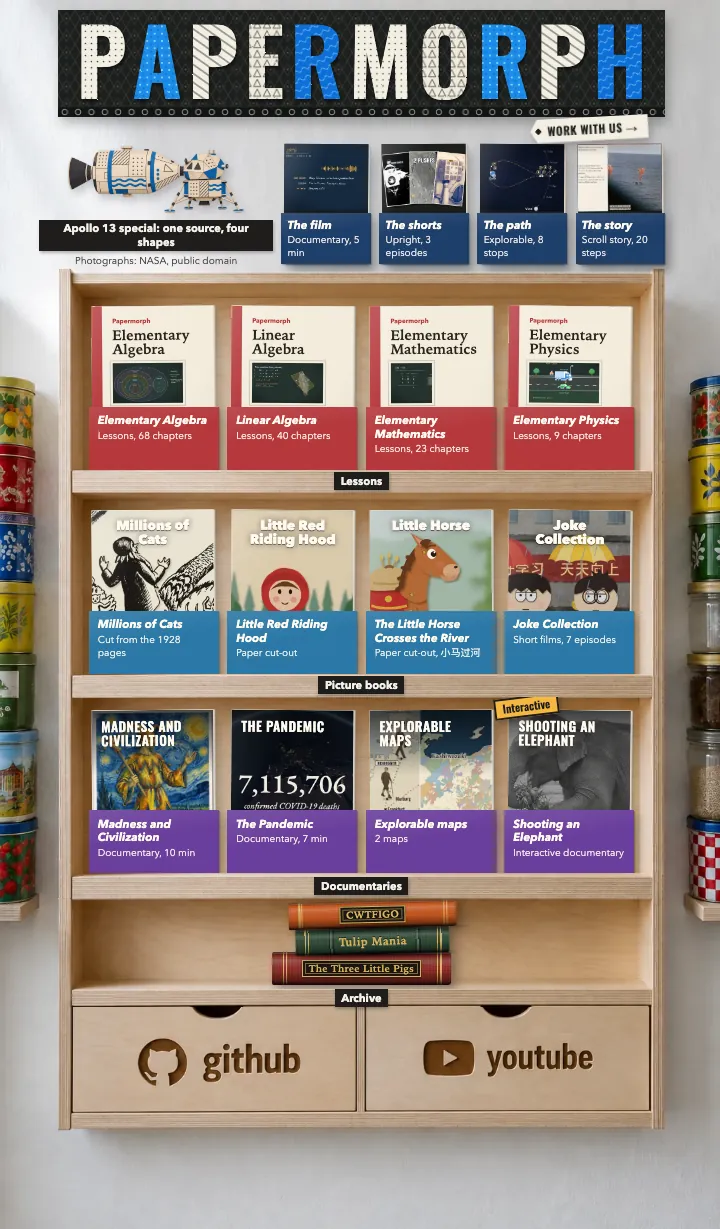
An agent skill that turns textbooks into narrated, interactive web lessons,
stories into paper-puppet films, and books into documentaries, upright shorts and pages you explore.
Open the live bookshelf → · Read the Skill → · Work with us
Everything is a static web page: no server, no database, no account. A book is a folder you can host anywhere.
On the shelf
One article, four shapes
One Wikipedia article, Apollo 13 (CC BY-SA 4.0), made over two days into a documentary, three upright shorts, an explorable path around the Moon and a scroll story. The facts are the same in all four, checked against NASA's own papers; what changes is the pace, the frame, and who is in control. Codex gathered and checked the research, Claude made the shapes with the Skill, and Codex reviewed every change; the making-of page shows how one article became four shapes. The film (5 minutes) · Three shorts (each under 100 seconds) · The Earth-Moon path (8 stops, drag the mission clock) · The scroll story (20 steps)
Lessons, from a textbook PDF
Formulas, diagrams and scenes change step by step as the narration explains, with quick checks and chapter practice that grade the maths, not the string. Elementary Algebra (68 chapters) · Linear Algebra (40, planes you can drag in 3D) · Elementary Mathematics (23) · Elementary Physics (9)
Picture books, from a story, a joke or a fairy tale
Paper puppets in front of sets drawn in code or painted by an image model, with acted voices, subtitles, sound effects, music and camera work. For children who can't read yet, the film stops for a game: a character asks for one thing at a time, the child touches it in the picture, and nothing is ever called wrong. A scanned picture book can bring its own art: the figures, sets and hand lettering are cut from the pages and moved as puppets. The Little Horse Crosses the River (小马过河) · Little Red Riding Hood · Millions of Cats (Wanda Gág, 1928, cut from the book's own pages) · Joke Collection (7 episodes)
Documentaries and upright shorts, from a book or an idea
Public-domain engravings, paintings, maps and charts, moved in step with the voice, with music. A documentary can be recut as a series of upright shorts for a phone feed. Madness and Civilization (10 minutes, and 4 shorts) · The Pandemic (7 minutes, 6 shorts and a scroll story) · Apollo 13 (5 minutes, 3 shorts, an explorable path and a scroll story)
Pages you play
A film can stop and hand the reader the next move, a map can be walked a year at a time, and a story can unfold as the reader scrolls. The Skill makes all three: explorable maps and scroll stories have their own starting kits. Shooting an Elephant (Orwell's essay; you hold the rifle) · Explorable maps: Time of the Magicians (Europe 1919–1929, four philosophers on the map) and The Map Redrawn (Japan 1868–1878) · The Pandemic as a scroll story · Apollo 13 as an Earth-Moon path you play on a mission clock and a scroll story
Get started
Install the Skill in your project, for Claude Code or OpenCode:
npx skills add DozenTwelve/Papermorph --skill papermorph --agent claude-code # or --agent opencodeThen type /papermorph. It finds the PDF in your project (or asks for your story), tells you what kind of book it is, suggests a chapter to try first and how much animation it needs, and offers a recommended option at every step. Your choices are saved in style.json, so every later chapter is made to the same style.
In OpenCode, a clone of this repository already has the command (.opencode/commands/papermorph.md) and the Skill; with a global install, copy that file to ~/.config/opencode/commands/.
You need uv, ffmpeg, and Playwright's browsers (uv run --with playwright playwright install chromium firefox). Narration uses Edge TTS (online) or Kokoro (local), free. A few steps are paid, optional and need an API key: acted ElevenLabs voices for picture books and documentaries, clips made from a still (OpenRouter), and painted sets for picture books (OpenRouter or OpenAI). The newest picture books cost under $0.45 each in voices.
How it works
A book is planned before it is drawn: chapters or scenes, then a script, then a storyboard. The narration is voiced and every word gets a time, and the picture is animated to those times. The model then watches its own output (contact sheets, overlap and blank-frame checks, end-to-end tests, a director's review against approved books) and fixes what it sees. Large chapters are made by a team of subagents, each step on the model you choose (core/team.md). The books on the shelf were made with Opus 5.5, GPT-6.1-Sol and Sonnet 5.5; an illustrated physics chapter costs about $10–18 of model usage.
Every book plays in the same player: pause anywhere, step back and forth, speed, captions, keyboard shortcuts, and progress saved per book, with the interface in English, Russian, Chinese, Japanese or Arabic (right to left). The player lives in engine/ and every book keeps its own copy, so a book never breaks when the engine changes; scripts/engine.py site updates them from the latest release (--from you/your-fork@main from your own).
Any chapter or episode also renders to a 1080p MP4 with an .srt, frame by frame from the lesson clock (scripts/export.py), and a book can be packaged for an LMS as SCORM (scripts/scorm.py, courses.md).
Roadmap
The first roadmap is done: maths books, science books, picture books, a model of your choice for every step, documentaries, and upright shorts. So are picture books for children who can't read yet: layered paper sets, four-legged puppets and listen-and-find games, in The Little Horse and the second Little Red Riding Hood; and a picture book cut from a scanned book's own pages, Millions of Cats. A rifle, explorable maps and a scroll story came along the way, and the Skill now makes the maps and scroll stories too. And one source in every shape: the Wikipedia article on Apollo 13 is now a documentary, three shorts, an explorable path and a scroll story, side by side (how). Next:
- More from a PDF of pictures. Millions of Cats cut its figures into puppets; next, tap to hear names over the painting and layers that drift in parallax. For your own books or a publisher's; our own examples use public-domain books or pictures we draw.
- Lessons with their own examples. The textbook sets what is taught, in what order and how hard; the Skill writes new worked examples and exercises, with answers computed in code, so nothing is copied from the book.
- Elementary Physics, remade with what the newer books can do.
Working with us
The shelf is a set of examples: the shapes that suit a maths book, a language course, a picture book or a documentary, and one source can take several of them (Apollo 13 is a film, three shorts, an explorable path and a scroll story). For publishers, schools and studios we build the pipeline around your own titles and your own style. See the work page, or write to a972848363@gmail.com with what the titles are, who they are for, and how many you have in mind.
FAQ
How is this different from Claude Motion? Claude Motion makes animated explainers. Papermorph makes whole books: many chapters in one consistent style, quizzes that are graded, progress that is saved, and a static site you own and can host anywhere.
Can I make a book from any PDF? Yes, for your own use. The finished book contains new explanations and drawings, not the PDF's pages, but publishing a book based on someone else's textbook is your call to check.
Contributing
Fixes to the Skill and the player are welcome. Please don't open pull requests that add a copyrighted book, its PDF, or lessons made from one. How to set up, run the checks and send a change: CONTRIBUTING.md. Agents changing the repository: start with AGENTS.md.
To try the examples locally:
git clone --depth 1 https://github.com/DozenTwelve/Papermorph.git
cd Papermorph
python3 .claude/skills/papermorph/scripts/serve.py 8765 site   # then open http://localhost:8765/
License
MIT. The bundled MathJax (engine/vendor/mathjax) is under the Apache License 2.0. The MIT licence covers the code. Pictures, recordings and data under site/ keep their own licences, listed beside them (for example site/pandemic/img/SOURCES.md); toned copies of CC BY-SA pictures stay CC BY-SA.