ScholarSkill
This project is currently in the testing stage. Star it, try it, and feel very welcome to share suggestions and feedback.
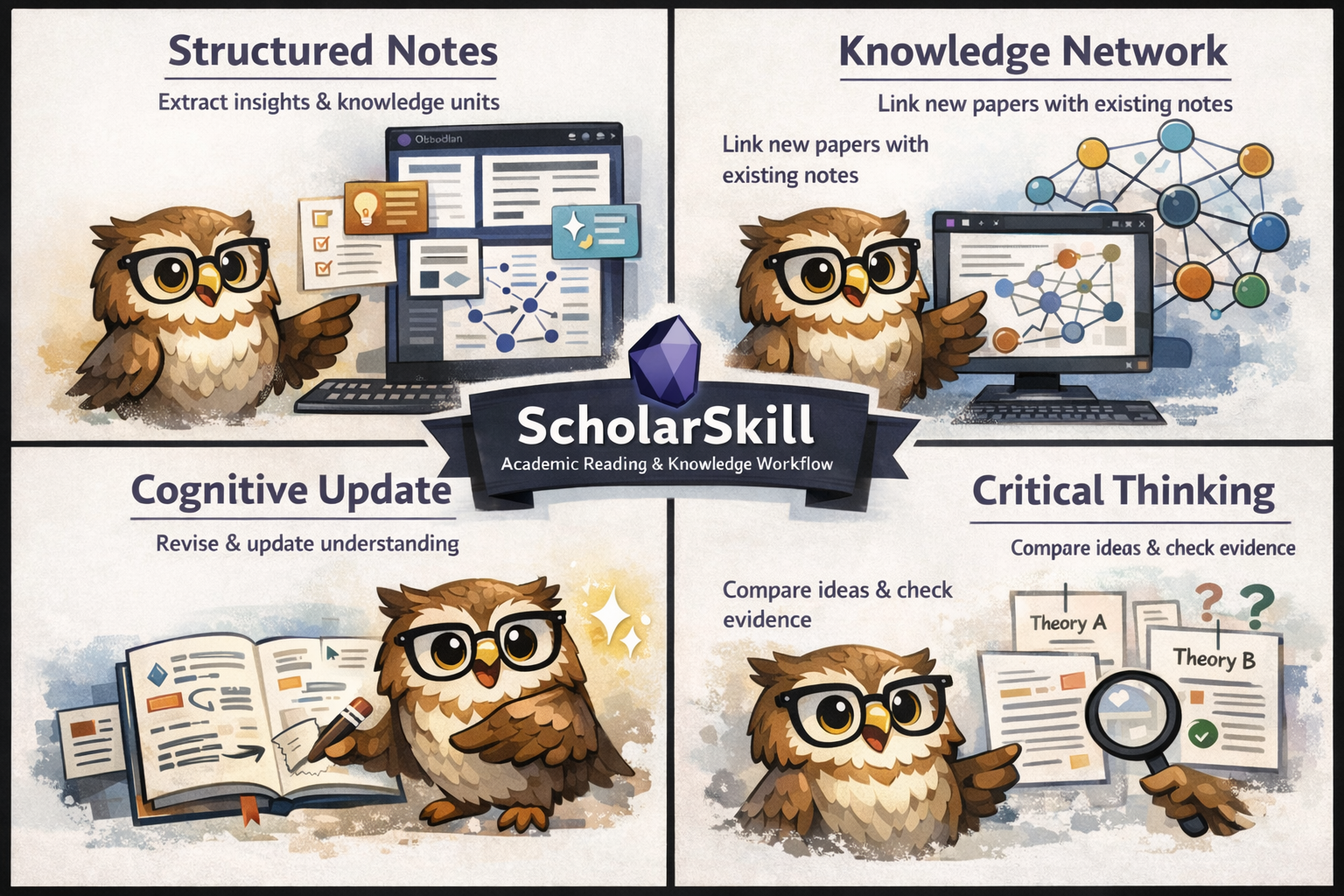
Build a living research knowledge system in Obsidian.
An OpenClaw skill for structured paper reading, knowledge linking, cognitive revision, and critical thinking.
English Skill Docs · 中文技能说明 · Installation · Core Strengths




ScholarSkill is an Obsidian-centered academic reading workflow for OpenClaw. It is designed for more than paper collection and note dumping: the goal is to help an agent read papers, extract durable knowledge, connect new ideas to an existing knowledge base, and keep that knowledge system evolving over time.
Why It Feels Different
Many academic assistants stop at search, summarization, or note capture. ScholarSkill is designed around the next step: turning paper reading into an evolving knowledge workflow inside Obsidian.
- It turns reading into structured notes instead of one-off summaries
- It connects new papers to existing notes and knowledge maps
- It supports revising older understanding as new evidence appears
- It encourages comparison, verification, and critical reflection
- It is built for a research workflow that keeps getting stronger over time
Installation
Quick Start
If you want the simplest path, clone the repository locally, open that workspace in OpenClaw, and let the agent finish the setup for you.
Example flow:
git clone https://github.com/EESJGong/scholar-skill.git
cd scholar-skill
Then ask the OpenClaw agent to finish the install, for example:
Please install this repository as an OpenClaw skill, use the Chinese package, and configure it for my Obsidian vault at /your/Obsidian/Vault.
or:
Please install this repository as an OpenClaw skill, use the English package, and configure it for my Obsidian vault at /your/Obsidian/Vault.
The agent can then place the repository into the correct skills directory, pick zh-CN/ or en/, and run the matching configure.py with --vault-path.
That is the complete quick-start path.
Manual Install and Detailed Setup
If you prefer to install and configure everything yourself, follow the detailed flow below.
Step 0: Choose your language package first
This repository ships as two parallel packages:
en/: English workflow, docs, and templateszh-CN/: Simplified Chinese workflow, docs, and templates
After cloning the repository, always start from the package you want to use, then run that package's setup script with an explicit vault path:
# English package
python en/scripts/configure.py auto --vault-path "/your/Obsidian/Vault"

# Simplified Chinese package
python zh-CN/scripts/configure.py auto --vault-path "/你的/Obsidian/Vault"
Passing --vault-path from the start avoids accidentally configuring the wrong vault and keeps templates separated under 9-Templates/en/ or 9-Templates/zh-CN/.
Option 1: Clone into the shared skills directory
Use this if you want ScholarSkill to be available across OpenClaw workspaces on the same machine.
mkdir -p ~/.openclaw/skills
git clone https://github.com/EESJGong/scholar-skill.git ~/.openclaw/skills/scholar-skill

openclaw skills info scholar-skill
openclaw skills check
Option 2: Clone or copy into a specific workspace
Use this if you want ScholarSkill to exist only inside one OpenClaw workspace.
mkdir -p <your-workspace>/skills
git clone https://github.com/EESJGong/scholar-skill.git <your-workspace>/skills/scholar-skill
Or, if you already downloaded the folder:
cp -R scholar-skill <your-workspace>/skills/
Then verify it:
cd <your-workspace>
openclaw skills list --eligible
openclaw skills info scholar-skill
openclaw skills check
Install dependency skills with ClawHub
clawhub install installs into ./skills under your current working directory, so run it from the location where you want the dependencies to live.
For shared installation:
cd ~/.openclaw
clawhub install obsidian-direct
clawhub install obsidian-cli
clawhub install arxiv-watcher
clawhub install academic-research-hub
clawhub install tavily
clawhub install pdf
clawhub install durable-task-runner
For workspace-scoped installation:
cd <your-workspace>
clawhub install obsidian-direct
clawhub install obsidian-cli
clawhub install arxiv-watcher
clawhub install academic-research-hub
clawhub install tavily
clawhub install pdf
clawhub install durable-task-runner
After the manual install is complete, start a new OpenClaw session so the new skills are picked up.
Core Strengths
Structured Notes
ScholarSkill turns a paper into more than a summary paragraph. It helps produce organized reading notes, extracted insights, reusable knowledge units, and a clearer record of what the paper actually contributes.
Instead of leaving the result as a one-off chat response, the workflow is designed to create notes that can be revisited, expanded, and linked later inside Obsidian.
Knowledge Network
ScholarSkill treats every new paper as part of a larger research context. New notes can be linked to existing topics, prior papers, domain concepts, and maps of content, so the vault grows as a network rather than a folder of isolated documents.
This makes it easier to see how ideas relate, where a new paper fits, and which parts of an existing knowledge base should be updated or expanded.
Cognitive Update
ScholarSkill is built around the idea that research understanding should evolve. When a new paper introduces stronger evidence, a better framing, or a contradiction to earlier notes, the workflow encourages revising older understanding instead of simply appending more information.
That makes the knowledge base progressively sharper over time, rather than larger but harder to trust.
Critical Thinking
ScholarSkill is not meant to passively record papers. It supports comparing claims, checking evidence, spotting assumptions, and asking whether a conclusion is actually well supported.
The goal is to make the reading process more evaluative and research-oriented, so the resulting knowledge system reflects judgment rather than just accumulation.
What It Supports
Literature Reading and Note Building
Use ScholarSkill to turn individual papers into structured notes that are easier to search, compare, and reuse later.
Memory Extraction for Long-Term Knowledge
Capture semantic, episodic, and procedural memories so the system preserves not only what a paper says, but also what was learned from reading it and what can be reused in future work.
Obsidian-Native Knowledge Growth
Keep the output inside an Obsidian vault, where notes, concept pages, and MOCs can evolve together instead of being trapped in disconnected chat logs.
Ongoing Research Understanding
Support workflows where reading a new paper can refine topic understanding, reveal gaps, or trigger updates to older notes and interpretations.
Verification-Oriented Research Workflows
Fit research processes that care about comparison, evidence checking, and synthesis instead of stopping at summarization.
Repository Structure
This repository is split into two parallel language packages:
scholar-skill/
├── README.md
├── README.zh-CN.md
├── SKILL.md                # repository entry
├── requirements.txt
├── en/                     # full English package
└── zh-CN/                  # full Simplified Chinese package
Getting Started
Start from the language-specific package you want to use:
- English package entry: en/SKILL.md
- Chinese package entry: zh-CN/SKILL.md
Shared repository files remain at the root:
Suggested Reading Order
- Read the package-level README or 中文版说明
- Open the package-level SKILL.md or 中文版 SKILL.md
- Run the setup guide in the corresponding package
- Install the required dependency skills and connect your Obsidian vault