Understand Anything
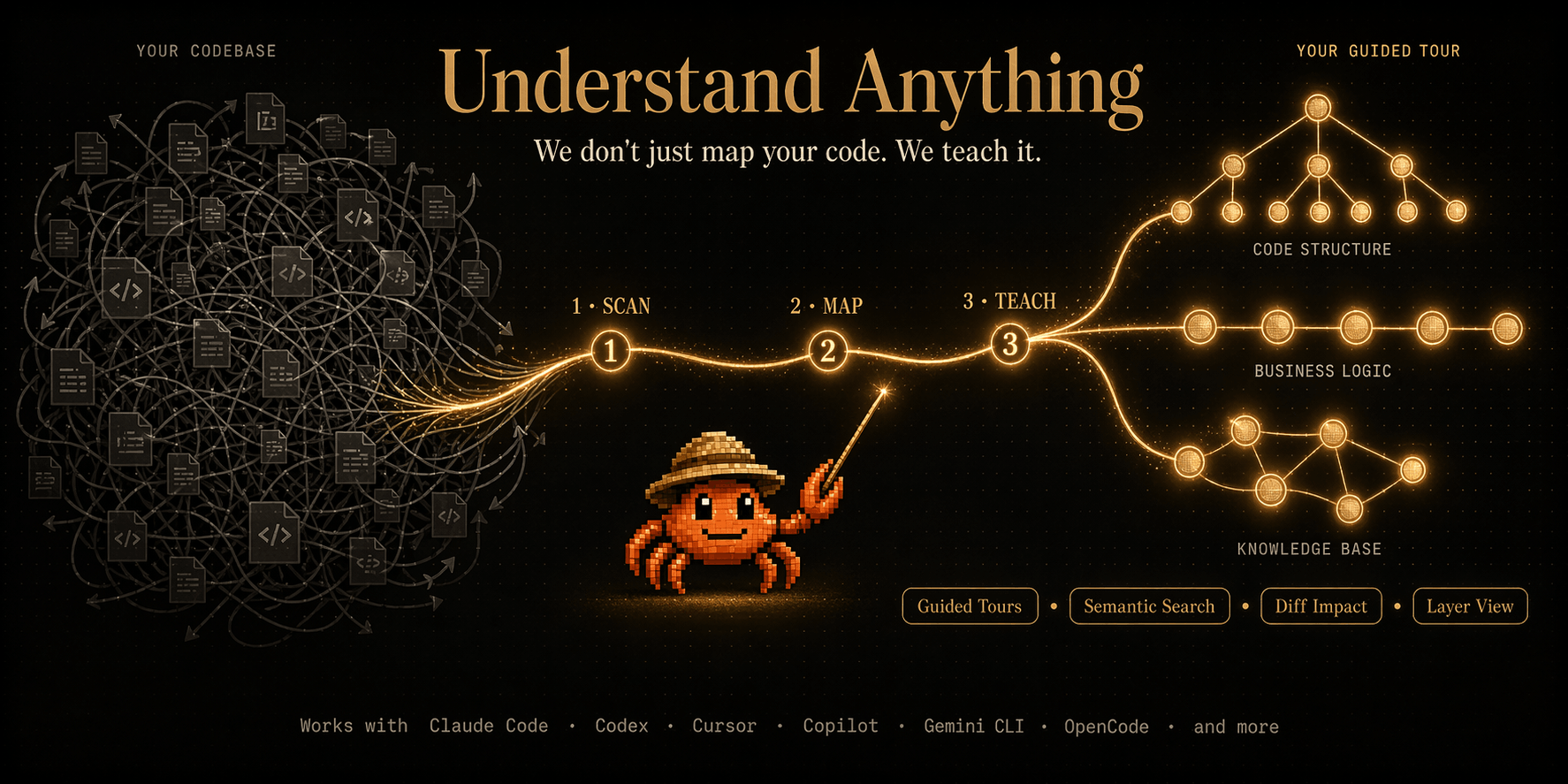
Turn any codebase, knowledge base, or docs into an interactive knowledge graph you can explore, search, and ask questions about.
Works with Claude Code, Codex, Cursor, Copilot, Gemini CLI, and more.
Understand Anything. Understand Anyone.
AI should help people, not replace them.
English | 简体中文 | 繁體中文 | 日本語 | 한국어 | Español | Türkçe | Русский



An open-source project from Egonex
Originally created by Lum1104.
You just joined a new team. The codebase is 200,000 lines of code. Where do you even start?
Understand Anything is a Claude Code Plugin that analyzes your project with a multi-agent pipeline, builds a knowledge graph of every file, function, class, and dependency, then gives you an interactive dashboard to explore it all visually. Stop reading code blind. Start seeing the big picture.
The goal isn't a graph that wows you with how complex your codebase is — it's a graph that quietly teaches you how every piece fits together.
✨ Features
[!NOTE] Want to skip the reading? Try the live demo in our homepage — a fully interactive dashboard you can pan, zoom, search, and explore right in your browser.
Explore the structural graph
Navigate your codebase as an interactive knowledge graph — every file, function, and class is a node you can click, search, and explore. Select any node to see plain-English summaries, relationships, and guided tours.
Understand business logic
Switch to the domain view and see how your code maps to real business processes — domains, flows, and steps laid out as a horizontal graph.
Analyze knowledge bases
Point /understand-knowledge at a Karpathy-pattern LLM wiki and get a force-directed knowledge graph with community clustering. The deterministic parser extracts wikilinks and categories from index.md, then LLM agents discover implicit relationships, extract entities, and surface claims — turning your wiki into a navigable graph of interconnected ideas.
🧭 Guided ToursAuto-generated walkthroughs of the architecture, ordered by dependency. Learn the codebase in the right order. |
🔍 Fuzzy & Semantic SearchFind anything by name or by meaning. Search "which parts handle auth?" and get relevant results across the graph. |
📊 Diff Impact AnalysisSee which parts of the system your changes affect before you commit. Understand ripple effects across the codebase. |
🎭 Persona-Adaptive UIThe dashboard adjusts its detail level based on who you are — junior dev, PM, or power user. |
🏗️ Layer VisualizationAutomatic grouping by architectural layer — API, Service, Data, UI, Utility — with color-coded legend. |
📚 Language Concepts12 programming patterns (generics, closures, decorators, etc.) explained in context wherever they appear. |
🚀 Quick Start
1. Install the plugin
/plugin marketplace add Egonex-AI/Understand-Anything
/plugin install understand-anything
Using a local model? For privacy or enterprise setups, point your platform at a local model provider such as Ollama — follow their integration guide to change the model provider.
2. Analyze your codebase
/understandA multi-agent pipeline scans your project, extracts every file, function, class, and dependency, then builds a knowledge graph saved to .ua/knowledge-graph.json. (Projects that already have a .understand-anything/ directory keep using it — it stays the data directory when present, so nothing needs migrating.)
Heads up on token usage: The initial
/understandanalyzes your whole codebase and can consume a significant number of tokens on large projects. We recommend running it on a token plan / subscription, or using a local model (see above) for initialization. Subsequent runs are incremental by default — only changed files are re-analyzed — so they use far fewer tokens.
Localized output: Use --language to generate content in your preferred language:
# Generate Chinese content (知识图节点描述和 Dashboard UI)
/understand --language zh

# Supported languages: en (default), zh, zh-TW, ja, ko, ru
On the first run in a project — when you don't pass --language and no language is stored yet — /understand detects the language you're conversing in. If it isn't English, it asks you to confirm (or override) before generating; English conversations are unaffected. Your choice is saved to .ua/config.json and reused on every later run.
The --language parameter affects:
- Node summaries and descriptions in the knowledge graph
- Dashboard UI labels, buttons, and tooltips
- Guided tour explanations
3. Explore the dashboard
/understand-dashboardAn interactive web dashboard opens with your codebase visualized as a graph — color-coded by architectural layer, searchable, and clickable. Select any node to see its code, relationships, and a plain-English explanation.
4. Keep learning
# Ask anything about the codebase
/understand-chat How does the payment flow work?

# Analyze impact of your current changes
/understand-diff

# Deep-dive into a specific file or function
/understand-explain src/auth/login.ts

# Generate an onboarding guide for new team members
/understand-onboard

# Extract business domain knowledge (domains, flows, steps)
/understand-domain

# Analyze a Karpathy-pattern LLM wiki knowledge base
/understand-knowledge ~/path/to/wiki

# Re-run anytime — incremental by default (only re-analyzes changed files)
/understand

# Auto-update on every commit via a post-commit hook
/understand --auto-update

# Scope to a subdirectory (for huge monorepos)
/understand src/frontend
🌐 Multi-Platform Installation
Understand-Anything works across multiple AI coding platforms.
Claude Code (Native)
/plugin marketplace add Egonex-AI/Understand-Anything
/plugin install understand-anything
One-line install (Codex / OpenCode / OpenClaw / Antigravity / Gemini CLI / Pi Agent / Vibe CLI / VS Code Copilot / Hermes / Cline / KIMI CLI / Trae / Nanobot / Kiro)
macOS / Linux:
curl -fsSL https://raw.githubusercontent.com/Egonex-AI/Understand-Anything/main/install.sh | bash
# or skip the prompt by passing the platform:
curl -fsSL https://raw.githubusercontent.com/Egonex-AI/Understand-Anything/main/install.sh | bash -s codex
Windows (PowerShell):
iwr -useb https://raw.githubusercontent.com/Egonex-AI/Understand-Anything/main/install.ps1 | iexThe installer clones the repo to ~/.understand-anything/repo and creates the right symlinks for the chosen platform. Restart your CLI/IDE afterwards.
Note on invoking skills: the invocation prefix differs per platform. Most platforms use slash commands (
/understand), but Codex uses$instead — type$understand, not/understand. If neither prefix is recognized on your platform, just ask in plain language: "Use the understand skill to analyze this project."
- Supported
<platform>values:gemini,codex,opencode,pi,openclaw,antigravity,vibe,vscode,hermes,cline,kimi,trae,nanobot,kiro - Update later:
- macOS / Linux:
./install.sh --update - Windows:
& "$HOME/.understand-anything/repo/install.ps1" -Update
- macOS / Linux:
- Uninstall:
- macOS / Linux:
./install.sh --uninstall <platform> - Windows:
& "$HOME/.understand-anything/repo/install.ps1" -Uninstall <platform>
- macOS / Linux:
Cursor
Cursor auto-discovers the plugin via .cursor-plugin/plugin.json when this repo is cloned. No manual installation needed — just clone and open in Cursor.
If auto-discovery doesn't pick it up, install it manually: open Cursor Settings → Plugins, paste https://github.com/Egonex-AI/Understand-Anything into the search field, and add it from there.
VS Code + GitHub Copilot
VS Code with GitHub Copilot (v1.108+) auto-discovers the plugin via .copilot-plugin/plugin.json when this repo is cloned. No manual installation needed — just clone and open in VS Code.
For personal skills (available across all projects), run the install.sh above with the vscode platform.
Copilot CLI
copilot plugin install Egonex-AI/Understand-Anything:understand-anything-pluginKiro CLI / IDE
curl -fsSL https://raw.githubusercontent.com/Egonex-AI/Understand-Anything/main/install.sh | bash -s kiroAfter installation:
- Kiro CLI:
kiro-cli chat --agent understand "Analyze this project" - Kiro IDE: The skills are symlinked into
~/.kiro/skills/and theunderstandagent is written to~/.kiro/agents/understand.json, so both are available after restarting the IDE.
For personal skills (available across all projects), run the install.sh above with the kiro platform.
Platform Compatibility
| Platform | Status | Install Method |
|---|---|---|
| Claude Code | ✅ Native | Plugin marketplace |
| Cursor | ✅ Supported | Auto-discovery |
| VS Code + GitHub Copilot | ✅ Supported | Auto-discovery |
| Copilot CLI | ✅ Supported | Plugin install |
| Codex | ✅ Supported | install.sh codex |
| OpenCode | ✅ Supported | install.sh opencode |
| OpenClaw | ✅ Supported | install.sh openclaw |
| Antigravity | ✅ Supported | install.sh antigravity |
| Gemini CLI | ✅ Supported | install.sh gemini |
| Pi Agent | ✅ Supported | install.sh pi |
| Vibe CLI | ✅ Supported | install.sh vibe |
| Hermes | ✅ Supported | install.sh hermes |
| Cline | ✅ Supported | install.sh cline |
| KIMI CLI | ✅ Supported | install.sh kimi |
| Trae | ✅ Supported | install.sh trae |
| Nanobot | ✅ Supported | install.sh nanobot |
| Kiro CLI / IDE | ✅ Supported | install.sh kiro |
📦 Share the Graph with Your Team
The graph is just JSON — commit it once, and teammates skip the pipeline. Good for onboarding, PR reviews, and docs-as-code.
Example: GoogleCloudPlatform/microservices-demo — Go / Java / Python / Node reference with a committed graph.
What to commit: everything in .ua/ except intermediate/ and diff-overlay.json (those are local scratch). (Legacy projects use .understand-anything/ — substitute that directory name below if it's the one present.)
.ua/intermediate/
.ua/diff-overlay.json
Keep it fresh: enable /understand --auto-update — a post-commit hook incrementally patches the graph so each commit lands with a matching graph. Or re-run /understand manually before releases.
Large graphs (10 MB+): track with git-lfs.
git lfs install
git lfs track ".ua/*.json"
git add .gitattributes .ua/
View the dashboard without Claude Code
Once a graph has been generated and committed, anyone on the team can open it with one command — no Claude Code, no LLM, no API key. Only Node.js (>= 18) is required:
npx https://github.com/Egonex-AI/Understand-Anything/releases/latest/download/understand-anything-viewer.tgz /path/to/analyzed/projectThe terminal prints a tokenized URL (http://127.0.0.1:5173/?token=…) and opens the full interactive dashboard in your browser. The project directory (default: current directory) must contain the committed data directory (.ua/, or legacy .understand-anything/). Everything is served read-only from local disk — no LLM calls, no data leaves your machine.
Working from a clone instead? pnpm install && pnpm --filter @understand-anything/core build, then GRAPH_DIR=/path/to/analyzed/project pnpm dev:dashboard does the same via the Vite dev server.
🔧 Under the Hood
Tree-sitter + LLM hybrid
Static analysis and LLMs do what each does best:
- Tree-sitter (deterministic) — parses source into a concrete syntax tree and extracts structural facts: imports, exports, function/class definitions, call sites, inheritance. Pre-resolved into an
importMapduring the scan phase and passed to file-analyzers so they don't re-derive imports from source. Same input → same output, every run. Also powers fingerprint-based change detection for incremental updates. - LLM (semantic) — reads the parsed structure alongside the original source to produce what parsers can't: plain-English summaries, tags, architectural layer assignments, business-domain mapping, guided tours, language concept callouts.
This split is why the graph is reproducible on the structural side (the same code always yields the same edges) while still capturing intent on the semantic side (what a file is for, not just what it imports).
Multi-Agent Pipeline
The /understand command orchestrates 5 specialized agents, /understand-domain adds a 6th, and /understand-knowledge adds a 7th:
| Agent | Role | Used By |
|---|---|---|
project-scanner | Discovers files, detects languages and frameworks | /understand |
file-analyzer | Extracts functions, classes, imports; produces graph nodes and edges | /understand |
architecture-analyzer | Identifies architectural layers | /understand |
tour-builder | Generates guided learning tours | /understand |
graph-reviewer | Validates graph completeness and referential integrity. Runs inline by default; use --review for full LLM review | /understand |
domain-analyzer | Extracts business domains, flows, and process steps | /understand-domain |
article-analyzer | Extracts entities, claims, and implicit relationships from wiki articles | /understand-knowledge |
File analyzers run in parallel, up to 5 concurrent workers and 20–30 files per batch.
The pipeline also supports incremental updates: only files changed since the last run are re-analyzed.
🎥 Community
A community-made walkthrough by Better Stack.
Made a video, blog post, or tutorial? Open an issue or PR — happy to feature it here.
🤝 Contributing
Contributions are welcome! Here's how to get started:
- Fork the repository
- Create a feature branch (
git checkout -b feature/my-feature) - Run the tests (
pnpm --filter @understand-anything/core test) - Commit your changes and open a pull request
Please open an issue first for major changes so we can discuss the approach.
Stop reading code blind. Start understanding everything.
Star History
Thanks to everyone who's used and contributed — knowing this saves people time is what made it worth building.
MIT License © Yuxiang Lin and Infinite Universe, Inc.