
Mortiflix
A motion design studio on your own machine.
Claude makes the video step by step. You approve every stage.
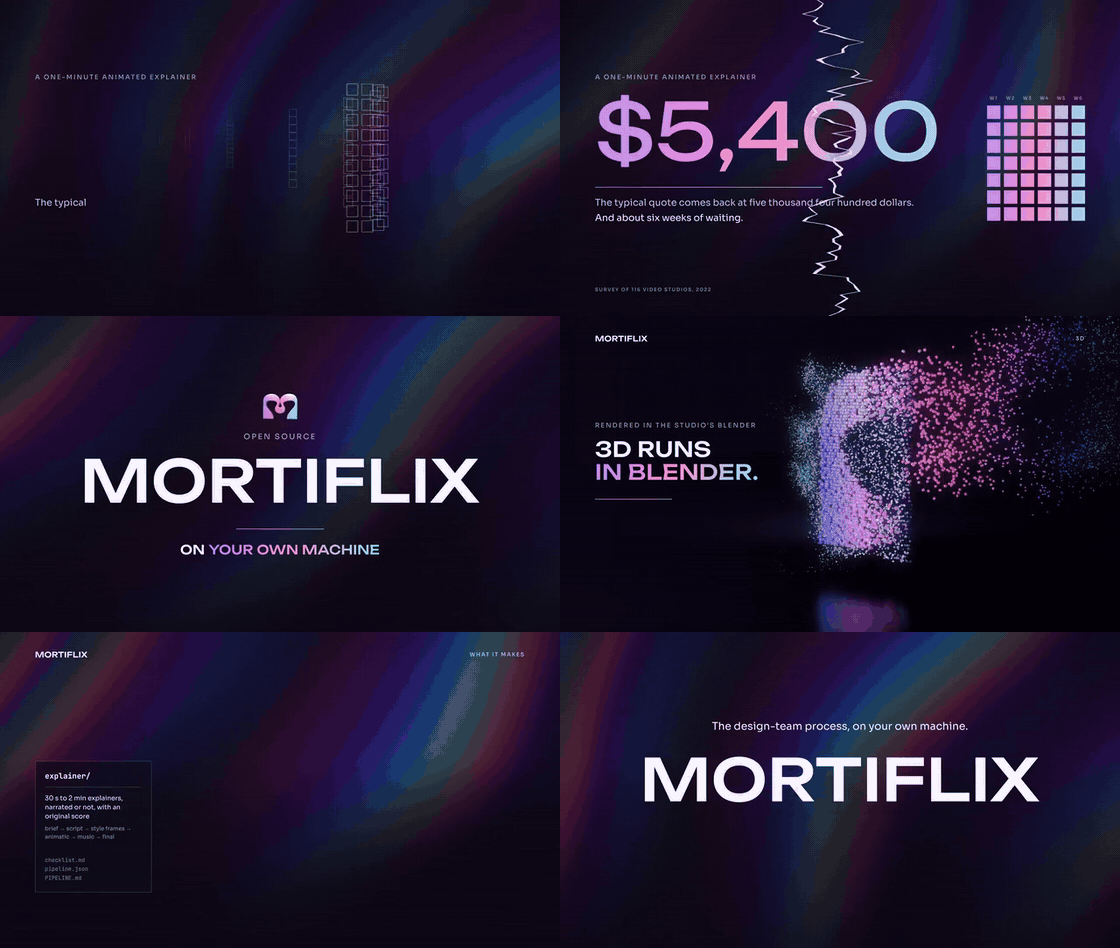
▶ Watch: How to use Mortiflix (3:07). This video was made with Mortiflix.
Most "AI video" tools are one prompt and a slot machine. Mortiflix works like a real motion design studio: a brief, a script, style frames, a transition board, an animatic, a final, and you review each stage before the next one starts. You pin a note on the exact spot of a frame or the exact moment of a video. The next version answers every note, one by one, and shows you what changed.
It's built for one person: you write the briefs, you review every stage, and the studio runs on your machine. The work is done by Claude through your own Claude Code login or your own Anthropic API key. Mortiflix is the harness around it: the pipelines, the gates, the review room, and the memory that carries a project across sessions and days.
 brief ──▶ script ──▶ style frames ──▶ animatic ──▶ build ──▶ final ──▶ delivered
   ▲          ▲            ▲              ▲                     ▲
   └── you ───┴──── you ───┴───── you ────┴──────── you ────────┘
       approve, pin notes, answer questions (the session stops at every gate)
Why it's built this way
- Sessions end at gates. A Claude session works until it has something for you to review, submits it, writes a handoff and stops. When you respond, a fresh session picks up from the journal. Waiting on you costs nothing, for hours or for days.
- The rules live in code, not in the prompt. Only you can approve a step you review. A submission is refused if it doesn't report every error check for its kind of work, or if it doesn't answer each note you left on the last version. What you reviewed is copied out of the session's reach, so it can't change afterwards.
- It learns your studio. When you point out a real mistake, the session proposes a new check ("text never
touches the frame edge"). Approve it once and every future video runs it. Your taste carries across projects in
TASTE.md. - Pipelines are folders. A pipeline is a
pipeline.json(steps, how each is reviewed, the error checks), aPIPELINE.md(the craft), and skills. Anyone can write one: that's the point of open-sourcing it.
Quick start
Tested mostly on Linux so far. A Windows version is coming in the next two weeks (by October 20, 2026): the installer is ready, sessions are next (docs/WINDOWS.md). macOS should mostly work but hasn't been tested yet.
You need Node 20+ and ffmpeg. For real videos you also need one of:
- Claude Code, logged in (your plan pays), or
- an Anthropic API key (you pay per token).
git clone https://github.com/GTKottman/mortiflix-oss.git && cd mortiflix-oss
npm install
npm link                 # puts `mortiflix` on your PATH (or use: node bin/mortiflix)

mortiflix init           # makes the studio folder (~/Mortiflix) and picks a backend it finds
mortiflix setup          # the walkthrough: Claude, narration, music, assets, 3D (asks before installing anything)
mortiflix demo           # a full walk-through with placeholder work: free, no Claude needed
Then either:
A. In the terminal
mortiflix new explainer          # asks the brief's questions
mortiflix run                    # sessions run until something waits on you
mortiflix review                 # read the note, answer questions, pin notes, approve or ask for changes
mortiflix run                    # ...and so on until it's delivered
B. In the browser
mortiflix serve # http://127.0.0.1:4646The web studio shows what's waiting on you, a live log of what Claude is doing, and the review room: click a frame
to pin a note, pause a video to note a moment, comment on a paragraph of the script, answer the session's questions,
and approve. Sessions start by themselves while serve runs. To use it from another device, run
mortiflix serve --host 0.0.0.0: you then get a private link with an access token (put it behind HTTPS if it leaves
your network).
C. In Claude Code
/plugin marketplace add GTKottman/mortiflix-oss
/plugin install mortiflix@mortiflix
/mortiflix
/mortiflix walks you through all of it in the conversation. It installs the CLI if you don't have it, then
covers setup, the demo, a new video's brief, and running the studio. At each gate it shows you what the session
sent, opens the frames and videos, and turns what you say into pinned notes. It reads them back to you before
sending. Jump straight to a part with /mortiflix demo, /mortiflix new explainer, /mortiflix review,
/mortiflix status or /mortiflix setup. If another plugin also has a /mortiflix, this one is
/mortiflix:mortiflix.
Your Claude Code conversation is the guide, not the studio. The video is still made by the studio's own sessions,
behind the same gates. The guide asks you at every gate and is told never to decide one for you. Keys
never go into the chat: you add them with mortiflix keys in a terminal, or in Settings › Keys. The guide asks
before it installs anything, opens a port or starts paid work. Only read commands are pre-allowed, so your Claude
Code permission settings apply to everything else. From a clone, claude --plugin-dir ./plugin loads it
without installing.
Backends
| Backend | What runs | Who pays |
|---|---|---|
claude-code | claude -p in the project folder, with your login | your Claude plan |
anthropic-api | Mortiflix's own agent loop on the Claude API: a persistent shell, a file editor that can show Claude the frames it renders, web search, prompt caching, compaction for long sessions | your API key, per token |
demo | a scripted stand-in that walks every gate with placeholder frames and a test-pattern video | nobody |
Pick one with mortiflix init --backend …, mortiflix config backend …, or Settings in the web studio.
Each project shows what its Claude work cost: on a Claude plan, what it would have cost at API prices (you didn't
pay that); with an API key through Claude Code, about what you spent.
Your keys
Mortiflix runs on your own accounts: there's nothing to sign up for. mortiflix init asks for your keys, and
mortiflix keys changes them any time (Settings › Keys in the web studio does the same):
Anthropic API key   only for the anthropic-api backend (Claude Code uses your own login)
ElevenLabs API key  only for ElevenLabs narration, sound effects and music
Upload-Post API key only for `mortiflix publish` through Upload-Post (optional; sessions never get it)
Postiz API key      only for `mortiflix publish` through your own Postiz (optional; sessions never get it)
Other keys          anything a pipeline's tools read from the environment, e.g. GEMINI_API_KEY
Typing is hidden, each key is checked with a free API call before it's saved, and they're written to the studio
folder only (secrets.json and session.env, mode 600). If a project needs a key you haven't added, it asks
before it starts (mortiflix new, or the web studio's Start button) instead of failing halfway through.
For scripts: echo "$KEY" | mortiflix keys set elevenlabs.
What it can make today
| Pipeline | Steps you review | Good for |
|---|---|---|
explainer | brief → script → style frames → transitions → animatic → music → final | 30 s to 2 min explainers, narrated or not, with an original score |
social-short | brief → hook frames → transitions → final | 45 s to 3 min vertical shorts: hook first, works with sound off |
logo-sting | directions → final | a 3–8 s logo animation; the quickest real run |
song | blueprint → final | an instrumental song from a genre and a topic: researched genre, checked score, MIDI, an instrument per channel, a mastered track |
They build in Remotion (React video) and check every render with ffmpeg (qc.mjs:
format, black or frozen frames, loudness, a frame sheet Claude has to look at). Remotion has its own license: free for individuals and small teams, a company
license above that. Check it for your case.
Narration
Pick a voice in Settings › Narration (or mortiflix voice):
- ElevenLabs: connect your key and choose from your voices, the default voices or the Voice Library, with Eleven v4 by default and every option the API offers (models, stability and similarity, language, text normalization, pronunciation dictionaries, audio format, data-residency servers), plus sound effects and music beds. Settings shows your plan, credits, and whether you may use the audio commercially (the free plan doesn't).
- This computer: Qwen3-TTS (open, Apache-2.0) through ComfyUI on your graphics card: free and private. Mortiflix checks your GPU and offers it when it fits (4 GB for the 0.6B voice, 8 GB for the 1.7B voice with delivery instructions).
- Your own voice: you read the script yourself, one short line at a time, in the recording booth: in the web
studio (hold Space to record, listen back, keep the best take), in a terminal (
mortiflix record <project>), or by importing files you recorded elsewhere (mortiflix record <project> --import <folder>). The studio asks for you when the script is ready and carries on once every line has a kept take. - None: on-screen text and music.
Generated lines are checked by speech to text and retaken if words go missing; word timings drive the animation. Details: docs/VOICE.md.
Transitions
Before the animatic, every project gets a transition board: for each change from one style frame to the next, the object or idea on screen that carries it, why the cut happens there, the word it lands on, and real in-between frames rendered from the two style frames and the chosen transition. Transitions come from the remotion-transitions library (installed by setup), or are new ones inspired by it. The screen never goes blank: no dip to a flat colour, no flash to white. A check reads every 10% of every transition and fails any frame that does.
Setup: music, assets and 3D
mortiflix setup (or Settings › Setup) explains each part, why it's needed and what it installs, then asks.
Everything goes into the studio folder, never system-wide. Full details: docs/SETUP.md.
- Music. One music engine writes songs (the
songpipeline) and video scores, in stages you can follow: the genre researched (songs), a blueprint, the score in Strudel as notes only, a machine check (harmony locked to the chart, the intensity curve as planned, every hit within a frame of the picture), the MIDI captured, an instrument chosen for every channel and auditioned, then a measured master. Every decision is written down in a music sheet. For videos, the recommended finish is yours: download the MIDI pack, make the sound in your own DAW, import your master. docs/MUSIC.md - Assets. If you have a website you use for assets, list it: sessions search it and download what fits in your own Chrome, with your own login, through browser-use's browser-harness, recording every asset's source and licence. Without one, sessions make every visual themselves.
- 3D. Blender with the studio's toolkits, in its own profile (your Blender setup is never touched): MoBlend
(MoGraph), Camera, Animate, Math, Circuits, Camera Flight for flying the camera yourself (
mortiflix blender), and Nova FX, Mortiflix's own particle engine (particles, fire, sparks, fireworks), which builds on Linux only for now.
Publishing (optional)
Once you approve a final, the video is yours to download. If you'd rather post it straight from the studio, pick a
service in setup (mortiflix setup publish, or Settings › Setup), add its key with mortiflix keys:
- Upload-Post: hosted, with paid plans. Connect your accounts there, under a profile.
- Postiz: free and open source (AGPL-3.0, like Mortiflix), on your own server or this
computer (Docker Compose). Connect your accounts in
it. You register a developer app with each platform yourself, and TikTok keeps posts private until it has reviewed
yours. Mortiflix talks to it over its API (
http://localhost:4007/apifor the official Docker image, orhttps://api.postiz.comfor Postiz Cloud); none of its code is bundled.
Then:
mortiflix publish <project>                                   # where the brief said (TikTok / Reels / Shorts), asks first
mortiflix publish <project> --to linkedin,x --title "…"       # somewhere else, with your own caption
mortiflix publish <project> --at 2026-10-20T18:00 --timezone Europe/Madrid   # scheduled
mortiflix publish <project> --status                          # per platform, with the links once they're live
Only you publish: it's a command you run, never something a session can reach (mfx has no way to it), and only a
delivered project's approved final goes out. It shows what goes where and asks before sending (--yes skips the
question in scripts). Running it again never posts the same video twice (--again does, on purpose). With Postiz,
the plan names each connected account it goes to. --profile is the Upload-Post profile your accounts are connected
under; it's remembered after the first time.
Publishing was started by @mutonby (#3), who built the Upload-Post side; Postiz came after, as the free choice.
Make your own pipeline
cp -r pipelines/logo-sting ~/Mortiflix/pipelines/my-pipeline   # the studio's own pipelines override built-ins
$EDITOR ~/Mortiflix/pipelines/my-pipeline/pipeline.json
mortiflix pipelines                                             # validates it
mortiflix new my-pipeline --backend demo                        # walk its gates for free
Read docs/PIPELINES.md. This is where help is most wanted: music videos, product films, data stories, kinetic type, 3D in Blender, captions for existing footage. If you can describe how a good studio makes it, it can be a pipeline.
How it works
- OVERVIEW.html: the whole project on one page, with UML diagrams (download it and open it in a browser)
- docs/ARCHITECTURE.md: the runner, the bridge (
mfx), the gates, the session brief, the backends - docs/PIPELINES.md: the pipeline format and how to write a good one
- harness/GATES.md: the protocol every session follows
- docs/SECURITY.md: what a session can and can't reach, and the web server's guards
- docs/COMPUTE.md: where the tokens, time and disk go, measured on a real project
- docs/VOICE.md: narration with ElevenLabs or on your own GPU, and every option
- docs/SETUP.md: every part of setup, what it installs and where
- docs/MUSIC.md: how the music step writes, checks and renders a score
Where it came from
Mortiflix began as a hosted motion design studio, where every video was made stage by stage behind the same kind of gates, with clients approving each one. This repository is that process, boiled down to one machine and opened up, so it can be improved by more people than one studio.
Not here yet (from the hosted studio, contributions welcome): workflow preferences learned from your pins, redo rounds on a delivered video, share links, music in the social-short pipeline, and more pipelines (codebase explainers, 3D music videos, real estate films).
Contributing
See CONTRIBUTING.md. Tests run in about a second (npm test) and never call the network.
License
AGPL-3.0. If you run a modified Mortiflix as a service for others, share your changes.
The bundled fonts (Sora, Unbounded) are under the SIL Open Font License (web/fonts/).