
🦞CutClaw: Agentic Hours-Long Video Editing via Music Synchronization
Shifang Zhao · Yihan Hu · Ying Shan · Yunchao Wei · Xiaodong Cun
Beijing Jiaotong University · GVC Lab, Great Bay University · Tencent ARC Lab
🎬 Your personal editor for turning hours of footage into cinematic montages.







Overview • Roadmap • Features • Gallery • Quick Start • Troubleshooting • Citation • Star History
💡 Overview
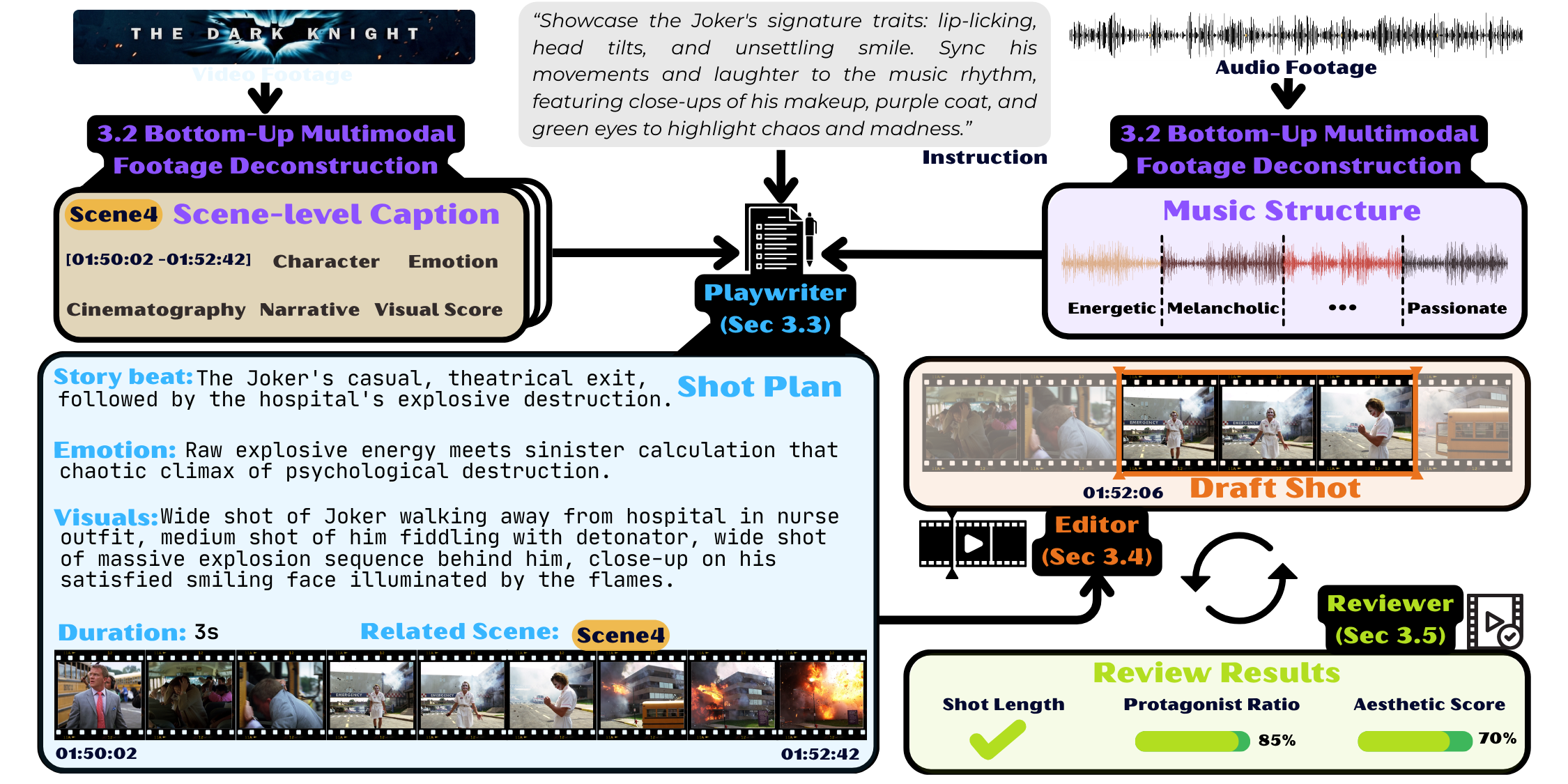
CutClaw is an end-to-end editing system for long-form footage + music.
It first deconstructs raw video/audio into structured captions, then uses a multi-agent pipeline to plan shots (shot_plan), select clip timestamps (shot_point), and validate final quality before rendering.
🗺️ Roadmap
We warmly welcome new issues and ideas from the community. If you have suggestions, please open an issue. Your feedback will help shape our future plans and be the fuel that helps this project take off. 🔥
Short-Term Goals
What we're building next for faster, cheaper, and more expressive video editing.
- 🧩 ARC-Chapter Integration
Bring in ARC-Chapter to reduce the cost of long-form footage deconstruction. - 💸 Low-Cost Mode
Add a budget-friendly mode that proactively reads only relevant footage instead of fully processing all source material. - 🎙️ Talking-Head + Visual Mixing
Introduce hybrid editing logic that coordinates narration-driven clips with supporting visual footage.
Long-Term Goals
Broader product and ecosystem directions for the next stage of CutClaw.
- ✍️ Playwriter Upgrade
Expand the Playwriter with richer editing patterns and more diverse visual storytelling methods. - 🔌 Claude Code MCP Support
Adapt CutClaw to work smoothly within Claude Code MCP workflows. - 🌐 Online Service Interface
Build a web-based service interface for easier access and deployment.
✨ Key Features
🎬 One-Click Deconstruction
Effortlessly transforms hours-long raw video and audio into structured, searchable assets with a single click. |
🎯 Instruction Control
Requires only one text instruction to steer the editing style—easily generating fast-paced character montages or slow-paced emotional narratives. |
📱 Smart Auto-Cropping
Content-aware cropping automatically identifies core subjects and adjusts aspect ratios to fit various social platforms. |
🎵 Music-Aware Sync
Extracts musical beats and energy signals to build rhythm-aware cuts that perfectly match the music's pacing. |
🖼️ Gallery(remember to turn on the audio)
🚀 Quick Start
1. Install
git clone https://github.com/GVCLab/CutClaw.git
cd CutClaw
conda create -n CutClaw python=3.12
conda activate CutClaw
pip install -r requirements.txt
We strongly recommend the GPU-accelerated Decord/NVDEC build for faster video decoding. Build from source.
2. Add your files
resource/
├── video/      ← put your .mp4 / .mkv here
├── audio/      ← put your .mp3 / .wav here
└── subtitle/   ← optional .srt (skips ASR, saves time)
3. Run
UI (recommended)
streamlit run app.py
Then open http://localhost:8501 in your browser. (*If http://localhost:8501 does not work well, try http://127.0.0.1:8501)
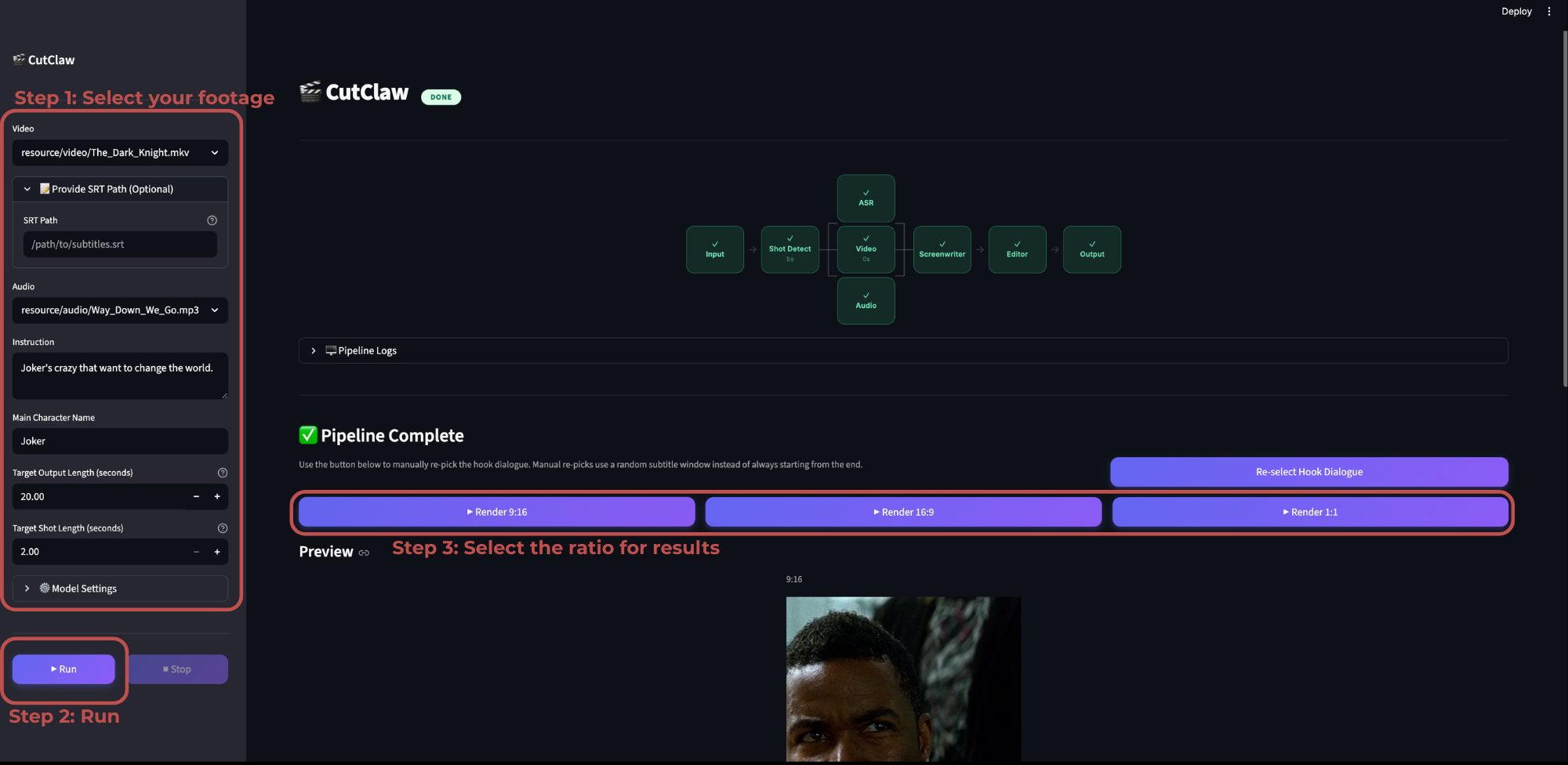
Place your footage in the paths above, then you can directly select those files in the UI.
Model selection guidance:
-
Video model
- Role: shot/scene understanding and visual captioning.
- Recommended: Gemini-3, Qwen3.5, GPT-5.3
-
Audio model
- Role: ASR plus music-structure parsing (beat/downbeat, pitch, energy) for music-aware segmentation.
- Recommended: Gemini-3
-
Agent model
- Role: drives the Screenwriter + Editor + Reviewer loop to generate
shot_planandshot_point. - Recommended: MiniMax-2.7, Kimi-2.5, Claude-4.5
- Role: drives the Screenwriter + Editor + Reviewer loop to generate
We leverage LiteLLM as the api manager gateway, the typical Model name is e.g. 'openai/MiniMax-2.7' which means using openai protocol to call the given model, more information see LiteLLM documents.
CLI (advanced)
python local_run.py \
  --Video_Path "resource/video/xxxx.mp4" \
  --Audio_Path "resource/audio/xxxx.mp3" \
  --Instruction "xxxx"
Common config overrides
Any src/config.py parameter can be overridden with --config.PARAM_NAME VALUE.
| Parameter | Default | Effect |
|---|---|---|
VIDEO_PATH | "resource/video/The_Dark_Knight.mkv" | Default input video path used by UI remembered inputs |
AUDIO_PATH | "resource/audio/Way_Down_We_Go.mp3" | Default input audio path used by UI remembered inputs |
INSTRUCTION | "Joker's crazy that want to change the world." | Default editing instruction prompt |
ASR_BACKEND | "litellm" | ASR engine (litellm cloud or whisper_cpp local) |
VIDEO_FPS | 2 | Sampling FPS for preprocessing |
MAIN_CHARACTER_NAME | "Joker" | Protagonist name for character-focused edits |
AUDIO_MIN_SEGMENT_DURATION | 3.0 | Minimum beat segment duration (seconds) |
AUDIO_MAX_SEGMENT_DURATION | 5.0 | Maximum beat segment duration (seconds) |
AUDIO_DETECTION_METHODS | ["downbeat", "pitch", "mel_energy"] | Audio keypoint detection methods |
PARALLEL_SHOT_MAX_WORKERS | 4 | Parallel shot selection workers |
Example:
python local_run.py \
  --Video_Path "resource/video/xxxx.mp4" \
  --Audio_Path "resource/audio/xxxx.mp3" \
  --Instruction "xxxx" \
  --config.MAIN_CHARACTER_NAME "Batman" \
  --config.VIDEO_FPS 2 \
  --config.AUDIO_TOTAL_SHOTS 50
Then render manually:
python render/render_video.py \
  --shot-plan  "Output/<video_audio>/shot_plan_*.json" \
  --shot-json  "Output/<video_audio>/shot_point_*.json" \
  --video  "resource/video/xxxx.mp4" \
  --audio  "resource/audio/xxxx.mp3" \
  --output "output/final.mp4" \
  --crop-ratio "9:16" \
  --no-labels --render-hook-dialogue
🛠️ Troubleshooting
Very slow runtime
- API latency — the pipeline sends a large number of concurrent requests to vision/language APIs. Speed is heavily dependent on your API provider's response time and rate limits.
- First-run Footage Deconstruction — the first time you process a video, shot detection, captioning, ASR, and scene analysis all run from scratch. This is a one-time cost per video; subsequent edits with the same footage reuse the cached results and are much faster.
- GPU acceleration — a CUDA-capable GPU significantly speeds up video decoding and encoding. We recommend building Decord with NVDEC support (see Install section).
- Video codec compatibility — if the pipeline appears to hang during video-related steps, the source video's encoding may be the cause. In our testing, videos encoded with
libx264worked reliably.
⭐ Citation
If you find CutClaw useful for your research, welcome to cite our work using the following BibTeX:
@article{cutclaw,
 title={CutClaw: Agentic Hours-Long Video Editing via Music Synchronization},
 author={Shifang Zhao, Yihan Hu, Ying Shan, Yunchao Wei, Xiaodong Cun},
 journal={arXiv preprint arXiv:2603.29664},
 year={2026}
}
📈 Star History