

oh — OpenHarness & ohmo
OpenHarness delivers core lightweight agent infrastructure: tool-use, skills, memory, and multi-agent coordination.
ohmo is a personal AI agent built on OpenHarness — not another chatbot, but an assistant that actually works for you over long sessions. Chat with ohmo in Feishu / Slack / Telegram / Discord, and it forks branches, writes code, runs tests, and opens PRs on its own. ohmo runs on your existing Claude Code or Codex subscription — no extra API key needed.
Join the community: contribute Harness for open agent development.













One Command (oh) to Launch OpenHarness and Unlock All Agent Harnesses.
Supports CLI agent integration including OpenClaw, nanobot, Cursor, and more.

✨ OpenHarness's Key Harness Features
🔄 Agent Loop

• Streaming Tool-Call Cycle • API Retry with Exponential Backoff • Parallel Tool Execution • Token Counting & Cost Tracking |
🔧 Harness Toolkit
• 43 Tools (File, Shell, Search, Web, MCP) • On-Demand Skill Loading (.md) • Plugin Ecosystem (Skills + Hooks + Agents) • Compatible with anthropics/skills & plugins |
🧠 Context & Memory
• CLAUDE.md Discovery & Injection • Context Compression (Auto-Compact) • MEMORY.md Persistent Memory • Session Resume & History |
🛡️ Governance

• Multi-Level Permission Modes • Path-Level & Command Rules • PreToolUse / PostToolUse Hooks • Interactive Approval Dialogs |
🤝 Swarm Coordination
• Subagent Spawning & Delegation • Team Registry & Task Management • Background Task Lifecycle • ClawTeam Integration (Roadmap) |
🤔 What is an Agent Harness?
An Agent Harness is the complete infrastructure that wraps around an LLM to make it a functional agent. The model provides intelligence; the harness provides hands, eyes, memory, and safety boundaries.
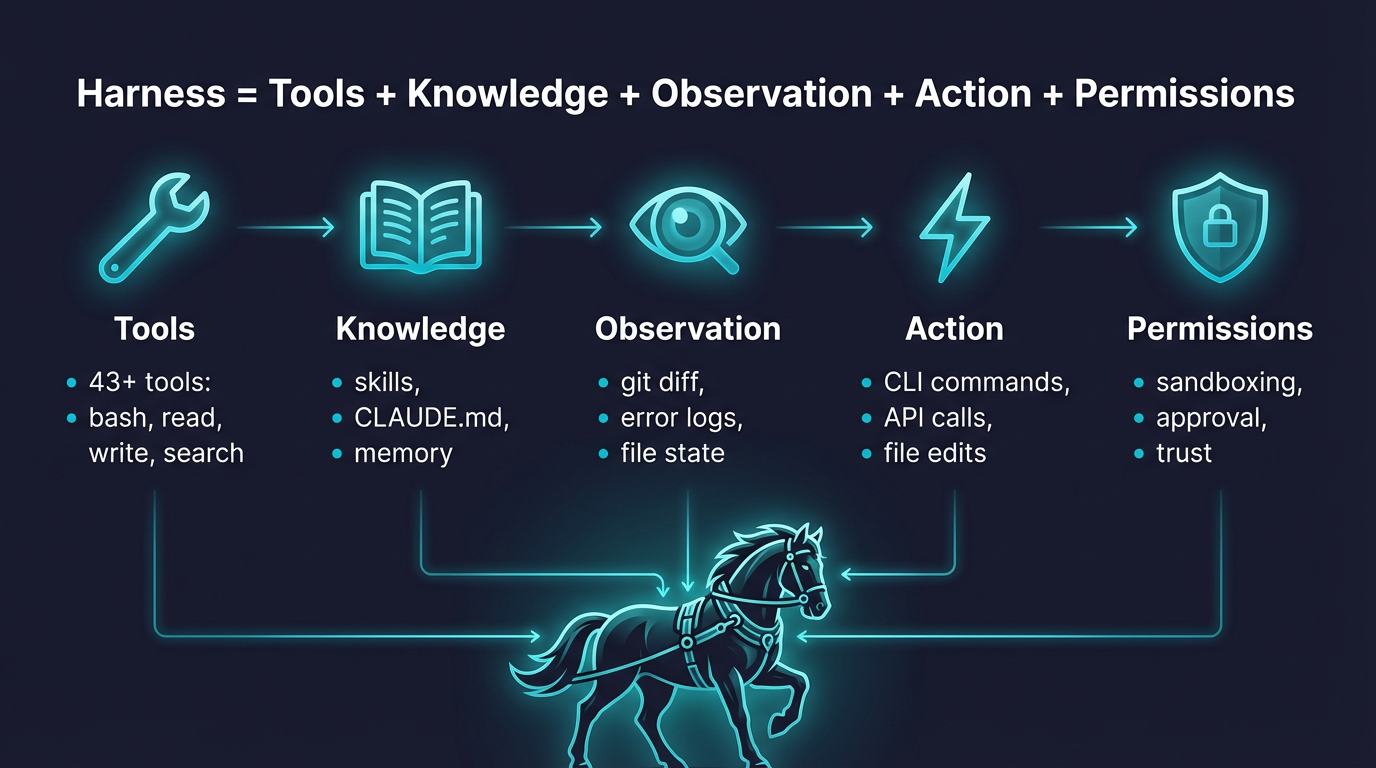
OpenHarness is an open-source Python implementation designed for researchers, builders, and the community:
- Understand how production AI agents work under the hood
- Experiment with cutting-edge tools, skills, and agent coordination patterns
- Extend the harness with custom plugins, providers, and domain knowledge
- Build specialized agents on top of proven architecture
📰 What's New
- Unreleased 🔍 Dry-run safe preview:
oh --dry-runpreviews resolved runtime settings, auth state, skills, commands, tools, and configured MCP servers without executing the model, tools, or subagents.- Dry-run now reports a
ready/warning/blockedreadiness verdict with concrete next-step suggestions such as fixing auth, fixing MCP config, or running the prompt directly. - Prompt previews include likely matching skills and tools, while slash-command previews show whether the command is mostly read-only or stateful.
- 2026-04-18 ⚙️ v0.1.7 — Packaging & TUI polish:
- Install script now links
oh,ohmo, andopenharnessinto~/.local/bininstead of prepending the virtualenvbindirectory toPATH, which avoids clobbering Conda-managed shells. - React TUI now supports
Shift+Enterto insert a newline while keeping plainEnteras submit. - Busy-state animation in the React TUI is quieter and less error-prone on Windows terminals, with conservative spinner frames and reduced flashing.
- Install script now links
- 2026-04-10 🧠 v0.1.6 — Auto-Compaction & Markdown TUI:
- Auto-Compaction preserves task state and channel logs across context compression — agents can run multi-day sessions without manual compact/clear
- Subprocess teammates run in headless worker mode; agent team creation stabilized
- Assistant messages now render full Markdown in the React TUI
ohmogains channel slash commands and multimodal attachment support
- 2026-04-08 🔌 v0.1.5 — MCP HTTP transport & Swarm polling:
- MCP protocol adds HTTP transport, auto-reconnect on disconnect, and tool-only server compatibility
- JSON Schema types inferred for MCP tool inputs — no manual type mapping needed
ohmochannels support file attachments and multimodal gateway messages- Subprocess agents are now pollable in real runs; permission modals serialized to prevent input swallowing
- 2026-04-08 🌙 v0.1.4 — Multi-provider auth & Moonshot/Kimi:
- Native Moonshot/Kimi provider with
reasoning_contentsupport for thinking models - Auth overhaul: fixed provider-switching key mismatch,
OPENAI_BASE_URLenv override, profile-scoped credential priority - MCP gracefully handles disconnected servers in
call_tool/read_resource - Security: built-in sensitive-path protection in PermissionChecker, hardened
web_fetchURL validation - Stability: EIO crash recovery in Ink TUI,
--debuglogging, Windows cmd flash fix
- Native Moonshot/Kimi provider with
- 2026-04-06 🚀 v0.1.2 — Unified setup flows and
ohmopersonal-agent app:oh setupnow guides provider selection as workflows instead of exposing raw auth/provider internals- Compatible API setup is now profile-scoped, so Anthropic/OpenAI-compatible endpoints can keep separate keys
ohmoships as a packaged app with~/.ohmoworkspace, gateway, bootstrap prompts, and channel config flow
- 2026-04-01 🎨 v0.1.0 — Initial OpenHarness open-source release featuring complete Harness architecture:
Start here: Quick Start · Provider Compatibility · Showcase · Contributing · Changelog
🚀 Quick Start
1. Install
Linux / macOS / WSL
# One-click install
curl -fsSL https://raw.githubusercontent.com/HKUDS/OpenHarness/main/scripts/install.sh | bash

# Or via pip
pip install openharness-ai
Windows (Native)
# One-click install (PowerShell)
iex (Invoke-WebRequest -Uri 'https://raw.githubusercontent.com/HKUDS/OpenHarness/main/scripts/install.ps1')

# Or via pip
pip install openharness-aiNote: Windows support is now native. In PowerShell, use openh instead of oh because oh can resolve to the built-in Out-Host alias.
2. Configure
oh setup    # interactive wizard — pick a provider, authenticate, done
# On Windows PowerShell, use: openh setup
Supports Claude / OpenAI / Copilot / Codex / Moonshot(Kimi) / GLM / MiniMax / NVIDIA NIM and any compatible endpoint.
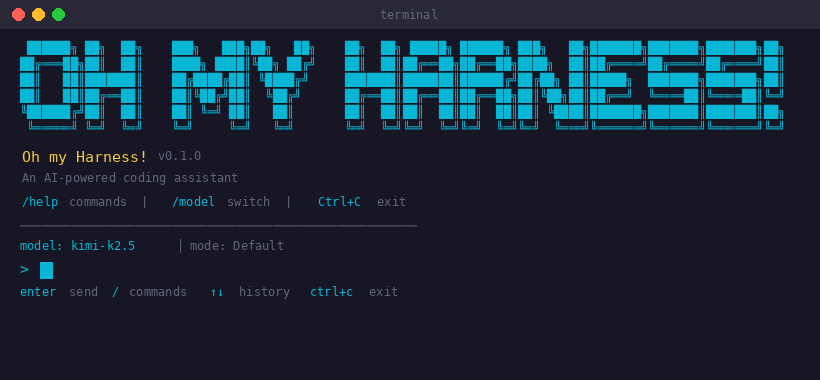
3. Run
oh
# On Windows PowerShell, use: openh
4. Set up ohmo (Personal Agent)
Want an AI agent that works for you from Feishu / Slack / Telegram / Discord?
ohmo init             # initialize ~/.ohmo workspace
ohmo config           # configure channels and provider
ohmo gateway start    # start the gateway — ohmo is now live in your chat app
ohmo runs on your existing Claude Code subscription or Codex subscription — no extra API key needed.
Non-Interactive Mode (Pipes & Scripts)
# Single prompt → stdout
oh -p "Explain this codebase"

# JSON output for programmatic use
oh -p "List all functions in main.py" --output-format json

# Stream JSON events in real-time
oh -p "Fix the bug" --output-format stream-json
Dry Run (Safe Preview)
Use --dry-run when you want to inspect what OpenHarness would use before any live execution starts.
# Preview an interactive session setup
oh --dry-run

# Preview one prompt without executing the model or tools
oh --dry-run -p "Review this bug fix and grep for failing tests"

# Preview a slash command path
oh --dry-run -p "/plugin list"

# Get structured output for scripts or channels
oh --dry-run -p "Explain this repository" --output-format json
Dry-run is intentionally static:
- It does not call the model
- It does not execute tools or spawn subagents
- It does not connect to MCP servers
- It does resolve settings, auth status, prompt assembly, skills, commands, tools, and obvious MCP config problems
Readiness levels:
ready: configuration looks usable; the next suggested action is usually to run the prompt directlywarning: OpenHarness can resolve the session, but something important still looks wrong, such as broken MCP config or missing auth for later model workblocked: the requested path will not run successfully as-is, for example an unknown slash command or a prompt that cannot resolve a runtime client
next actions in the dry-run output tell you the shortest fix or follow-up step, such as:
- run
oh auth login - fix or disable broken MCP configuration
- run the prompt directly with
oh -p "..."or open the interactive UI withoh
🔌 Provider Compatibility
OpenHarness treats providers as workflows backed by named profiles. In day-to-day use, prefer:
oh setup
oh provider list
oh provider use <profile>
Built-in Workflows
| Workflow | What it is | Typical backends |
|---|---|---|
| Anthropic-Compatible API | Anthropic-style request format | Claude official, Kimi, GLM, MiniMax, internal Anthropic-compatible gateways |
| Claude Subscription | Claude CLI subscription bridge | Local ~/.claude/.credentials.json |
| OpenAI-Compatible API | OpenAI-style request format | OpenAI official, OpenRouter, DashScope, DeepSeek, SiliconFlow, Groq, Ollama, GitHub Models |
| Codex Subscription | Codex CLI subscription bridge | Local ~/.codex/auth.json |
| GitHub Copilot | Copilot OAuth workflow | GitHub Copilot device-flow login |
Compatible API Families
Anthropic-Compatible API
Typical examples:
| Backend | Base URL | Example models |
|---|---|---|
| Claude official | https://api.anthropic.com | claude-sonnet-4-6, claude-opus-4-6 |
| Moonshot / Kimi | https://api.moonshot.cn/anthropic | kimi-k2.5 |
| Zhipu / GLM | custom Anthropic-compatible endpoint | glm-4.5 |
| MiniMax | custom Anthropic-compatible endpoint | minimax-m1 |
OpenAI-Compatible API
Any provider implementing the OpenAI /v1/chat/completions style API works:
| Backend | Base URL | Example models |
|---|---|---|
| OpenAI | https://api.openai.com/v1 | gpt-5.4, gpt-4.1 |
| OpenRouter | https://openrouter.ai/api/v1 | provider-specific |
| Alibaba DashScope | https://dashscope.aliyuncs.com/compatible-mode/v1 | qwen3.5-flash, qwen3-max, deepseek-r1 |
| DeepSeek | https://api.deepseek.com | deepseek-chat, deepseek-reasoner |
| GitHub Models | https://models.inference.ai.azure.com | gpt-4o, Meta-Llama-3.1-405B-Instruct |
| SiliconFlow | https://api.siliconflow.cn/v1 | deepseek-ai/DeepSeek-V3 |
| NVIDIA NIM | https://integrate.api.nvidia.com/v1 | openai/gpt-oss-120b, nvidia/llama-3.3-nemotron-super-49b-v1 |
| Google Gemini | https://generativelanguage.googleapis.com/v1beta/openai | gemini-2.5-flash, gemini-2.5-pro |
| Groq | https://api.groq.com/openai/v1 | llama-3.3-70b-versatile |
| Ollama (local) | http://localhost:11434/v1 | any local model |
Advanced Profile Management
# List saved workflows
oh provider list

# Switch the active workflow
oh provider use codex

# Add your own compatible endpoint
oh provider add my-endpoint \
  --label "My Endpoint" \
  --provider openai \
  --api-format openai \
  --auth-source openai_api_key \
  --model my-model \
  --base-url https://example.com/v1
For custom compatible endpoints, OpenHarness can bind credentials per profile instead of forcing every Anthropic-compatible or OpenAI-compatible backend to share the same API key.
Ollama (Local Models)
Run local models through Ollama's OpenAI-compatible endpoint:
# Add an Ollama provider profile
oh provider add ollama \
  --label "Ollama" \
  --provider Ollama \
  --api-format openai \
  --auth-source openai_api_key \
  --model glm-4.7-flash:q8_0 \
  --base-url http://localhost:11434/v1
Saved provider profile: ollama
# Activate and verify
oh provider use ollama
Activated provider profile: ollama
oh provider list claude-api: Anthropic-Compatible API [ready]
...
moonshot: Moonshot (Kimi) [missing auth]
auth=moonshot_api_key model=kimi-k2.5 base_url=https://api.moonshot.cn/v1
* ollama: Ollama [ready]
auth=openai_api_key model=glm-4.7-flash:q8_0 base_url=http://localhost:11434/v1
GitHub Copilot Format (--api-format copilot)
Use your existing GitHub Copilot subscription as the LLM backend. Authentication uses GitHub's OAuth device flow — no API keys needed.
# One-time login (opens browser for GitHub authorization)
oh auth copilot-login

# Then launch with Copilot as the provider
uv run oh --api-format copilot

# Or via environment variable
export OPENHARNESS_API_FORMAT=copilot
uv run oh

# Check auth status
oh auth status

# Remove stored credentials
oh auth copilot-logout| Feature | Details |
|---|---|
| Auth method | GitHub OAuth device flow (no API key needed) |
| Token management | Automatic refresh of short-lived session tokens |
| Enterprise | Supports GitHub Enterprise via --github-domain flag |
| Models | Uses Copilot's default model selection |
| API | OpenAI-compatible chat completions under the hood |
🏗️ Harness Architecture
OpenHarness implements the core Agent Harness pattern with 10 subsystems:
openharness/
  engine/          # 🧠 Agent Loop — query → stream → tool-call → loop
  tools/           # 🔧 43 Tools — file I/O, shell, search, web, MCP
  skills/          # 📚 Knowledge — on-demand skill loading (.md files)
  plugins/         # 🔌 Extensions — commands, hooks, agents, MCP servers
  permissions/     # 🛡️ Safety — multi-level modes, path rules, command deny
  hooks/           # ⚡ Lifecycle — PreToolUse/PostToolUse event hooks
  commands/        # 💬 54 Commands — /help, /commit, /plan, /resume, ...
  mcp/             # 🌐 MCP — Model Context Protocol client
  memory/          # 🧠 Memory — persistent cross-session knowledge
  tasks/           # 📋 Tasks — background task management
  coordinator/     # 🤝 Multi-Agent — subagent spawning, team coordination
  prompts/         # 📝 Context — system prompt assembly, CLAUDE.md, skills
  config/          # ⚙️ Settings — multi-layer config, migrations
  ui/              # 🖥️ React TUI — backend protocol + frontend
The Agent Loop
The heart of the harness. One loop, endlessly composable:
while True:
    response = await api.stream(messages, tools)

    if response.stop_reason != "tool_use":
        break  # Model is done

    for tool_call in response.tool_uses:
        # Permission check → Hook → Execute → Hook → Result
        result = await harness.execute_tool(tool_call)

    messages.append(tool_results)
    # Loop continues — model sees results, decides next action
The model decides what to do. The harness handles how — safely, efficiently, with full observability.
Harness Flow
flowchart LR
    U[User Prompt] --> C[CLI or React TUI]
    C --> R[RuntimeBundle]
    R --> Q[QueryEngine]
    Q --> A[Anthropic-compatible API Client]
    A -->|tool_use| T[Tool Registry]
    T --> P[Permissions + Hooks]
    P --> X[Files Shell Web MCP Tasks]
    X --> Q
✨ Features
🔧 Tools (43+)
| Category | Tools | Description |
|---|---|---|
| File I/O | Bash, Read, Write, Edit, Glob, Grep | Core file operations with permission checks |
| Search | WebFetch, WebSearch, ToolSearch, LSP | Web and code search capabilities |
| Notebook | NotebookEdit | Jupyter notebook cell editing |
| Agent | Agent, SendMessage, TeamCreate/Delete | Subagent spawning and coordination |
| Task | TaskCreate/Get/List/Update/Stop/Output | Background task management |
| MCP | MCPTool, ListMcpResources, ReadMcpResource | Model Context Protocol integration |
| Mode | EnterPlanMode, ExitPlanMode, Worktree | Workflow mode switching |
| Schedule | CronCreate/List/Delete, RemoteTrigger | Scheduled and remote execution |
| Meta | Skill, Config, Brief, Sleep, AskUser | Knowledge loading, configuration, interaction |
Every tool has:
- Pydantic input validation — structured, type-safe inputs
- Self-describing JSON Schema — models understand tools automatically
- Permission integration — checked before every execution
- Hook support — PreToolUse/PostToolUse lifecycle events
📚 Skills System
Skills are on-demand knowledge — loaded only when the model needs them:
Available Skills:
- commit: Create clean, well-structured git commits
- review: Review code for bugs, security issues, and quality
- debug: Diagnose and fix bugs systematically
- plan: Design an implementation plan before coding
- test: Write and run tests for code
- simplify: Refactor code to be simpler and more maintainable
- pdf: PDF processing with pypdf (from anthropics/skills)
- xlsx: Excel operations (from anthropics/skills)
- ... 40+ more
Skills can live in bundled, user, ohmo, project, or plugin locations. User-level skills are loaded from:
~/.openharness/skills/<skill>/SKILL.md
~/.claude/skills/<skill>/SKILL.md
~/.agents/skills/<skill>/SKILL.md
Project-level skills are enabled by default and are discovered from the current working directory up to the git root:
<project>/.openharness/skills/<skill>/SKILL.md
<project>/.agents/skills/<skill>/SKILL.md
<project>/.claude/skills/<skill>/SKILL.md
Disable project skills for untrusted repositories with:
oh config set allow_project_skills falseUse /skills to list loaded skills with their source and path. User-invocable skills can be run directly as slash commands, for example /deploy staging.
Compatible with anthropics/skills — use the SKILL.md directory layout above.
🌐 Web search and proxy settings
Built-in web_search uses DuckDuckGo HTML search by default. In regions where that endpoint is unreachable, point OpenHarness at a trusted public HTML search endpoint or your own SearXNG instance:
export OPENHARNESS_WEB_SEARCH_URL="https://your-searxng.example/search"web_search and web_fetch keep trust_env=False for SSRF safety, so they do not automatically inherit HTTP_PROXY / HTTPS_PROXY. If you need a proxy, opt in with an OpenHarness-specific variable:
export OPENHARNESS_WEB_PROXY="http://127.0.0.1:7890"The proxy URL must be HTTP/HTTPS and cannot contain embedded credentials.
🔌 Plugin System
Compatible with claude-code plugins. Tested with 12 official plugins:
| Plugin | Type | What it does |
|---|---|---|
commit-commands | Commands | Git commit, push, PR workflows |
security-guidance | Hooks | Security warnings on file edits |
hookify | Commands + Agents | Create custom behavior hooks |
feature-dev | Commands | Feature development workflow |
code-review | Agents | Multi-agent PR review |
pr-review-toolkit | Agents | Specialized PR review agents |
# Manage plugins
oh plugin list
oh plugin install <source>
oh plugin enable <name>
🤝 Ecosystem Workflows
OpenHarness is useful as a lightweight harness layer around Claude-style tooling conventions:
- OpenClaw-oriented workflows can reuse Markdown-first knowledge and command-driven collaboration patterns.
- Claude-style plugins and skills stay portable because OpenHarness keeps those formats familiar.
- ClawTeam-style multi-agent work maps well onto the built-in team, task, and background execution primitives.
For concrete usage ideas instead of generic claims, see docs/SHOWCASE.md.
🛡️ Permissions
Multi-level safety with fine-grained control:
| Mode | Behavior | Use Case |
|---|---|---|
| Default | Ask before write/execute | Daily development |
| Auto | Allow everything | Sandboxed environments |
| Plan Mode | Block all writes | Large refactors, review first |
Path-level rules in settings.json:
{
  "permission": {
    "mode": "default",
    "path_rules": [{"pattern": "/etc/*", "allow": false}],
    "denied_commands": ["rm -rf /", "DROP TABLE *"]
  }
}
🖥️ Terminal UI
React/Ink TUI with full interactive experience:
- Command picker: Type
/→ arrow keys to select → Enter - Permission dialog: Interactive y/n with tool details
- Mode switcher:
/permissions→ select from list - Session resume:
/resume→ pick from history - Animated spinner: Real-time feedback during tool execution
- Keyboard shortcuts: Shown at the bottom, context-aware
📡 CLI
oh [OPTIONS] COMMAND [ARGS]

Session:     -c/--continue, -r/--resume, -n/--name
Model:       -m/--model, --effort, --max-turns
Output:      -p/--print, --output-format text|json|stream-json
Permissions: --permission-mode, --dangerously-skip-permissions
Context:     -s/--system-prompt, --append-system-prompt, --settings
Advanced:    -d/--debug, --mcp-config, --bare

Subcommands: oh setup | oh provider | oh auth | oh mcp | oh plugin
🧑💼 ohmo Personal Agent
ohmo is a personal-agent app built on top of OpenHarness. It is packaged alongside oh, with its own workspace and gateway:
# Initialize personal workspace
ohmo init

# Configure gateway channels and pick a provider profile
ohmo config

# Run the personal agent
ohmo

# Run the gateway in foreground
ohmo gateway run

# Check or restart the gateway
ohmo gateway status
ohmo gateway restart
Key concepts:
~/.ohmo/- personal workspace root
soul.md- long-term agent personality and behavior
identity.md- who
ohmois
- who
user.md- user profile and preferences
BOOTSTRAP.md- first-run landing ritual
memory/- personal memory
gateway.json- selected provider profile and channel configuration
ohmo config uses the same workflow language as oh setup, so you can point the personal-agent gateway at:
Anthropic-Compatible APIClaude SubscriptionOpenAI-Compatible APICodex SubscriptionGitHub Copilot
ohmo init creates the home workspace once. After that, use ohmo config to update provider and channel settings; if the gateway is already running, the config flow can restart it for you.
Currently ohmo init / ohmo config can guide channel setup for:
- Telegram
- Slack
- Discord
- Feishu
📊 Test Results
| Suite | Tests | Status |
|---|---|---|
| Unit + Integration | 114 | ✅ All passing |
| CLI Flags E2E | 6 | ✅ Real model calls |
| Harness Features E2E | 9 | ✅ Retry, skills, parallel, permissions |
| React TUI E2E | 3 | ✅ Welcome, conversation, status |
| TUI Interactions E2E | 4 | ✅ Commands, permissions, shortcuts |
| Real Skills + Plugins | 12 | ✅ anthropics/skills + claude-code/plugins |
# Run all tests
uv run pytest -q                           # 114 unit/integration
python scripts/test_harness_features.py     # Harness E2E
python scripts/test_real_skills_plugins.py  # Real plugins E2E
🔧 Extending OpenHarness
Add a Custom Tool
from pydantic import BaseModel, Field
from openharness.tools.base import BaseTool, ToolExecutionContext, ToolResult

class MyToolInput(BaseModel):
    query: str = Field(description="Search query")

class MyTool(BaseTool):
    name = "my_tool"
    description = "Does something useful"
    input_model = MyToolInput

    async def execute(self, arguments: MyToolInput, context: ToolExecutionContext) -> ToolResult:
        return ToolResult(output=f"Result for: {arguments.query}")
Add a Custom Skill
Create ~/.openharness/skills/my-skill.md:
---
name: my-skill
description: Expert guidance for my specific domain
---

# My Skill

## When to use
Use when the user asks about [your domain].

## Workflow
1. Step one
2. Step two
...
Add a Plugin
Create .openharness/plugins/my-plugin/.claude-plugin/plugin.json:
{
  "name": "my-plugin",
  "version": "1.0.0",
  "description": "My custom plugin"
}
Add commands in commands/*.md, hooks in hooks/hooks.json, agents in agents/*.md.
🌍 Showcase
OpenHarness is most useful when treated as a small, inspectable harness you can adapt to a real workflow:
- Repo coding assistant for reading code, patching files, and running checks locally.
- Headless scripting tool for
jsonandstream-jsonoutput in automation flows. - Plugin and skill testbed for experimenting with Claude-style extensions.
- Multi-agent prototype harness for task delegation and background execution.
- Provider comparison sandbox across Anthropic-compatible backends.
See docs/SHOWCASE.md for short, reproducible examples.
🤝 Contributing
OpenHarness is a community-driven research project. We welcome contributions in:
| Area | Examples |
|---|---|
| Tools | New tool implementations for specific domains |
| Skills | Domain knowledge .md files (finance, science, DevOps...) |
| Plugins | Workflow plugins with commands, hooks, agents |
| Providers | Support for more LLM backends (OpenAI, Ollama, etc.) |
| Multi-Agent | Coordination protocols, team patterns |
| Testing | E2E scenarios, edge cases, benchmarks |
| Documentation | Architecture guides, tutorials, translations |
# Development setup
git clone https://github.com/HKUDS/OpenHarness.git
cd OpenHarness
uv sync --extra dev
uv run pytest -q  # Verify everything works
Useful contributor entry points:
CONTRIBUTING.mdfor setup, checks, and PR expectationsCHANGELOG.mdfor user-visible changesdocs/SHOWCASE.mdfor real-world usage patterns worth documenting
🔧 Troubleshooting
Backspace key in macOS Terminal.app
OpenHarness handles both common terminal delete sequences, including the raw DEL byte (0x7f) that macOS Terminal.app sends for Backspace. If Backspace inserts spaces or visible control characters instead of deleting text, upgrade OpenHarness first.
For older versions that do not include this fix, use a terminal that sends a standard Backspace sequence or adjust your terminal keyboard profile as a temporary workaround.
📄 License
MIT — see LICENSE.
Oh my Harness!
The model is the agent. The code is the harness.
Thanks for visiting ✨ OpenHarness!