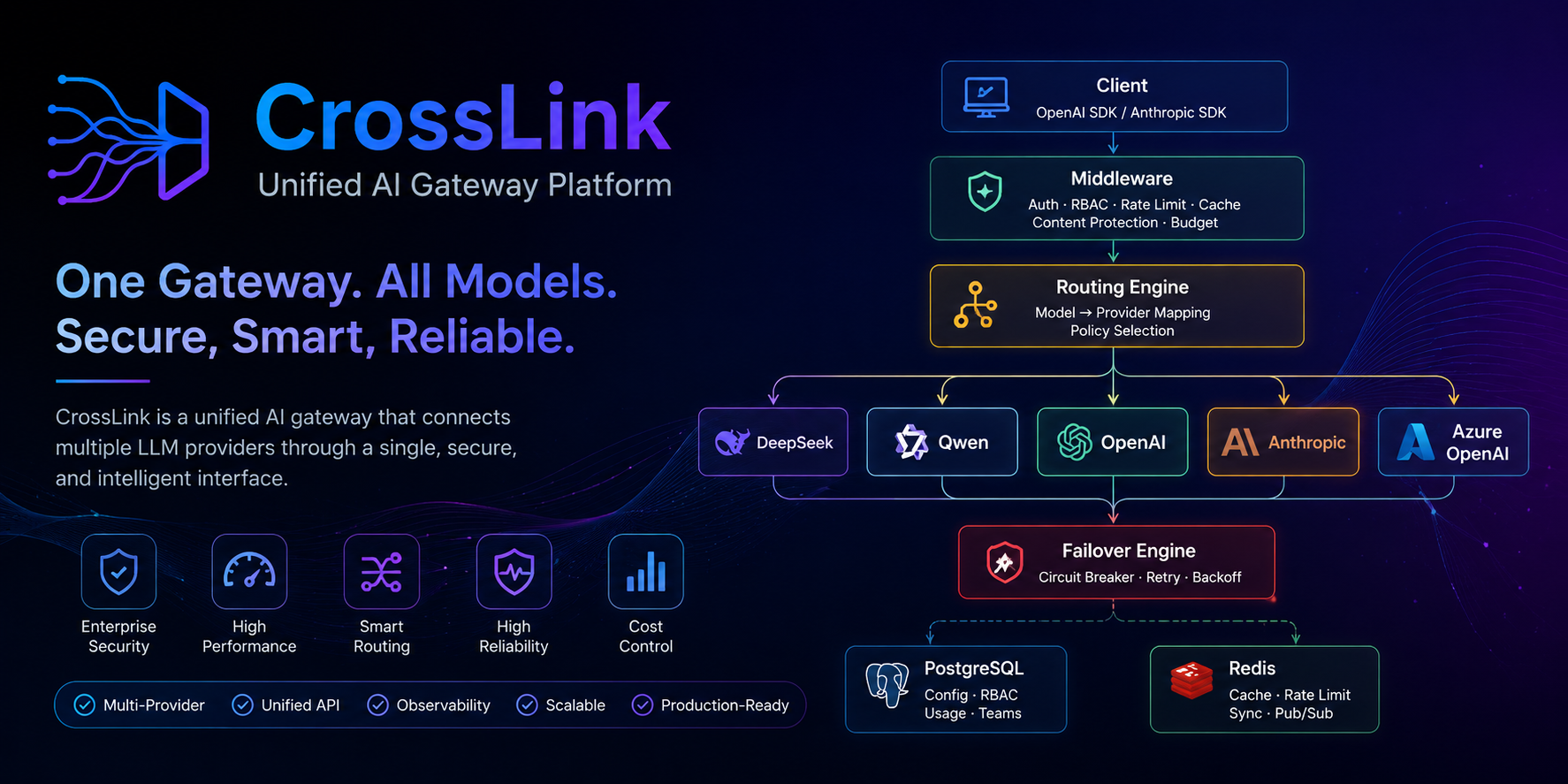







CrossLink
One Gateway. Every Model. Zero Lock-in.
OpenAI & Anthropic Compatible LLM API Gateway
A unified proxy with true bidirectional protocol translation, error-classified failover, an MCP gateway with per-tool RBAC, pluggable guardrails, and a built-in admin dashboard — for OpenAI, Anthropic, Azure, DeepSeek, Qwen, Ollama, and any OpenAI-compatible provider.
Get Started · Highlights · Features · Architecture · Docs · Contributing
Why CrossLink?
Every LLM provider has a different API format, auth mechanism, and feature set. Adapting your code for each one is tedious, error-prone, and locks you in.
CrossLink is a universal adapter between your application and any LLM provider:
- One endpoint — Your code talks to a single API in either OpenAI or Anthropic format
- Any provider — Requests are routed to OpenAI, Anthropic, Azure, DeepSeek, Qwen, Ollama, or any OpenAI-compatible service
- True bidirectional translation — Full streaming SSE conversion between OpenAI, Anthropic, and the OpenAI Responses API, including tool use and extended thinking
- Resilient by classification — Failover isn't blind retry. Errors are classified as persistent (quota/billing — one strike, long cooldown) or transient (rate limit — threshold-based), so retries go where they can actually succeed
- Observable routing — Every response carries
x-crosslink-fallback-*headers, and a routing-stats API shows configured-vs-actual traffic distribution so you can see drift
Highlights
What makes CrossLink different — each backed by code, not marketing.
- 🔁 Bidirectional streaming translation — OpenAI ↔ Anthropic ↔ Responses API, all three directions, via a real state machine (not request-level rewrites). Handles thinking blocks, partial-JSON tool args, and token counting mid-stream. → Architecture
- 🛡️ Error-classified failover — DB-backed rule table distinguishes persistent vs. transient failures; half-open single-flight probing prevents stampedes when a flaky provider returns. → Routing & Failover
- 🔌 MCP gateway with per-tool RBAC — Not a thin proxy. Transport abstraction, tool discovery with singleflight caching, encrypted credentials, and allow/deny lists scoped by key, team, or role. → MCP Gateway
- 🚧 Guardrails as a plugin registry — Plug in any engine (regex, external API, future
ML) via
RegisterEngine. Actions: block / log / mask. Per-model config, fail-open or fail-closed. → Architecture - 📊 Routing transparency —
x-crosslink-fallback-model/x-crosslink-fallback-countheaders on every response, plus a routing-distribution API showing configured-vs-actual weight, deviation, error rate, and latency per provider. - ❤️🩹 Self-healing dispatch counters — Per-(provider, model) concurrency/RPM limits via Redis Lua with a TTL heartbeat; a crashed process can't leave a provider stuck "busy".
- 🇨🇳 GM national crypto + air-gapped ready — SM2/SM3/SM4 mode (including HMAC-SM3 JWT signing) and a self-hosted slider CAPTCHA. No reCAPTCHA/hCaptcha dependency — deploys fully offline for 信创 compliance. → Deployment
- 🎁 Generous open core — The Community edition (Apache 2.0) ships 47 actions including MCP, RBAC, routing stats, error rules, guardrail CRUD (keyword / length / credential detection), the interactive playground, prompt templates, and scoped PATs. Pro adds secrets, guardrail alerts, debug replay, DataLens, and agent shielding; Enterprise adds multi-org, audit, and budget management.
Features
Core Gateway
- Dual Protocol —
/v1/chat/completions(OpenAI) and/v1/messages(Anthropic) with automatic bidirectional translation, streaming included - Multi-Provider — OpenAI, Anthropic, Azure OpenAI, DeepSeek, Qwen, Moonshot, Ollama, and any OpenAI-compatible provider
- Intelligent Routing — 6 strategies: weighted random, round-robin, least latency, least cost, least busy, and canary deployment
- Automatic Failover — Multi-provider fallback chains with circuit breakers, configurable retry policies (exponential/fixed/linear backoff), and error classification
- Response Caching — Redis-based caching with per-model TTL, gzip compression, and cache key isolation per user
- Video Generation —
POST /v1/videoswith status polling and content download, routed through the same fallback chain as chat - Prompt Templates — Curated template catalog managed at
/admin/api/templates; key holders discover them viaGET /v1/templates(metadata + ready-to-use curl examples)
Security & Control
- Rate Limiting — Per-key RPM/TPM limits with global concurrency control (2000)
- RBAC — Role-based access control for providers, models, API keys, and MCP
- Budget Enforcement — Per-key and per-team budget limits enforced at the gateway with automatic circuit breaking (budget management console: Enterprise)
- Guardrails — Built-in engines (keyword filter, content length, credential-leak
detection with an auto-seeded default rule) plus a pluggable
RegisterEngineregistry; block / log / mask actions, admin CRUD, per-model config - Scoped PATs — Personal access tokens for CI / machine access with read-only usage, budget, and health APIs
- SSRF Protection — Dialer- and redirect-level guards on outbound provider calls
- Crypto Flexibility — Standard (SHA-256/RSA/AES) or Chinese national cryptography (SM3/SM2/SM4)
Observability
- Usage Analytics — Token usage, cost tracking (including tiered image pricing and per-key price multipliers), latency metrics, cache hit rates, and fallback/retry counts per request
- Prometheus Metrics — Built-in metrics endpoint for monitoring
- OpenTelemetry — Distributed tracing support
- Structured Logging — JSON logging with request context
- Bundled OpenAPI Spec —
/openapi.jsonserved out of the box for Postman import and SDK codegen
MCP Gateway
- Model Context Protocol — HTTP/SSE transport, tool discovery with caching, health checks
- Permission Management — Per-principal tool access control (allow/deny by key, team, or role)
- Call Logging — Comprehensive tool call logging with monthly partitioning and auto-cleanup
Operations
- Vue 3 Admin Dashboard — Built-in web UI for providers, models, keys, usage, and MCP management (CrossLink-UI-Standard)
- Admin Playground — Test chat, streaming, image generation, TTS / transcription, video, and the Responses API from the dashboard, through the real fallback chain
- Zero-Cost Demo Mode — Optional mock provider + embedded demo key power a public
/demotry page with no upstream spend - Multi-Instance — Redis Pub/Sub for provider registry sync and distributed round-robin
- Graceful Shutdown — 5-phase drain: in-flight SSE streams → HTTP shutdown → worker flush → background goroutine cancellation → DB cleanup
- One-Command Deploy — Docker Compose spins up gateway, frontend, PostgreSQL, and Redis in one command
Architecture
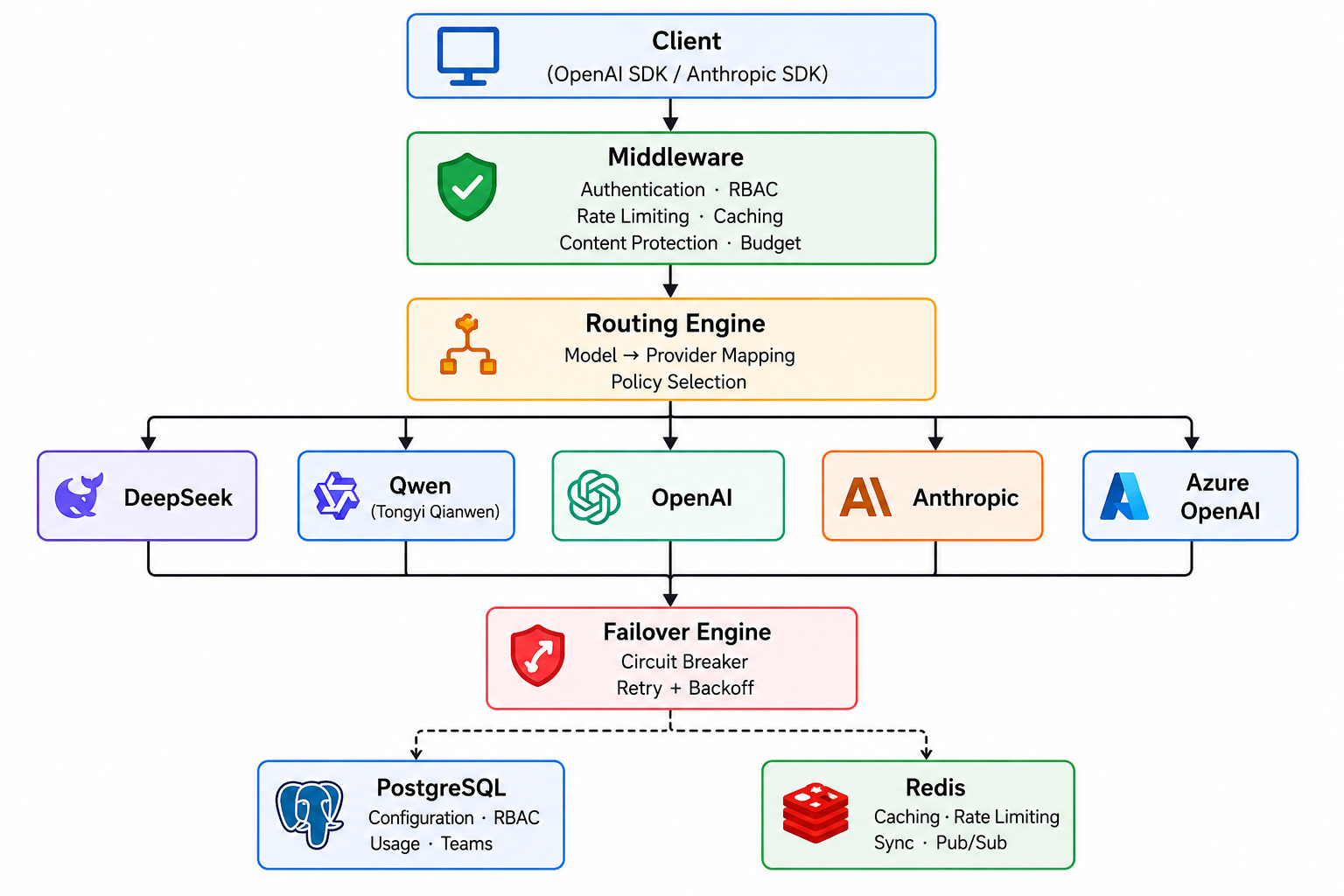
See Architecture for the request flow, the streaming translator state machine, the fallback engine's timeout budgeting, and the 5-phase graceful shutdown.
Dashboard Preview
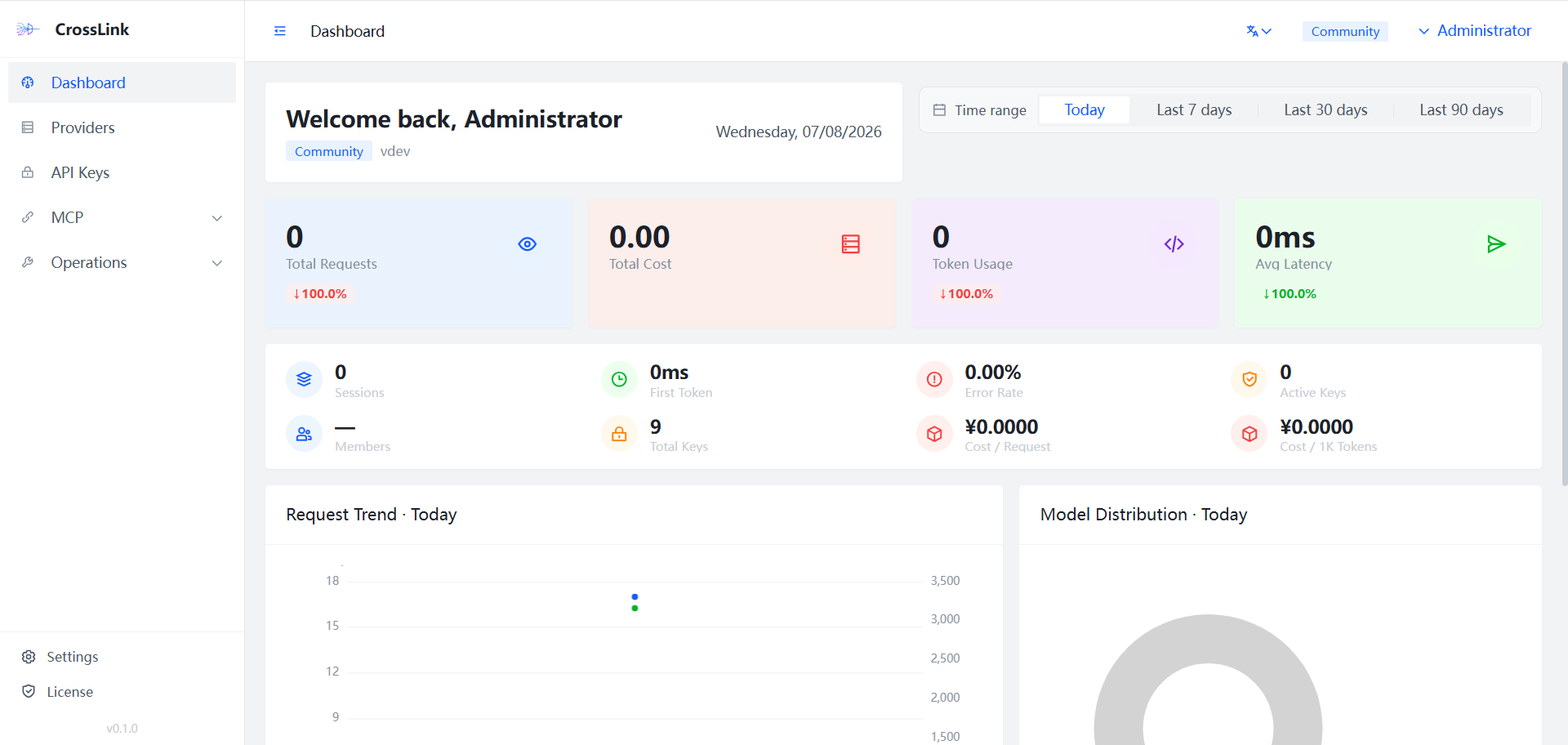
The admin dashboard: request volume, cost, token usage, latency, error rate, and model distribution at a glance.
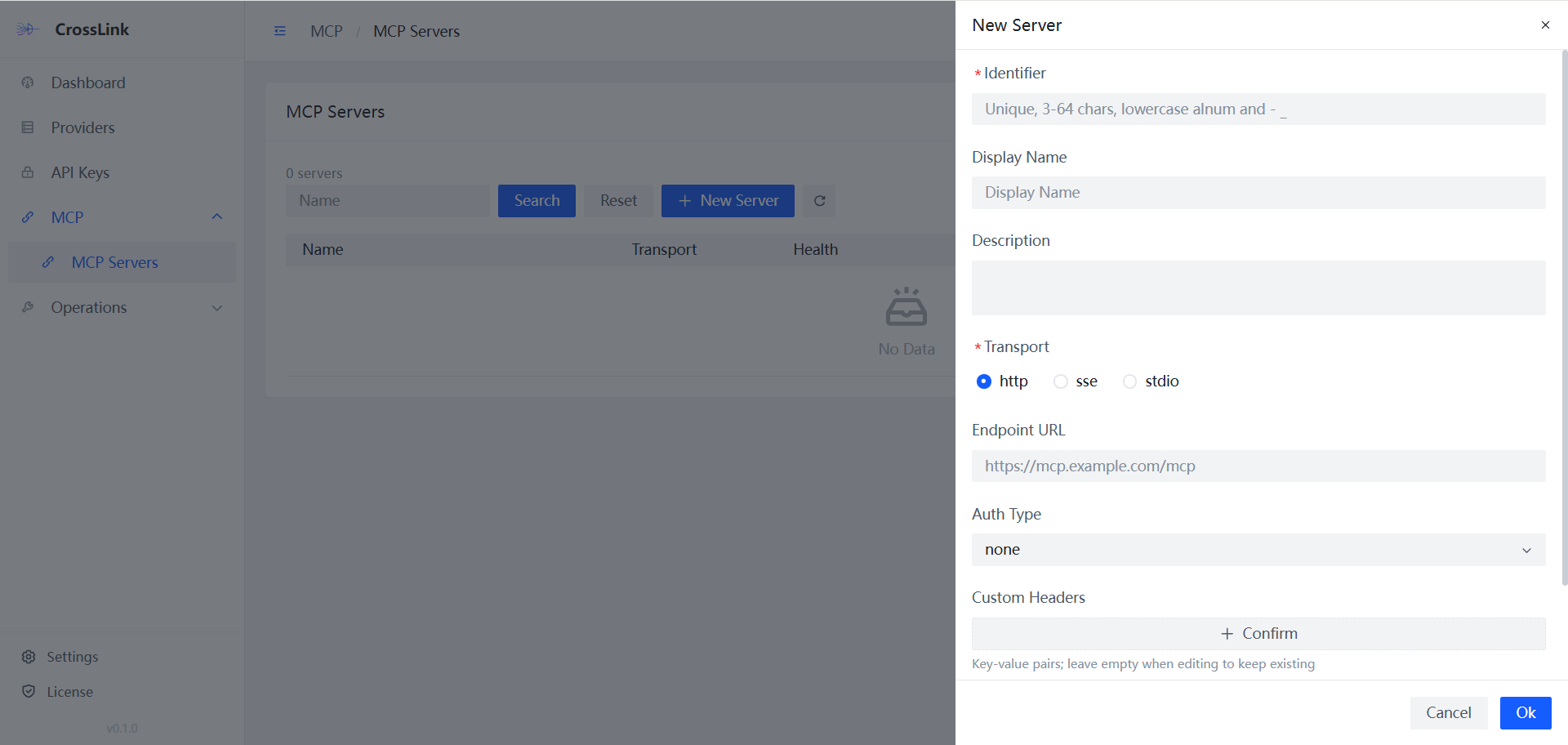
MCP server management: registry with transport types (HTTP/SSE/stdio), health status, and per-server configuration.
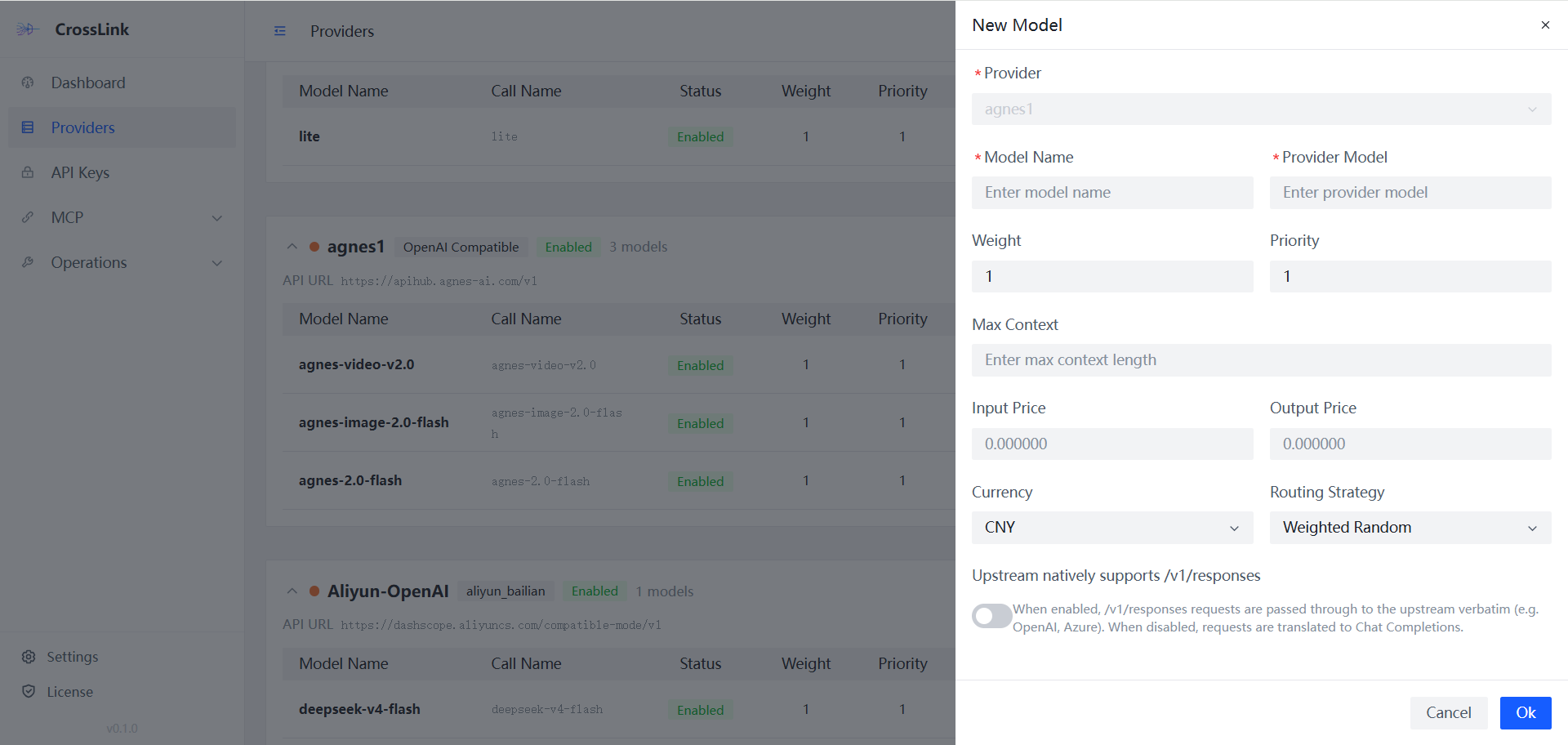
Provider & model configuration: weight, priority, pricing, and routing strategy per model.
Quick Start
Prerequisites
- Go 1.22+ (building from source)
- PostgreSQL 14+
- Redis 7+
Docker Compose (Recommended)
Frontend (CrossLink-UI-Standard) and backend are built together. One command starts everything:
git clone https://github.com/HotRiceNoodles/CrossLink.git
cd CrossLink
docker compose -f deployments/docker-compose.dev.yaml up --build
Frontend dashboard and API gateway are available at http://localhost (port 80).
China network? Use
docker compose -f deployments/docker-compose.cn.yaml up --buildwith Go and npm mirrors pre-configured.
Build from Source
git clone https://github.com/HotRiceNoodles/CrossLink.git
cd CrossLink
cp configs/config.example.yaml configs/config.yaml
# Edit config.yaml with your database and Redis settings
make build
./bin/crosslink
Make Your First Request
Create an API key via the admin dashboard (http://localhost:8080), then try it in 30 seconds:
curl http://localhost:8080/v1/chat/completions \
  -H "Authorization: Bearer cl-your-api-key" \
  -H "Content-Type: application/json" \
  -d '{
    "model": "deepseek-chat",
    "messages": [{"role": "user", "content": "Hello!"}]
  }'
No provider key yet? Enable zero-cost demo mode (
demo.enabled: trueinconfig.yaml) — a mock provider plus an embedded demo key power a public/demotry page, so you can exercise the gateway without any upstream account.
OpenAI SDK (Python)
from openai import OpenAI

client = OpenAI(
    base_url="http://localhost:8080/v1",
    api_key="cl-your-api-key"
)

response = client.chat.completions.create(
    model="deepseek-chat",
    messages=[{"role": "user", "content": "Hello!"}]
)
print(response.choices[0].message.content)
Anthropic SDK (Python)
import anthropic

client = anthropic.Anthropic(
    base_url="http://localhost:8080",
    api_key="cl-your-api-key"
)

message = client.messages.create(
    model="claude-sonnet-4-20250514",
    max_tokens=1024,
    messages=[{"role": "user", "content": "Hello!"}]
)
print(message.content[0].text)
Configuration
All configuration lives in configs/config.yaml. Every value can be overridden with
environment variables using the CL_ prefix (e.g., CL_DATABASE_HOST, CL_REDIS_PORT).
server:
  port: 8080
  read_timeout: 30s
  write_timeout: 120s

database:
  host: localhost
  port: 5432
  user: crosslink
  password: crosslink
  dbname: crosslink
  sslmode: disable

redis:
  host: localhost
  port: 6379

gateway:
  auth_key: "cl-change-me"

admin:
  username: admin
  password: changeme
  jwt_secret: "change-me-to-a-random-secret"

cache:
  enabled: true
  default_ttl: 5m

mcp:
  enabled: true
  health_check_interval: 30s

crypto:
  mode: standard    # standard (SHA-256/RSA/AES) or gm (SM3/SM2/SM4)
Provider Seeding
Providers are seeded from configs/providers.yaml on first run:
providers:
  - name: deepseek
    adapter_type: openai_compatible
    base_url: https://api.deepseek.com/v1
    api_key: ${DEEPSEEK_API_KEY}
    models:
      - name: deepseek-chat
        provider_model: deepseek-chat
API Endpoints
Gateway (API Key Required)
| Method | Path | Description |
|---|---|---|
POST | /v1/chat/completions | OpenAI-compatible chat (stream & non-stream) |
POST | /v1/messages | Anthropic-compatible messages (stream & non-stream) |
GET | /v1/models | List available models |
POST | /v1/videos | Video generation (poll via GET /v1/videos/:id, fetch via /:id/content) |
GET | /v1/usage | Self-service quota & usage for key holders |
GET | /v1/templates | Prompt-template catalog (metadata + curl examples) |
GET | /openapi.json | Bundled OpenAPI spec — import into Postman or generate an SDK |
MCP Gateway
| Method | Path | Description |
|---|---|---|
POST | /mcp/:server | MCP JSON-RPC forwarding |
GET | /mcp/:server | MCP SSE transport |
Admin (JWT Required)
| Method | Path | Description |
|---|---|---|
POST | /admin/api/auth/login | Login |
CRUD | /admin/api/providers | Provider management (test via POST /:id/test) |
CRUD | /admin/api/models | Model mapping management |
CRUD | /admin/api/keys | API key management (regenerate via POST /:id/regenerate) |
GET | /admin/api/usage | Usage logs with multi-dimensional filtering |
GET | /admin/api/usage/stats | Usage stats (incl. image metrics) + reconciliation export |
GET | /admin/api/routing/stats | Routing distribution: configured vs. actual per provider |
CRUD | /admin/api/error-rules | Error-classification rules for failover |
CRUD | /admin/api/guardrails | Guardrail rules (test via POST /:id/test, plus /stats, /config) |
CRUD | /admin/api/templates | Prompt templates (preview via POST /:id/preview) |
CRUD | /admin/api/pats | Personal access tokens |
POST | /admin/api/playground/* | Playground: chat, stream, image, tts, transcribe, translate, video, responses |
GET/PUT | /admin/api/system/content-log | Hot-toggle request/response body logging |
CRUD | /admin/api/mcp/servers | MCP server management |
GET | /admin/api/mcp/servers/:id/tools | List tools on MCP server |
Tables list the highlights, not everything. The gateway serves a bundled, importable
OpenAPI spec at /openapi.json, and the full API reference — including
request/response shapes, error codes, and the x-crosslink-fallback-* response headers —
is in docs/api-reference.md.
Deployment
Production Docker Compose
docker compose -f deployments/docker-compose.prod.yaml up -d --buildChina Network
Use the CN variant with Go proxy (goproxy.cn) and npm mirror (registry.npmmirror.com):
docker compose -f deployments/docker-compose.cn.yaml up --buildNginx · Caddy · Systemd · GM
Production-ready Nginx config (TLS, security headers, SSE streaming) at
deployments/nginx/, a Caddyfile for automatic HTTPS, a systemd unit, and a dedicated
GM (SM2/SM3/SM4) deployment with GmSSL/Nginx + TLCP at deployments/gm/.
→ See Deployment for all options and multi-instance scaling notes.
Documentation
- Architecture — request flow, translator state machine, fallback engine
- Routing & Failover — strategies, circuit breaker, error classification
- MCP Gateway — transport, per-tool RBAC, encrypted credentials
- API Reference — full endpoint reference
- Deployment — all deployment variants
Roadmap
CrossLink is under active development. Current focus:
- Provider guardrails with health-aware routing
- Routing-distribution observability (
/admin/api/routing/stats) - Self-healing concurrency counters (TTL heartbeat)
- OpenAI Responses API translation (stream + non-stream) — engine + playground in
Community; the public
/v1/responsesroute ships with commercial editions - Self-hosted slider CAPTCHA (air-gapped ready)
- Community guardrail engines (keyword / length / credential detection) with admin CRUD
- Built-in admin playground (chat, image, audio, video, Responses)
- Zero-cost demo mode (mock provider + public
/demopage) - Bundled OpenAPI spec at
/openapi.json - Provider guard alert rules (Enterprise) — in progress
- Expanded guardrail engine ecosystem (ML-based classifiers)
- Multi-team budgets and audit (Enterprise)
Have a request? Open a Discussion or a feature request.
Community & Support
- 💬 Questions & ideas — GitHub Discussions
- 🐛 Bug reports — open an issue (use the bug-report template)
- 🔒 Security reports — see SECURITY.md for private disclosure
- ⭐ Like the project? Give it a star — it helps others find CrossLink.
Contributing
We welcome contributions of all sizes — bug fixes, features, docs, or ideas.
- Fork the repository
- Create a feature branch (
git checkout -b feature/my-feature) - Commit your changes (
git commit -m 'Add some feature') - Push to the branch (
git push origin feature/my-feature) - Open a Pull Request
See CONTRIBUTING.md for detailed guidelines.
Development
make build          # Build binary (bin/crosslink)
make run            # Run the server
make test           # Run all tests
make lint           # Run golangci-lint
make clean          # Remove build artifacts
Security
See SECURITY.md for our security policy and vulnerability reporting instructions.