
Alethe
The multi-agent coding workspace.
Run Claude Code, Codex, Copilot and your shells side by side — in one local-first desktop app.






Download · Report Bug · Request Feature · Security · Privacy · Contribute
[!IMPORTANT] Alethe is an early public release. The desktop app is free, open source, and local-first, not local-only: update checks and provider usage polling are on by default, while other network features are optional or action-triggered. Manual GitHub Gist Sync is already available; first-party hosted sync or cloud backup may be offered separately later. See the privacy and data-flow guide.
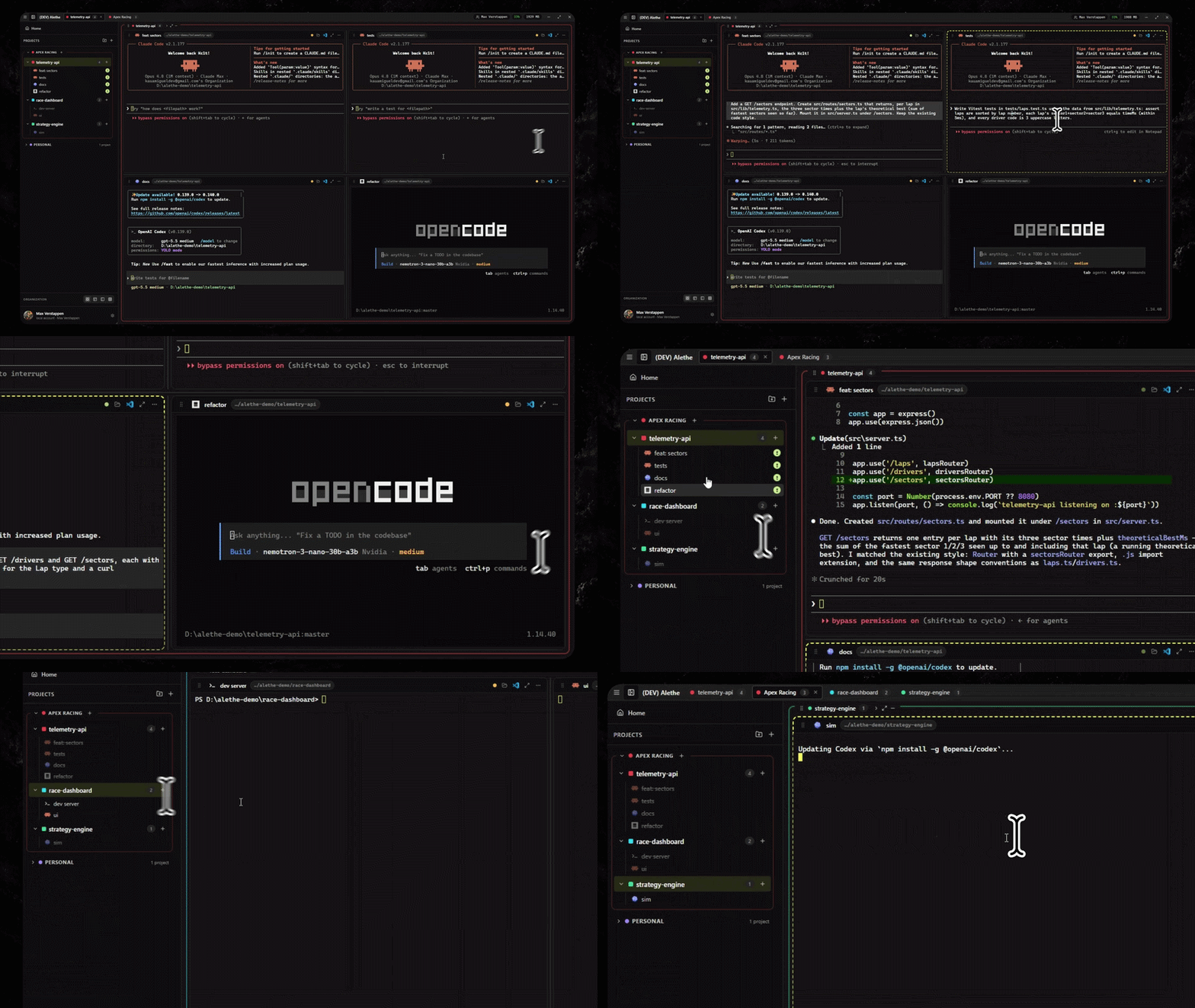
What Alethe Is
One agent in one terminal is easy. Five agents across three repositories is the actual job — and that is where terminal tabs stop working: sessions get lost, MCP servers drift out of sync between agents, and nobody knows which agent is doing what, where.
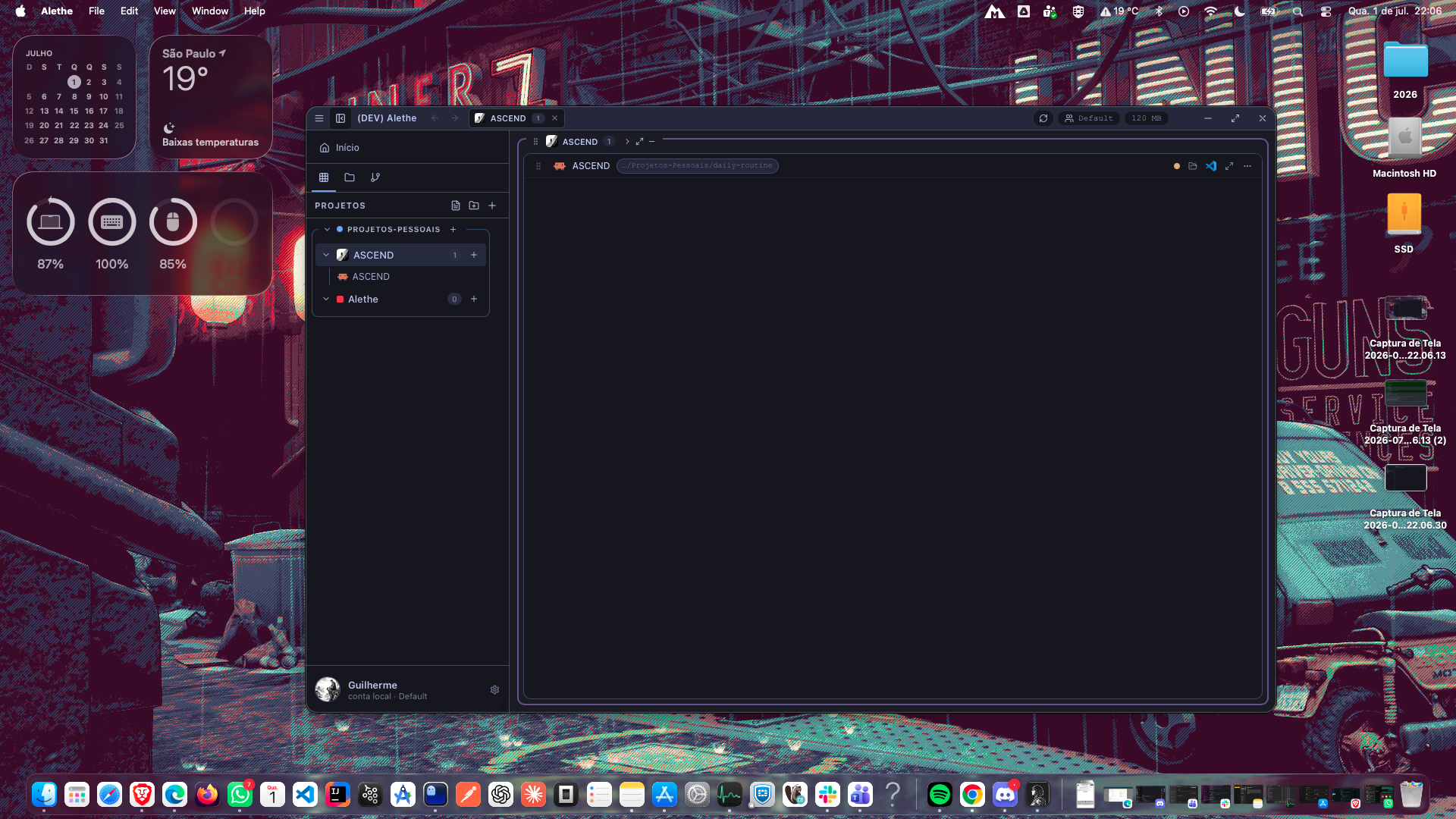
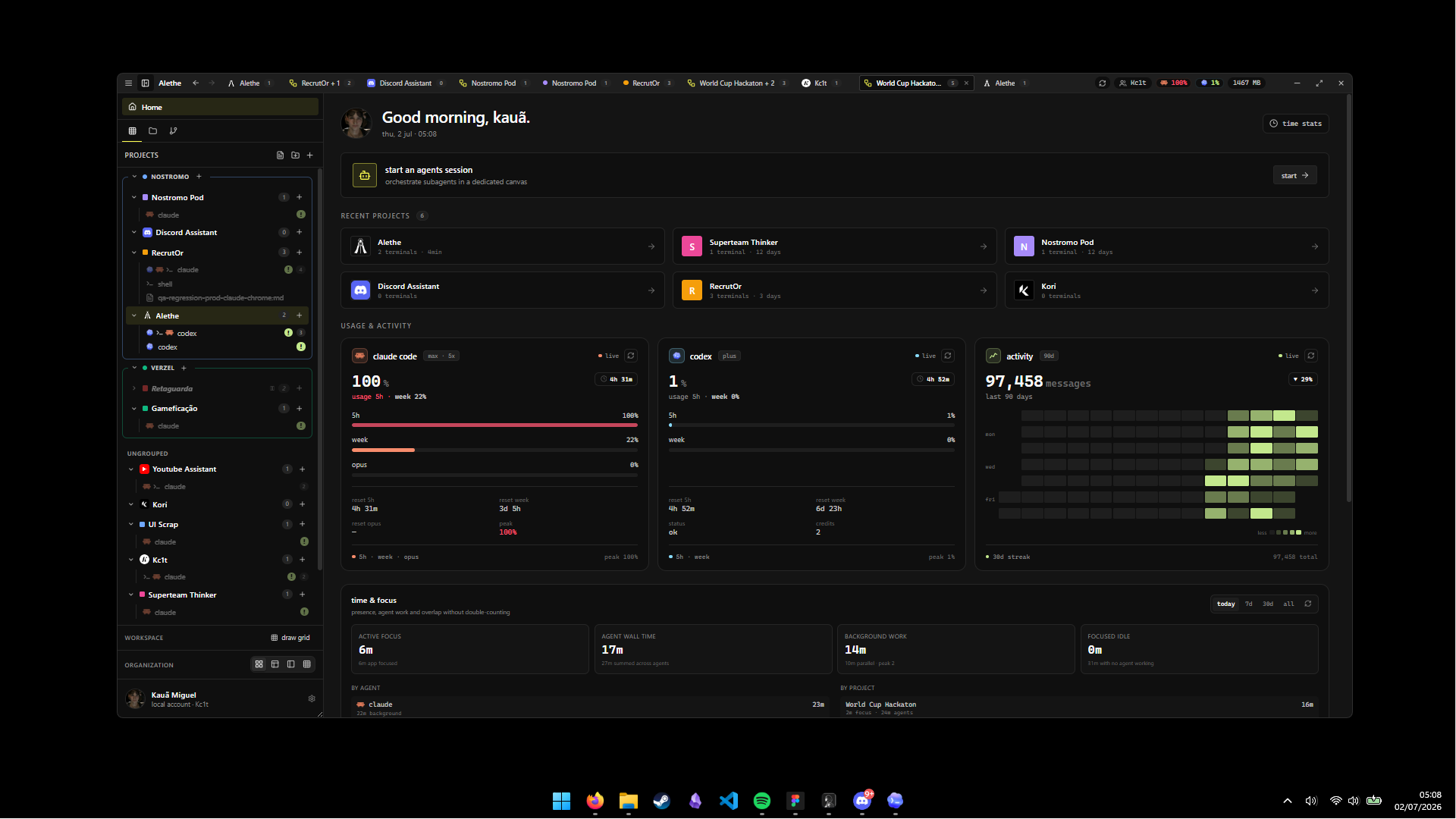
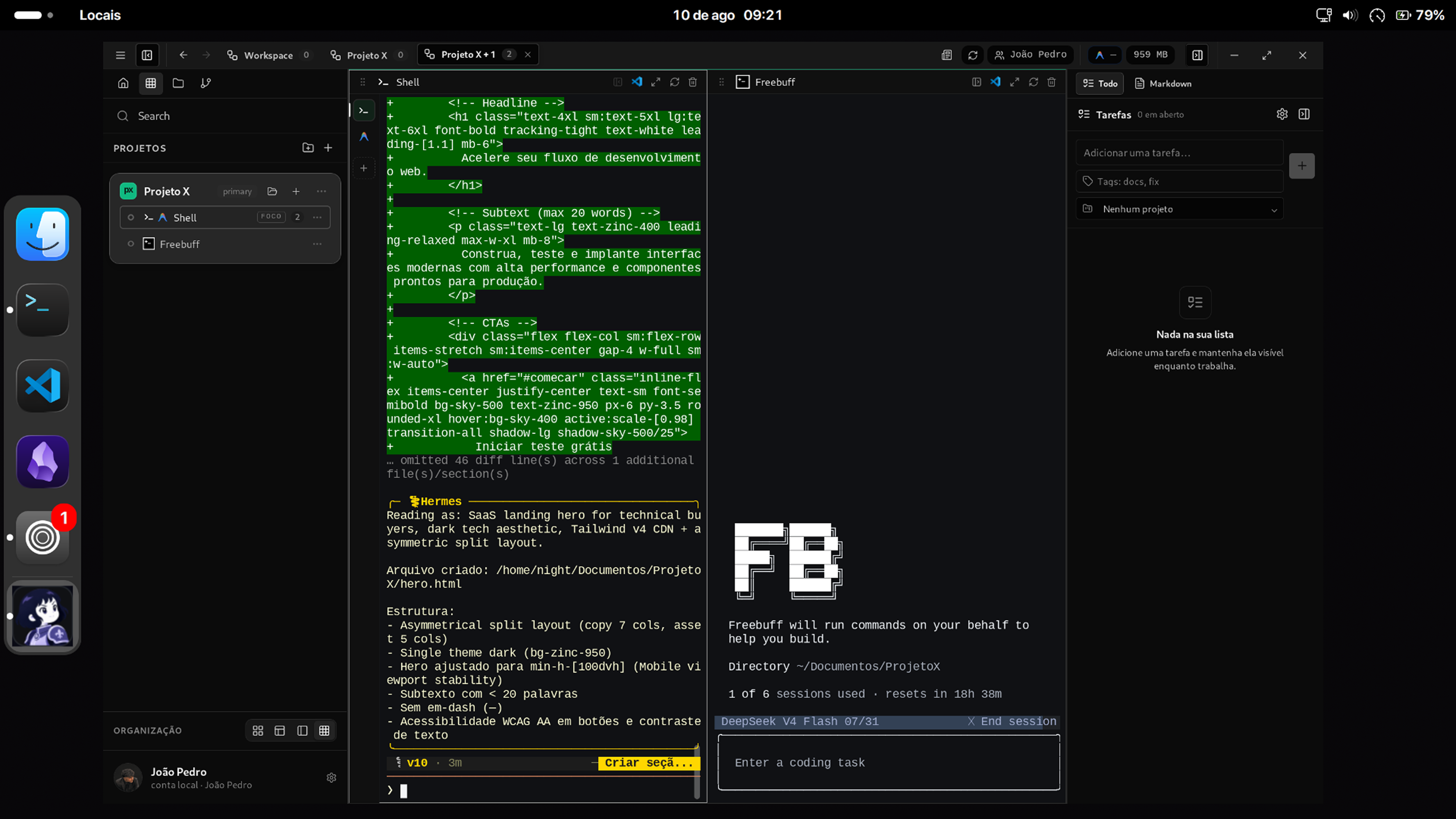
Alethe is a desktop workspace built for that. Every agent runs in a real PTY inside a persistent project layout, keeps its own session and history, and stays alive when you rearrange the UI. On top of that, Alethe manages the things agents share: their CLIs, their MCP servers, their skills, and the conversations you move between them.
Cross-platform (Windows, macOS, Linux), local-first, built with Tauri, Rust, React, and xterm.js.
“Local-first” describes workspace persistence, not an internet-free guarantee; see
docs/PRIVACY.md for current network defaults, credentials, and retention.
Supported Platforms
| macOS | Windows | Linux |
|---|---|---|
|
|
|
| Available on macOS | Available on Windows | Available on Linux |
Agents
| Agent | CLI | |
|---|---|---|
| Claude Code | claude | Session resume, usage cards, local history |
| Codex | codex | Session resume, usage cards |
| GitHub Copilot CLI | copilot | |
| Cursor | cursor-agent | Session resume |
| Antigravity | agy | Usage cards |
| OpenCode | opencode | Session resume |
| Kiro CLI | kiro-cli | |
| Mimo | mimo | |
| Freebuff | freebuff | |
| Shell | pwsh / bash / zsh | The plain terminal, same pane model |
| WSL | wsl.exe | The default distro, as a plain shell (Windows) |
Missing CLIs can be installed, updated, and uninstalled from inside Alethe — it probes the machine for Node, npm, WinGet, Scoop, and Chocolatey and offers only the methods that actually work there, preferring each vendor's official installer. Already-installed CLIs are discovered across PATH, registry, npm/pnpm/Volta/fnm/nvm/Bun/Cargo/Scoop/Chocolatey, and can be pointed at a custom path. A plugin can add an agent of its own to this list.
Agents can optionally be routed through 9router, a local proxy that spreads traffic across providers with automatic fallback. Alethe installs and runs a private, version-pinned copy without touching your global npm packages. Routing is off by default and applies only to terminals opened after it is switched on.
What It Does
Run agents in parallel
- Projects, groups, and subgroups organize repositories; each open project becomes a container with its own panes.
- One agent per pane, or several agents as sub-tabs inside the same pane — each with its own PTY, working directory, and session.
- Auto, spotlight, sidebar, and custom grid layouts, editable directly on the grid.
- Closing a container hides it; the process keeps running.
Keep the context
- Sessions of Claude Code, Codex, Cursor, and OpenCode resume after a crash or a restart.
- Recent chats lists the conversations of a pane's working directory and reopens any of them.
- A Claude Code conversation can be handed off to Codex (and back) through a locally redacted context packet — no copy-pasting the thread by hand. Redaction is best effort, so review the packet before starting the target agent.
- Scrollback is persisted per PTY, so reattaching shows what happened before.
Manage what the agents share
- MCP tab: every MCP server configured on the machine, grouped by server and showing which agents have it — read from Claude Code, Codex, Cursor, OpenCode, and Antigravity configs. Add, remove, copy a server from one agent to another, search the official registry, and ask each agent to verify it can really reach a server. Every write is backed up, re-parsed, and committed atomically.
- Skills tab: the skills installed for each agent, with links and shared stores resolved so a shared skill shows up once.
- Graphify: a code graph of the project, served to the agents as an MCP server.
Extend it with plugins
- Features load as plugins, not hard-wired code. Official ones — Todo List, Git Control, Theme Pack — ship inside the installer and can be switched off in Preferences ▸ Plugins, with their surfaces appearing and disappearing without a restart.
- A plugin can contribute a workspace pane, a sidebar tab, a command palette entry, a full theme, or a new agent provider. It declares what it needs in its manifest, and the app refuses anything it did not ask for.
- Plugin catalogue: plugins published by other people are listed inside Alethe with their permissions spelled out, and a listing that ships a package installs — and updates — in one click. The index pins every package to a SHA-256 checksum, so what runs is what the listing was reviewed against. An installed plugin arrives switched off and goes through a trust dialog before it runs.
Publishing a plugin
A plugin is a folder whose name matches the id in its plugin.json, next to a main.js bundle
that binds against window.alethe (React included — never bundle your own). The manifest declares
the tabs, commands and capabilities; the code implements them.
- Try it locally. Drop the folder into
<profile>/plugins/<id>/, or use Preferences ▸ Plugins ▸ Import plugin. It arrives switched off — enabling it goes through the trust dialog. - Ship a zip. Zip the plugin folder, take its SHA-256, and attach it to a release:
zip -r my-plugin.zip my-plugin && sha256sum my-plugin.zip. - Get it listed. Open a pull request against this repository adding one entry to
plugins.jsonwithid,name,downloadUrland — to make it installable from inside Alethe —package.urlandpackage.sha256. Re-hash whenever the zip changes. - Once merged, the listing reaches everyone within six hours, or immediately on Refresh.
Listing is a human reading your pull request, not an audit: the plugin still arrives disabled and
still goes through the trust dialog. docs/examples/notes-plugin/ is a working plugin in plain
JavaScript with no build step; the plugin guide has the full contract.
Stay in control
- RAM readout in the title bar; disable a terminal or suspend a whole group to get memory back.
- Git panel per project — status, stage, commit, branches, diffs in a pane — plus worktrees for parallel tasks.
- Pull Request review: the merge panel finds the open GitHub PR for an agent worktree through the
local
ghCLI, opens its metadata, and can start an AI review inside the same isolated worktree — read-only, with no commits, pushes, merges, or GitHub comments. Squash-merging stays an explicit human action, blocked when the head SHA moved, the PR is a draft, or GitHub reports conflicts. No GitHub token is stored; authentication is delegated togh. - Content panes beside the terminals: file explorer, Markdown, diffs, images, video, embedded browser.
- Todos per project with a Pomodoro timer, isolated profiles, local backup export/import, UI and terminal themes, EN and pt-BR.
- Orchestration board: a lead agent delegates units of work to Claude and Codex workers that Alethe runs in parallel — each optionally in its own git worktree, each reporting status, cost, tokens and diff on its card, and each able to ask you before it leaves its sandbox. Off by default.
- Local voice dictation with an on-device model, and cloud sync of your preferences through a GitHub sign-in — both optional.
- Remote Control: an authenticated LAN web view, paired by QR code, to follow and answer agents from your phone. It is off by default and uses unencrypted HTTP/WebSocket transport on the LAN, so enable it only on a trusted network. Clean profiles are read-only; answering agents requires a separate input opt-in, and shell input has its own additional opt-in.
- Spotify Now Playing, using your own Spotify app credentials in Preferences ▸ Spotify with
http://127.0.0.1:8888/callbackas the redirect URI. Current releases store those credentials in local profile files; see the privacy guide before exporting or sharing profile data.
Core Concepts
| Group | A collection of projects that opens, collapses, and suspends together. |
| Project | A saved working context: terminals, layout, color, local state. |
| Container | The visible frame of an opened project. Closing it does not kill anything. |
| Pane | A terminal view inside a container. |
| Sub-tab | A separate agent or shell session inside the same pane. |
| PTY | The real backend process, alive independently of the UI. |
Product Philosophy
A focused core with optional capabilities, closer to Obsidian than to a maximalist IDE. Non-essential features ship behind feature flags or opt-in settings, and a clean installation stays a first-class experience. Coherence over volume.
Install
Use the published installers from Releases.
[!WARNING] Windows builds are not code-signed yet, so Defender may flag
alethe.exeasTrojan:Win32/Bearfoos.A!mland quarantine it. The!mlsuffix denotes a machine-learning heuristic rather than a publisher signature, and terminal-multiplexer behavior such as spawning child processes and creating PTYs can produce false positives. Verify that the download came from the official Releases page; do not bypass a warning for an artifact from another source.
To recover it: Windows Security → Virus & threat protection → Protection history → Actions →
Restore, then add an exclusion for %LOCALAPPDATA%\Alethe (and src-tauri/target if you build
from source). Reports of incorrect detection go to
Microsoft Security Intelligence. macOS builds are
not notarized yet either — right-click the app and choose Open to bypass Gatekeeper. Signing and
notarization are on the roadmap.
Run From Source
git clone https://github.com/Kc1t/alethe-agents.git
cd alethe-agents
npm install
npm run app
Requirements: Node.js 18+, Rust stable, Visual Studio Build Tools on Windows, Tauri system dependencies on Linux:
sudo apt install -y libwebkit2gtk-4.1-dev libappindicator3-dev librsvg2-dev patchelfnpm run app # desktop app with hot reload
npm run dev # frontend only
npm run build # typecheck + build frontend
npm run tauri build # installers → src-tauri/target/release/bundle/Terminal Command
Install the alethe command from Settings ▸ Integrations ▸ Terminal command:
alethe                # opens the current folder as a project
alethe ~/some/project # opens the given folder
If the folder is already a project, it is brought into the workspace instead of duplicated. If Alethe
is already running, the existing window is focused. The command lands in ~/.local/bin/alethe
(macOS/Linux) or %LOCALAPPDATA%\Alethe\bin\alethe.cmd (Windows) — reinstall it after moving the app.
Roadmap
- Multi-agent workspace with projects, groups, containers, and sub-tabs.
- Real PTYs with spawn, attach, resize, scrollback, and session resume.
- Agent install/update/uninstall, MCP and skills management.
- Releases for Windows, Linux, and macOS.
- Windows release signing and macOS notarization.
- Broader Linux/macOS validation on real machines.
- First-party hosted cloud sync/backup (manual GitHub Gist Sync is already available).
Contributing
Contributions are welcome. Read CONTRIBUTING.md for setup, project layout, and
house rules. The easiest ways to help:
- Pick an issue labeled
good first issueorhelp wanted— comment to claim it. - Report a bug with clear reproduction steps, or request a feature with the workflow it improves.
- Improve docs, screenshots, and platform validation — Linux and macOS are the least tested.
For larger changes, open an issue first so the direction can be discussed.
Built with Alethe
Projects and products built with Alethe as the workspace — agents running in parallel, shells alongside them, sessions resumed across days.
Nothing here yet. Built something with Alethe? Add it to SHOWCASE.md — it's one line and a pull request, and you end up in the contributors list too.
See SHOWCASE.md for the full list and how to submit.
Watch Alethe in Action
See Alethe in real development workflows and learn how to orchestrate coding agents in parallel.
| Video | What you will see |
|---|---|

|
Stop Using One AI Agent at a Time: Orchestrate AI Agents
A practical introduction to coordinating multiple AI coding agents instead of working with only one at a time. Kauã Miguel - Dev · Portuguese |

|
A Day in the Life of a Software Developer — Devlog 1
A real-world developer workflow showing Alethe as part of the day-to-day coding process. Guilherme Dev · Portuguese |
Also On Mobile
https://github.com/user-attachments/assets/ae3aed75-2ead-43c4-a9ca-fd29d83b7e1d
Contributors
Thanks to everyone helping shape Alethe.


License
The source code is distributed under AGPL-3.0-or-later. Modifications and covered derivative
works that are distributed, or made available to users over a network, must provide their
corresponding source under the same license. See LICENSE and NOTICE.
Official hosted services, such as sync, backup, billing, or cloud features, may be proprietary and
offered separately. The code license does not grant rights to the Alethe name, logo, application
icon, or official branding. Modified builds must be independently branded, and commercial use of
the Alethe brand requires prior written permission from Kauã Miguel. See
TRADEMARK.md.
Community
- Security reports:
SECURITY.md - Privacy and data flows:
docs/PRIVACY.md - Maintainer: Kc1t
- Project: https://github.com/Kc1t/alethe-agents
- Bugs and feature requests: https://github.com/Kc1t/alethe-agents/issues