Prop Firm Sim is a LuxAlgo open-source project. Official repository: github.com/LuxAlgo/prop-firm-sim


Quickstart · Why your odds are worse · Your real trades · Packages · Rules data · Method
Prop Firm Sim tells you your odds before you pay for a prop-firm challenge. Give it your trading statistics, or your actual trade history, and it plays ten thousand complete challenge journeys through the firm's exact ruleset. Out come the numbers that matter: pass probability per phase and joint, with confidence intervals. Expected attempts, total cost, and expected value with every fee priced in. Time to funding, stagnation, and the probability a funded account ever collects a payout.
The engine is pure, deterministic TypeScript: everything runs locally, and the same seed reproduces the same numbers byte for byte. Firm rules come live from LuxAlgo's public prop-firm directory (keyless, read-only), and any ruleset can be passed inline, fully offline.
Thirty seconds to your odds
npx @luxalgo/prop-firm-sim-cli simulate \
  --firm ftmo --challenge 100k-2step \
  --winrate 0.48 --avg-win 1.6 --avg-loss 1 \
  --risk 1% --trades-per-day 4
FTMO · FTMO Challenge 100K (2-step)
ftmo/100k-2step · cfd · account 100,000 USD · fee 540 USD one-time
Data: live LuxAlgo directory · provenance directory, every simulated rule read from a structured
directory column
Trader: win rate 48.0% · avg win 1.6R · avg loss 1R · 4 trades/day · risk 1% of balance per trade
Run: 10,000 paths · seed 42 · attempt cap 25 · engine 1.0.0
Pass probability per attempt 93.2% (95% CI 92.7–93.7%)
Step 1 · target +10% 96.5% (95% CI 96.2–96.9%) · fails: max-loss 3.5%
Step 2 · target +5% 96.6% (95% CI 96.2–96.9%) · fails: max-loss 3.4%
Avg days per attempt 16.5 when passed · 16 when failed
Funded within 25 attempts 100.0% (95% CI 100.0–100.0%)
Attempts until funded mean 1.1 · p50 1 · p90 1
Total cost mean 39.26 USD · p50 0 USD · p90 0 USD · p95 540 USD
Cost when funded mean 39.26 USD · p50 0 USD · p90 0 USD
Days to funded (trading days) p50 15 · p75 22 · p90 31
Stagnation (days without a new equity high) p50 4 · p90 12
EV · challenge journey + funded horizon of 90 trading days
EV total +66,755 USD ± 589 USD (95% CI)
P(EV > 0) 96.2%
Payout if funded mean 66,794 USD · p50 71,011 USD · avg 6.8 payout events
Payout probability | funded 96.2%
Days to 1st payout p50 10 · p90 10
Funded accounts blown 26.0% within the horizon
Max drawdown while evaluating p50 5.9% · p95 12.5% of initial balance
Not simulated / assumptions:
• trades-resolve-same-day: All trades are modeled as same-day round trips; overnight and weekend
holding are not simulated.
• intra-trade-excursions-not-modeled: Equity is observed at each trade close; favorable/adverse
excursions inside a trade are not modeled, which slightly understates trailing-drawdown and
open-PnL breach risk (real odds are somewhat worse).
...five more flags follow: every run prints the full assumptions list and the disclaimer.That trader is good. Profit factor near 1.5, and the static max loss still kills 3.5% of step-one attempts, while 26% of the funded accounts blow up within 90 trading days. Drop the win rate three points (the built-in sensitivity panel shows exactly this) and the picture darkens fast.
Prefer a browser? The same run in the hosted simulator:
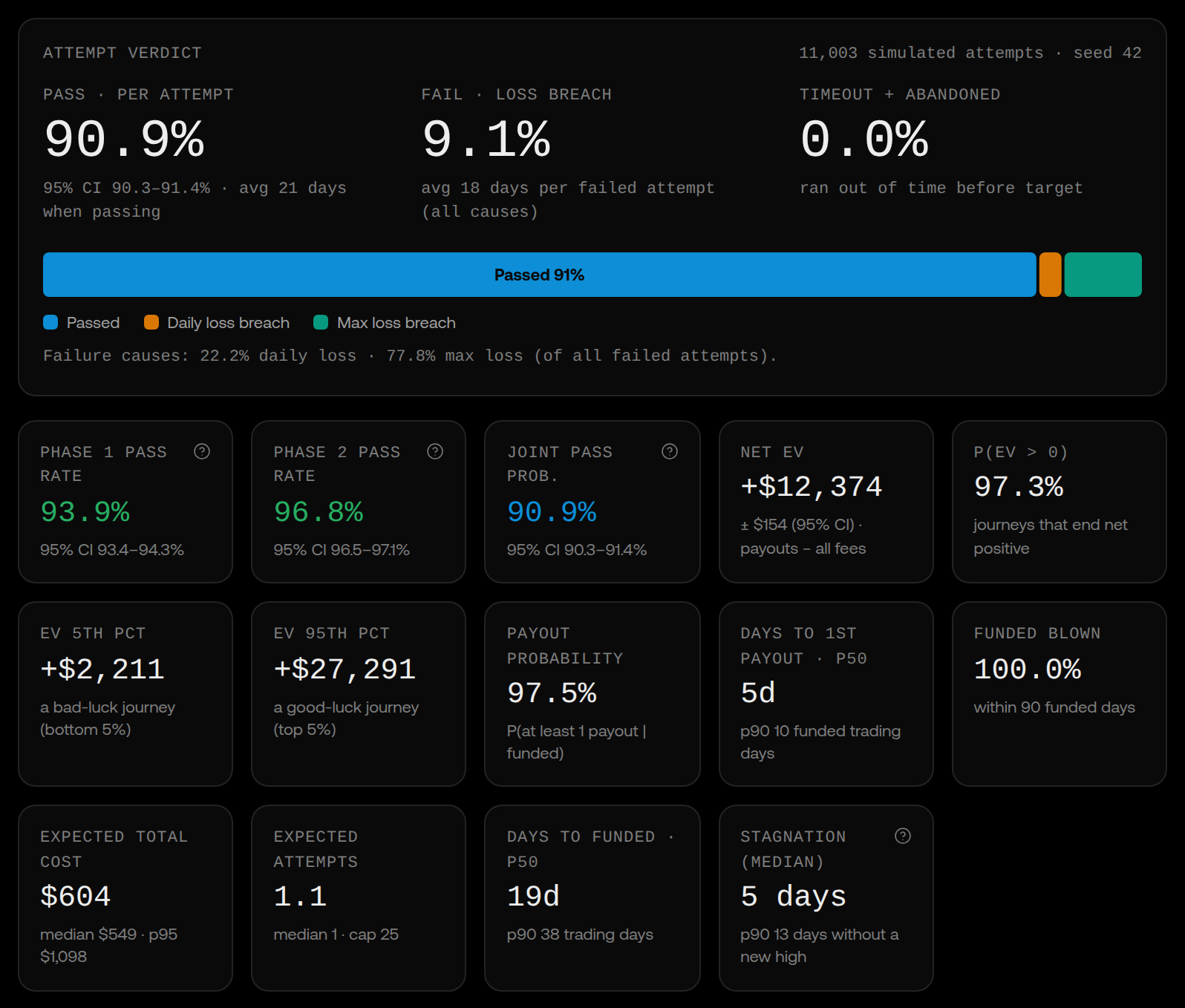
The hosted simulator after one run: verdict, per phase and joint pass rates, EV with fees priced in, and the stagnation tile. Everything runs client side; nothing you enter leaves your browser.
Why your odds are worse than you think
Every prop-firm calculator you have seen multiplies a win rate into a binomial formula. That number is wrong, and wrong in the house's favor, because the odds do not live in the profit target. They live in the exact mechanics of the loss rules.
-
"Trailing drawdown" is four different rules. A max loss that is static from the initial balance, one that trails end-of-day highs, one that trails peak unrealized equity intraday, and one that trails then locks at breakeven are wildly different odds wearing the same headline number. The intraday variant, standard on futures evaluations, routinely cuts pass probability by a third versus the static rule at the same limit. The semantics, with pen-and-paper examples.
-
A "5% daily loss" is four choices multiplied together. Five percent of what, anchored to which day-start number, counting open P&L or not, checked live or only at the close. Same headline, different survivors. Every switch is explicit in the spec schema.
-
Your trades come in streaks; the naive math assumes they do not. Streaks are exactly what breach daily-loss and trailing rules. Paste your real R-multiples and the engine block-bootstraps them, preserving your autocorrelation. With a tight loss limit, i.i.d. math overstates your pass probability, and the flattery lands exactly where the rules bite.
-
The risk that maximizes passing is not the risk that maximizes EV. Passing wants small risk, to survive the floors. EV wants more, because fees are fixed and payouts scale. Here is that curve, from a realistic two-step ruleset, reproducible with one command:
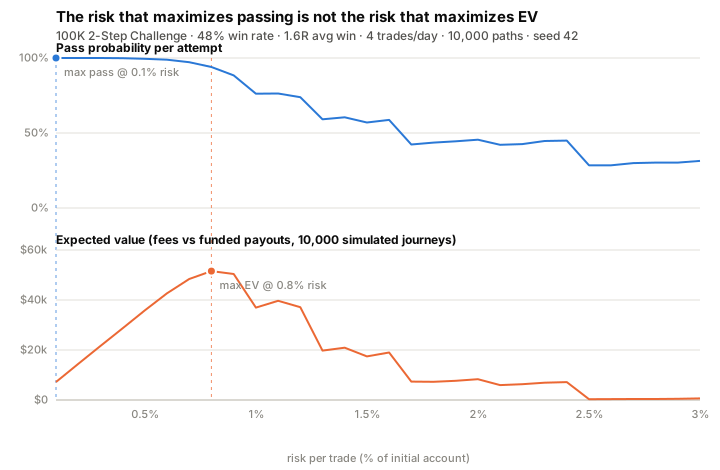
npx @luxalgo/prop-firm-sim-cli optimal-risk --firm ftmo --challenge 100k-2step \
--winrate 0.48 --avg-win 1.6 --trades-per-day 4 --seed 42-
You probably overestimate your win rate. Every simulate run can carry a sensitivity panel: what one percentage point of win-rate optimism costs you in pass probability. It is usually a lot.
-
Getting funded is not getting paid. Consistency rules are simulated: one outsized day raises your effective target, and the extra days at risk are sometimes the days the trailing floor gets hit. So is payout gating: winning-day minimums, profit buffers, per-payout caps. Results report the probability a funded account ever collects a payout, and how long the first one takes.
-
Dead time is part of the price. Every result reports stagnation: the longest stretch of days without a new equity high inside an attempt. Cutting risk raises your pass odds and stretches your stagnation. Surviving is slow, and slow is what makes traders abandon accounts and force trades.
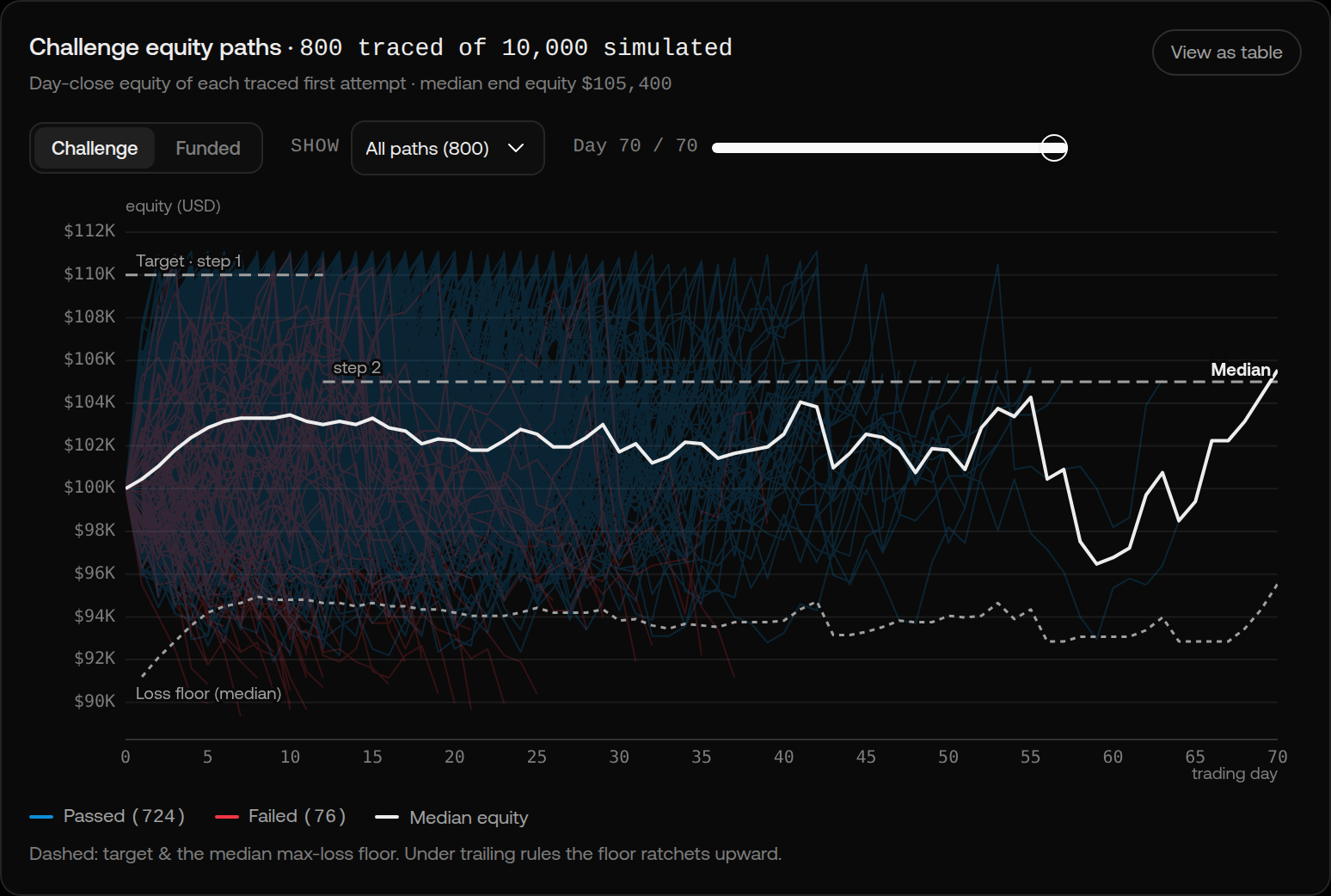
The centerpiece of the hosted simulator draws all of this at once: 800 traced equity paths against the ruleset's actual moving loss floor. Under trailing rules you can watch the floor ratchet up beneath the paths.
Run it on your real trades
Summary stats are a start. Timestamps are the truth. Paste or upload your trade history: real platform exports import directly (TradingView list of trades, MT4/MT5 statements including the HTML reports, MT5 deals tables, ThinkOrSwim account statements), along with plain timestamped CSVs, a documented generic template, and broker trade history as JSON in the open-source @luxalgo/broker-sdk shape, so a live broker pull drops straight into the simulator. Files that carry P&L but no risk data are refused until you state the risk you took per trade: R-multiples are computed, never fabricated. With timestamps in hand, two more questions become answerable:
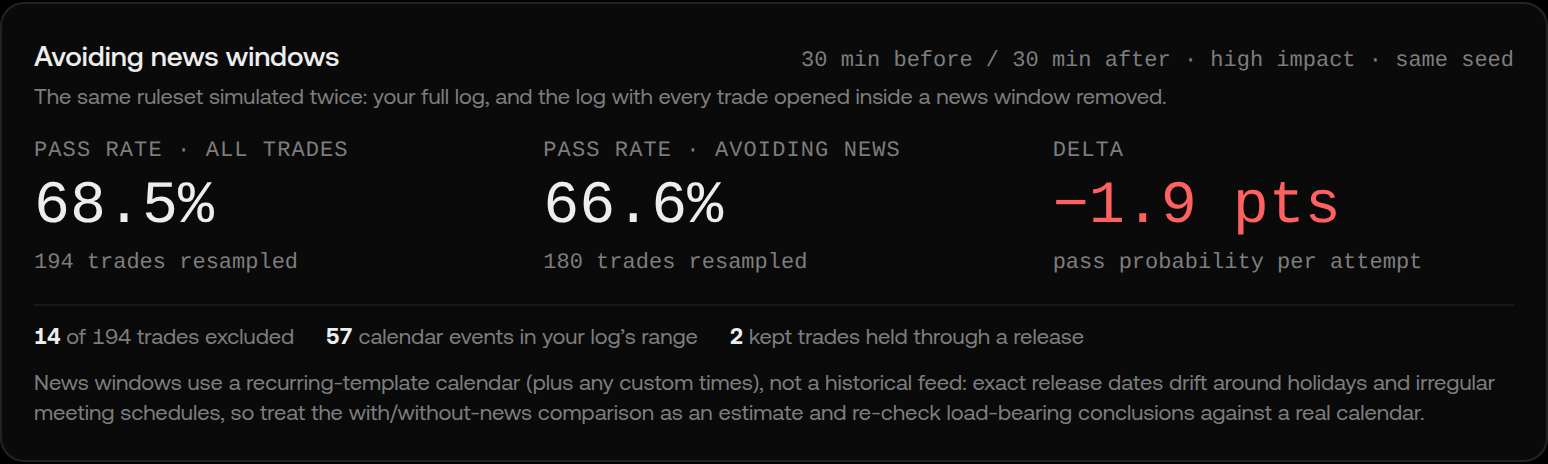
What if I stop trading around news? Prop firms restrict or frown on positions opened around scheduled releases, and some pay out only if you avoided them. The news filter replays your log with every trade opened inside a configurable window (minutes before and after, impact tier, currency) removed, on a recurring release calendar, then simulates both versions with the same seed. You see the delta, not a lecture. Sometimes avoiding news costs you probability, and the card says so.
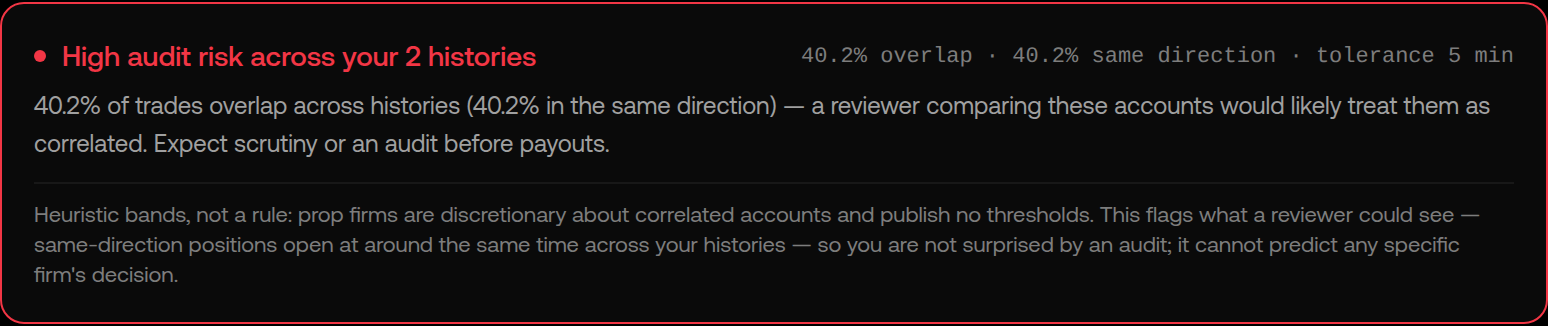
Would a combined portfolio get me audited? Upload up to five strategy histories for one simulation. Before merging them chronologically, the overlap audit counts same-direction positions open at the same time across histories, exactly what a payout reviewer looks for in copied accounts, and flags the risk with disclosed heuristic bands before you find out the expensive way.
The same engine, three ways
| Package | What it is |
|---|---|
@luxalgo/prop-firm-sim-core | The engine. Pure TypeScript, zero I/O, browser and worker safe, deterministic under seed (permalinks reproduce byte for byte). 10,000 paths in about a third of a second. |
@luxalgo/prop-firm-sim-cli | simulate, optimal-risk, compare, overlap, firms, rules in your terminal, on live directory data or inline specs. |
@luxalgo/prop-firm-sim-mcp | MCP server exposing the simulator to AI agents. Ask your assistant: given my last 200 trades, what are my odds on this challenge, and at what risk? |
| the hosted simulator | The same engine in your browser, client side only, with precomputed reference odds per firm. |
Use the core directly:
import { simulate } from "@luxalgo/prop-firm-sim-core";
import { adaptFirm } from "@luxalgo/prop-firm-sim-core/directory";

// Live rules from the LuxAlgo directory, or build the spec object yourself:
// the engine is pure and needs no network at all.
const { propfirms } = (await (await fetch("https://app.luxalgo.com/api/propfirms/list")).json()).data;
const challenge = adaptFirm(propfirms.find((f) => f.propfirmId === "ftmo"))[0];

const result = simulate(
  challenge.spec,
  {
    kind: "parametric",
    winRate: 0.52,
    avgWinR: 1.8,
    tradesPerDay: 3,
    risk: { mode: "percent-of-balance", value: 0.5 },
  },
  { paths: 10_000, seed: 42 },
);

result.perAttempt.passProbability; // with Wilson 95% CI alongside
result.perAttempt.stagnationDays; // dead time distribution per attempt
result.journey.cost.mean; // expected total cost to funded
result.ev.evTotal; // E[payouts minus fees] over the funded horizon
result.assumptions.flags; // every simplification, spelled out
challenge.provenance; // "directory" or "directory+inferred", inferred fields listed
Have real trade history? Feed a raw R-multiple series into bootstrap mode, or run any broker
export through importTradeHistory (structured diagnostics, adapter detection, a strict
R-provenance ladder; see docs/trade-import.md) and a timestamped log
unlocks the context tools (parseTradeLog, filterTradesAroundNews, mergeTradeLogs,
analyzeOverlap). Your odds, from your actual trades, computed locally.
Where the rules come from
Firm and challenge data is fetched at runtime from LuxAlgo's public prop-firm directory API
(https://app.luxalgo.com/api/propfirms/list, keyless and read-only, the data behind
luxalgo.com/prop-firms), then adapted into simulatable
specs by @luxalgo/prop-firm-sim-core/directory under a
three-tier honesty policy:
- Structured rule columns are used verbatim. Exact drawdown mode, daily-loss anchor semantics, consistency caps, payout gating.
- Free text is inferred only when one reasonable reading exists, and every inferred field
is disclosed in the result (
provenance: "directory+inferred",inferredFields: [...]). - Ambiguity is refused. A challenge whose loss semantics cannot be established is reported as not simulatable instead of being guessed. The max-loss mode is too consequential to guess.
When the directory serves a source citation (sourceUrl, lastVerifiedAt), it passes through
into the spec's sources and every result. The data is data, not endorsement: no rankings, no
offers, no affiliate anything in any simulation result. Rules the engine cannot faithfully
simulate are declared (flagsNotSimulated) and echoed into every result rather than silently
dropped.
Firms change rules without notice. The firm's page is always authoritative. Found drift?
Report it. And any ruleset,
including one the directory refuses or does not carry, can be passed inline as a spec object,
fully offline.
Assumptions, owned loudly
The full list ships inside every result (assumptions.flags), but the big ones:
- Trades are same-day round trips; intra-trade excursions are not modeled. This slightly understates trailing-drawdown risk, so real odds are somewhat worse.
- Attempts are i.i.d. draws from your stated stats: no learning, no tilt.
- Consistency rules, payout gating (winning days, buffers, caps) and locking trails are simulated. Scaling plans and remaining firm-specific niceties are not; entries that have them say so, and results repeat it.
- The funded stage is a horizon simulation: withdrawals take the maximum the rules allow and never cross the loss floor; monthly billing approximates to 21 trading days.
- The news calendar is a recurring template, not a historical feed, and every filtered result says so.
Simulation, not prediction. Distributions, never promises. Read the full disclaimer.
Development
pnpm install
pnpm build          # topological: core, then cli and mcp
pnpm test:run       # unit tests incl. hand-computed micro-cases for every drawdown semantic
pnpm bench          # hot-loop benchmark
Engine changes that move simulated numbers must update the golden snapshots and justify themselves in the PR. Silent drift in published odds is the one bug this repo treats as unforgivable. See CONTRIBUTING.md.
License
MIT © LuxAlgo Global, LLC. Free to use, embed, fork, and verify. No telemetry, no tracking, in any package. The project name and the LuxAlgo name and logo are trademarks; see TRADEMARKS.md. Security reports: SECURITY.md.