🦋 Molt
A Hugging Face-native, minimal, and scalable framework for agentic RL research.
Ray · vLLM · NeMo AutoModel: the smallest Hugging Face-native stack for fully asynchronous, multimodal, multi-turn agentic RL at 1T-class scale.










Project Page · Docs · Technical Report · Video · News · Architecture · Why Molt · Installation · Quick Start · Comparison · Documentation · Contributing
| Package | SFT | RL | Runtime |
|---|---|---|---|
molt | molt.cli.train_sft | molt.cli.train_rl_ray | vLLM |
Molt is agentic-first, Hugging Face-native, minimal, and scalable. The agent is the
program: the reward is whatever Python you write in an Env or a ChatAgent, whether a grader, a
multi-turn tool loop, a VLM environment, or an LLM judge. Three components do the rest. Ray
places the processes and runs the async queues, vLLM generates the rollouts, and NeMo
AutoModel + FSDP2 trains a single actor. The model stays an ordinary PyTorch module in the
Hugging Face layout, so one checkpoint directory serves both vLLM and the trainer, with no bridge
to write and no weights to convert. The whole RL path is ~9.2K lines, and it scales to 1T-class
MoE with TP / EP / CP: the entry point that trains a 4B model on one node also trains GLM-5.2
(753B) at --fsdp.ep_size 256, with Adam CPU offload for the largest actors.
📰 News
-
2026-11 · Molt powers REINFORCE Zero. Trainer–inference invariance (TII) and unclipped token-level importance sampling keep asynchronous RL stable through 20,000 policy updates. See the guide and the kernel-alignment agent skill.
-
2026-09 · FlashREINFORCE lands in Molt: critic-free, single-rollout RL that trains stably beyond 6,000 steps. Start from the quick-start script.
🧩 Architecture
One loop. Six stages.
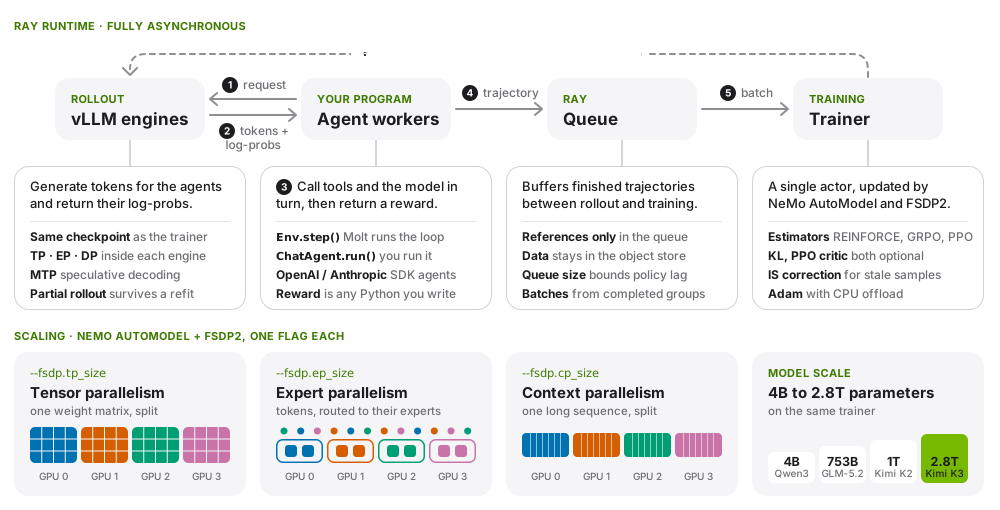
Read the figure top to bottom: the loop, what each part provides, and how the trainer scales. Ray places three kinds of processes (agent workers, vLLM engines, and one trainer) and carries the queue between them. That is the entire runtime. In asynchronous mode the six stages overlap, so a slow episode delays only itself. The contract is token-first: token ids, log-probs, action ranges, rewards, and multimodal tensors stay aligned from rollout to training. Anything you can compute in Python is a valid reward, including LLM-as-judge calls back through the same vLLM engines that drive rollout.
✨ Why Molt
| What you get | Why it matters for research | |
|---|---|---|
| 🤖 Agentic-first | One Gymnasium-aligned API, Env.step() or ChatAgent.run(), covers graders, multi-turn tools, VLM environments, and existing agents that speak the OpenAI or Anthropic API | The agent is the program. Iterate on environments in plain Python while the trainer stays untouched |
| ⚙️ Fully asynchronous runtime | Ray placement, async rollout queues, vLLM engines, partial rollout, weight sync | Rollout, training, and weight sync overlap, so a DeepSeek-V3-class actor stays fed without bespoke infrastructure |
| 🔥 Hugging Face-native, PyTorch end to end | The model is an ordinary PyTorch module in the Hugging Face layout (NeMo AutoModel + FSDP2), and one checkpoint directory feeds both vLLM and the trainer | Models load as released, with no bridge to write and no checkpoint to convert. Changing one means editing plain PyTorch |
| 🎯 Single-actor simplicity | One actor and an optional KL reference. The whole RL graph fits on a page | Every gradient is explicit, and every loss term is one file away |
| 🚀 Frontier-scale MoE | AutoModel + FSDP2 with TP / EP / CP and Adam CPU offload, MoE-native. GLM-5.2 (753B) runs at --fsdp.ep_size 256 | The 4B and 753B recipes share the entry point, the agent, and the algorithm. Nothing is rewritten between scales |
| 🔗 Token-first contract | Token ids, log-probs, action ranges, rewards, and multimodal tensors stay aligned | Multi-turn, VLM, and tool-call traces share one format end to end |
| 🪶 Small, hackable surface | ~9.2K lines of RL code in three thin layers. Each mechanism (advantage, loss, token capture, training loop) is one file | The function you edit is the function that runs. Read it in an afternoon, or hand it whole to a coding agent |
📦 Installation
Clone the repository first. The launch scripts, agents, and recipes live in it, and the container mounts this checkout.
git clone https://github.com/NVIDIA-NeMo/labs-molt.git
cd labs-molt
🐳 Container (recommended)
dockerfile/Dockerfile bakes the whole CUDA 13 stack (torch 2.14, vLLM, TransformerEngine, flash-attn,
mamba, DeepEP, NeMo AutoModel) for A100, H100, H200, B200, and GB200. SFT and RL run in it as-is.
docker pull hijkzzz/molt:latest                                 # or a pinned release: hijkzzz/molt:0.1.10
docker build -f dockerfile/Dockerfile -t hijkzzz/molt:latest .  # to change the CUDA / vLLM / AutoModel pins
Tags from 0.1.9 are multi-arch (amd64 and arm64), so the same pull works on x86 and on Grace-Blackwell
hosts. One Dockerfile builds both: publish a tag with
docker buildx build --platform linux/amd64,linux/arm64 --push.
💻 Local install
For development outside the container. It installs the exact git-pinned AutoModel this repository is
validated against (setup.py, AUTOMODEL), so R3 routing replay and Muon work out of the box.
pip install -e ".[vllm]"CUDA 13 is required (torch==2.14.0+cu130). A CUDA 12 environment will not work. With a host driver
older than 580, use the container: it ships the CUDA forward-compatibility layer and enables it
automatically.
The molt-rl package on PyPI cannot carry the git-pinned AutoModel, so it lags the pin and is not a
supported install path. Use the container or the local install.
🪶 Optional backend: AutoModel-Slim
The default is upstream NeMo AutoModel, pinned in setup.py.
automodel-slim is Molt's own trimmed copy
of that pinned commit, with the same package name, import paths, and API. To opt in, see
Installation in the guide.
🚀 Quick Start
📘 SFT
torchrun --standalone --nproc_per_node=8 -m molt.cli.train_sft \
  --model.model_name_or_path /path/to/automodel \
  --data.dataset /path/to/sft.jsonl \
  --data.input_key input \
  --data.output_key output \
  --ckpt.output_dir ./ckpt/sft \
  --fsdp.attn_implementation te
SFT uses the same AutoModel and FSDP2 model-loading path as RL. Example script:
examples/scripts/quick_start/sft_qwen3_4b.sh.
🎮 RL
python3 -m molt.cli.train_rl_ray \
  --actor.model_name_or_path /path/to/automodel \
  --data.prompt_dataset /path/to/prompts.jsonl \
  --data.input_key input \
  --data.label_key answer \
  --train.agent_path examples/python/agents/math.py \
  --vllm.num_engines 2 \
  --vllm.tensor_parallel_size 2 \
  --rollout.batch_size 128 \
  --train.batch_size 128 \
  --train.micro_batch_size 1 \
  --algo.advantage.estimator reinforce \
  --fsdp.attn_implementation te \
  --ckpt.output_dir ./ckpt/rl
Example script: examples/scripts/quick_start/rl_qwen3_4b.sh.
Every launch script, single-node and Slurm, is in examples/scripts/.
Sample groups, KL, asynchronous training, IS correction, and evaluation are each a flag or two away. The Quick start guide lists them, and the RL flags reference has every flag.
📊 How It Compares
The RL ecosystem optimizes for breadth. Molt optimizes for agentic research velocity at scale: the smallest Hugging Face-native stack that still drives fully asynchronous agentic RL at frontier MoE scale.
| 🦋 Molt | OpenRLHF | verl | slime | |
|---|---|---|---|---|
| Training backend | PyTorch / FSDP2 + NeMo AutoModel | DeepSpeed ZeRO-3 | FSDP / FSDP2 / Megatron | Megatron (FSDP exp.) |
| Hugging Face models | native | native | native on FSDP; bridged on Megatron | bridged (rebuilt in Megatron, weights mapped both ways) |
| Rollout engine | vLLM (Ray) | vLLM (Ray) | vLLM / SGLang / TRT-LLM | SGLang only |
| RL topology | actor (+ optional PPO critic) | actor + critic + RM | actor + critic + RM | actor + critic + RM |
| Reward source | agent Python | agent / endpoint / RM | agent / RM / endpoint | rollout fn / RM |
| Parallelism | TP / EP / CP, MoE-native | ZeRO-3 / FSDP | TP / PP / EP / SP | TP / PP / DP / CP / EP |
| Multimodal | VLM RL, multi-turn tool calls | VLM RL (v0.10+) | Qwen2.5-VL, Kimi-VL | geo3k VLM |
| Config surface | CLI flags only | CLI + scripts | Hydra + YAML | CLI + YAML |
| RL code size¹ | ~9.2K LOC | ~7.2K | ~62K | ~25K |
| Design center | agentic-first research | RLHF coverage | production breadth | Megatron throughput |
One framework, one job. Molt takes a checkpoint from SFT to frontier-scale agentic RL on vLLM, with no bridge in between. Read every line that touches your gradients, in plain PyTorch.
¹ How the RL-code line counts were measured
¹ RL code = every Python file the framework's RL path uses — online trainer, rollout, Ray orchestration, experience/advantage/reward/KL/loss, actor/critic/RM inference, plus shared models, utils, parallelism, and kernels the RL training command depends on. Excludes pure SFT, DPO/KTO/IPO trainers, reward-model training, distillation, vendored third-party code, tests, examples, scripts, and docs. Counts code lines only (blank and comment-only lines excluded). Measured by tracing the import graph from each RL entry point (
molt.cli.train_rl_ray,openrlhf.cli.train_ppo_ray,verl.trainer.main_ppo); slime loads its Megatron/SGLang backends lazily, so its coreslime/package plus itsslime_plugins/model-zoo (+~4.7K — the in-repo model code its RL path uses, counted on the same basis as molt'smodels/) are counted, minus SFT/distillation. Molt measured 2026-07-20 on this repo; the others measured 2026-06-16 at each repo's then-latest main HEAD (verl86e8123, slime243773c, OpenRLHFb3d2927).
📖 Documentation
This README is the overview. The guide covers each area in depth.
| Area | Pages |
|---|---|
| Agents and rewards | Agent contract · Recipes |
| Training | Algorithms · Asynchronous training · IS correction · Evaluate and debug |
| Scaling | Scaling · MoE routing · MTP rollout · LoRA |
| Reference | RL flags · SFT flags · molt.agents API |
The pages are Markdown files in docs/guide/pages/.
✅ Validation
Fast local checks:
python -m compileall -q molt examples/python tests
pytest -q
Container checks:
SKIP_BUILD=1 DOCKER_GPUS=all DOCKER_SHM_SIZE=32g \
  bash examples/scripts/docker_run.sh "pytest -q"
🙏 Acknowledgement
Molt builds on OpenRLHF and keeps its Python package layout where practical. The architecture is
deliberately minimal: a Gymnasium-aligned agent (Env or ChatAgent), a single trainable actor,
optional KL reference workers, vLLM generation, and online policy optimization, all on PyTorch and
NeMo AutoModel.
📚 Citation
If you use Molt in your research, please cite:
@techreport{hu2026molt,
  title       = {Molt: A Hugging Face-Native, Minimal, and Scalable Framework for Agentic Reinforcement Learning},
  author      = {Jian Hu and Molt Contributors},
  institution = {NVIDIA},
  year        = {2026},
  url         = {https://www.researchgate.net/publication/409325071_Molt_A_Scalable_PyTorch-Native_Training_Framework_for_Agentic_Reinforcement_Learning}
}
🤝 Contributing
External contributions are welcome. See CONTRIBUTING.md. Every commit must be
signed off with git commit -s, per the
Developer Certificate of Origin (DCO).
📄 License
Apache License 2.0. Copyright and third-party attributions are in NOTICE and THIRD_PARTY_NOTICES.md.