

Docs | Roadmap | Installation | API Reference | Contributing | License | build.nvidia.com Powered By NVCF
NVIDIA Cloud Functions
NVIDIA Cloud Functions (NVCF) is a platform for deploying, managing, and running GPU-accelerated workloads at scale. It routes inference, streaming, and other GPU work to worker clusters, so you can scale demanding workloads with less infrastructure to run yourself.
This monorepo contains NVCF service code, deployment assets, documentation, examples, CLI code, agent skills, and validation tooling.
Architecture
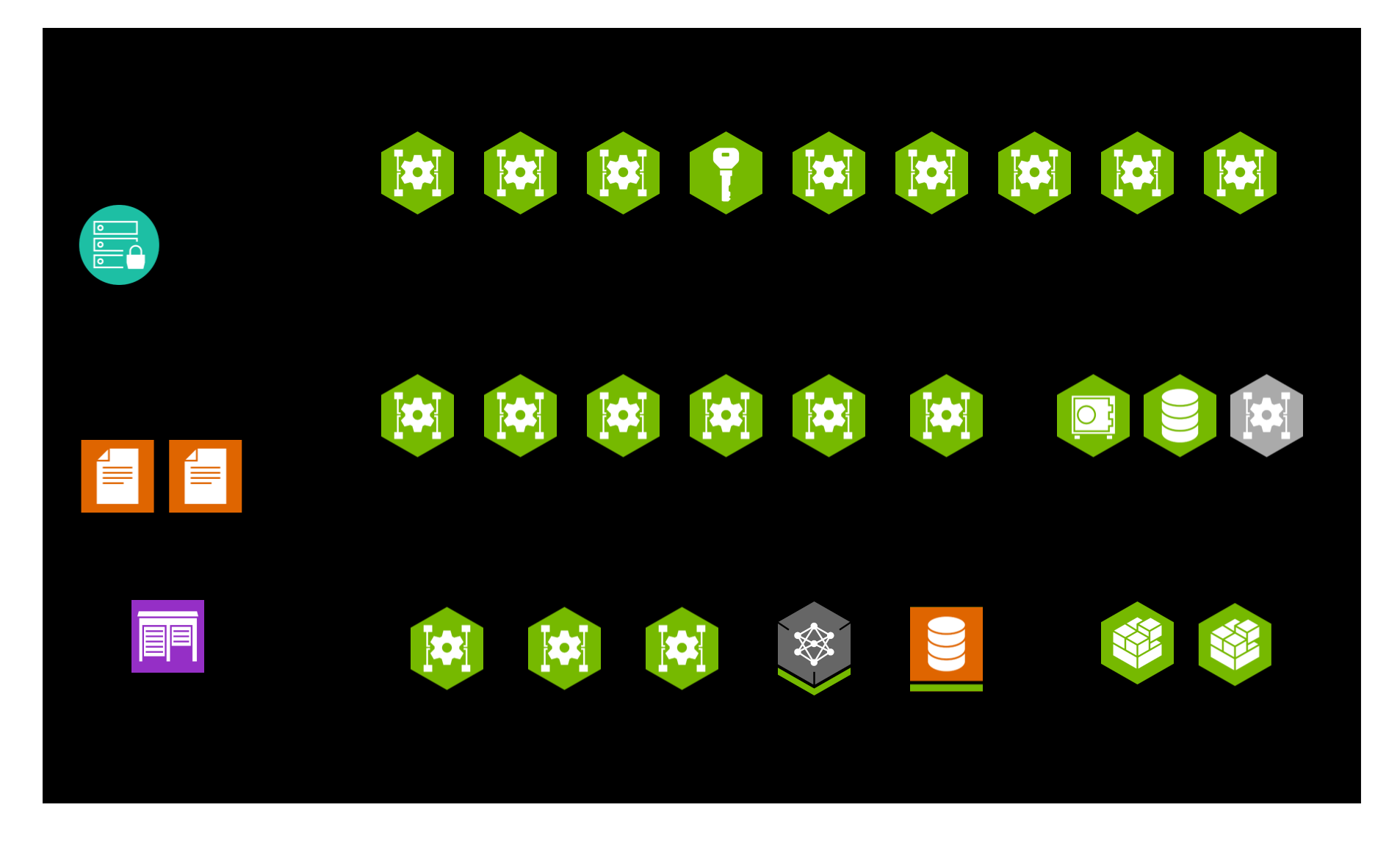
NVCF runs as Kubernetes services that manage function lifecycle, invocation routing, GPU cluster integration, artifact access, secrets, observability, and operations.
At a high level:
- The control plane exposes the NVCF API, manages function and deployment state, handles secret management, and coordinates platform operations.
- The invocation plane receives HTTP, streaming, and gRPC requests, applies routing and rate limiting, and sends work to running function workloads.
- GPU clusters connect through the NVIDIA Cluster Agent (NVCA). NVCA registers GPU resources and manages workload execution on GPU nodes.
- Function artifacts live in registries that the NVCF deployment can access.
- Observability, dashboards, and runbooks help operators monitor health and debug workload behavior.
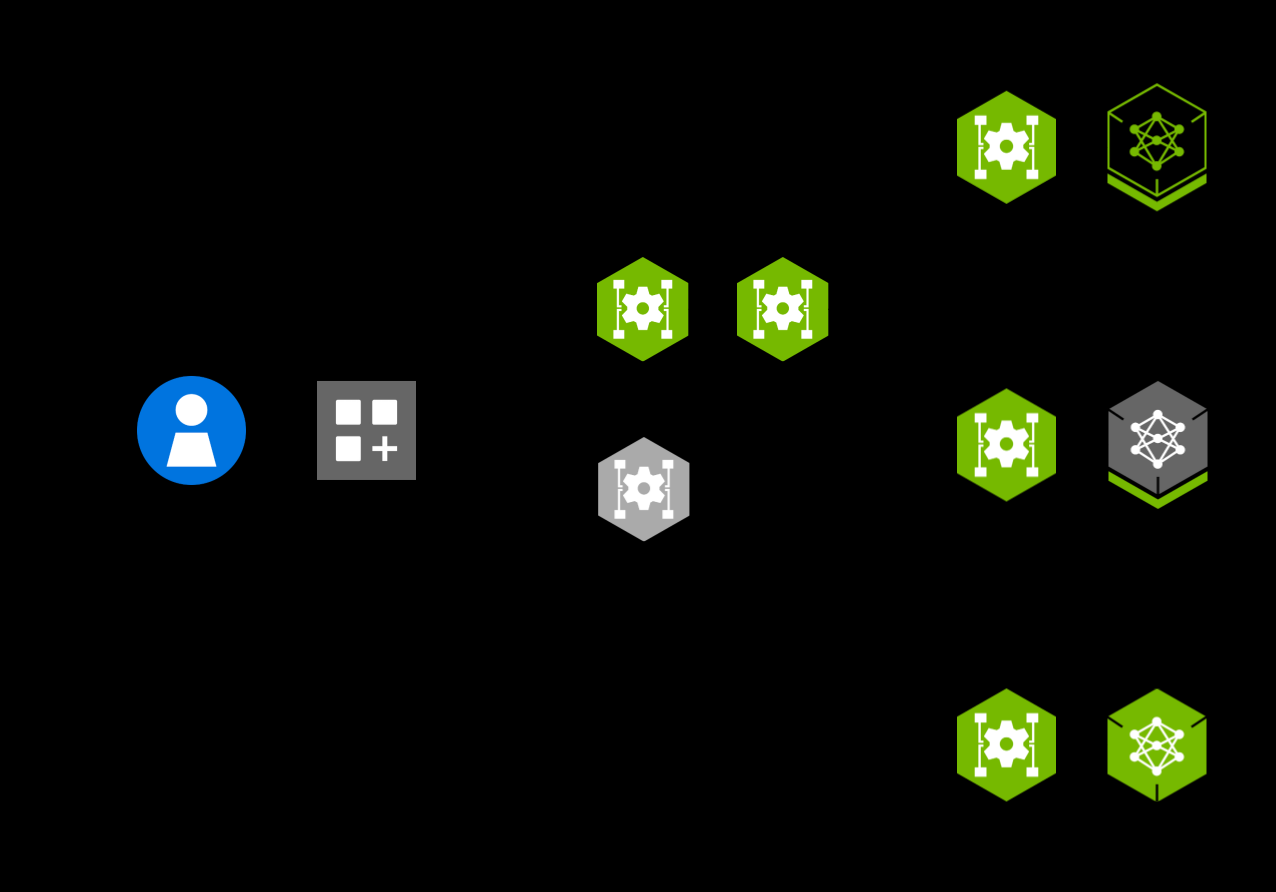
The following diagram shows how self-managed NVCF can span regions and GPU clusters.
Workload types
NVCF functions are long-running, invokable workloads. Use a function when a client needs an endpoint for inference, streaming, or another service-style GPU workflow. Functions can be packaged as a container when the workload is a single service with health and inference endpoints, or as a Helm chart when the workload needs multiple coordinated containers, services, sidecars, or other Kubernetes resources.
NVCF tasks are asynchronous, run-to-completion workloads. Use a task for batch inference, evaluation, fine-tuning, data preparation, or other GPU jobs that should finish and report status instead of staying online behind an invocation endpoint. Tasks can be packaged as a container when the workload is a single service with health and inference endpoints, or as a Helm chart when the workload needs multiple coordinated containers, services, sidecars, or other Kubernetes resources.
Core capabilities
| Capability | What it does |
|---|---|
| Unified control plane | Manages and routes requests across multi-region GPU clusters. |
| Load-balanced workload routing | Balances inference, streaming, and custom workloads based on worker availability. |
| Multiple protocols | Supports multiple protocols for different workload and client needs. |
| Multi-cluster autoscaling | Scales workloads from zero to max across clusters. |
| Mixed GPU support | Supports mixed GPU types across clusters for workloads with different GPU requirements. |
| Health checks and telemetry | Tracks worker status and request latency through health checks and telemetry. |
Usage
After installing a self-managed NVCF deployment and configuring nvcf-cli, a
typical function workflow is:
nvcf-cli init
nvcf-cli api-key generate

# Update the example file with your function image before creating it.
nvcf-cli function create --input-file src/clis/nvcf-cli/examples/create-function.json
nvcf-cli function deploy create
nvcf-cli function invoke --request-body '{"message": "hello world"}'
For the full setup, cleanup, and configuration flow, see
docs/user/cli.md and
docs/user/quickstart.md.
Repository map
| Area | Paths | Purpose |
|---|---|---|
| Control plane | src/control-plane-services/ | APIs and services that manage NVCF function and deployment state. |
| Invocation plane | src/invocation-plane-services/ | HTTP invocation, gRPC proxying, rate limiting, LLM gateway paths, and request authorization. |
| Compute plane | src/compute-plane-services/ | GPU cluster integration, cache services, image credentials, ESS Agent, and telemetry collection. |
| CLI and libraries | src/clis/, src/libraries/ | User and developer clients plus shared Go and Python code. |
| Deployment | deploy/, migrations/ | Helm charts, stack installation, infrastructure services, and datastore migrations. |
| Documentation | docs/user/, docs/dev/, fern/ | Self-managed user docs, developer docs, and published docs navigation. |
| Examples | examples/ | Local development guides, function samples, and load-test assets. |
| Tools | tools/ | Build, docs, dependency, license, and validation utilities. |
| AI tooling | ai-tooling/ | Public agent skills and workflow helpers for NVCF users and developers. |
Building with Bazel
Bazel is the build, test, and packaging tool across the monorepo. Native
subtrees (src/clis/nvcf-cli, src/libraries/go/lib) build fully under
Bazel today. Phase B has additionally landed Bazel scaffolds in
upstream-owned service trees: nvcf-grpc-proxy, nvcf-ratelimiter,
nvcf-nats-auth-callout-service, nvcf-cache/nvcf-unbound (dns-cache),
nvcf-image-credential-helper, and nvca. Their BUILD.bazel,
MODULE.bazel, and rules/oci/ files are picked up automatically when
the subtrees are synced into the umbrella; from the umbrella you can
build, test, and produce OCI images for any of them without leaving the
monorepo.
Quick start (Linux):
curl -fSL -o ~/.local/bin/bazel \
  "https://github.com/bazelbuild/bazelisk/releases/download/v1.25.0/bazelisk-linux-$(dpkg --print-architecture)"
chmod +x ~/.local/bin/bazel

# Native subtrees
bazel build //src/clis/nvcf-cli:nvcf-cli            # host binary
bazel test  //src/clis/nvcf-cli/...                 # unit tests
bazel build //src/clis/nvcf-cli:dist                # all 5 platforms

# Phase B upstream example: build the grpc-proxy multi-arch OCI image
bazel build //src/invocation-plane-services/grpc-proxy:image_index
bazel test  //src/invocation-plane-services/grpc-proxy/...

# Run the full tree
bazel test //...
Quick start (macOS):
brew install bazelisk

bazel build //src/clis/nvcf-cli:nvcf-cli
bazel test  //src/clis/nvcf-cli/...
bazel build //src/clis/nvcf-cli:dist
Builds read from the configured remote cache by default and do not upload local results. If you are off the network path that can reach that cache and Bazel fails before local execution starts, disable the remote cache for that build:
bazel build --remote_cache= //src/clis/nvcf-cli:nvcf-cliTo make the local-only path persistent, add the override to your user Bazel config:
echo 'build --remote_cache=' >> ~/.bazelrc.userTo seed the cache from a dev box (corp network or VPN required), add
--config=remote-write:
bazel build --config=remote-write //src/clis/nvcf-cli/...Full setup, day-to-day commands, OCI image build/push, stamping, caches,
remote-cache probe, and CI map live in BAZEL.md.
For CLI-specific developer flow see src/clis/nvcf-cli/README.md.
Local dev env setup
Before opening your first pull request, set up a local build and test environment:
- Install Bazel through bazelisk. See Building with Bazel.
- Confirm your toolchain with
bazel build //src/clis/nvcf-cli:nvcf-cli. - Run the relevant tests locally before pushing:
bazel test //src/clis/nvcf-cli/..., orbazel test //...for the full tree.
See BAZEL.md for the complete setup, cache, and CI map.
Roadmap
GitHub issue #27 is the current public roadmap for the quarter. Use that issue as the source of truth for active priorities, status updates, and follow-up proposals.
The broader issues board tracks the remaining backlog. Have an idea or a request that is not covered by the quarterly roadmap? Start a Discussion or file a feature issue.
Support
- File bugs, feature ideas, and documentation requests as GitHub issues. Use the appropriate template and include the component name in the title (for example, [nvcf-nvca] Pod fails to start on arm64).
- Use GitHub Discussions for support and usage help.
- To report a security vulnerability see
SECURITY.md. Do not open a public issue.
Contributing
We welcome contributions of all sizes, from typo fixes to new features. See
CONTRIBUTING.md for the full guide.
NVCF is a new open source project, and we are actively smoothing the contribution workflow. We accept external contributions through GitHub pull requests today, with a few temporary wrinkles while the repository becomes more GitHub-native.
Before changing a service, read AGENTS.md and the nearest nested
AGENTS.md. The nested file is the best source for service-specific build,
test, style, and review expectations.
Use Conventional Commits.
For documentation-only changes, run git diff --check and any targeted
validation that applies to the changed files.
Code of conduct
This project follows the Contributor Covenant Code of Conduct. Contributors
agree to uphold this standard. See
CODE_OF_CONDUCT.md for the full text and enforcement
guidelines.
Dependency rollups
Dependency collection guide and tool:
tools/collect-dependencies/README.md
and tools/collect-dependencies.
License
Apache-2.0. See LICENSE.