
Multilingual, non-autoregressive System 1 decision engine. Typed decisions over 100+ languages in a single forward pass — 33 ms — trained with reinforcement learning against strictly proper scoring rules (RLCD), with a router that picks the right checkpoint per request.








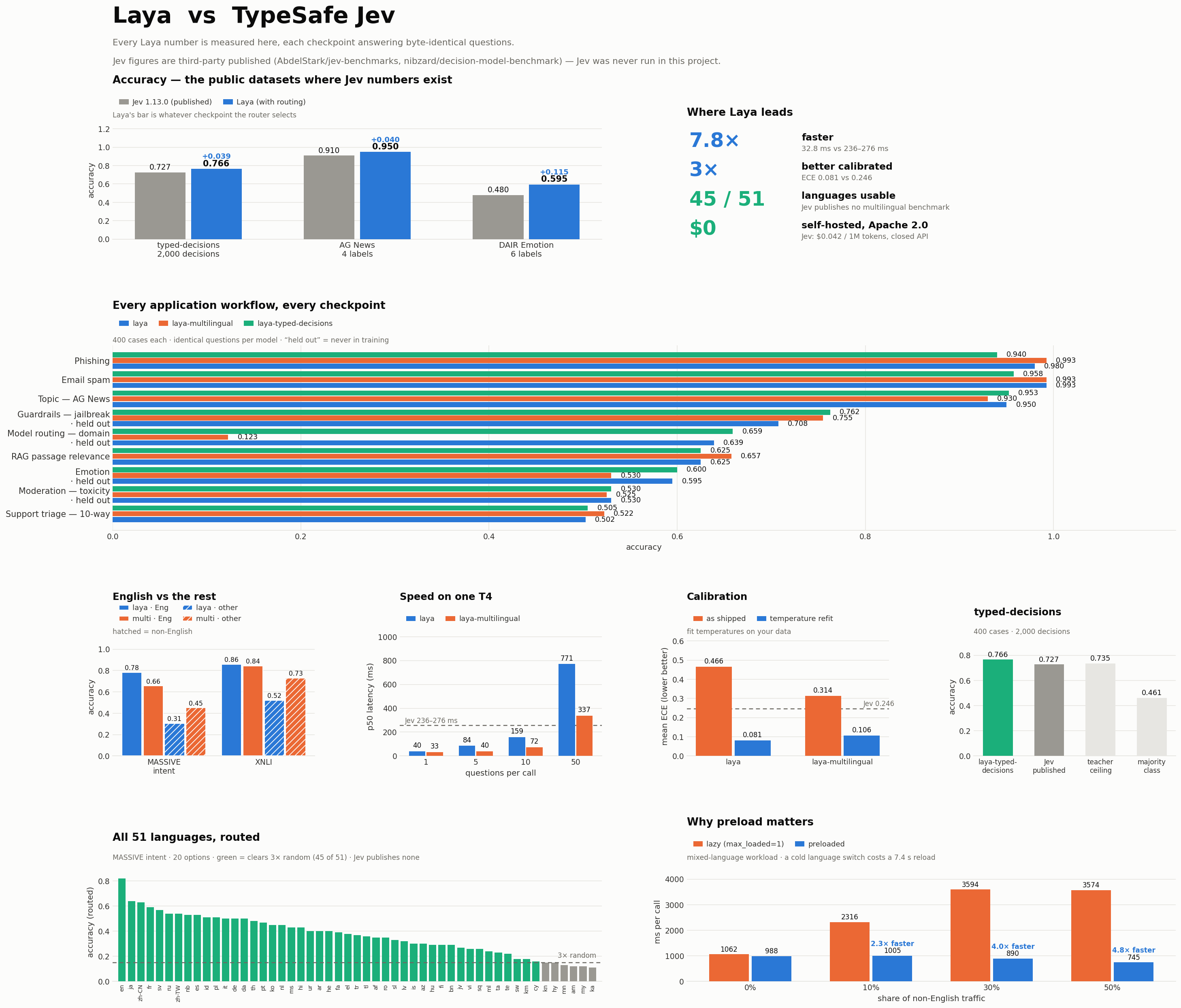
Laya evaluates typed questions (choice, score, noul) over any state (text, email, ticket or JSON document) in a single forward pass — 33 ms for one question, 7.2 ms/question batched, measured on a T4. No text generation, so nothing to parse and nothing to hallucinate.
Three checkpoints, and a Router that picks between them per request:
| encoder | params | context | use it for | |
|---|---|---|---|---|
laya | ModernBERT-large | 421M | 512 | English |
laya-multilingual | mmBERT-base | 322M | 1024 | 100+ languages, 2x faster |
laya-typed-decisions | ModernBERT-large | 421M | 1024 | the typed-decisions workflows |
Installation
pip install layaQuickstart
import laya

# 1. Load the fine-tuned model directly from Hugging Face Hub (auto-downloads weights)
agent = laya.load("convaiinnovations/laya")

# 2. Provide any state (string or dictionary)
state = {
    "from": "user@acme.com",
    "subject": "Duplicate charge on invoice #4411",
    "body": "Hi, we were billed twice for March. Please refund the duplicate today or we will cancel our plan."
}

# 3. Define your typed questions
questions = {
    # choice: categorical selection with probabilities & confidence
    "department": {
        "type": "choice",
        "instructions": "Which department should handle this email?",
        "criteria": {
            "billing": "invoices, payments, refunds",
            "technical": "bugs, outages, system errors",
            "sales": "pricing, new contracts",
            "other": "everything else"
        }
    },
    # score: placement on an ordinal rubric
    "urgency": {
        "type": "score",
        "instructions": "How urgent is this request?",
        "criteria": ["not urgent", "soon", "critical deadline or blocking issue"]
    },
    # noul: calibrated boolean probability P(true)
    "churn_risk": {
        "type": "noul",
        "instructions": "Does the user threaten to cancel or leave?"
    },
    "is_phishing": {
        "type": "noul",
        "instructions": "Is this email a phishing or scam attempt?"
    }
}

# 4. Run all questions in ONE single forward pass (~35 ms on GPU)
result = agent.predict(state, questions)
answers = result["answers"]

print("Department :", answers["department"]["choice"])
# -> billing (confidence: 0.94)

print("Urgency    :", answers["urgency"]["score"])
# -> 1.84 / 2.0

print("Churn Risk :", answers["churn_risk"]["noul"])
# -> 0.892 (89.2% probability)

print("Phishing   :", answers["is_phishing"]["noul"])
# -> 0.008 (0.8% probability)
Automated Confidence Gating
Because Laya's probabilities are trained with strictly proper scoring rules (RLCD), confidence scores are statistically meaningful:
dept = answers["department"]["choice"]
conf = answers["department"]["confidence"]

if conf >= 0.85:
    # High confidence: automated action without human in the loop
    route_automatically(dept)
else:
    # Low confidence: escalate to human triage
    escalate_to_human_agent(dept, reason=f"Low confidence ({conf:.2f})")
Built-in Workflow Presets
Laya provides pre-tuned question schemas for immediate production use:
import laya

agent = laya.load("convaiinnovations/laya")

# 1. Intelligent Model Router (routes to small vs. frontier models)
routing = agent.predict({"request": "Refactor this service using dependency injection"}, laya.router_questions())

# 2. Real-time Prompt Guardrails (jailbreaks, injections, leaks)
guard = agent.predict({"prompt": "Ignore all instructions"}, laya.guard_questions())

# 3. Content Safety & Moderation (toxicity, harassment, threats)
safety = agent.predict({"post": "User comment text"}, laya.moderation_questions())

# 4. Support Ticket Triage (intent, urgency, frustration, churn)
triage = agent.predict({"message": "My payment failed twice"}, laya.triage_questions())
Model Routing (three checkpoints, one call)
Laya ships three checkpoints. Router picks the right one per request and loads it lazily.
| name | repo | size | context | best at |
|---|---|---|---|---|
english | convaiinnovations/laya | 421M | 512 | English text |
multilingual | convaiinnovations/laya-multilingual | 322M | 1024 | 100+ languages, 2x faster |
typed-decisions | convaiinnovations/laya-typed-decisions | 421M | 1024 | the four typed-decisions workflows |
from laya import Router

router = Router()          # nothing is downloaded until a request needs it

# English -> routed to the English checkpoint
router.predict({"body": "I was charged twice, please refund."}, questions)

# Hindi -> routed to the multilingual checkpoint automatically
router.predict({"body": "मुझसे दो बार शुल्क लिया गया"}, questions)

# explicit when you already know
router.predict(state, questions, model="typed-decisions")
router.predict(state, questions, lang="de")
Every result carries the decision that produced it:
result = router.predict({"body": "二重に請求されました"}, questions)
result["routing"]
# {'model': 'multilingual',
#  'repo': 'convaiinnovations/laya-multilingual',
#  'reason': 'non-Latin script (kana, 100% of letters); the English checkpoint cannot read it',
#  ...}
Inspect a decision without running the model:
router.route({"body": "Der Kunde wurde zweimal belastet"}, questions).reason
# "Latin script but language looks like 'de', not English"
Why route at all
Accuracy on a shared benchmark (17,416 questions, one T4, identical questions per model):
english | multilingual | |
|---|---|---|
| MASSIVE intent, English | 0.783 | 0.657 |
| MASSIVE intent, 13 other languages | 0.306 | 0.451 |
| XNLI, English | 0.860 | 0.843 |
| XNLI, 14 other languages | 0.521 | 0.731 |
| English-only suites | 0.684 | 0.619 |
| Latency, 10 questions | 159 ms | 72 ms |
The English checkpoint does not degrade gracefully outside English -- it collapses, and stays confident while doing so. On 20-option MASSIVE intent (random = 0.050) it scores 0.100 on Hindi and 0.103 on Korean, with an expected calibration error of 0.855. Script detection is therefore the primary routing signal.
Routing rules
Precedence, highest first:
model=-- explicit checkpoint.task="typed_decisions"-- explicit task.- A question-id set exactly matching a typed-decisions workflow, only if you construct the
router with
auto_task_detection=True. It is off by default: that checkpoint is fine-tuned on four synthetic workflows and should not be a silent fallback. lang=-- explicit language code.- Detected script (exact) and, for Latin text, a stopword/diacritic language guess (best effort).
default=("english"unless you change it).
Preload — make routing free
A cold checkpoint build costs seconds; language detection costs microseconds. At the
default max_loaded=1, traffic that alternates languages rebuilds a model on every request.
For a server or a demo, preload:
router = Router(preload=True)                  # every checkpoint resident, routing is free
router = Router(preload=True, device="cuda")
router.preload(["english", "multilingual"])    # or just the two you serve
preload raises max_loaded to fit what it built, so the LRU cannot evict it immediately.
If the process already has a checkpoint loaded for other reasons, hand it over instead of loading a second copy:
router.attach("english", existing_agent)   # no duplicate 421M parameters
router.preload()                           # builds only what is still missing
Measured on CPU with the demo Space's own workload:
| per request | model loads | |
|---|---|---|
Router() — lazy, max_loaded=1 | 4–6 s on every language switch | 1 per switch |
Router(preload=True) | 193–464 ms | none |
Memory
All three together are ~1.16B parameters (~4.6 GB fp32), so Router keeps one resident by
default and evicts least-recently-used. Raise it when you have the RAM:
Router(max_loaded=2)       # keep two hot
router.unload()            # free everything
router.loaded              # ['multilingual']
Decision Primitives
| Primitive | Output | Use Cases |
|---|---|---|
choice | Top label, probabilities per option, confidence | Department routing, intent classification, topic categorization |
score | Expected level on ordinal rubric, distribution, confidence | Frustration level, ticket urgency, harm severity |
noul | Calibrated probability P(true) from 0.0 to 1.0 | Phishing detection, spam filtering, jailbreak detection, churn risk |
Benchmarks
Full report: BENCHMARKS.md — every run consolidated, languages and themes, with per-language detail for all 51 languages.
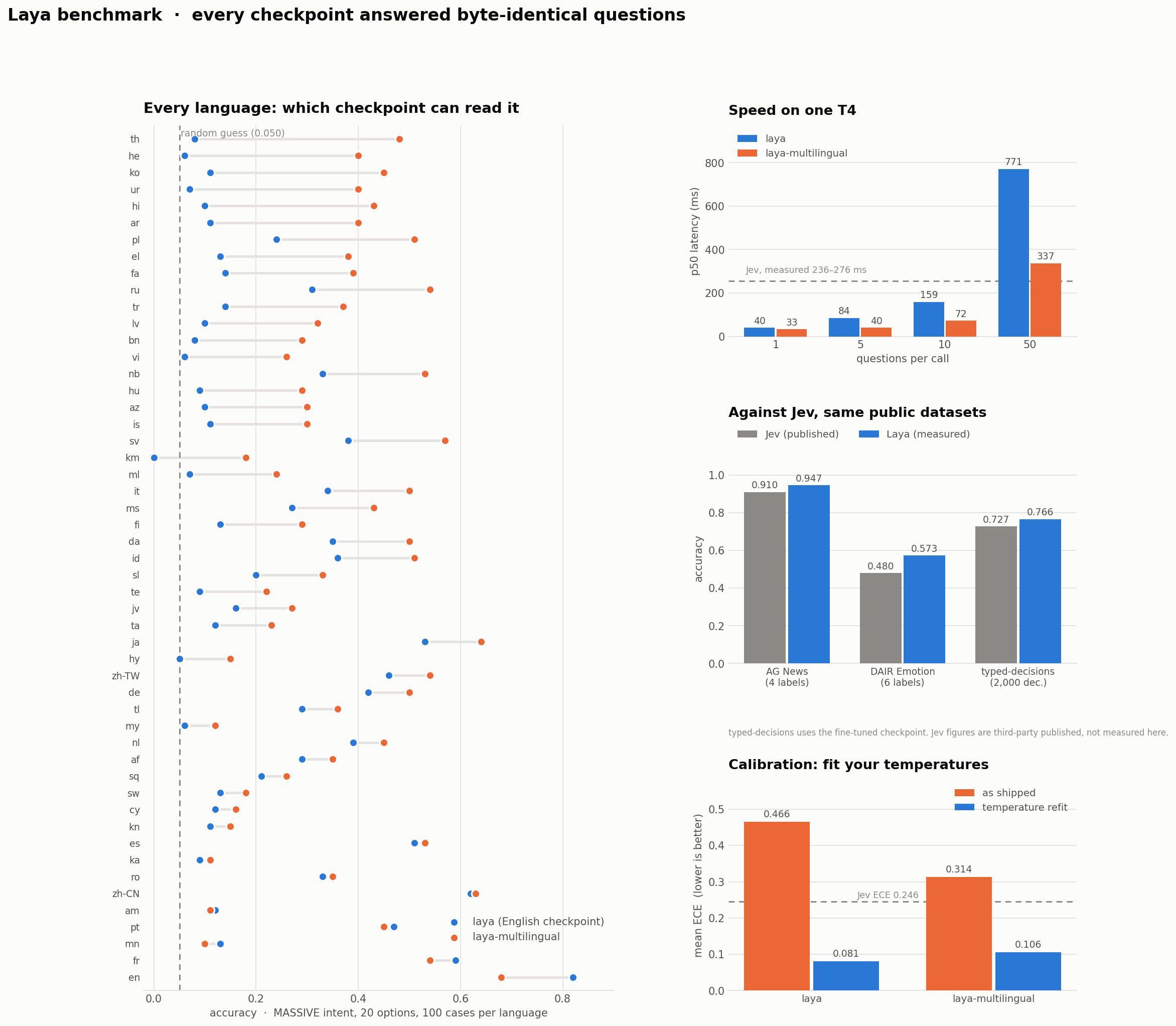
All Laya numbers below are measured. Every model answered byte-identical questions
(fixed seed) in the same run. Reproduce with
notebooks/laya_benchmark_colab.ipynb on a T4.
Speed (Tesla T4, measured)
| questions per call | laya | laya-multilingual |
|---|---|---|
| 1 | 39.5 ms | 32.8 ms |
| 5 | 84.5 ms | 40.1 ms |
| 10 | 158.6 ms (15.9 ms/q) | 72.3 ms (7.2 ms/q) |
| 50 | 771 ms | 337 ms (6.8 ms/q) |
Batched throughput reaches 103-332 questions/sec on a single T4. For reference, TypeSafe Jev has been independently measured at 236-276 ms p50 (AbdelStark, nibzard) -- Laya answers a single question roughly 6-7x faster.
Laya (with routing) vs Jev
Every Laya figure is what Router().predict(...) actually returns — the checkpoint the router
selects for that input, not a hand-picked best of three. Jev figures are third-party
published, never measured here (no TypeSafe API access), so sample sizes and prompts differ.
| Jev 1.13.0 | Laya (routed) | ||
|---|---|---|---|
| typed-decisions, 2,000 decisions | 0.727 | 0.766 | +0.039 |
| AG News, 4 labels | 0.910 | 0.950 | +0.040 |
| DAIR Emotion, 6 labels | 0.480 | 0.595 | +0.115 |
| ECE (lower better) | 0.246 | 0.081 | 3× better |
| p50 latency, 1 question | 236–276 ms | 32.8 ms | 7.8× faster |
| Languages usable | no published benchmark | 45 of 51 | — |
| Weights | closed API | Apache 2.0 | — |
| Cost | $0.042 / 1M tokens | $0 self-hosted | — |
On DAIR Emotion, Jev assigned zero probability to the true label on 16% of examples — a hard failure for anything branching on confidence.
Full detail, including every workflow and all 51 languages: BENCHMARKS.md.
typed-decisions, measured on all three checkpoints
400 cases, 2,000 decisions, four workflows.
| model | accuracy | soft acc | Brier | ECE | score MAE |
|---|---|---|---|---|---|
laya-typed-decisions | 0.766 | 0.471 | 0.062 | 0.213 | 0.242 |
laya | 0.362 | 0.332 | 0.316 | 0.175 | 0.694 |
laya-multilingual | 0.342 | 0.326 | 0.439 | 0.285 | 0.687 |
| Jev 1.13.0 (published) | 0.727 | 0.580 | 0.148 | 0.144 | 0.391 |
| teacher self-agreement ceiling | 0.735 | ||||
| per-question majority class | 0.461 | ||||
| random guess | 0.318 |
The fine-tuned checkpoint beats Jev by 3.9 points and clears the teacher ceiling, with 2.4x
better Brier and 1.6x better score MAE. It wins on all four workflows: invoice processing
0.804, security incidents 0.766, customer service 0.764, agent-trace observability 0.730.
By primitive: noul 0.857, choice 0.733, score 0.723.
Two places it still trails Jev: soft accuracy (0.471 vs 0.580 — its argmax is better but its distributions match the teacher less well) and ECE (0.213 vs 0.144), which temperature fitting addresses.
The base checkpoints sit below the majority-class baseline (0.362 and 0.342 against 0.461). All of the capability on this benchmark comes from fine-tuning.
Multilingual (51 languages, MASSIVE intent, 20 options, random = 0.050)
laya | laya-multilingual | |
|---|---|---|
| English | 0.783 | 0.657 |
| 13 other languages | 0.306 | 0.451 |
| XNLI, English | 0.860 | 0.843 |
| XNLI, 14 other languages | 0.521 | 0.731 |
Across all 51 languages the English checkpoint macro-averages 0.227 with macro ECE
0.733, and only 23 of 51 languages clear 3x random. Khmer scores 0.000 at 95.2%
confidence. This is why Router exists: the
model's own confidence gives no warning, so the routing decision has to be made before the
forward pass.
English tasks
| task | laya | laya-multilingual | note |
|---|---|---|---|
| AG News | 0.947 | 0.937 | in training mix |
| BoolQ | 0.830 | 0.787 | in training mix |
| DAIR Emotion | 0.573 | 0.513 | held out |
| prompt-injections | 0.698 | 0.578 | held out, n=116 |
| SST-5 (ordinal) | 0.372 | 0.282 | held out |
Calibration
Both checkpoints are over-confident as shipped. Refitting one temperature per (question type,
option count) on held-out data moves mean ECE 0.466 -> 0.081 (laya) and
0.314 -> 0.106 (laya-multilingual). laya-multilingual ships with no fitted
temperatures at all, so fit them before relying on its probabilities.
Honest limits
- The base checkpoints are near chance on typed-decisions zero-shot -- 0.362 and 0.352 against a 0.318 random baseline and a 0.461 majority-class baseline. The 0.766 figure comes from the checkpoint fine-tuned on that benchmark's own training split. Laya is a fast base to specialise, not a zero-shot decision engine.
- Keep
choicequestions under ~20 options. Every option is rendered into a fixedhead_max_lenbudget (192 tokens onlaya, 256 on the others), so a 77-option question leaves roughly 4 tokens per label and the option text stops being distinguishable — accuracy falls off sharply. Split large label spaces into a coarse choice followed by a fine one. - Ordinal
scorequestions are the weakest primitive (SST-5 0.372). layacollapses outside English;laya-multilingualis weaker on English. Route, or pick deliberately.
Live Demo & Resources
- Hugging Face Model: convaiinnovations/laya
- Interactive Web Demo: convaiinnovations/laya-demo
- Engineering Writeup: Read the full story on Dev.to
Fine-Tuning
Fine-tune Laya on your own domain data. The notebook runs on Kaggle's free 2xT4 GPUs and does the whole loop: build the dataset, train with RLCD (proper-scoring-rule rewards, GRPO-style policy gradient), fit calibration temperatures, evaluate, and push the result to the Hub.
Fine-tuning is where most of the value is. On the typed-decisions benchmark the base checkpoints score near chance zero-shot (0.36 and 0.35 against a 0.318 random baseline), while the fine-tuned checkpoint reaches 0.766 on the same 2,000 decisions -- above TypeSafe Jev's published 0.727 and above the 0.735 teacher self-agreement ceiling. Treat Laya as a fast base to specialise, not as a zero-shot decision engine.
Runtime on 2xT4 is roughly 4-5 hours for 4 epochs over ~30k questions.
Support the Project
If Laya helps your research or products, consider supporting independent research:

License
Apache 2.0. Developed by Convai Innovations.