SimpleNav
Make Navigation VLA Simple.
A simple, unified, reproducible, and extensible framework for navigation VLA research.





中文 · Project Page · Data Pipeline · Documentation · Results · Data, Environments & Models
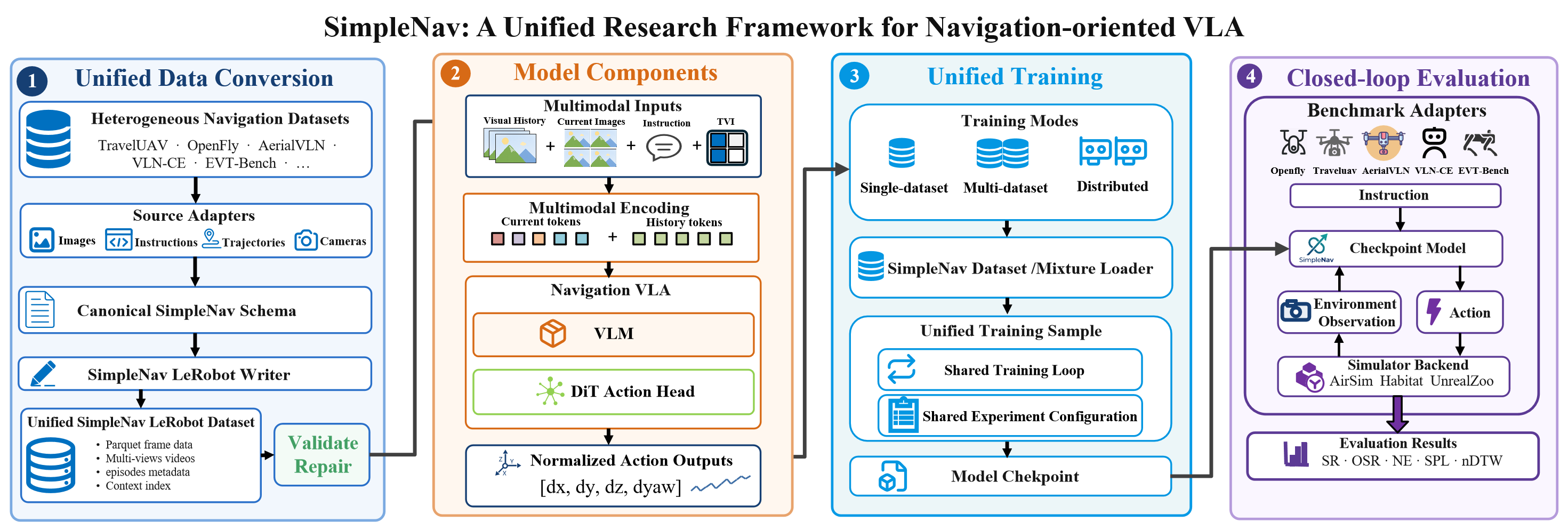
SimpleNav is a simple, unified, reproducible, and extensible framework for navigation VLA research, jointly developed and open-sourced by THUNLP at Tsinghua University, AI9Stars, OpenBMB, and HITDIP. It provides a unified research pipeline that connects heterogeneous navigation data, long-horizon VLA models, training, and benchmark evaluation through well-defined interfaces. SimpleNav supports both aerial and ground navigation, preserves dataset-specific coordinate systems and simulator semantics through dedicated adapters, and standardizes model, action, artifact, and evaluation interfaces to enable efficient reuse, comparison, and extension across datasets, tasks, and platforms.
Table of Contents
Vision
Navigation research should not require a separate data-model-evaluation stack for every dataset. SimpleNav provides one research loop in which:
- source datasets enter through explicit conversion adapters;
- model components remain replaceable and composable;
- training runs are defined by portable configs;
- benchmark-specific behavior stays inside evaluation plugins;
- results remain traceable to code, data, config, checkpoint, and simulator versions.
Why SimpleNav
| Area | What is provided |
|---|---|
| Simple Data | Conversion, trajectory augmentation, AirSim image collection, LeRobot v3 writing, validation, statistics, BATS context, and visual-token cache tools. |
| Simple Model | Qwen3.5-VL navigation, long-history selection, temporal-view encoding, visual-token caching, and diffusion action heads. |
| Simple Training | Configuration-driven local, distributed, single-dataset, and mixed-dataset training. |
| Simple Evaluation | Portable OpenFly, TravelUAV, AerialVLN, EVT-Bench, R2R-CE, and RxR-CE configs with shared rollout artifacts. |
Framework
| Path | Description |
|---|---|
data_pipeline/ | Raw-data conversion, trajectory augmentation, simulator image collection, and enhanced-data construction. |
starVLA/ | Dataloaders, models, training runtime, and shared modules. |
examples/NavVLA/ | Portable training entry points and configs. |
NavVLAeval/ | Closed-loop and offline benchmark evaluation. |
tool/navvla/ | Dataset validation, repair, statistics, context, cache, and open-loop tools. |
deployment/ | Deployment-side entry points. |
docs/ | Documentation for installation, data, models, training, evaluation, and results. |
Data Protocol
The primary LeRobot dataloader keeps storage, model input, and prediction target separate:
| Field | Protocol |
|---|---|
Stored observation.state | One pose [x, y, z, yaw] in the coordinate convention declared by the dataset adapter. |
| Model state | When include_state: true, consecutive body-frame relative motions over the selected BATS history, ending at the current frame. It is not the stored absolute pose or the future action target. |
| Primary action target | A future chunk [H, 4] of [dx_forward, dy_right, dz_down, dyaw]. Every waypoint is independently anchored at the current pose, not at the previous predicted waypoint. |
| Normalization | dataset_statistics.json is authoritative. Actions use per-dimension q01/q99; padded action rows are zero after normalization. |
Benchmark adapters may declare a different action Protocol when required by the benchmark. The config and adapter Protocol are authoritative. See Data Structure and State/Action Protocol.
Trajectory augmentation
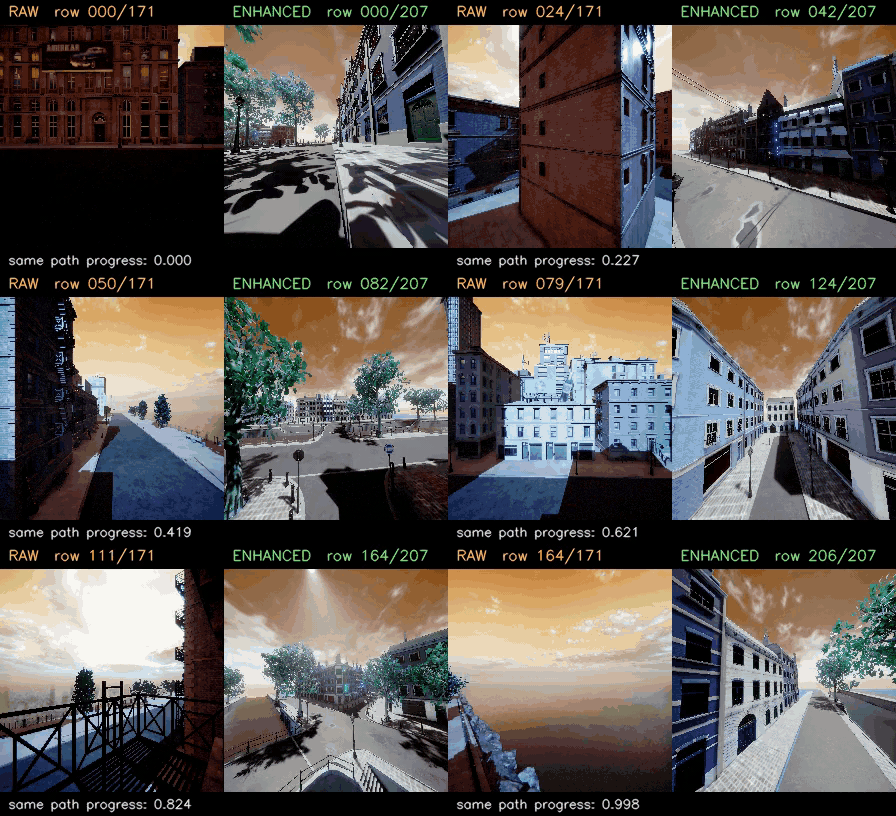
Each animation aligns one raw trajectory with its enhanced version. Click an animation to open the MP4.
 AerialVLN · Example 1 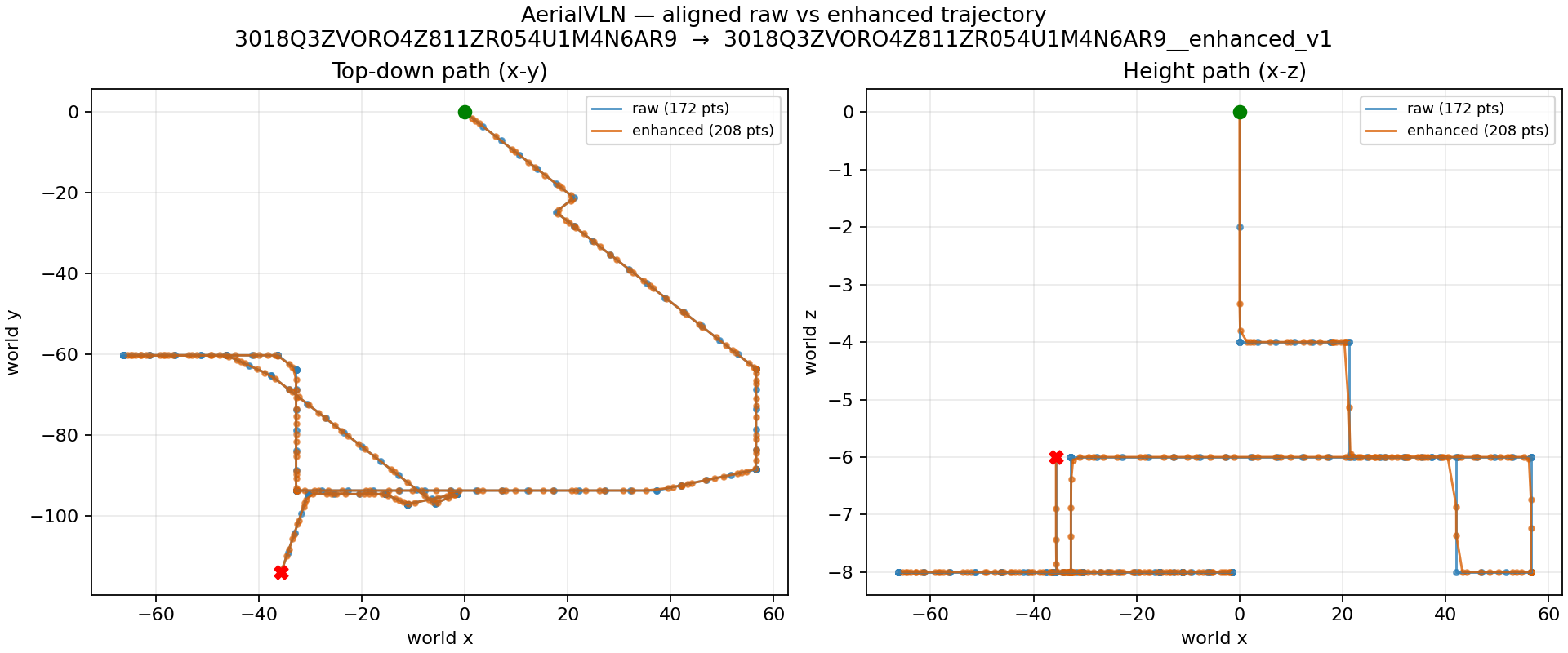 | 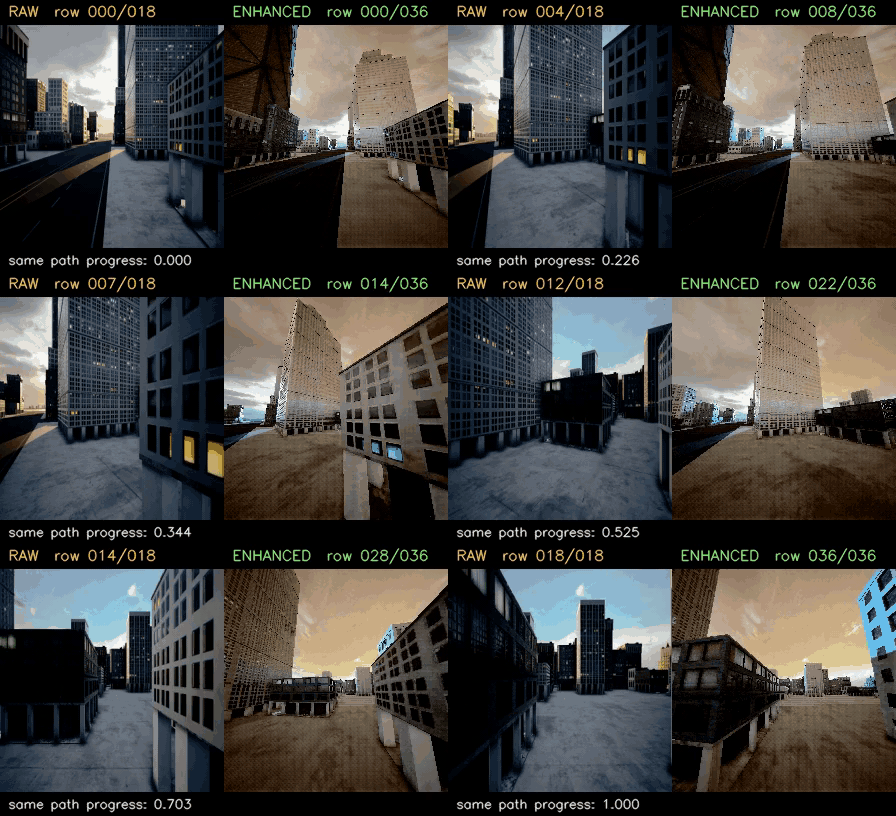 OpenFly · Episode 000008 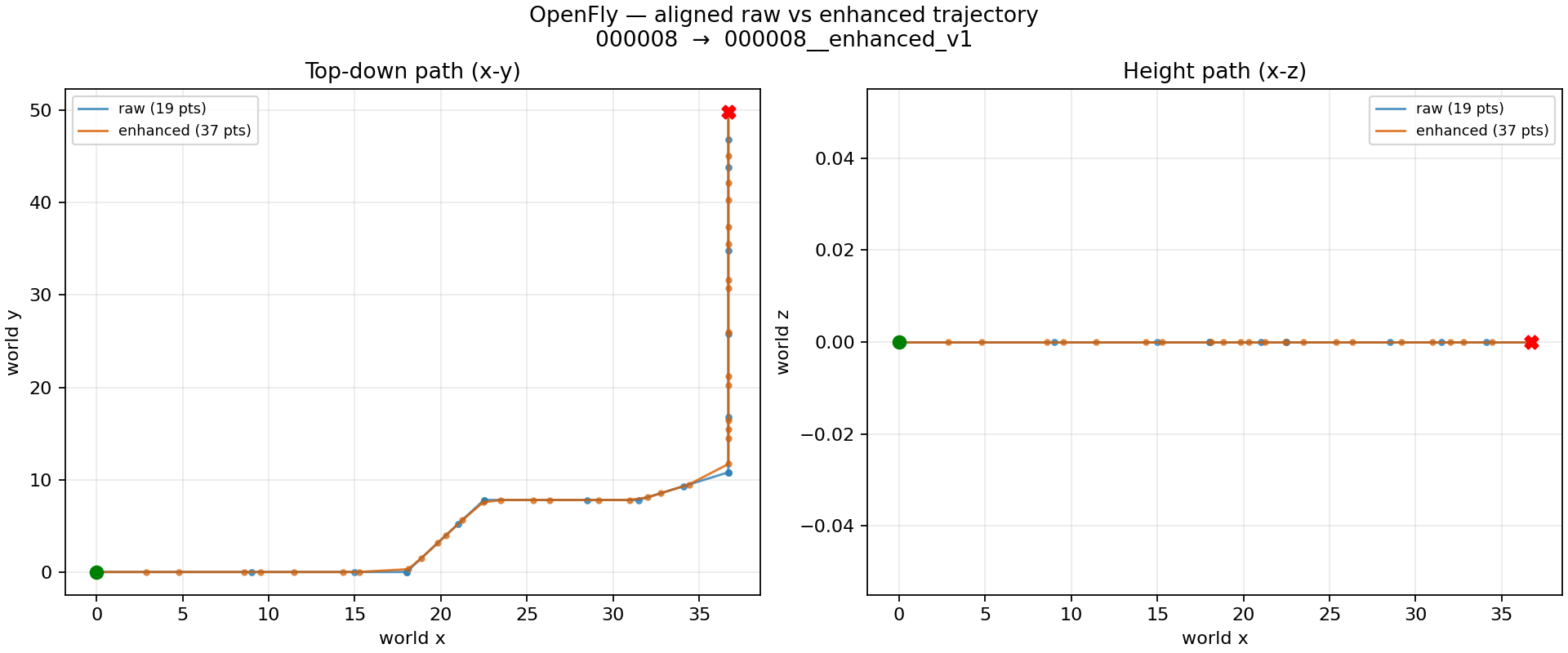 |
Model
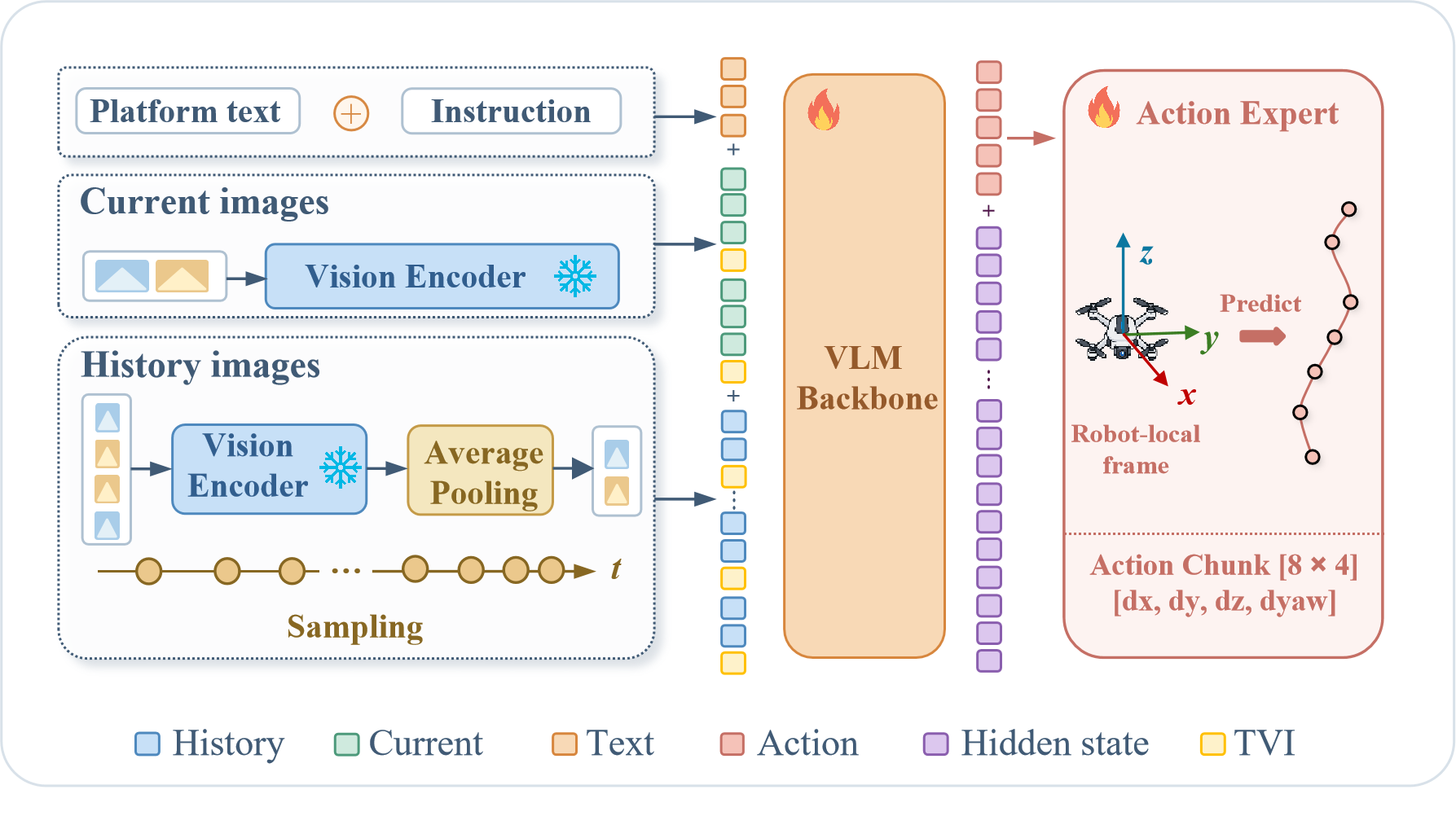
SimpleNav combines a vision-language backbone, selected long history, temporal-view context, and a continuous action head. The model consumes the protocol above and keeps dataset-specific coordinate semantics in the adapter.
Results
We adopt Qwen3.5-VL 4B as the unified vision-language backbone, and complete model training and closed-loop evaluation on 6 benchmarks respectively. Except for the necessary adaptation of data and task interfaces, we do not perform task-specific performance optimization for any individual benchmark. The results are summarized as follows. Full comparison tables and protocol notes are in Release 01 Benchmarks.
| Benchmark | Split | NE↓ | SR↑ | OS/OSR↑ | SPL↑ | nDTW↑ | SDTW↑ |
|---|---|---|---|---|---|---|---|
| OpenFly | Seen | 37.1 m | 52.8 | 74.2 | 51.0 | - | - |
| TravelUAV | Test Seen / Full | 85.6 m | 22.4 | 55.1 | 20.5 | - | - |
| AerialVLN-S | Val Seen | 126.0 m | 8.4 | 18.9 | - | - | 3.4 |
| R2R-CE | Val-Unseen | 4.7 m | 49.2 | 55.9 | 45.8 | - | - |
| RxR-CE | Val-Unseen | 4.6 m | 58.4 | - | 52.2 | 74.6 | - |
| Benchmark | Task | SR↑ | TR↑ | CR↓ |
|---|---|---|---|---|
| EVT-Bench | STT | 82.8 | 93.5 | 1.2 |
Demos
Selected rollout trajectory previews are shown below. See the project-page video gallery for full videos.
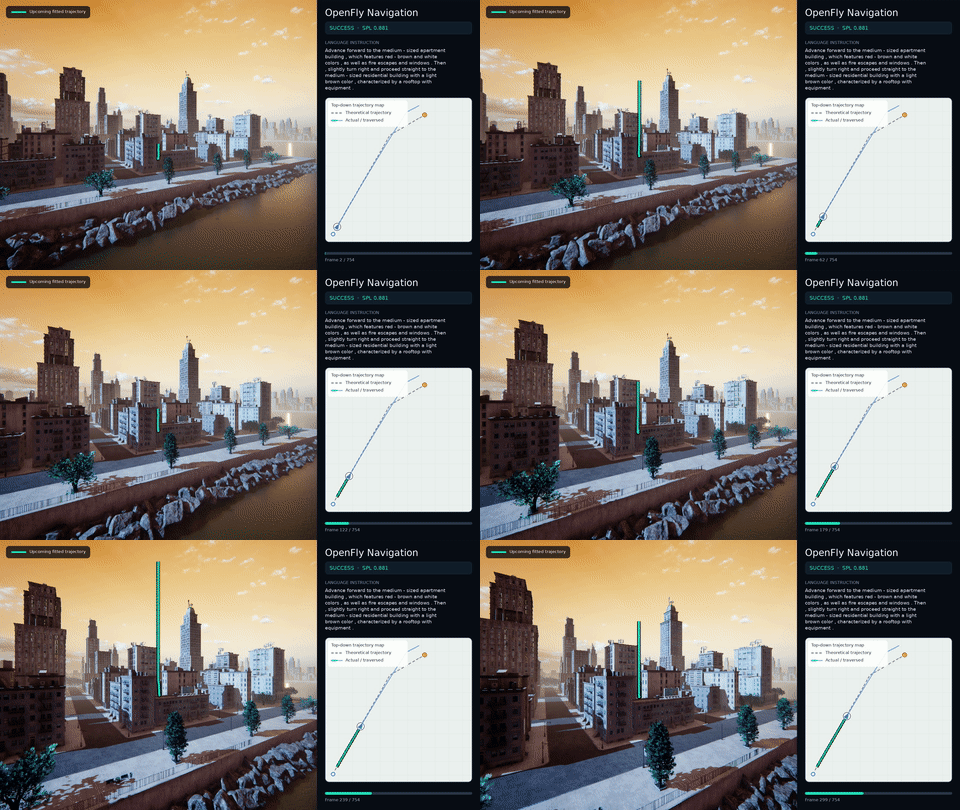 OpenFly · Env 16 | 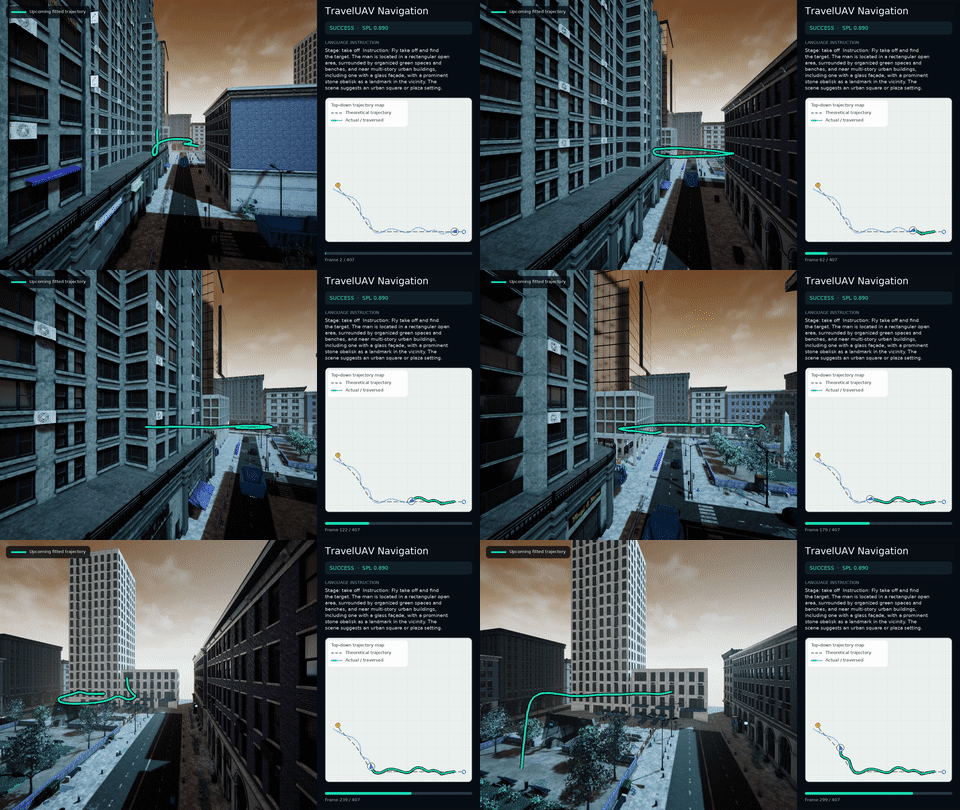 TravelUAV · Modern City |
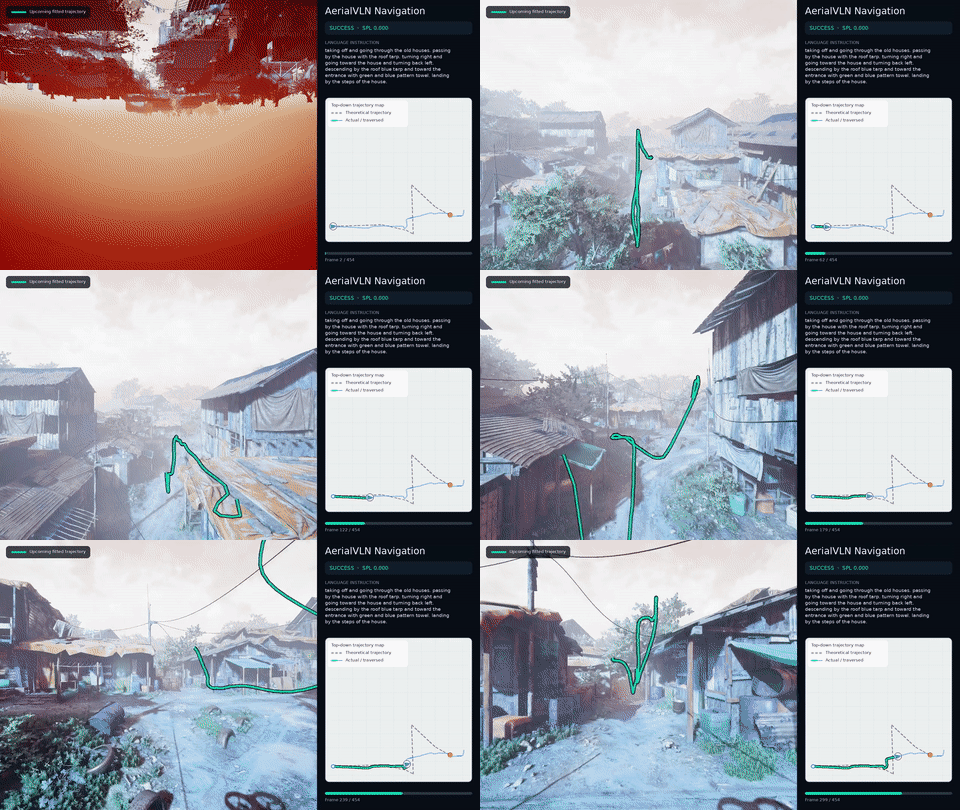 AerialVLN · Env 8 | 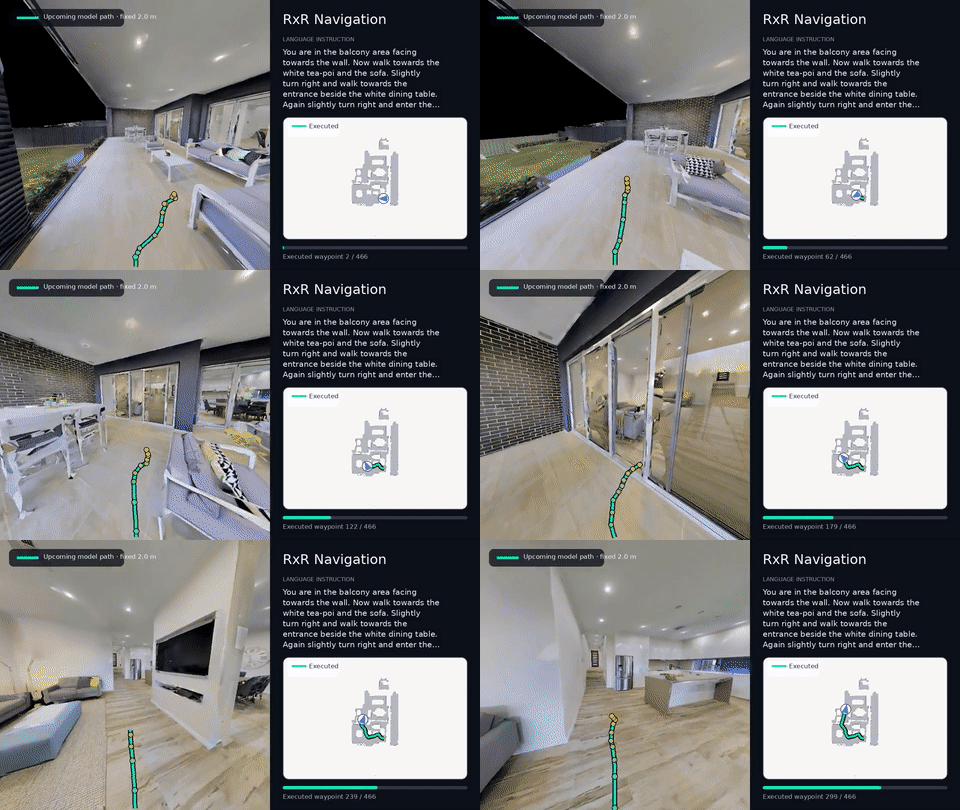 RxR-CE · Episode 10129 |
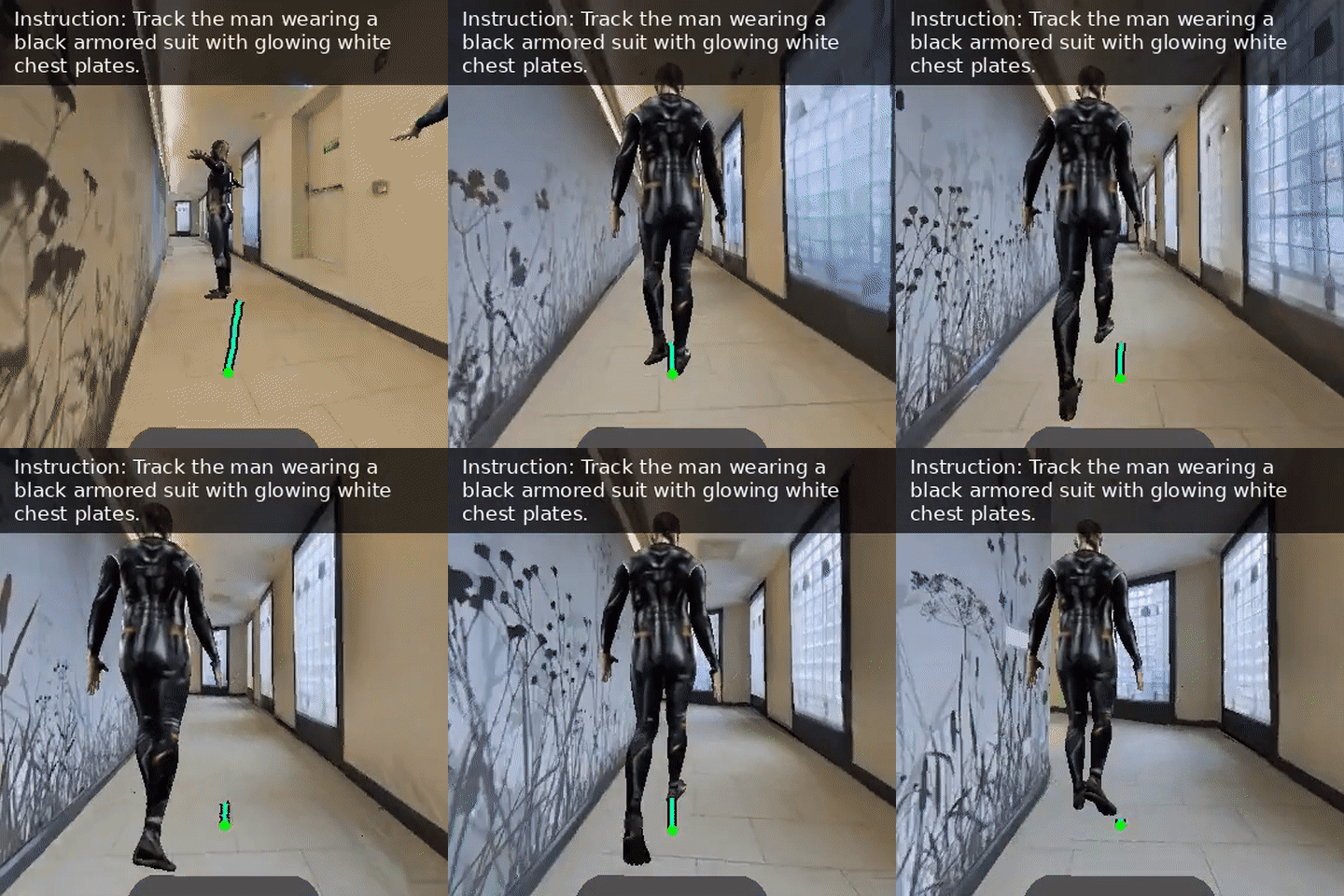 EVT-Bench · Scene 2 | 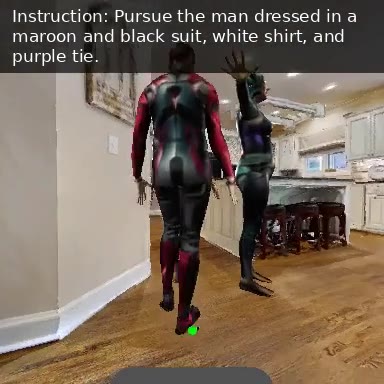 EVT-Bench · Scene 30 |
Risks and Limitations
- SimpleNav is a research framework, not a safety-certified flight-control system. Do not use model outputs as the sole control authority.
- Validate in simulation and controlled environments with qualified supervision, manual override, emergency stop, geofencing, and independent safety monitors.
- Performance can degrade under distribution shift, perception or communication latency, actuator/simulator mismatch, and coordinate or action-protocol errors.
- No guarantee is made for collision avoidance, fail-safe behavior, or regulatory compliance; operators remain responsible for deployment decisions.
Quick Start
Public resources:
Place downloaded packages in the repository-relative local/ layout below.
1. Clone and install the model environment
Requirements: Linux, Python 3.10, and a model-compatible NVIDIA driver. Dataset conversion also requires ffmpeg; closed-loop evaluation requires the corresponding simulator and scene assets.
git clone -b SimpleNav https://github.com/OpenBMB/SimpleNav.git SimpleNav
cd SimpleNav
curl -LsSf https://astral.sh/uv/install.sh | sh
uv python install 3.10
uv sync --frozen --no-dev
uv run --no-sync python -c "import torch, transformers; print(torch.__version__, transformers.__version__)"
For the Qwen3.5 reference recipe, install the optional CUDA extension after the base environment succeeds:
uv sync --frozen --no-dev --extra flash-attentionSee Installation for the Conda data-tool environments and system packages.
2. Prepare data
Install only the data component you need. For raw-dataset conversion:
cd data_pipeline/dataset_conversion
conda env create -f environment.yml
conda activate vln-dataset-conversion
vln-convert --help
The other component entry points are:
data_pipeline/trajectory_augmentation  -> vln-augment
data_pipeline/image_collection         -> vln-collect
Follow Data Preparation, then place local resources under:
local/
├── models/                         # base VLMs and auxiliary models
├── data/                           # converted datasets and benchmark inputs
├── checkpoints/                    # SimpleNav checkpoints + dataset_statistics.json
├── simulators/                     # AirSim/Habitat runtimes and scene assets
├── eval_results/
└── results/
Validate a converted split:
uv run --no-sync python -m tool.navvla.cli.validate_dataset \
  local/data/<dataset>/<split> --visual-token-mode online_images --smoke-load 8
3. Train
The public reference recipe is OpenFly Qwen3.5-VL training:
bash examples/NavVLA/train_files/qwen35/run_train.sh \
  examples/NavVLA/train_files/qwen35/navvla_qwen35_cpm_openfly_portable.yaml \
  --dry-run

bash examples/NavVLA/train_files/qwen35/run_train.sh \
  examples/NavVLA/train_files/qwen35/navvla_qwen35_cpm_openfly_portable.yaml
Copy the portable config before changing data mixtures, GPU counts, or attention implementations. See Training.
4. Evaluate
Each public config resolves paths relative to its own directory.
| Benchmark | Config | Launcher |
|---|---|---|
| OpenFly | NavVLAeval/openfly/config_portable.yaml | bash NavVLAeval/openfly/run_eval.sh |
| TravelUAV | NavVLAeval/traveluav/config_portable.yaml | bash NavVLAeval/traveluav/run_eval.sh |
| AerialVLN | NavVLAeval/aerialvln/config_portable.yaml | bash NavVLAeval/aerialvln/run_eval.sh |
| AerialVLN-S Val Seen · action stop | NavVLAeval/aerialvln/config_qwen35_tb1024_ph32_s_seen_stop_finalseg0p292_k2.yaml | bash NavVLAeval/aerialvln/run_eval.sh --config <config> |
| EVT-Bench | NavVLAeval/track/eval_qwen35_track.py | bash NavVLAeval/track/run_qwen35_track_eval.sh |
| R2R-CE | NavVLAeval/vlnce/r2r/config_portable.yaml | bash NavVLAeval/vlnce/r2r/run_eval.sh |
| RxR-CE | NavVLAeval/vlnce/rxr/config_portable.yaml | bash NavVLAeval/vlnce/rxr/run_eval.sh |
Inspect a two-episode plan before starting a simulator:
bash NavVLAeval/openfly/run_eval.sh --dry-run \
  --override benchmark.max_samples=2 \
  --override parallel.gpu_ids='[0]' \
  --override output.run_name=openfly_dry_run
See Evaluation for resource layout, execution, resume, and artifacts.
For the OpenFly, AerialVLN, and TravelUAV data-to-training-to-evaluation workflow, use Aerial Training and Evaluation.
For the released R2R-CE and RxR-CE Qwen3.5 workflow, use VLN-CE Training and Evaluation.
Documentation
| Task | Document |
|---|---|
| Install environments | Installation |
| Convert, augment, and render data | Data Preparation |
| Understand state/action semantics | Data Structure and State/Action Protocol |
| Understand or extend the model | Model Architecture |
| Find model and checkpoint entries | Models and Checkpoints |
| Train a model | Training |
| Reproduce mixed EVT-Bench training/evaluation | EVT_BENCH_RECIPE |
| Run a benchmark | Evaluation |
| Reproduce OpenFly, AerialVLN, and TravelUAV training/evaluation | Aerial Training and Evaluation |
| Reproduce R2R-CE and RxR-CE training/evaluation | VLN-CE Training and Evaluation |
| Inspect complete results | Release 01 Benchmarks |
| Read the project direction | Vision and Roadmap |
Roadmap
- Maintain released checkpoints, model cards, converted-data manifests, dataset cards, and simulator packages.
- Add portable multi-domain training recipes and extend the released single-dataset workflows.
- Expand model backbones, history and memory modules, action heads, and platform adapters.
- Publish reproducible result bundles with resolved configs and episode-level artifacts.
- Connect evaluation failures to data generation and the next training iteration.
Citation
If SimpleNav is useful in your work, please cite the repository.
@software{simplenav,
  title = {SimpleNav: Make Navigation VLA Simple},
  author = {{SimpleNav Contributors}},
  year = {2026},
  url = {https://github.com/OpenBMB/SimpleNav},
}
License
Repository source code is released under the MIT License. Datasets, pretrained models, simulators, scene assets, and third-party components retain their own licenses.
Acknowledgements
We thank pioneering navigation VLA studies, including NavFoM, Qwen-RobotNav, ABot-N0, starVLA and InternVLA-N1, whose valuable explorations have helped shape and advance this field.
SimpleNav builds upon starVLA, Qwen-VL, LeRobot, PyTorch, Transformers, DeepSpeed, AirSim, Habitat, as well as the datasets and benchmarks described above. We gratefully acknowledge these open-source contributions and encourage users to cite the original projects and datasets employed in their experiments.