| 📜 Blog |
News
- [2026-06] ⚡ Release FlashQLA v0.1.1 — adds intra-card sequence parallelism for the backward pass and SM100 support. Also upgrades tilelang to v0.1.9 and aligned entry function signatures to the latest
flash-linear-attentioninterface..
Introduction
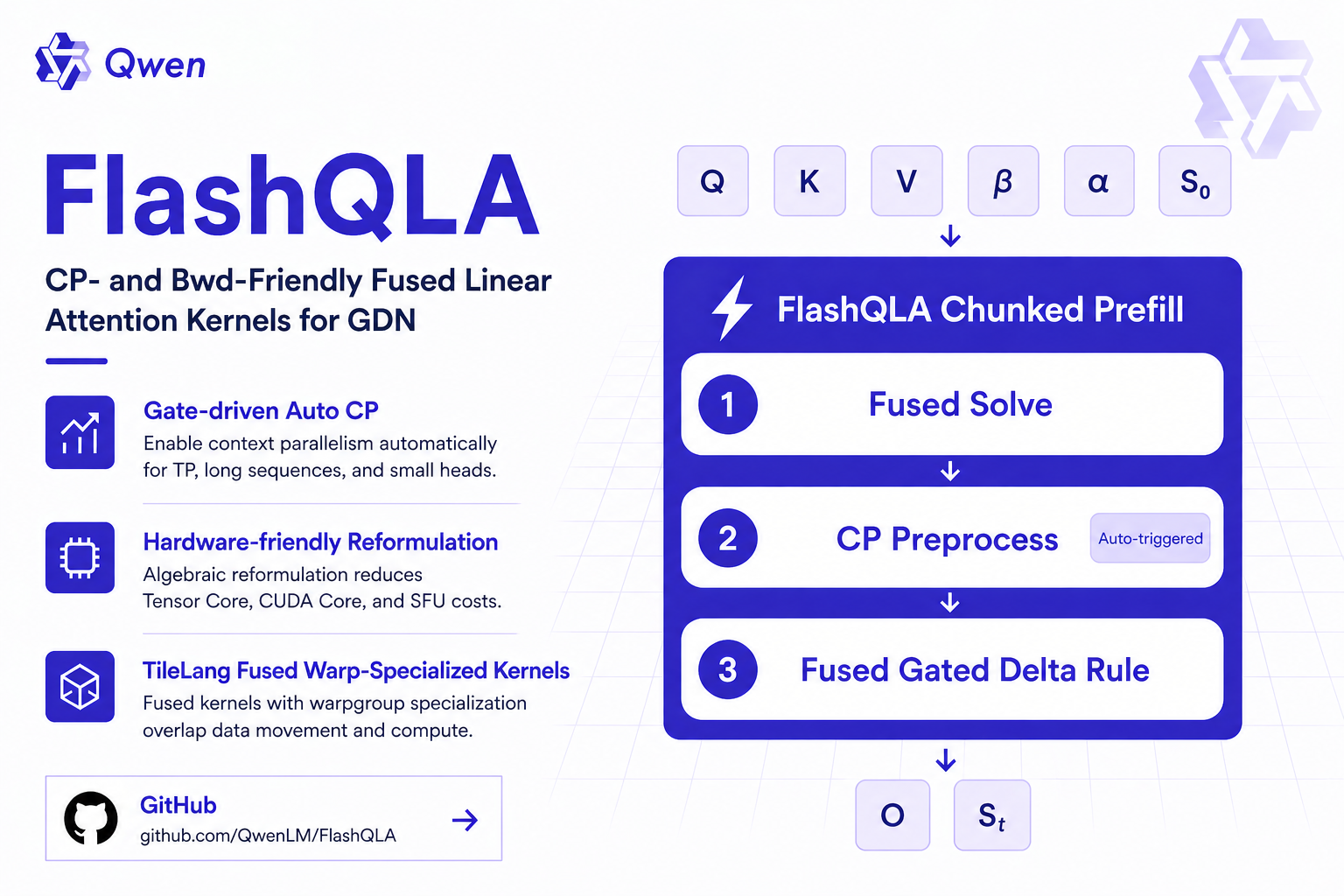
FlashQLA is a high-performance linear attention kernel library built on TileLang. FlashQLA applies reasonable operator fusion and performance optimization to the forward and backward passes of GDN Chunked Prefill, achieving 2-3× forward speedup and 2× backward speedup over the FLA Triton kernel across multiple scenarios on NVIDIA Hopper and Blackwell. The efficiency gains are particularly pronounced in pretraining scenarios and edge-side agentic inference.
Key features:
1.Gate-driven automatic intra-card context parallelism. By exploiting the exponential decay property of the GDN gate, FlashQLA automatically enables intra-card CP under TP, long-sequence, and small-head-count settings, improving GPU SM utilization.
2.Hardware-friendly algebraic reformulation. We reformulate the forward and backward flows of GDN Chunked Prefill to a certain extent, effectively reducing Tensor Core, CUDA Core, and SFU overhead without sacrificing numerical precision.
3.TileLang fused warp-specialized kernels. Rather than following the step-by-step decomposition into independent kernels, nor fusing the entire computation flow into a single kernel, we take CP and backward requirements into account, use TileLang to build several key fused kernels, and manually implement warpgroup specialization to overlap data movement, Tensor Core computation, and CUDA Core computation.
Requirements
- SM90 or SM100
- CUDA 12.8 or above
- PyTorch 2.8 or above
Installation
git clone https://github.com/QwenLM/FlashQLA.git
cd FlashQLA
pip install -v .
Usage
High-level API
import torch
from flash_qla import chunk_gated_delta_rule

o, final_state = chunk_gated_delta_rule(
    q=q,          # [B, T, H_q, K]
    k=k,          # [B, T, H_q, K]
    v=v,          # [B, T, H_v, V]
    g=g,          # [B, T, H_v]
    beta=beta,    # [B, T, H_v]
    scale=scale,
    initial_state=initial_state,   # optional, [B, H_v, K, V]
    output_final_state=True,
    cu_seqlens=cu_seqlens,         # optional, for variable-length sequences
)
Low-level API
For separate forward and backward calls:
from flash_qla import chunk_gated_delta_rule_fwd, chunk_gated_delta_rule_bwd

# Forward
g, A, o, h, final_state = chunk_gated_delta_rule_fwd(
    q, k, v, g, beta, scale=scale, initial_state=h0, cu_seqlens=cu_seqlens
)

# Backward
dq, dk, dv, db, dg, dh0 = chunk_gated_delta_rule_bwd(
    q, k, v, g, beta, A, do, dht=dht, scale=scale, initial_state=h0, cu_seqlens=cu_seqlens
)
Tests
python -m pytest tests/test_gdr_unit.py -vProfiling
# require flash linear attention for comparison
pip install flash_linear_attention==0.5.0

python profile/profile_gdr.py --set develop
python profile/profile_gdr.py --set develop --skip-bwd
Benchmark
We benchmarked FlashQLA against the FLA Triton and FlashInfer baseline (FLA 0.5.0, Triton 3.5.1, FlashInfer 0.6.9, TileLang 0.1.8) on the head configurations used by the Qwen3.5 / Qwen3.6 family h_k,v \in {64, 48, 32, 24, 16, 8}, corresponding to TP1 through TP8.
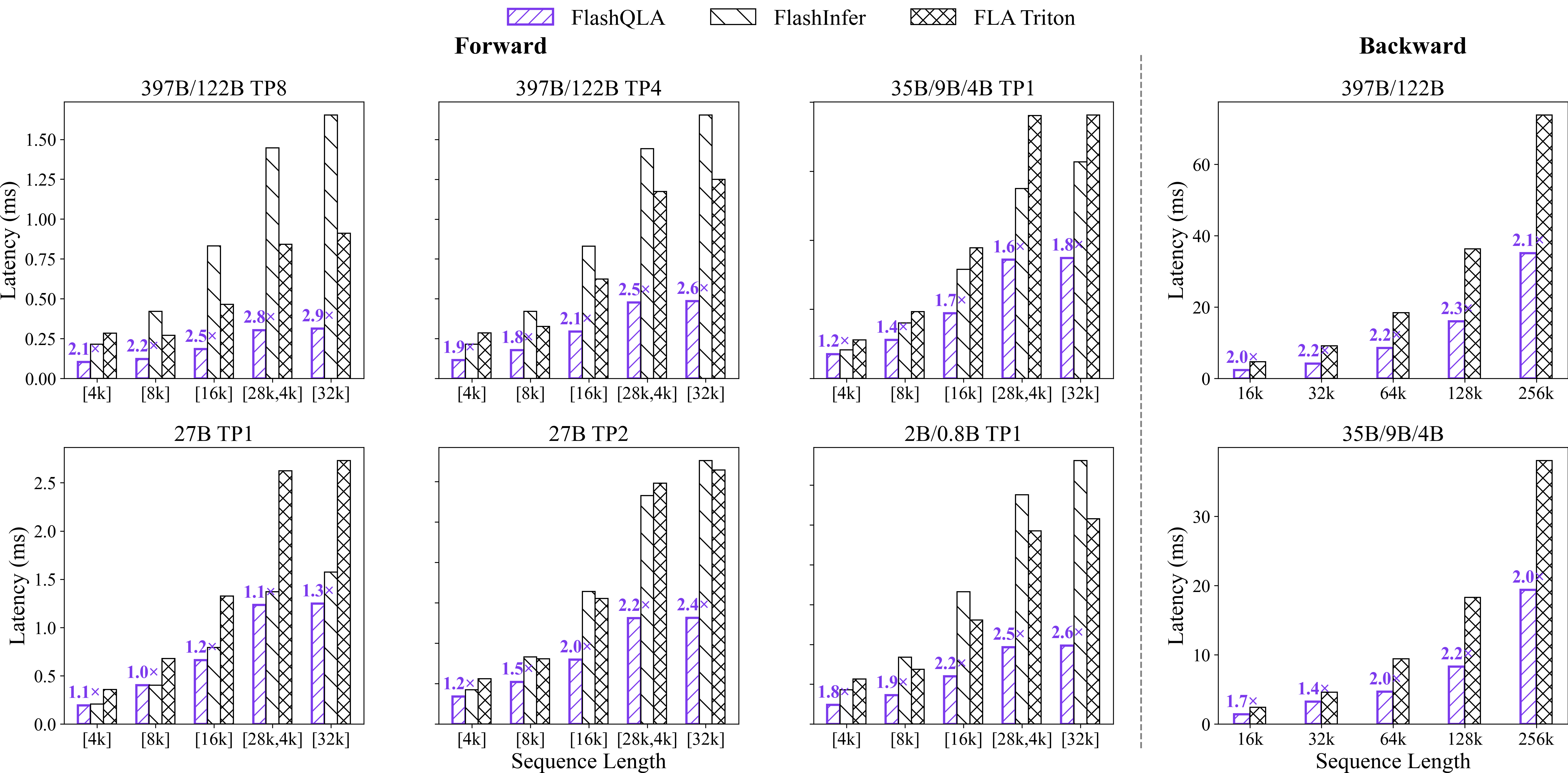
Specifically, the forward (FWD) benchmarks measure single-kernel latency for different models and TP settings under varying batch lengths, while the backward (BWD) benchmarks examine the relationship between total token count within a batch and latency during a single update step.
More detail in benchmark_results_H200.txt and benchmark_results_GB200.txt.
# require flash linear attention and flashinfer for comparison
pip install flash_linear_attention==0.5.0 flashinfer-python==0.6.13

python benchmark/bench_gated_delta_rule.py
Acknowledge
FlashQLA is inspired by Flash Linear Attention, TileLang and FlashInfer projects.
License
FlashQLA is released under the MIT License.
Citation
@misc{flashqla2025,
    title={FlashQLA: Flash Qwen Linear Attention},
    author={Zhang, Chengruidong and Lin, Xi and Jiang, Huiqiang and Wang, Zekun and Li, Xiao and Cao, Yizhong and Zhuang, Bohan and Men, Rui and Zhang, Jianwei and Zheng, Bo and Lin, Junyang and Liu, Dayiheng and Zhou, Jingren},
    year={2026},
    publisher={GitHub},
    howpublished={\url{https://github.com/QwenLM/FlashQLA}},
}