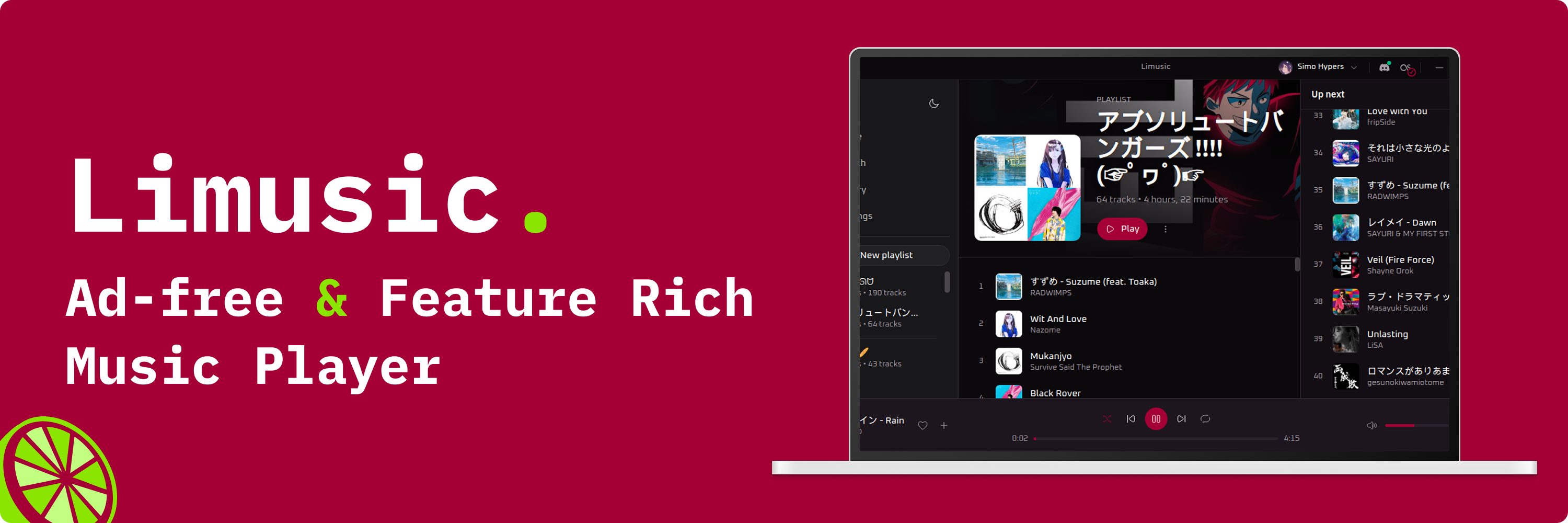
Limusic
A native desktop YouTube Music client. Rust + Tauri, ad-free, no Electron.






Limusic talks directly to YouTube's internal API and plays audio through libmpv: no bundled browser runtime, no backend server, no ads in the audio. It started as a desktop rebuild of the playback engine behind Metrolist, an Android YouTube Music client, and grew from there.
Features
- Ad-free playback: streams come straight from YouTube's API, ads never do
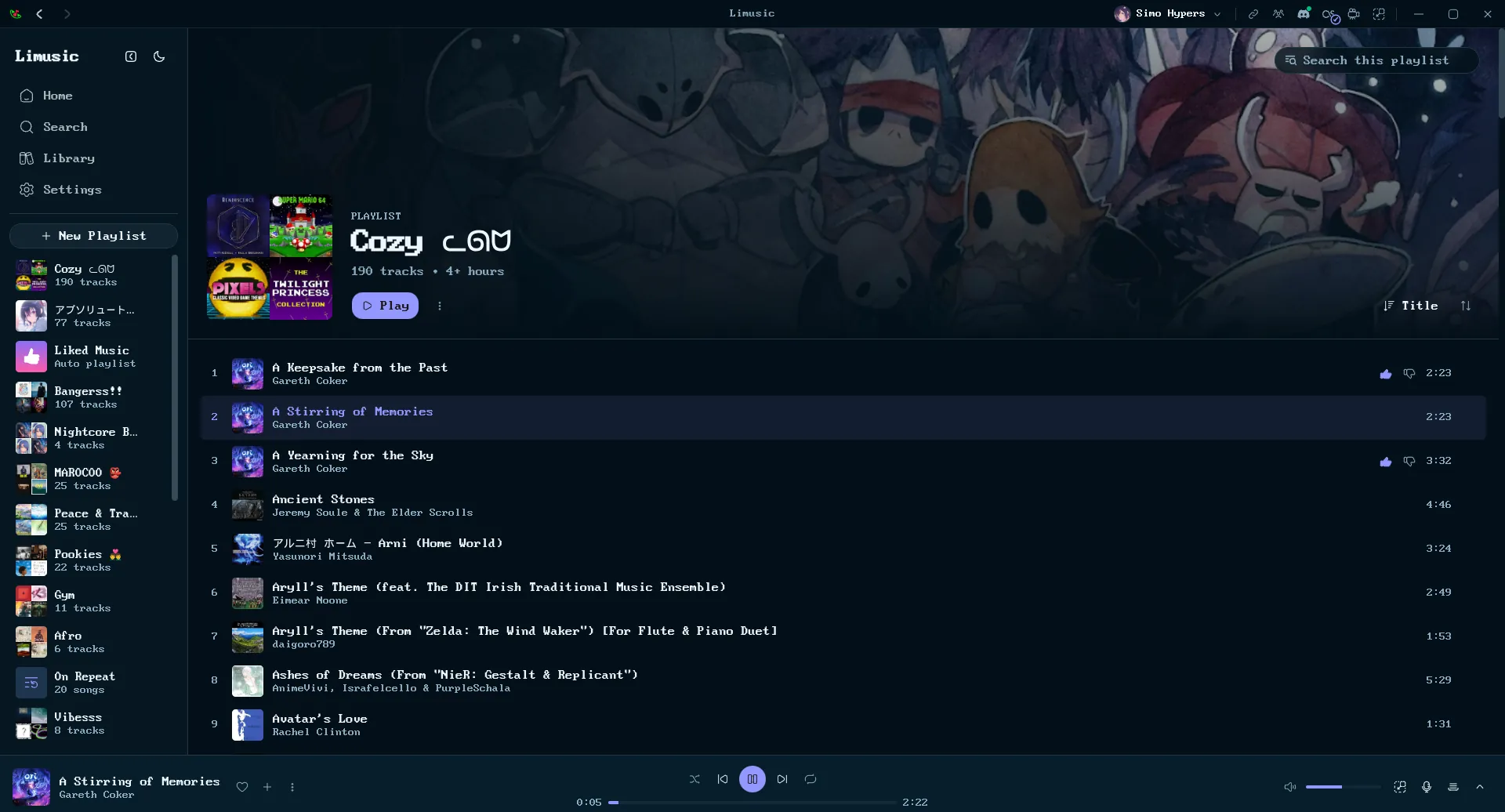
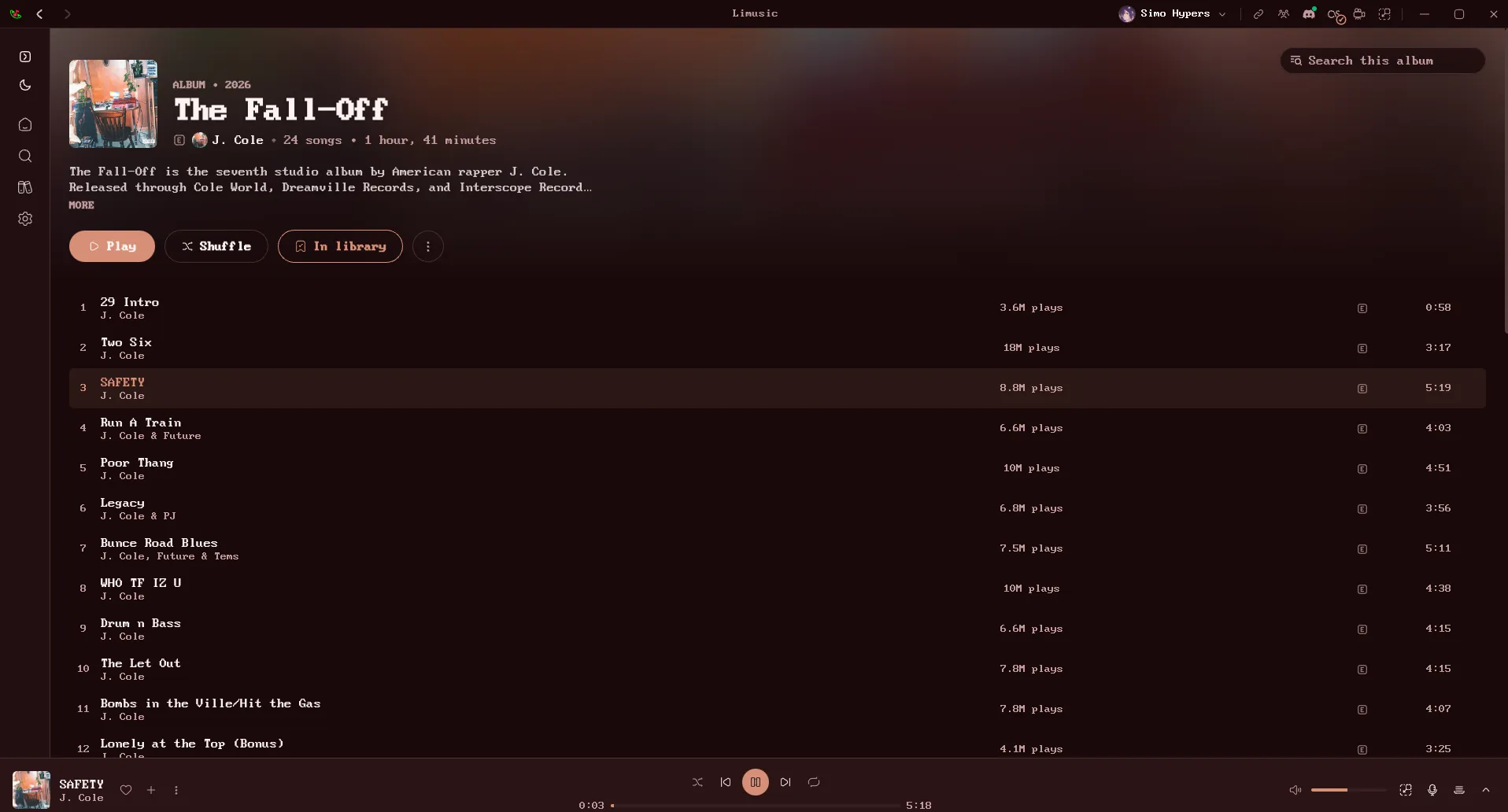
- Search & browse: songs, albums, artists, playlists and the YTM home feed, with results previewing as you type
- Sign in with your YouTube Music account: in-app Google login or cookie-paste, several accounts at once with switching between them
- Your library: playlists, liked songs, saved albums and artists, your uploads, and write actions (like, add to playlist, create/edit/delete playlists including cover art, subscribe, save to library)
- History: everything you have played, in YouTube Music's own day buckets
- Gapless playback with loudness normalization, powered by libmpv
- Queue with radio/automix continuation, drag to reorder, restored across restarts
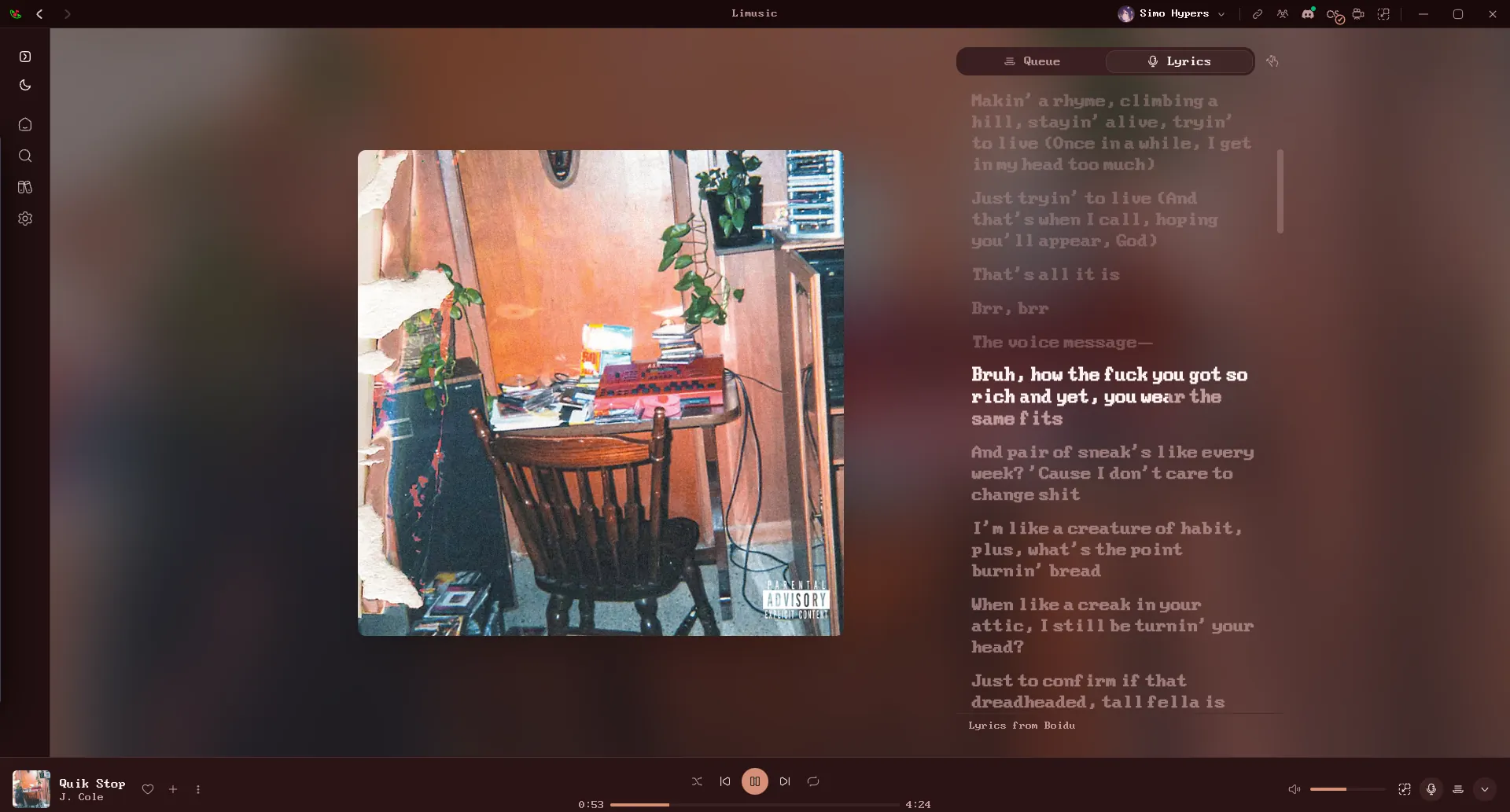
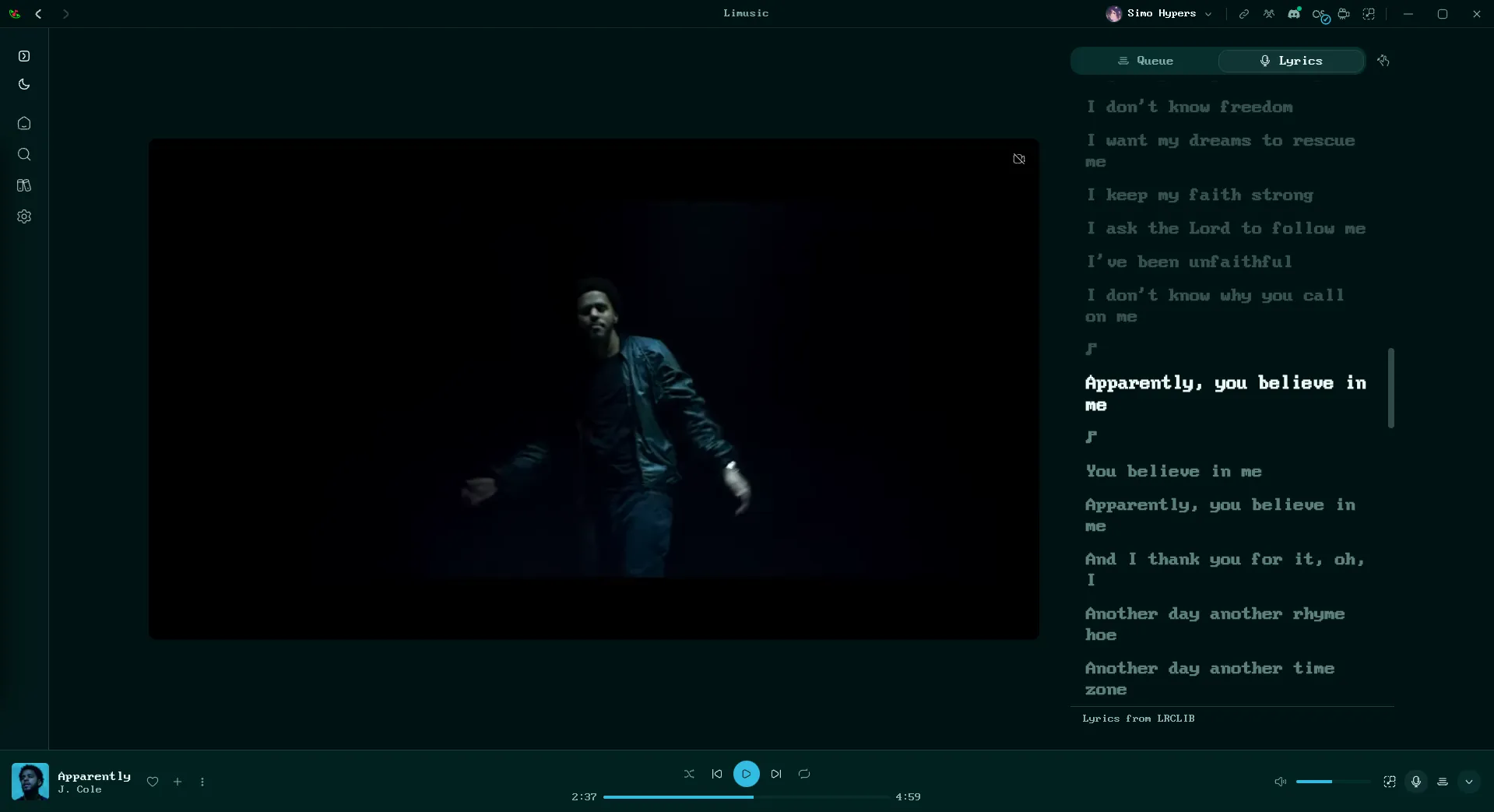
- Synced lyrics: side panel with auto-scroll and click-to-jump, word by word where the source has the timings, with translations under each line
- Music videos: optional, the video plays where the artwork sits, with the same gapless audio behind it
- Mini Player and theater mode: shrink to a strip that keeps playing, or go fullscreen with cover and lyrics side by side
- Local Music: play your own files, with all metadata still intact
- Last.fm scrobbling: connect once from the title bar, every play is scrobbled
- Discord Rich Presence: artwork, live progress bar, one click to toggle
- OS media keys and now-playing integration (MPRIS on Linux, SMTC on Windows, plus playback buttons on the Windows taskbar preview)
- System tray: close the window, keep the music; play/pause and skip from the tray, optional start-on-login
- Listen Together: synced listening rooms over a small self-hosted relay
- Keyboard and mouse:
Ctrl+Ksearches from anywhere,Ctrl+Hlists every shortcut, right-click menus throughout,Ctrland the wheel zooms the interface - Six languages: English, Spanish, French, Turkish, Brazilian Portuguese and Indonesian, with more in progress
- Self-updating builds (AppImage on Linux, setup.exe on Windows, .app on macOS)
- Make it yours: accent palettes, custom colors, your own fonts, corner roundness, a custom app icon, and an adaptive theme that recolors the app from the playing cover
Screenshots
 |  |
 |  |
Download & Install

| Platform | File | Notes |
|---|---|---|
| Linux | .AppImage | Self-updating, libmpv bundled. Needs glibc 2.39+ (Ubuntu 24.04+, Debian 13+, Fedora 40+) |
| Linux (Ubuntu/Debian) | .deb | No self-update. Needs Ubuntu 24.04+ / Debian 13+; apt pulls libmpv and webkit2gtk in for you |
| Linux (Fedora/RHEL) | .rpm | Needs mpv-libs installed (sudo dnf install mpv-libs). Updates through dnf, not in-app |
| Linux (Arch) | AUR | yay -S limusic-bin. Community-maintained by @xiryuudev, updates through pacman |
| Windows | -setup.exe | Self-updating |
| Windows | .msi | Plain installer, no auto-update |
| macOS (Apple Silicon) | .dmg | Self-updating. Unsigned, so the first launch needs xattr -dr com.apple.quarantine /Applications/limusic.app |
| macOS (Intel) | none | Build from source, see docs/BUILD-PLATFORMS.md |
Scrobbling & Discord
Both live in the title bar, next to the window controls.
- Last.fm: click the Last.fm mark, approve Limusic in the browser tab that opens, and you're connected for good. Tracks scrobble at the halfway point (or four minutes, whichever comes first), which is Last.fm's own rule. Click again to see the account or disconnect.
- Discord: click the Discord mark to toggle Rich Presence. Green dot means it's live. The card shows the track, artist, album art, and a progress bar, and it disappears when you pause.
Building from source? Last.fm needs your own API credentials, and they are not in
the repo. Get a key at last.fm/api/account/create
and put it in src-tauri/lastfm.keys:
LIMUSIC_LASTFM_API_KEY=your_key
LIMUSIC_LASTFM_API_SECRET=your_secret
Without that file everything else still builds and runs; the Last.fm button just reports that it isn't configured.
Lyrics
Open the panel with the microphone button in the player bar, next to the queue button. It takes the same side of the window as the queue, so opening one closes the other.
Lyrics come from Boidu first, then LRCLIB, then YouTube Music's own timed lyrics, then Netease, QQ Music and Kugou, falling back to plain un-timed text when nobody has a synced version. Matching is keyed on the track's exact length, because popular songs exist as several cuts and the wrong one drifts a few seconds out. Results are cached locally, so replaying a track is instant.
Boidu is the only source with per-word timings, which is what lets a line highlight word by word as it's sung. It goes first for that reason, which also means it is asked about every track you play. Turn it off in Settings -> Playback -> Word-by-word lyrics and the other sources still provide line-by-line lyrics. Netease additionally supplies translations, shown under each line where it has them.
Note that YouTube Music's lyrics are licensed per region and are missing entirely in some countries. Where that's the case, LRCLIB does all the work.
Listen Together
Synced listening with friends. Everyone streams their own audio from YouTube; the room only relays play/pause, seeks, track changes and the queue. One person hosts the relay:
cargo run -p sync-server # plain WebSocket on 0.0.0.0:8080Front it with something that terminates TLS (Tailscale Funnel, Cloudflare
Tunnel), then paste the wss:// URL into the Listen Together panel in the app.
Rooms have join codes and the host approves every join and every track
suggestion.
Translations
Limusic is translated on Weblate, who host it free for libre projects.

English, Spanish, French, Turkish, Brazilian Portuguese and Indonesian ship in the app today. The badge above shows everything else in flight.
Translate on Weblate, not in a pull request. Weblate keeps its own copy of
the catalogs, so a hand-edited fr.json merged here puts the two out of sync
and the next batch of real translations arrives as a merge conflict. Weblate
also shows you the English original beside each string, flags translations that
went stale when the English changed, checks that placeholders like {count}
survived, and opens the pull request for you. Anything untranslated falls back
to English in the app, so partial work is safe to submit.
en.json is the exception: it changes by hand, in whichever pull request
changes the UI. Switching a finished language on in the picker takes a small
code change too, see CONTRIBUTING.md.
Building from Source
Fedora:
sudo dnf install mpv-libs mpv-libs-devel webkit2gtk4.1-devel \
  gcc gcc-c++ make openssl-devel librsvg2-devel
cd ui && pnpm install && cd ..
cargo tauri build
Windows and macOS instructions live in docs/BUILD-PLATFORMS.md.
How It Works, Briefly
- A pure Rust crate speaks YouTube's InnerTube API, impersonating several official client identities and falling back between them when one fails.
- YouTube's stream URLs are protected by obfuscated JavaScript (the signature
cipher and the
nparameter) and by BotGuard attestation. Limusic runs that JavaScript where it expects to run, in a real webview, hidden, and never lets any of it touch the UI process. - Audio goes through libmpv: gapless transitions, an on-disk cache, and loudness normalization from YouTube's own metadata.
- The UI is a SvelteKit SPA that only ever talks to the Rust core. It never contacts YouTube itself.
Support
Limusic is free and stays free. If it earned a coffee, ko-fi.com/simohypers is where to leave one.
Disclaimer
This project is not affiliated with, funded, authorized, endorsed by, or in any way associated with YouTube, Google LLC, or any of their affiliates and subsidiaries.
All trademarks, service marks, and intellectual property rights referenced in this project belong to their respective owners.