TokenTest
Prove the model, route, usage, and safety before production.
Black-box model verification for AI routers, procurement teams, and CI pipelines.
Website · Product Manual · Remote MCP · GitHub



TokenTest is the production-reference evaluation layer for AI middle-layer buyers. It tests an OpenAI-compatible or Anthropic-style router from the outside, compares the model you requested with the model you actually received, audits token usage, probes safety and channel behavior, and turns the evidence into a production admission decision.
It is deliberately different from an AI gateway: TokenTest does not proxy your application traffic, manage provider keys, or claim to improve an upstream SLA. It helps you decide whether a route is trustworthy before you put it behind your gateway.
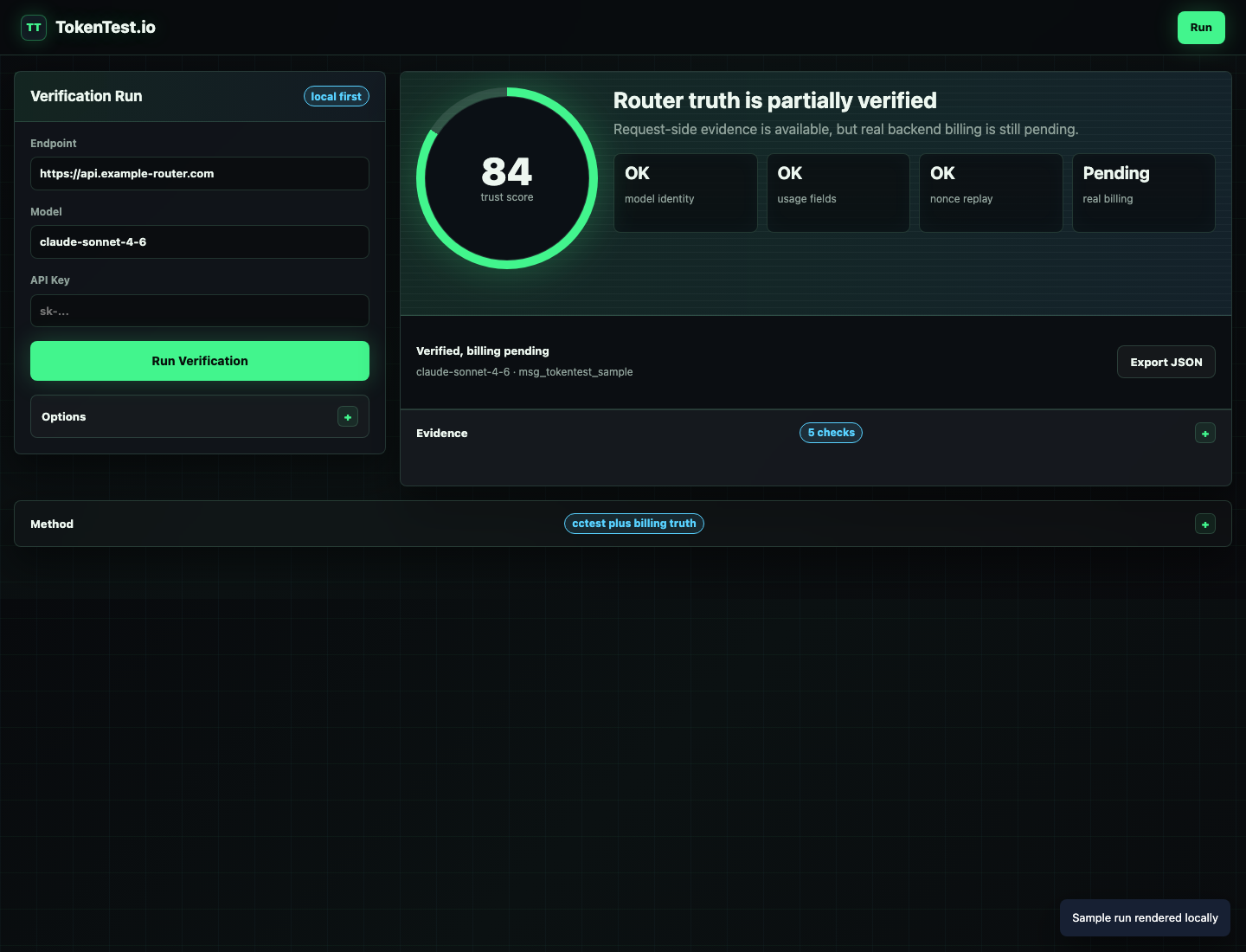
What can you do with TokenTest?
- Evaluate one model or a batch of models through the web console.
- Discover models exposed by an OpenAI-compatible
/modelsendpoint. - Detect silent model downgrades, protocol mismatches, suspicious usage numbers, and endpoint-level failures.
- Review six production-reference dimensions in one report: identity, deterministic output, channels, tokens, safety, and stability.
- Gate deployments from CI with
npx tokentest evaluateand strict exit codes. - Connect Claude Desktop, Cursor, VS Code, or another MCP client to
discover_models,evaluate_model, andevaluate_batch. - Export JSON, CSV, HTML, or JUnit evidence for procurement, release review, and incident follow-up.
- Keep browser history locally, with API keys and raw authorization evidence excluded from saved reports.
Quickstart
1. Open the evaluation console
Visit tokentest.io, enter a router endpoint, a test-only upstream key, and one or more model IDs. You can click discover models when the router exposes /models, then start a quick or deep evaluation.
The browser sends probes to your configured router. TokenTest does not need a TokenTest account, and completed history stays in your browser's local storage.
2. Run a CI admission check
After publishing this package, run it directly with npx:
TOKENTEST_BASE_URL="https://api.example.com/v1" \
TOKENTEST_API_KEY="$MODEL_API_KEY" \
TOKENTEST_MODELS="model-a,model-b" \
npx tokentest evaluate \
  --min-score 80 \
  --format junit \
  --output tokentest.junit.xml
The command evaluates every requested model and applies strict admission. It exits 0 only when every model passes the score threshold, has production_reference_pass, has no critical identity/authentication/token gate failure, and completes without an evaluator error.
3. Run TokenTest locally
git clone https://github.com/SolveaCX/tokentest.io.git
cd tokentest.io
npm install
npm start
The console is available at http://localhost:8080. The local MCP server runs over stdio:
npm run mcpCLI reference
Command-line options override environment variables:
| Option | Environment variable | Description |
|---|---|---|
--base-url <url> | TOKENTEST_BASE_URL | Router base URL. |
--api-key <key> | TOKENTEST_API_KEY | Upstream router/model key. Used in memory for this run only. |
--model <id> | TOKENTEST_MODELS | Repeatable or comma-separated target model IDs. |
--provider openai|anthropic | TOKENTEST_PROVIDER | Optional protocol hint. |
--min-score 0..100 | TOKENTEST_MIN_SCORE | Minimum score; defaults to 80. |
--deep | — | Enable deeper coverage probes. |
--format summary|json|junit | TOKENTEST_FORMAT | Output format; defaults to summary. |
--output <file> | TOKENTEST_OUTPUT | Write the report to a file instead of stdout. |
Exit codes are designed for release gates:
| Code | Meaning |
|---|---|
0 | Every requested model passed strict admission. |
1 | Evaluation completed, but one or more models failed admission. |
2 | Invalid or missing configuration, argument, format, or output path. |
3 | Evaluation could not complete, or a model returned an evaluator error. |
Reports are sanitized before they are printed or written. API keys, authorization headers, raw request/response payloads, and captcha tokens are not included.
GitHub Actions
Use a repository or environment secret for the upstream key. JUnit output can be uploaded to the CI test-report UI; the non-zero exit code blocks the job when a model is not production-ready.
name: model-admission

on:
  pull_request:
  workflow_dispatch:

jobs:
  verify-model-route:
    runs-on: ubuntu-latest
    steps:
      - uses: actions/checkout@v4
      - uses: actions/setup-node@v4
        with:
          node-version: 20
      - name: Evaluate model route
        env:
          TOKENTEST_BASE_URL: ${{ secrets.MODEL_BASE_URL }}
          TOKENTEST_API_KEY: ${{ secrets.MODEL_API_KEY }}
          TOKENTEST_MODELS: claude-sonnet-4-6,gpt-4o-mini
        run: npx tokentest@latest evaluate --min-score 80 --format junit --output tokentest.junit.xml
      - name: Upload TokenTest evidence
        if: always()
        uses: actions/upload-artifact@v4
        with:
          name: tokentest-evidence
          path: tokentest.junit.xml
Six production-reference dimensions
The text evaluator scores six weighted dimensions. A high total score cannot override a production gate: P0/P1 failures and missing critical evidence remain visible in the risk verdict.
| Dimension | Weight | What it checks |
|---|---|---|
| D1 · Identity & Protocol Integrity | 30% | Requested vs resolved model, response shape, model registry, nonce replay, header provenance, and authentication compatibility. |
| D2 · Output Discipline & Deterministic Tasks | 30% | Strict JSON, multi-constraint following, language format, arithmetic, logic, code, tables, counterfactuals, and proof checks. |
| D3 · Channel & Output Integrity | 5% | Tool calls, vision, documents, web search, long output, streaming SSE, delta granularity, thinking fields, and stop signals. |
| D4 · Token Usage Integrity | 15% | Usage presence, total consistency, input monotonicity, output reasonableness, stop-limit linkage, stream usage, and cache evidence. |
| D5 · Safety & Robustness | 10% | Benign allow, prompt-injection resistance, secret protection, harmful-code boundaries, incomplete safety output, and error leakage. |
| D6 · Stability, Reliability & Compliance | 10% | Endpoint generation risks, P50/P95/P99 latency, TTFT, and short-run success rate. |
The result separates three related but different questions:
- Is this the model that was requested? — identity and authenticity evidence.
- Can this endpoint be trusted for production workflows? — compatibility score and risk gates.
- What should we do next? — a concise reason, weak dimensions, evidence, and an admission verdict.
Reports and evidence
Every completed run can be inspected in the console and exported:
- JSON — machine-readable report for downstream analysis and artifact storage.
- CSV — flattened dimension, category, case, scoring-standard, and evidence rows.
- HTML — portable report for procurement and review meetings.
- JUnit — one testcase per model for CI test-report integrations.
Reports distinguish an unscored evaluation error from a low model score. A timeout, authentication failure, network error, or unavailable endpoint is not silently converted into a 0 capability score.
MCP Gateway integration
TokenTest exposes the same evaluator core through local stdio MCP and remote Streamable HTTP MCP.
Available tools
discover_models— list model IDs advertised by an OpenAI-compatible router.evaluate_model— return one model's D1-D6 dimensions, risk gates, coverage audit, usage evidence, and redacted probe evidence.evaluate_batch— evaluate several models and return per-model results plus a batch summary.
Remote MCP smoke test
curl -sS https://tokentest.io/mcp \
  -H 'Accept: application/json, text/event-stream' \
  -H 'Content-Type: application/json' \
  -H 'Authorization: Bearer <MCP_ACCESS_TOKEN>' \
  --data '{"jsonrpc":"2.0","id":1,"method":"tools/list","params":{}}'
Production deployments can require MCP_ACCESS_TOKEN or intentionally enable public, rate-limited mode with MCP_PUBLIC_MODE=1. Public mode caps batch size, disables deep evaluation, blocks private-network URLs by default, and redacts authorization evidence. See docs/remote-mcp.md for the complete policy and tool schema.
Supported routes and modalities
| Area | Current support |
|---|---|
| Text protocol | OpenAI-compatible /chat/completions; Anthropic-style message protocol through the evaluator's provider selection. |
| Model discovery | OpenAI-compatible GET /models. |
| Streaming | SSE response and stream usage checks where the upstream route supports them. |
| Tools | Function/tool-call capability probes. |
| Vision | Image input capability probes in the visual evaluator. |
| Documents | Inline document/context probes. |
| Image and video | Dedicated web-console visual evaluation flows with core and optional cases. |
| Providers | Provider hints for openai and anthropic; model IDs are evaluated through the configured router rather than hard-coded provider credentials. |
TokenTest is compatible with gateways and relays that expose these behaviors. It does not require the upstream provider to be hosted by TokenTest.
Architecture
flowchart LR
  A[Web Console] --> B[TokenTest HTTP API]
  C["npx tokentest CLI"] --> D[Evaluator Core]
  E[MCP stdio / HTTP] --> D
  B --> D
  D --> F[Configured Router]
  D --> G[6D Scoring + Risk Gates]
  G --> H[JSON / CSV / HTML / JUnit]
  A --> I[Browser-local history]
The evaluator core is shared by the browser API, MCP tools, and CLI. The CLI does not proxy through Express, so CI can run the same probes without a TokenTest account or server-side report storage.
Privacy and security
- Upstream API keys are supplied per run and are not written to browser history or CLI reports.
- Standard remote MCP evidence redacts authorization values before returning traces.
- Public MCP mode applies origin checks, request limits, tool limits, batch caps, and private-network URL blocking.
- Browser history is local-only and supports export or deletion; there is no server sync in the MVP.
- For self-hosted deployments, keep
EVAL_TRACE_RAW=0in production unless raw traces are explicitly required and the trace directory is access-controlled. - Use a test-only upstream key whenever possible and apply the upstream provider's own spending and network policies.
Roadmap
The current product is an evaluation and admission layer. The following gateway-adjacent capabilities are intentionally future work rather than implied functionality:
- scheduled regression runs and long-term trend dashboards;
- provider pricing and cost-aware route comparison;
- configurable fallback/retry recommendations based on observed evidence;
- team workspaces, RBAC, and shared report storage;
- policy packs and organization-specific admission rules;
- richer audio/realtime coverage and provider-specific adapters.
Development
npm install
npm start                 # web console + HTTP API on :8080
npm run mcp              # local stdio MCP server

npm run test:evaluator
npm run test:server
npm run test:mcp
npm run test:http-mcp
npm run test:e2e
npm run test:visual
The CLI and local-history contracts can also be run directly:
node scripts/cli_contract_test.mjs
node scripts/cli_report_test.mjs
node scripts/cli_e2e_test.mjs
node scripts/local_history_test.mjs
Contributing
Issues and pull requests are welcome. When changing scoring behavior, add or update a deterministic fixture and explain whether the change affects authenticity, production compatibility, or optional channel evidence. Do not include real API keys, raw authorization headers, or provider customer data in fixtures, reports, screenshots, or pull requests.
Before opening a pull request, run the relevant evaluator, server, MCP, CLI, and UI tests and include the results in the description.
License
This project is licensed under the Apache License 2.0. The TokenTest name and logo are trademarks of SolveaCX and are not licensed for use as a product identity under this license.