UnrealBridge
Give your AI Agent the ability to control and edit Unreal Engine.








UnrealBridge is an Unreal Engine editor bridging layer built for AI Agents. It provides a typed operation surface for core scenarios such as animation-asset introspection, reactive event subscription, asset search and reference analysis, and automatic layout of Blueprint graphs. The Agent issues queries and modifications against a locally running editor instance; every change takes effect in real time, is bounded by the transaction system, and is undoable.
Highlights
-
AST-based hallucination defense. Before any script reaches UE,
bridge_preflight.pyparses it as Python AST and validates everyunreal.UnrealBridge*Library.fn(...)call against an auto-generated manifest (22 libraries × 1033 UFUNCTIONs) — catching unknown function/library names (with did-you-mean), wrong positional arg counts, unknown kwargs, and non-existent bridge-enum members without ever round-tripping to the editor. A second layer redirects rawAssetRegistry/GameplayStaticsusage patterns to their bridge equivalents and tracks each returned value's type so attribute access on astrorSoftObjectPathdoesn't silently misbehave; on a realAttributeErrorfrom a UE object the bridge calls back into UE Python, lists that live class's reflectedUPROPERTYs, and emits a paste-ready correction (auto-handlessnake_case↔PascalCasemismatches). A third layer ships a kwargs-only Python wrapper module so positional-arg-order errors are structurally impossible. Together these dropped a fresh-context agent's bridge-call failure rate from 24% → 16% across A/B validation runs — protection that prompt-only "look-up-before-call" rules inSKILL.mdhad failed to deliver.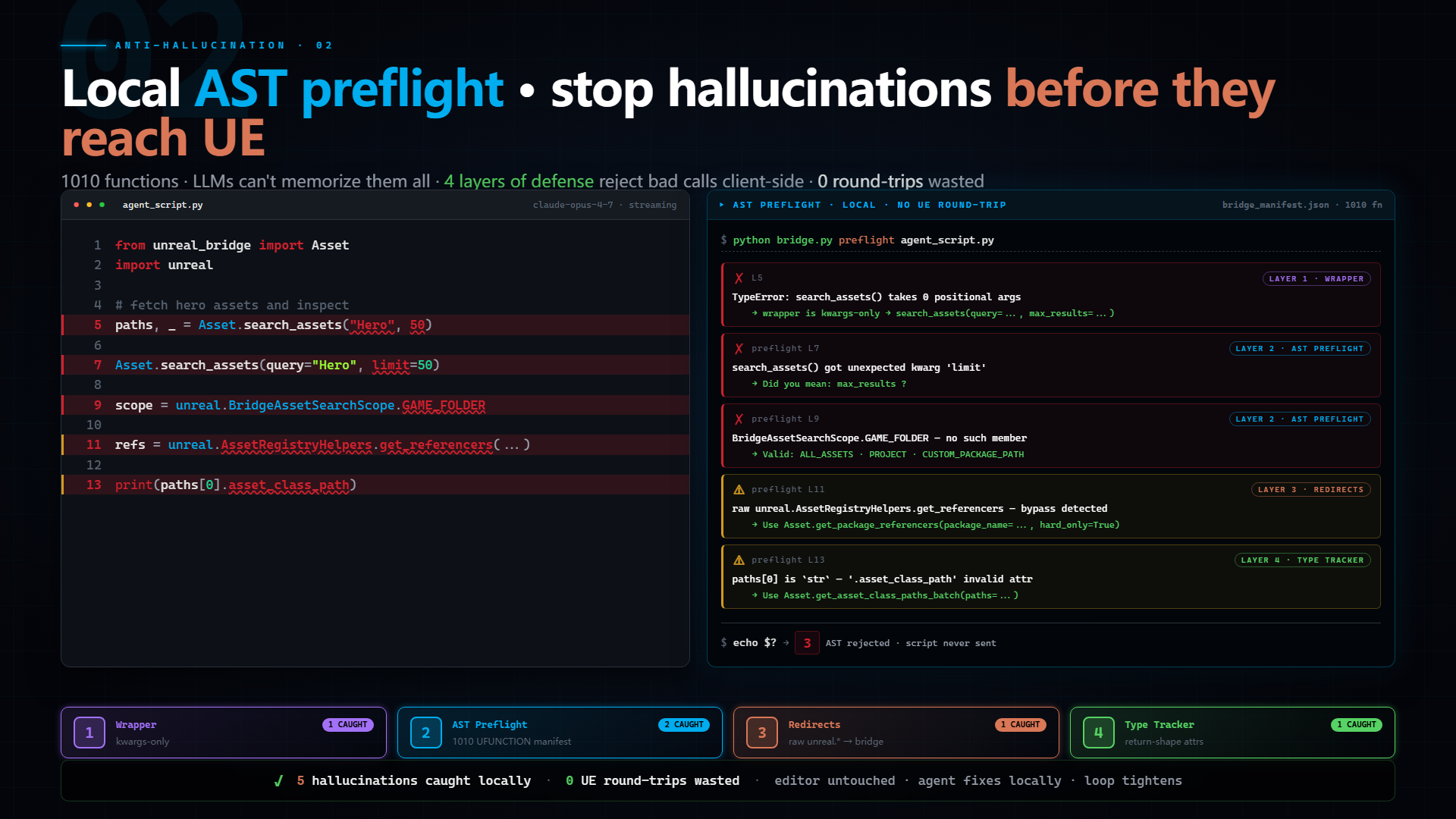
-
Deep asset-structure introspection + author-level write ops.
UnrealBridgeAnimLibrarycovers full queries over AnimBP state machines, AnimGraph nodes, linked layers, slots, curves, Sequence / Montage / BlendSpace, and the skeleton tree — paired with a full suite of write ops: building an ABP from scratch, adding / removing states / transitions / condition rules, creating and wiring AnimGraph nodes, auto-layout of both the state machine and AnimGraph.UnrealBridgeAssetLibrarygoes beyond keyword search with forward-dependency and reverse-reference analysis, surfacing a complete dependency view to the Agent. Compared with basic CRUD wrappers or schemes that require hand-assembled reflection calls, this level of structured capability is available out of the box. -
Reactive event subscription. The Agent can subscribe to GAS events, attribute changes, actor lifecycle, AnimNotify, input, timers, and editor-side asset-change events. When the specified event fires, the bridge calls back proactively — no polling needed. This is a scenario that a pure request / response protocol cannot cover.
-
Agent control surface at PIE runtime.
UnrealBridgeGameplayLibraryprovides aggregated world observation, navigation pathfinding, and input operations for movement / look / jump — suitable for AI-behavior validation, automated testing, and in-game NPC prototyping. -
Blueprint graph quality toolchain. More than just auto-layout:
auto_layout_graph'spin_alignedstrategy reads live Slate geometry to align exec rails,straighten_exec_chainsnaps the main rail,collapse_nodes_to_functionextracts subgraphs,lint_blueprintscans by fixed rules for orphans / unnamed nodes / oversized functions / uncommented large graphs, andadd_comment_box+ preset palette (Section / Validation / Danger / Network / UI / Debug / Setup) partition graphs for readability. AnimGraph and state machines get dedicatedauto_layout_anim_graph/auto_layout_state_machine(the latter recurses into each state's inner graph + every transition rule graph). -
Native Python execution. 22
UnrealBridge*Librarysurfaces expose ~1033UFUNCTIONs in total, covering common subsystems; un-wrapped capabilities are reachable directly through the nativeunreal.*API. Compared to fixed-tool-list MCP schemes or reflection protocols that expose only a singlecallcommand, this design strikes a balance between flexibility and structure. Every level write op is wrapped inFScopedTransactionand supports standard Undo / Redo.
Architecture
flowchart LR
    Agent["AI Agent"]

    subgraph Host["Agent host"]
      CLI["bridge.py"]
      Pre["AST preflight<br/>(local — rejects bad calls<br/>before TCP send)"]
      Mani[("bridge_manifest.json<br/>22 libs · 1033 UFUNCTIONs")]
    end

    Gen["tools/gen_manifest.py<br/>scans C++ headers"]

    subgraph UE["Unreal Editor 5.3+"]
      Disc["FUnrealBridgeDiscovery<br/>UDP responder"]
      Server["FUnrealBridgeServer<br/>TCP · length-prefixed JSON"]
      Reactive["UnrealBridgeReactiveSubsystem<br/>+ 10 event adapters"]
      Exec["IPythonScriptPlugin::<br/>ExecPythonCommandEx<br/>(GameThread)"]
      Wrap["unreal_bridge<br/>kwargs-only wrapper<br/>(optional safer surface)"]
      Libs["22× UnrealBridge*Library"]
      Engine["UEditor · UWorld · Assets"]
    end

    Agent --> CLI
    CLI -- "AST gate" --> Pre
    Pre -. "lookup" .-> Mani

    Gen -- "writes" --> Mani
    Gen -- "writes" --> Wrap

    CLI -- "UDP probe<br/>239.255.42.99:9876" --> Disc
    CLI -- "TCP / JSON<br/>(port from discovery)" --> Server
    Server -- "RPC script" --> Exec
    Engine -. "delegate fires" .-> Reactive
    Reactive -- "handler script" --> Exec

    Exec -- "user code calls" --> Libs
    Exec -. "or via" .-> Wrap
    Wrap --> Libs
    Libs --> Engine
Quick Start
1. Clone the repo
git clone https://github.com/<your-fork>/UnrealBridge.git
cd UnrealBridge
2. 🚨 Run link_agents_skills.bat (one-time)
Required for Codex / Gemini CLI / OpenCode / Cursor. Skip if you only use Claude Code.
The skill source of truth lives at .claude/skills/. This script creates an NTFS junction at .agents/skills/ so every Agent runtime following the Agent Skills open standard sees the same content. Junctions can't be committed (Windows git limitation), so each clone has to materialize it locally — once.
link_agents_skills.batMac / Linux equivalent: ln -sfn .claude/skills .agents/skills (run from repo root).
3. Install the plugin
Edit the DST line in sync_plugin.bat to point at your UE project's Plugins/ folder:
set "DST=D:\Path\To\YourProject\Plugins\UnrealBridge"Run sync_plugin.bat. It mirrors Plugin/UnrealBridge/ into the project, skipping Binaries/ and Intermediate/.
4. Build & launch
Open the .uproject and let UE rebuild the plugin automatically, or run the project's Build.bat from the command line. Launch the editor — the plugin starts the server at PostEngineInit. You're good once LogUnrealBridge: Listening on 127.0.0.1:<port> shows up in the log (the port is OS-assigned; the client finds it via multicast — no manual config needed).
5. Verify
python .claude/skills/unreal-bridge/scripts/bridge.py ping
# → pong
python .claude/skills/unreal-bridge/scripts/bridge.py exec \
  "import unreal; print(unreal.UnrealBridgeLevelLibrary.get_level_summary())"
Claude Code integration (optional)
Copy the skill somewhere Claude Code can discover it:
cp -r .claude/skills/unreal-bridge ~/.claude/skills/            # user-wide
# or into the target project's own .claude/skills/
For rebuild_relaunch.py to auto-relaunch the editor, set one of:
setx UNREAL_EDITOR_EXE "C:\Program Files\Epic Games\UE_5.7\Engine\Binaries\Win64\UnrealEditor.exe"
setx UE_ROOT            "C:\Program Files\Epic Games\UE_5.7"
Quick usage
Once the skill is installed, drop any of these into a Claude Code session:
- "List every PointLight in the current level."
- "Move the PlayerStart up by 200 units."
- "Compile
/Game/Blueprints/BP_Characterand tell me whether it has errors." - "Show me the state machines inside
/Game/Animations/ABP_Hero." - "Create an ABP on
SK_Mannequinwith an Idle / Walk / Run state machine driven by aSpeedvariable (>10 enters Walk, >200 enters Run), then layer a Slot + LayeredBoneBlend in the outer graph for an upper-body overlay."
The Agent reads SKILL.md, picks the right UnrealBridge*Library function, calls it through bridge.py, and reports back.
Usage
CLI
bridge.py ping
bridge.py exec "print('hello from UE')"
bridge.py exec-file my_script.py
Flags (all optional — the common case works with no flags):
--project=<name|path>— disambiguate when >1 editors are running--endpoint=host:port— skip discovery, connect directly (also envUNREAL_BRIDGE_ENDPOINT)--token=<secret>— only when the server binds non-loopback (also envUNREAL_BRIDGE_TOKEN)--timeout(default 30s),--json,--discovery-timeout=<ms>(default 800)
bridge.py list-editors sends a probe and lists every editor that answered — handy for multi-editor setups.
From Python inside UE
import unreal

summary = unreal.UnrealBridgeLevelLibrary.get_level_summary()
print(summary)

lights = unreal.UnrealBridgeLevelLibrary.find_actors_by_class(
    "/Script/Engine.PointLight", 50
)
print(len(lights), "point lights")
Two reload loops
python .claude/skills/unreal-bridge/scripts/hot_reload.py        # body-only edits
python .claude/skills/unreal-bridge/scripts/rebuild_relaunch.py  # reflection changes
Bridge libraries
| Library | Purpose |
|---|---|
UnrealBridgeServer | TCP listener, length-prefixed JSON framing, GameThread dispatch |
UnrealBridgeBlueprintLibrary | Full-stack Blueprint read / write: class hierarchy / variables / functions / components / interfaces / event dispatchers; graph call relationships, exec flow, pin connections, node search; 20+ node-type insertion (Branch, Cast, loops, Delay, Timer, SpawnActor, MakeStruct, …), pin connect, node-coordinate read / write, alignment, comment boxes, AutoLayoutGraph; runtime debug — set/list/clear breakpoints, get_last_breakpoint_hit captures function locals/params/return plus the executing object's BP-class instance variables (tagged with OwnerClass), PIE node coverage; compile-error query |
UnrealBridgeAssetLibrary | Asset keyword search (include / exclude tokens); derived-class query; forward-dependency and reverse-reference analysis (recursive); DataAsset / StaticMesh / SkeletalMesh / Texture / Sound metadata; folder tree, redirector resolution, batch tag and disk-size query; SearchableName index queries (find_assets_referencing_searchable_name / get_searchable_names_used_by_asset / list_searchable_name_values) — the data backing the editor's right-click "Find References" on a GameplayTag / PrimaryAssetId / any USTRUCT-keyed named value |
UnrealBridgeAnimLibrary | AnimBP deep introspection: state machines, AnimGraph nodes, linked layers, slots, curves; Sequence / Montage / BlendSpace asset info; skeleton tree, Sockets, VirtualBone, BlendProfile. Write ops: ABP creation and variables, state machine / state / conduit / transition add / remove / modify, transition properties (crossfade, priority, bidirectional), const-rule shortcut and real variable-driven rules (paired with the BP library to author KismetMathLibrary comparator nodes), 9 typed AnimGraph node factories + add_anim_graph_node_by_class_name fallback, pin connect / disconnect / reorder, auto-layout of AnimGraph and state-machine interiors; AnimNotify, sync marker, Montage Section, Socket CRUD |
UnrealBridgePoseSearchLibrary | Motion Matching — UPoseSearchSchema / UPoseSearchDatabase introspection: schema channels and weights, database animation entries, sampling / branch sampling, indexing status (wait-pose-index CLI helper); pose evaluation against a runtime pose vector. The DatabaseAnimationAssets / Channels arrays are private: in C++ and unreachable via get_editor_property — this library is the only path |
UnrealBridgeChooserLibrary | Motion Matching — UChooserTable introspection and authoring: columns, rows (with disabled flag and resolved result), context objects, NestedChooser drill-down (:Name paths). Write ops: column add / remove, row add / remove, set context object class with auto-Compile + PostEditChange so the editor refreshes. The ResultsStructs / DisabledRows arrays are private: in C++ — this library is the only path |
UnrealBridgeStructLibrary | UUserDefinedStruct (UDS) author-time surface — create the asset, add / remove / rename / retype / reorder fields, write defaults, set tooltips and per-field "edit on instance" flag. Goes through FStructureEditorUtils so writes trigger recompile + downstream BP propagation. The UserDefinedStructureFactory and StructureEditorUtils are not exposed to native Python; this library is the only way to programmatically build a UDS that DataTable / Blueprint variable types can reference |
UnrealBridgeDataTableLibrary | DataTable row-level read / write with conditional filters; CSV / JSON import / export — file-path variants plus in-memory text variants for LLM-generated content, and create_data_table_from_csv / create_data_table_from_json to build a fresh DataTable with row-struct resolution by content path or short name; cross-table row copy, row-diff compare; reverse lookup by RowStruct to find every table referencing that struct |
UnrealBridgeCurveLibrary | Curve assets (UCurveFloat / UCurveVector / UCurveLinearColor) and UCurveTable rows: asset info, key CRUD (batch-safe + atomic tangent writes), pre / post-infinity extrapolation, auto-tangent recompute, batch sampling (N time points in one round-trip), uniform sampling; curve-table row add / remove / rename / replace. Write ops broadcast OnCurveChanged so open Curve Editor tabs refresh instantly |
UnrealBridgeMaterialLibrary | Material instance parameter queries |
UnrealBridgeUMGLibrary | UMG widget tree, properties, animations, bindings, events; widget search by name / class; property writes |
UnrealBridgeLevelLibrary | Actor query (name / Class / Tag / Folder / radius / Box / ray) and edit (spawn / destroy / transform / attach / visibility / Mobility, nested property read / write, function invocation); terrain height profile and Trace probing; in-editor custom NavGraph (nodes, edges, shortest path, JSON persistence); orthographic top-down view plus animation Pose / Montage timeline screenshots; every write op runs in a transaction |
UnrealBridgeEditorLibrary | Editor session control: asset open / close / save / load; Content Browser and viewport; PIE start / stop / simulate / pause; undo / redo, console commands, CVars; batch Blueprint compile, redirector fixup; Live Coding trigger; screenshot, GBuffer channels (Depth / DeviceDepth / Normal / BaseColor) and HitProxy ID pass; tabs, notifications, diagnostics. Bridge self-observation: call log (ring-buffered request id, latency, endpoint, output size), latency stats, signature-registry JSON dump (one shot returns metadata for all ~1020 UFUNCTIONs) |
UnrealBridgeGameplayAbilityLibrary | GameplayAbility / GameplayEffect / AttributeSet Blueprint metadata; tag hierarchy and matching; list abilities and effects by tag; actor ASC state (attribute values, active abilities / effects, cooldown checks); runtime SendGameplayEvent and attribute mutation; GA / GE / GC Blueprint authoring (CDO edit, GA graph nodes, GE magnitude / component / inherited tags, GC tag set) |
UnrealBridgeGameplayTagLibrary | GameplayTag refactoring: find_assets_referencing_tag (with child-tag expansion), list_all_registered_tags, get_tag_source_info. Mutations add_gameplay_tag / rename_gameplay_tag (auto-redirect, redirect persistence hardened against UE 5.7's silent-drop quirk) / remove_gameplay_tag. Source enumeration via list_tag_source_inis; redirect ledger via list_gameplay_tag_redirects + remove_gameplay_tag_redirect for enumerate-then-sweep cleanup |
UnrealBridgePerfLibrary | AAA-grade performance instrumentation across eight dimensions. Point-in-time: frame timing (FPS / GT / RT / GPU / RHI ms via FStatUnitData + RHI globals), render counters, process memory, TObjectIterator class histogram, ISO-8601-stamped aggregate snapshot. Memory & asset breakdown: texture / mesh / audio / UObject grouped by folder / LOD group / compression format / class — disk or runtime mode; top-N largest assets across any UClass; world-actor breakdown by class × level (World Partition partial). Time series: opt-in periodic sampling with ring buffer, always-on frame-time histogram, hitch log via OnEndFrame hook, CSV export, get_frame_time_percentiles([50,90,95,99]) for AAA-grade tail-latency investigation. Render breakdown: per-actor render cost, LOD distribution, primitives-by-material, shadow casters, Lumen / Nanite diagnostics; get_texture_streaming_residency (per-texture resident vs wanted mip + pool over-budget), get_render_target_memory (per-subclass RT byte totals), get_per_pass_gpu_timings (BasePass / Lumen / Translucency averages from FRealtimeGPUProfiler; falls back gracefully on UE 5.7's new RHI profiler), analyze_all_materials (cross-library complexity heuristic to surface heaviest masters). Live trace control: start_trace_capture / stop_trace_capture / list_trace_channels / get_trace_state wrapping FTraceAuxiliary. Trace summary parsers (5.7+): parse_trace_to_summary returns CPU + GPU hot scopes + per-thread hot scopes + counters + load-time breakdown + frame stats from a .utrace file in one call; specialised parse_alloc_trace_to_summary (peak commit + tag inventory + alloc/free delta), parse_net_trace_to_summary (per-game-instance + per-connection traffic totals), parse_cook_trace_to_summary (top-N packages by BeginCacheCookedPlatformData for 4-hour cook attribution). Regression workflow: compare_perf_snapshots(before, after, threshold) returns per-field deltas + flagged regressions list; begin_auto_hitch_capture / end_auto_hitch_capture ring-buffer rich snapshots on every frame ≥ threshold; begin_insights_for_trace shells out UnrealInsights.exe for human handoff |
UnrealBridgeGameplayLibrary | PIE-runtime Agent control: aggregated world observation, navigation pathfinding; movement / look / jump / teleport / sticky input, Enhanced Input runtime injection plus IA / IMC enumeration and IMC mapping authoring (list_input_actions / list_input_mapping_contexts / get_input_mapping_context_mappings / add_ia_mapping_to_imc / remove_ia_mapping_from_imc — the binding side that previously required raw unreal.*); pawn velocity, ability, jump-arc simulation; camera ray, screen ↔ world, NavMesh projection; damage, physics impulse, time dilation, sound, camera shake; debug draw; AI-controller probing |
UnrealBridgeNavigationLibrary | Export NavMesh as OBJ for external visualization and geometry analysis |
UnrealBridgeProceduralLibrary | Procedural content authoring primitives — point-list-in / point-list-out sampling + filters + instancing on the editor world. Deterministic given (params, seed): FRandomStream(Seed) + ECC_Visibility + bTraceComplex=true for surface trace; Poisson-2D / grid / radial / spline / mesh-surface samplers; slope / min-distance / mask filters; ISM / HISM batch spawn; Landscape grid + project-to-surface (callable as plain Python arrays — intentionally NOT a PCG-graph wrapper) |
UnrealBridgeGeometryLibrary | Geometry Script wrapper — UDynamicMesh handle pool + cross-engine asset I/O (copy_mesh_from_static_mesh / create_new_static_mesh_asset_from_mesh) + 25+ ops covering primitives / boolean / smooth / decimate / displace / voxel-merge / uv-unwrap / bake normals + occlusion / extrude / sweep-along-spline / selection. Field names follow standard UE Python snake_case (bHasNormals → .has_normals) |
UnrealBridgePCGLibrary | PCG (Procedural Content Generation) read + trigger only — NO graph editing (PCG's territory; agents write code not visual graphs). Component override get / set, generate / cleanup, asset graph introspection. Whole library gated to UE 5.7+ with stub bodies on 5.3-5.6 |
UnrealBridgeReactive* | Event subscription framework with 10 adapters: runtime (GameplayEvent, AttributeChanged, ActorLifecycle, MovementMode, AnimNotify, InputAction, Timer) and editor (AssetEvent, PieState, BpCompiled); handler register / list / pause / resume / stats; cross-session JSON persistence. Replaces polling |
UnrealBridgePropertyLibrary | Privileged generic UPROPERTY surface. Read / write any reflected property by dotted path with [N] array indexing — bypasses UE Python's binding-layer access checks (the "is protected and cannot be read" rejection, the EditDefaultsOnly-on-struct-copy rejection that blocks nested writes like Modifiers[0].ModifierMagnitude.ScalableFloatMagnitude.Value). list_u_properties returns full reflection (private/protected/bare UPROPERTY + decoded EPropertyFlags + metadata map); array_append_u_property auto-detects FGameplayTagContainer to maintain ParentTags cache; get_asset_cdo_path resolves the CDO path correctly. Wraps writes in FScopedTransaction + optional PostEditChangeChainProperty for editor-window refresh. |
Protocol
Two channels:
-
UDP multicast discovery on
239.255.42.99:9876. Client broadcasts aprobewith a request id and an optional project filter; every running editor replies with its bound TCP address + port + token fingerprint. Multiple editors coexist on the same host viaSO_REUSEADDR. -
TCP data on the port the editor reports in its discovery response (OS-assigned;
127.0.0.1by default). Length-prefixed JSON:
Request :  [4-byte big-endian length][{"id","script","timeout","token?"}]
Response:  [4-byte big-endian length][{"id","success","output","error"}]
Ping    :  {"id","command":"ping"}  →  pong
Token auth kicks in automatically when the server binds non-loopback; the client reads the token from <Project>/Saved/UnrealBridge/token.txt and includes it in every request.
Scripts run on the GameThread; captured stdout and stderr are separated by the special __UB_ERR__ sentinel.
Server config (CLI / env / EditorPerProjectUserSettings.ini [UnrealBridge])
| CLI | Env | Default |
|---|---|---|
-UnrealBridgeBind= | UNREAL_BRIDGE_BIND | 127.0.0.1 |
-UnrealBridgePort= | UNREAL_BRIDGE_PORT | 0 (OS-assigned) |
-UnrealBridgeToken= | UNREAL_BRIDGE_TOKEN | empty (required when bind ≠ loopback) |
-UnrealBridgeDiscoveryGroup= | UNREAL_BRIDGE_DISCOVERY_GROUP | 239.255.42.99:9876 |
-UnrealBridgeNoDiscovery (flag) | UNREAL_BRIDGE_DISCOVERY=0 | discovery on |
Repository layout
UnrealBridge/
├── Plugin/UnrealBridge/         # UE 5.3+ Editor plugin (C++)
│   ├── Source/UnrealBridge/     #   TCP server + bridge libraries
│   └── Content/Python/          #   Helpers auto-loaded into UE's Python env
├── .claude/skills/unreal-bridge/
│   ├── scripts/                 # bridge.py, hot_reload.py, rebuild_relaunch.py
│   └── references/              # Per-library API docs
├── docs/                        # Design notes and plans
├── tools/                       # Standalone helpers
└── sync_plugin.bat              # Mirror plugin into a UE project
Requirements
- Unreal Engine 5.3+ with
PythonScriptPluginandGameplayAbilities(both ship with the engine). The matrix attools/build_matrix.pyverifies clean BuildPlugin against 5.3.2 / 5.4.4 / 5.5.4 / 5.6.1 / 5.7.1 / 5.8.0; some libraries (Chooser / PoseSearch / Material / Navigation + a few standalone UFUNCTIONs) require 5.7+, and a handful of inline shims cover 5.3 and 5.8 — see docs/version-compatibility.md. UE 5.2 and earlier are not supported. - Windows 10/11 — the plugin itself is portable, but paths inside the helper scripts are hard-coded Windows-style
- Python 3.9+ on PATH
- Visual Studio 2022 with the UE workload — for plugin compilation. Toolchain notes:
- 5.5 / 5.6 / 5.7 / 5.8 work with current MSVC (verified on 14.44.35207, VS 17.14).
- 5.3 / 5.4 require MSVC with
_MSC_VER ≤ 1939(verified on 14.38.33130, VS 17.8). Newer MSVCs hit an engine-sideC4668: '__has_feature' is not definedinConcurrentLinearAllocator.hthat 5.3 / 5.4's UBT promotes to a hard error via/we4668; 5.5+ guarded the macro and dropped the promotion. To verify 5.3 / 5.4 on a machine with both toolchains installed: pin via<CompilerVersion>14.38.33130</CompilerVersion>in%APPDATA%\Unreal Engine\UnrealBuildTool\BuildConfiguration.xmlfor the duration of the build, then restore. - 5.8 source build (vs. Launcher install) may need the UBA executor disabled if the engine snapshot is missing the
UbaDetours.dllcontent normally fetched bySetup.bat. Configure viaengines.local.json's per-engineenvblock:"env": { "UnrealBuildTool_BuildConfiguration__bAllowUBAExecutor": "false" }. UBT falls back to the local ParallelExecutor.
- Claude Code CLI — optional, only if you use the bundled skill
Safety
- Every level-edit op is wrapped in
FScopedTransaction— Ctrl+Z in the editor reverts anything the bridge did. - The TCP server binds to
127.0.0.1only; it is not reachable from the network.
License
MIT — see LICENSE.