MotionRFT: Unified Reinforcement Fine-Tuning for Text-to-Motion Generation
Accepted by IEEE Transactions on Pattern Analysis and Machine Intelligence (TPAMI)
Extended from EasyTune (ICLR 2026)
Xiaofeng Tan
Wanjiang Weng
Hongsong Wang
Fang Zhao
Xin Geng
Liang Wang
Southeast University
Nanjing University
Chinese Academy of Sciences










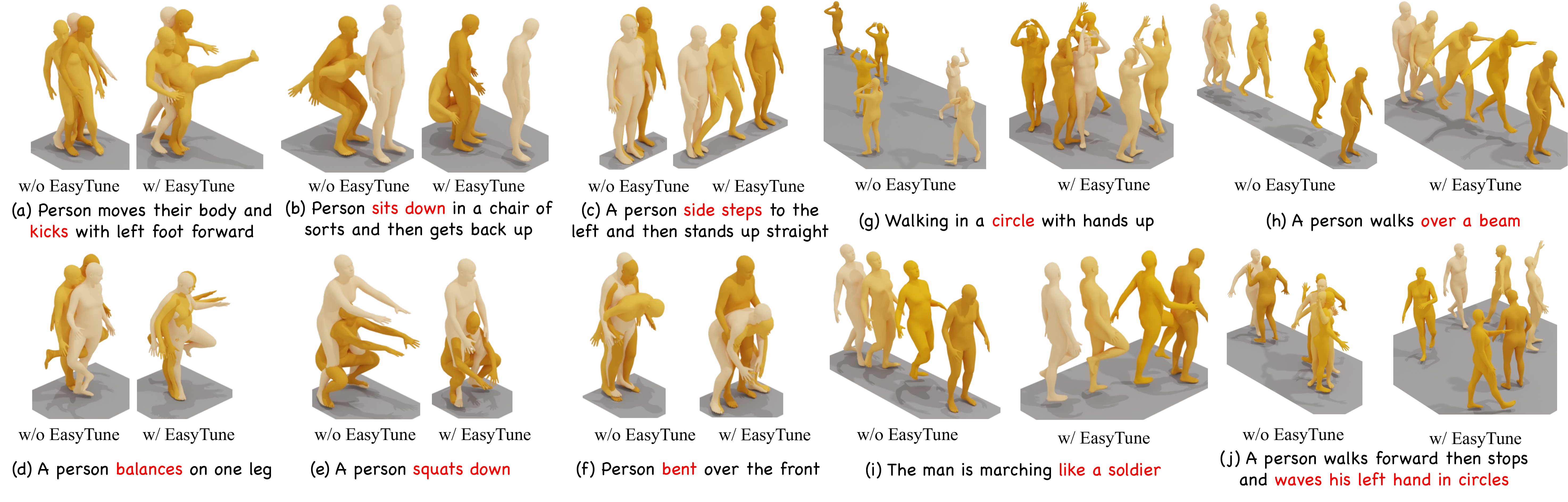
Visual results on HumanML3D. "w/o" = original base model; "w/" = after fine-tuning with EasyTune.
This repository offers the official code for MotionRFT, accepted by IEEE Transactions on Pattern Analysis and Machine Intelligence (TPAMI). If you have any questions, feel free to contact Xiaofeng Tan (xiaofengtan@seu.edu.cn).
If you encounter any issues with the code, please don't hesitate to let us know — we are committed to building and continuously maintaining a robust codebase for reinforcement fine-tuning in motion generation.
📑 Table of Contents
- 🔥 News
- 📋 Plan
- 💡 Introduction
- 📊 Experimental Results
- 📁 Project Structure
- ⚙️ Setup
- 📦 1. Data Preparation
- 🎯 2. MotionReward Training
- 🚀 3. Reinforcement Fine-Tuning (RFT)
- 🎬 4. Visualization & Rendering
- 🙏 Acknowledgement
- 📝 Citation
🔥 News
- [2026/10] 🎉 MotionRFT has been accepted by IEEE Transactions on Pattern Analysis and Machine Intelligence (TPAMI)!
- [2026/03] Paper is available on arXiv.
- [2026/02] Release code, data, and pretrained models.
📋 Plan
- Release training data and pretrained dependencies.
- Release MotionReward training and evaluation code.
- Release RFT code for MLD (263-dim).
- Release RFT code for HY-Motion (135-dim).
- Release pretrained checkpoints.
- Release paper.
- Organize and polish documentation for each codebase module.
💡 Introduction
MotionRFT is a reinforcement fine-tuning framework for text-to-motion generation, comprising a unified multi-representation reward model MotionReward and a step-wise, memory-efficient fine-tuning strategy EasyTune. It allows developers to fine-tune any diffusion- or flow-based motion generation model using multi-dimensional reward signals, achieving significant improvements in semantic alignment, human preference, and motion quality.
Key Features
- Unified Multi-Representation Reward: A single reward model serving three motion representations (263-dim, 22x3, 135-dim) via a shared semantic embedding space.
- Multi-Dimensional Reward: Jointly optimizes retrieval, preference, M2M similarity, and AI detection rewards, preventing single-objective over-optimization.
- Three-Stage Training: Stage 1 (Retrieval) → Stage 2 (Critic LoRA) → Stage 3 (AI Detection LoRA), each building on the previous.
- Step-Wise Fine-Tuning (EasyTune): O(1) memory instead of O(T) by decoupling denoising-step dependence, enabling dense and fine-grained optimization.
- Cross-Model Generalization: Validated on 6 models × 3 representations, achieving FID 0.132 with 22.10 GB peak memory.
Framework
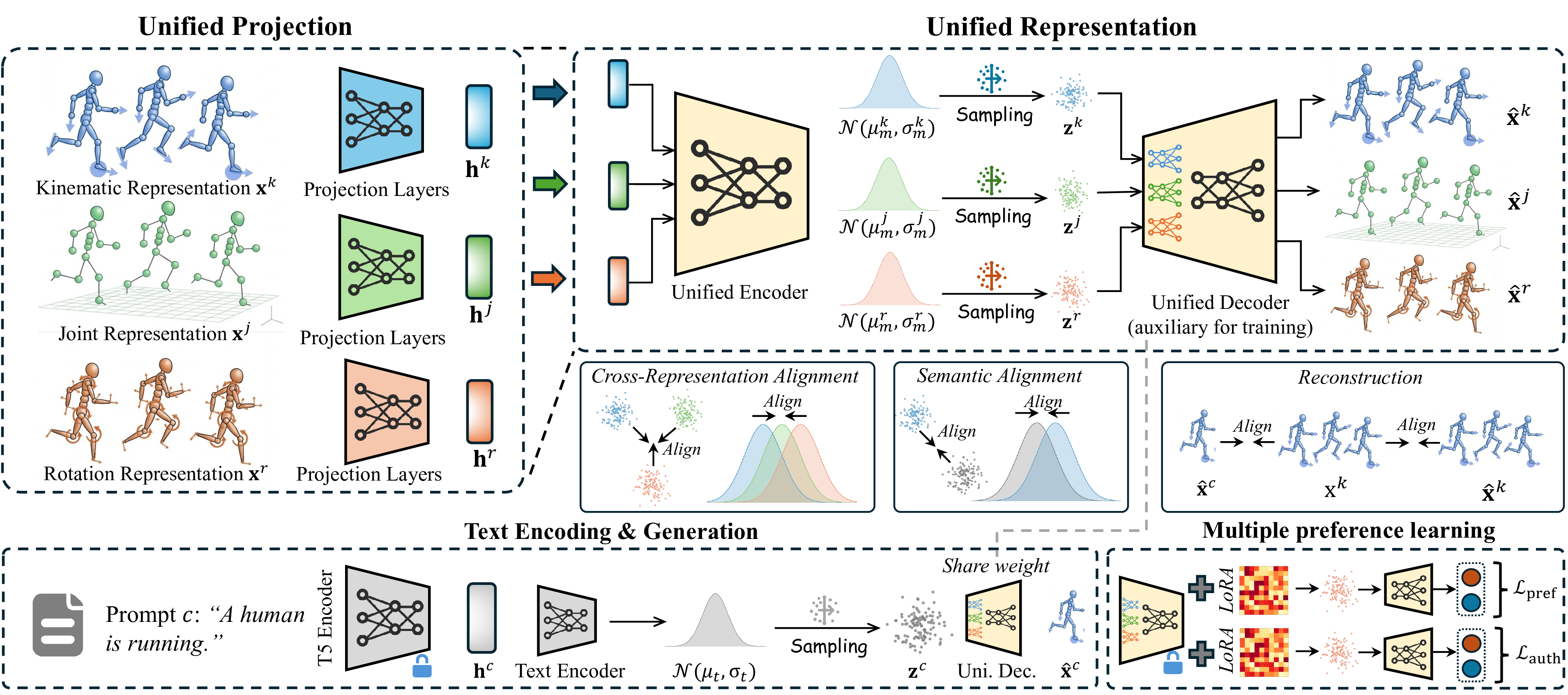
MotionReward: Maps heterogeneous motion representations into a shared semantic embedding space, where text serves as an anchor for multi-dimensional reward learning.
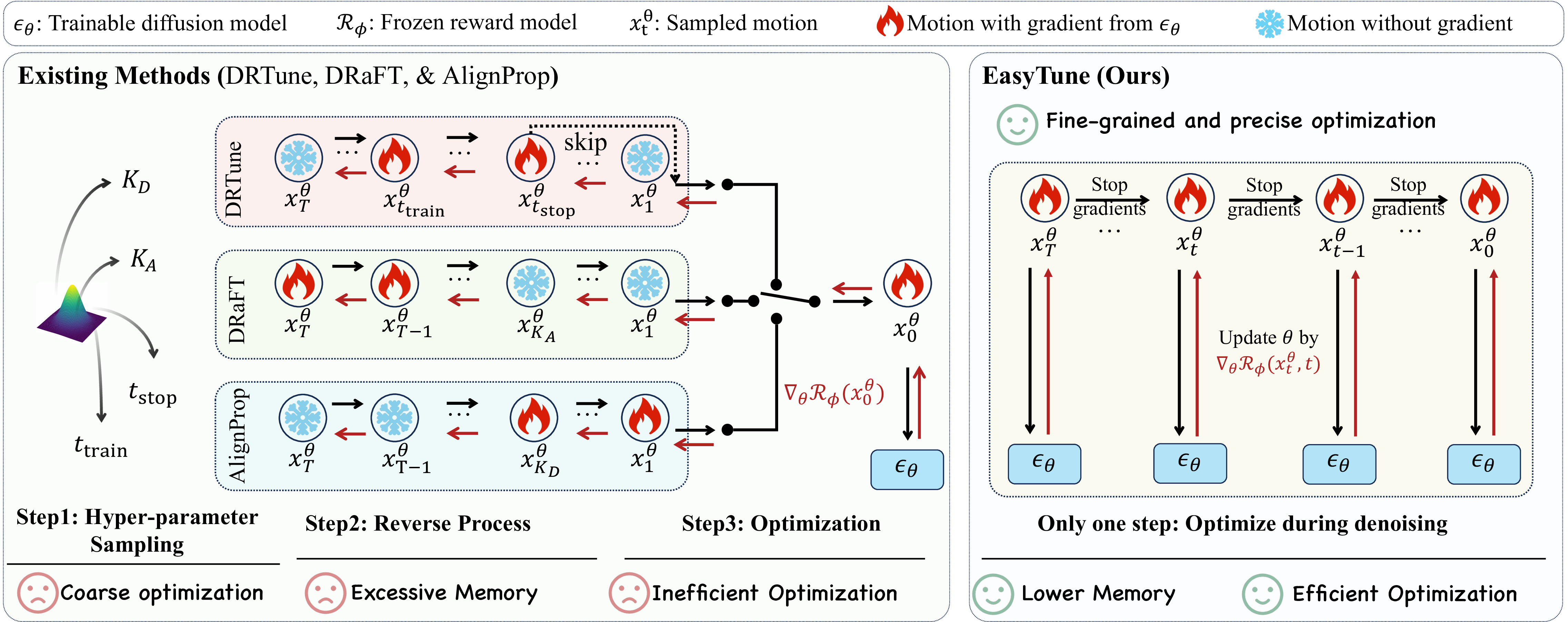
EasyTune: Fine-tunes step-wise rather than over the full denoising trajectory, decoupling recursive dependence for memory-efficient and fine-grained optimization.
📊 Experimental Results
MotionReward Evaluation
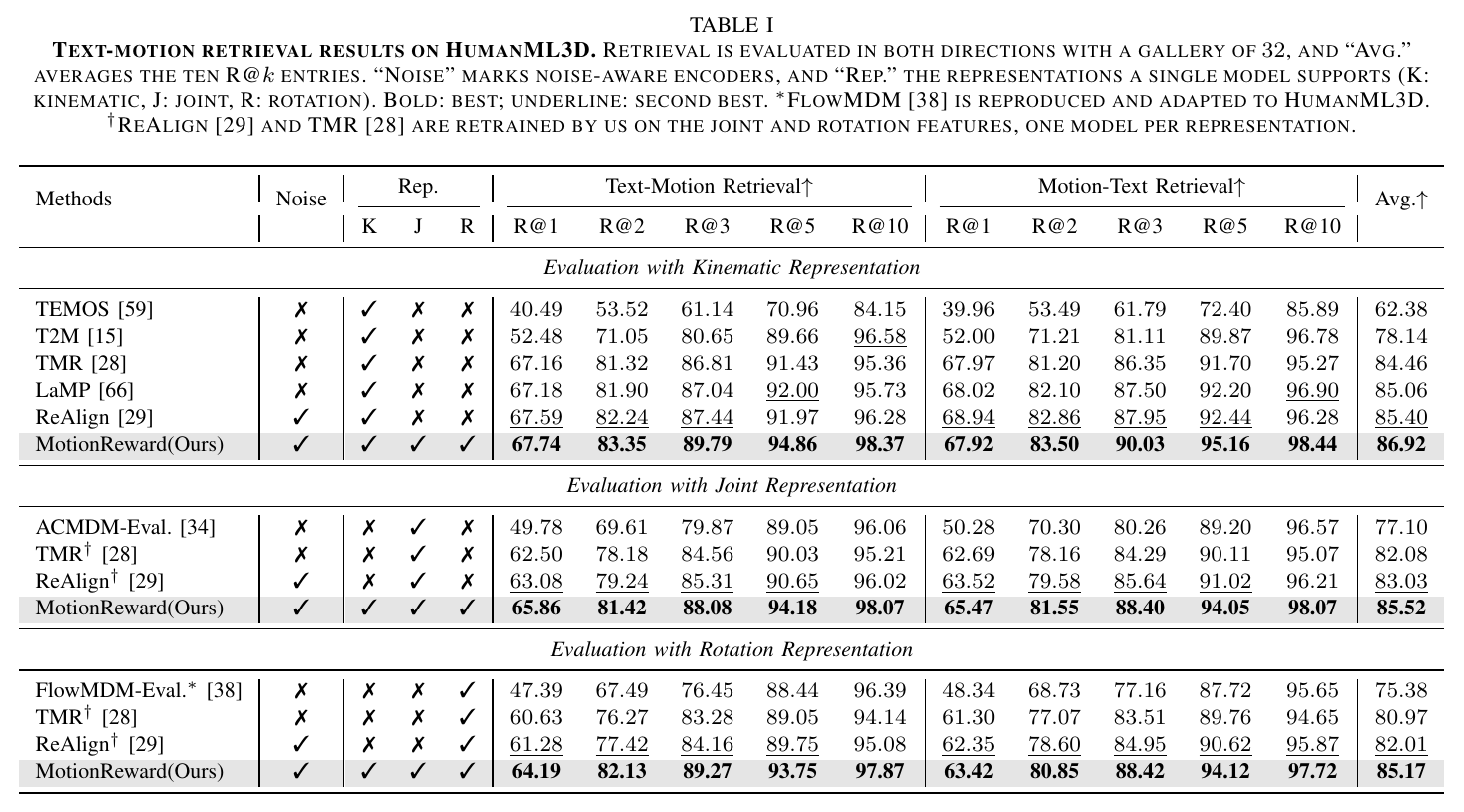
Text-motion retrieval evaluation across kinematic (263), joint (22x3), and rotation (135) representations.
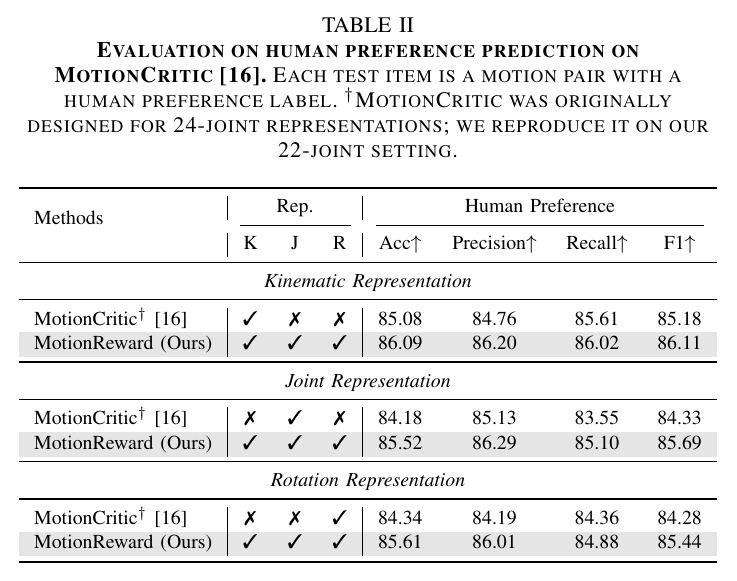
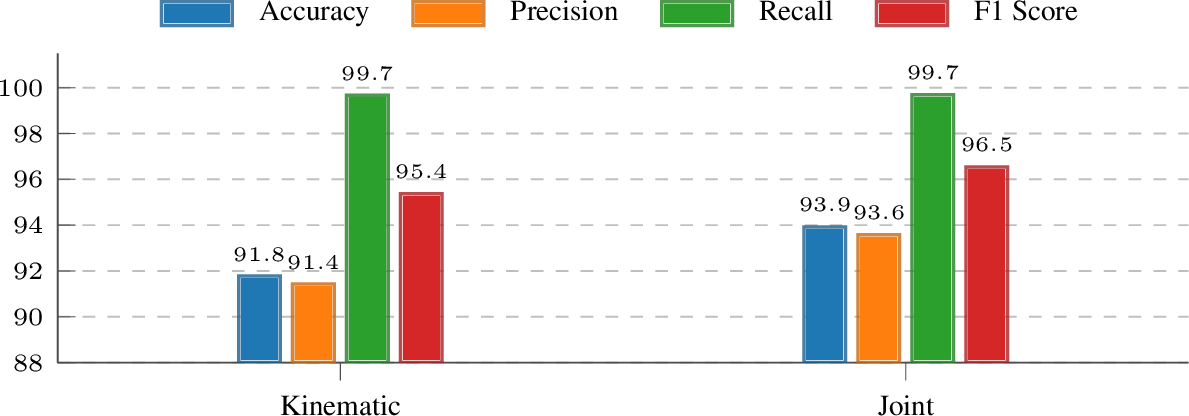
Left: Human preference prediction. Right: Motion authenticity detection.
SoTA Comparison on HumanML3D
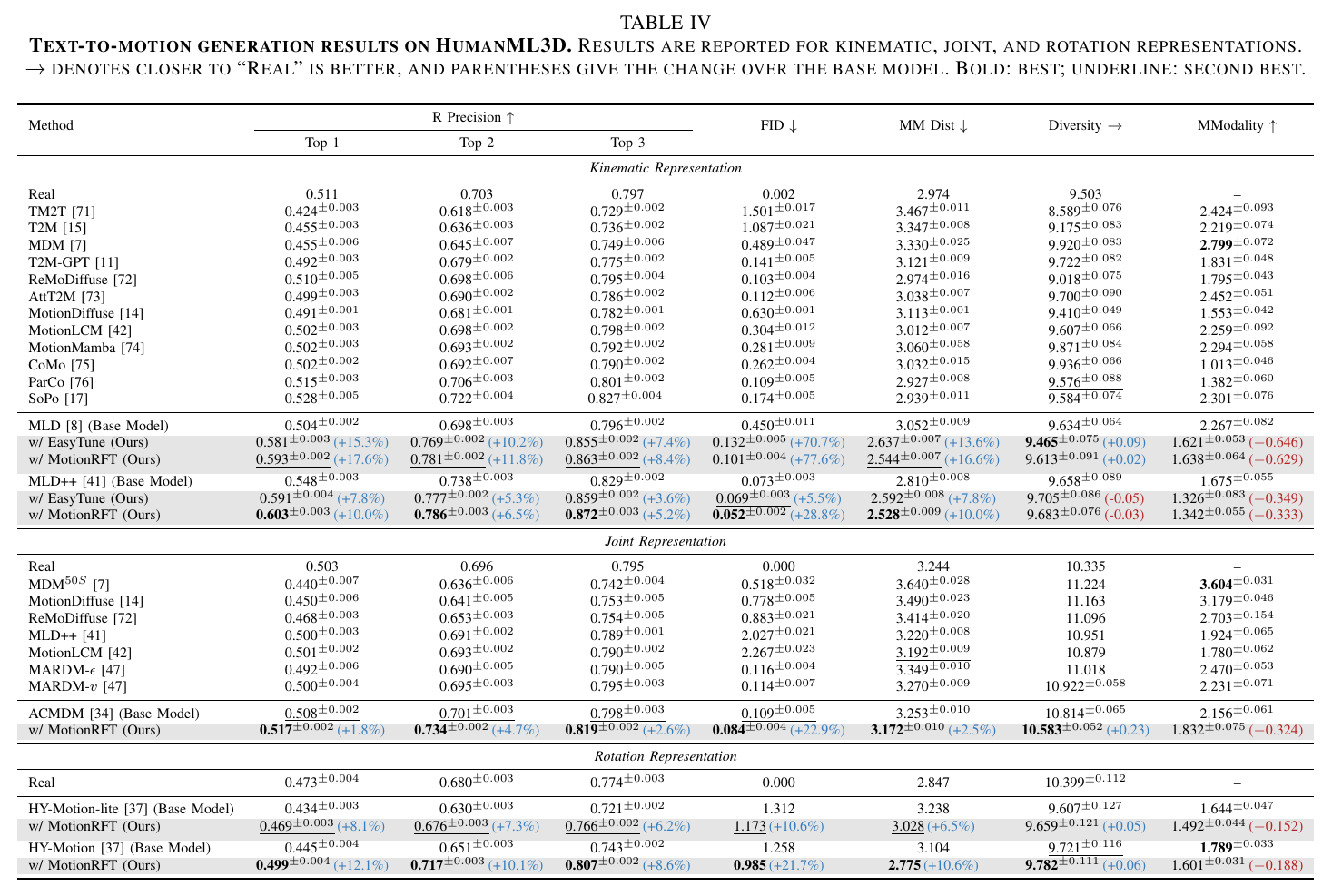
Text-to-motion generation on HumanML3D across kinematic, joint, and rotation representations. MotionRFT reaches FID 0.052 on MLD++, 0.084 on ACMDM, and 0.985 on HY-Motion. HY-Motion improves by 12.1% in R-Precision Top 1 and 21.7% in FID.
Fine-Tuning Comparison on HumanML3D
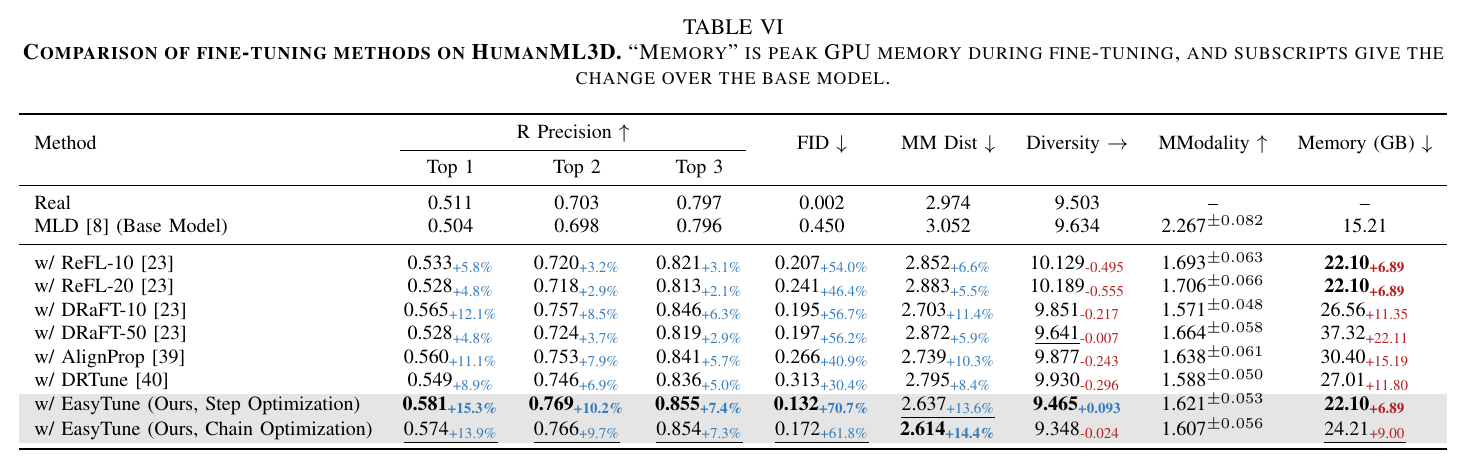
Comparison of fine-tuning methods on HumanML3D. EasyTune achieves FID 0.132 (70.7% improvement) with 22.10 GB peak memory, saving up to 15.22 GB over DRaFT.
Generalization Across Models
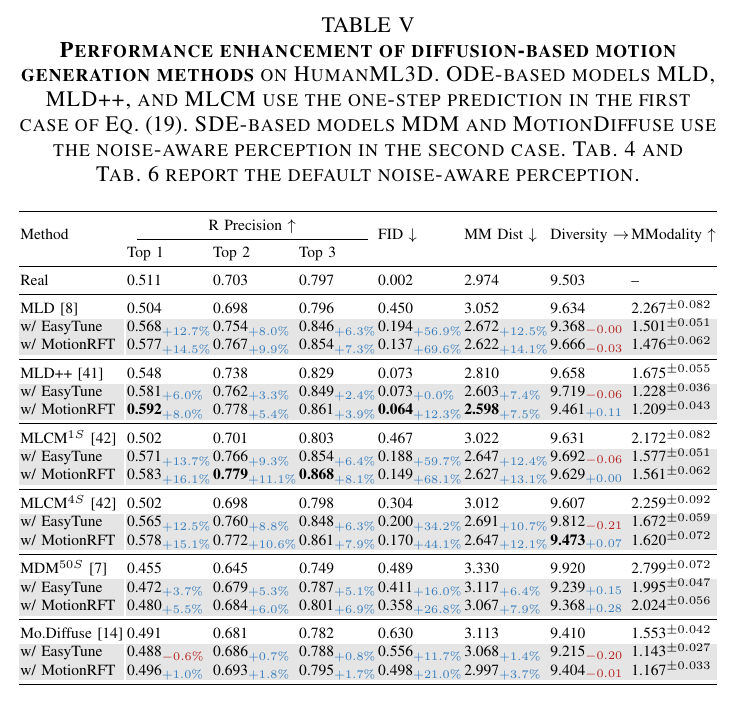
EasyTune and MotionRFT across six pre-trained models on HumanML3D. ODE-based models use one-step prediction; SDE-based models use noise-aware perception.
📁 Project Structure
MotionRFT/
├── motionreward/                      # MotionReward core package
│   ├── models/                        # Model definitions
│   ├── training/                      # Training logic
│   │   └── train_retrieval_lora_new.py
│   ├── datasets/                      # Data loading
│   ├── evaluation/                    # Evaluation metrics
│   └── utils/                         # Utilities
├── RFT_MLD/                           # RFT for MLD (263-dim)
│   ├── mld/                           # MLD model code
│   ├── configs/                       # MLD training configs
│   ├── checkpoints/rft_mld/           # RFT fine-tuned MLD checkpoints
│   ├── motionrft_mld.py               # Multi-reward fine-tuning
│   ├── eval_mld.py                    # Multi-replication evaluation
│   ├── reward_adapter.py              # MotionReward adapter
│   ├── run_motionrft_mld.sh           # Training launcher (4 rewards)
│   └── run_eval_mld.sh               # Batch evaluation
├── RFT_HY/                            # RFT for HY-Motion (135-dim)
│   ├── hymotion/                      # HY-Motion model code
│   ├── ReAlignModule/                 # ReAlign evaluation module
│   ├── t2m/evaluator.pth              # SPM evaluator checkpoint
│   ├── motionrft_hy.py                # RL fine-tuning with MotionReward
│   ├── eval_hy.py                     # Evaluation
│   └── run_eval_hy.sh                # Batch evaluation
├── datasets/                          # Training data (after extraction)
│   ├── humanml3d/                     # Stage 1: HumanML3D multi-repr data
│   ├── critic/                        # Stage 2: Critic preference data
│   └── ai_detection_packed/           # Stage 3: AI Detection data
├── deps/                              # Pre-trained dependencies
│   ├── sentence-t5-large/             # Frozen text encoder
│   ├── t2m/                           # T2M evaluation checkpoints
│   ├── glove/                         # GloVe embeddings
│   └── smpl/                          # SMPL body model
├── pretrain/                          # Pretrained generation models
│   ├── mld/                           # MLD pretrained weights (from MotionRFT_Models)
│   ├── hymotion/                      # HY-Motion weights (from official repo)
│   ├── clip-vit-large-patch14/        # CLIP text encoder (from OpenAI)
│   └── Qwen3-8B/                      # Qwen3 text encoder (from Qwen)
├── checkpoints/                       # MotionReward trained weights
│   └── motionreward/                  # Stage 1-3 checkpoints
├── scripts/                           # Utility scripts
│   ├── train_motion_reward.sh         # MotionReward training launcher
│   ├── visualize_263.py               # 263-dim visualization
│   ├── visualize_joints22.py          # 22x3 visualization
│   ├── visualize_135.py               # 135-dim visualization
│   ├── _vis_packed.py                 # Packed data visualization
│   └── verify_data.py                 # Data integrity check
├── setup.py
├── requirements.txt
└── README.md
⚙️ Setup
1. Environment
conda create -n motionrft python=3.10 -y
conda activate motionrft
pip install -r requirements.txt
pip install -e .
Training logs are tracked with SwanLab. After installation, login to enable cloud logging:
swanlab loginRegister a free account at https://swanlab.cn. If not logged in, training still proceeds normally with logging disabled.
Note: Due to policy restrictions, we are unable to publicly release the training logs. If you need them for research purposes, please contact xiaofengtan@seu.edu.cn.
2. Download Pre-trained Dependencies
Shared dependencies used across MotionReward, RFT_MLD, and RFT_HY. All files are hosted on txf0620/MotionRFT_Models / XiaofengTan/MotionRFT_Models.
| Dependency | Path | Description | Size |
|---|---|---|---|
| Sentence-T5-Large | deps/sentence-t5-large/ | Frozen text encoder (all modules) | ~3.9 GB |
| T2M | deps/t2m/ | Text-to-Motion evaluation models | ~1.1 GB |
| GloVe | deps/glove/ | GloVe word embeddings | ~10 MB |
| SMPL | deps/smpl/ | SMPL body model | ~112 MB |
Option 1: HuggingFace
huggingface-cli download txf0620/MotionRFT_Models \
    --include "deps/*" --local-dir .
Option 2: ModelScope
modelscope download --model 'XiaofengTan/MotionRFT_Models' \
    --include 'deps/*' --exclude 'README*' --local_dir .
3. Download Pretrained Generation Models
Base generation models to be fine-tuned via RFT. MLD is hosted on our model repo; HY-Motion and its text encoders should be downloaded from their official sources.
3a. MLD Pretrained Weights (for RFT_MLD)
| Model | Path | Size |
|---|---|---|
| MLD (HumanML3D) | pretrain/mld/mld_humanml_v1.ckpt | ~184 MB |
Option 1: HuggingFace
huggingface-cli download txf0620/MotionRFT_Models \
    --include "pretrain/mld/*" --local-dir .
Option 2: ModelScope
modelscope download --model 'XiaofengTan/MotionRFT_Models' \
    --include 'pretrain/mld/*' --local_dir .
3b. HY-Motion Pretrained Weights (for RFT_HY)
Download from the official HY-Motion repository on HuggingFace:
| Model | HuggingFace Repo | Local Path | Size |
|---|---|---|---|
| HY-Motion-1.0-Lite | tencent/HY-Motion-1.0 | pretrain/hymotion/HY-Motion-1.0-Lite/ | ~1.7 GB |
| HY-Motion-1.0 | tencent/HY-Motion-1.0 | pretrain/hymotion/HY-Motion-1.0/ | ~3.9 GB |
# HY-Motion Lite (recommended for training)
huggingface-cli download tencent/HY-Motion-1.0 \
    --include "HY-Motion-1.0-Lite/*" \
    --local-dir pretrain/hymotion

# HY-Motion Full (optional)
huggingface-cli download tencent/HY-Motion-1.0 \
    --include "HY-Motion-1.0/*" \
--local-dir pretrain/hymotionNote: The HY-Motion config uses
mean_std_dir: ./stats/for normalization statistics (Mean.npy,Std.npy). If these files are not included in the official download, copy them from the HumanML3D dataset.
3c. Text Encoders for HY-Motion (Optional)
HY-Motion uses CLIP and Qwen3 as text encoders. You have two options:
Option A (Recommended): Load from HuggingFace Hub at runtime
Set the environment variable before running RFT_HY — no local download needed:
export USE_HF_MODELS=1Option B: Download locally
huggingface-cli download openai/clip-vit-large-patch14 \
    --local-dir pretrain/clip-vit-large-patch14

huggingface-cli download Qwen/Qwen3-8B \
    --local-dir pretrain/Qwen3-8B
4. Download MotionReward Checkpoints (Optional)
Pre-trained MotionReward checkpoints — skip this step if you plan to train MotionReward yourself (Section 2). These checkpoints are required by RFT (Section 3).
All hosted on txf0620/MotionRFT_Models / XiaofengTan/MotionRFT_Models.
We provide two variants with different LoRA ranks:
Default (rank=16, recommended):
| Checkpoint | Path |
|---|---|
| Stage 1 Backbone | checkpoints/motionreward/stage1_retrieval_backbone.pth |
| Stage 2 Critic LoRA | checkpoints/motionreward/stage2_critic_lora.pth |
| Stage 2 Critic Head | checkpoints/motionreward/stage2_critic_head.pth |
| Stage 3 AI Det LoRA | checkpoints/motionreward/stage3_ai_detection_lora.pth |
| Stage 3 AI Det Head | checkpoints/motionreward/stage3_ai_detection_head.pth |
High-capacity variant (rank=128):
| Checkpoint | Path |
|---|---|
| Stage 1 Backbone | checkpoints/motionreward/stage1_retrieval_backbone_r128.pth |
| Stage 2 Critic LoRA | checkpoints/motionreward/stage2_critic_lora_r128.pth |
| Stage 2 Critic Head | checkpoints/motionreward/stage2_critic_head_r128.pth |
| Stage 3 AI Det LoRA | checkpoints/motionreward/stage3_ai_detection_lora_r128.pth |
| Stage 3 AI Det Head | checkpoints/motionreward/stage3_ai_detection_head_r128.pth |
Note: The rank=128 variant was used for the RFT_MLD experiments in the paper. When using rank=128 checkpoints, set
--lora_rank 128 --lora_alpha 256accordingly.
Option 1: HuggingFace
huggingface-cli download txf0620/MotionRFT_Models \
    --include "checkpoints/*" --local-dir .
Option 2: ModelScope
modelscope download --model 'XiaofengTan/MotionRFT_Models' \
    --include 'checkpoints/*' --exclude 'README*' --local_dir .
5. Download RFT Checkpoints (Optional)
Pre-trained RFT fine-tuned checkpoints for direct evaluation / inference, without retraining. Hosted on a separate repository: txf0620/MotionRFT_Checkpoints / XiaofengTan/MotionRFT_Checkpoints.
| Model | Path | Description |
|---|---|---|
| RFT-MLD (best) | RFT_MLD/checkpoints/rft_mld/best/checkpoints/best.ckpt | Best MLD checkpoint (R1=0.603, FID=0.096), 1.5 GB |
| RFT-HY evaluator | RFT_HY/t2m/evaluator.pth | SPM evaluator for HY-Motion, 102 MB |
Option 1: HuggingFace
huggingface-cli download txf0620/MotionRFT_Checkpoints --local-dir .Option 2: ModelScope
modelscope download --model 'XiaofengTan/MotionRFT_Checkpoints' \
    --exclude 'README*' --local_dir .
📦 1. Data Preparation
1.1 Data Overview
MotionReward uses three types of training data across three motion representations:
| Data | Stage | Format | Size |
|---|---|---|---|
humanml3d.tar.gz | Stage 1 - Retrieval | .npy + .txt | ~6.4 GB |
critic.tar.gz | Stage 2 - Critic | .pth | ~10.8 GB |
ai_detection_packed.tar.gz | Stage 3 - AI Detection | .pth | ~26.8 GB |
Each dataset contains three motion representations: 263-dim (joint features), 22x3 (joint positions), and 135-dim (6D rotations).
1.2 Download Data
| Platform | Repository |
|---|---|
| HuggingFace | txf0620/MotionRewardData |
| ModelScope | XiaofengTan/MotionRewardData |
Option 1: HuggingFace
huggingface-cli download txf0620/MotionRewardData \
    humanml3d.tar.gz critic.tar.gz ai_detection_packed.tar.gz \
    --repo-type dataset --local-dir .
Option 2: ModelScope
modelscope download --dataset 'XiaofengTan/MotionRewardData' \
    --exclude 'README*' --local_dir .
1.3 Extract Data
mkdir -p ./datasets
tar xzf humanml3d.tar.gz -C ./datasets/
tar xzf critic.tar.gz -C ./datasets/
tar xzf ai_detection_packed.tar.gz -C ./datasets/
1.4 Verify Data
Integrity check — verify all 3 datasets x 3 representations:
python scripts/verify_data.py --data_root ./datasetsVisual sanity check — render stick-figure animations:
python scripts/visualize_263.py \
    --npy_path ./datasets/humanml3d/new_joint_vecs/000000.npy --mode animation

python scripts/visualize_joints22.py \
    --npy_path ./datasets/humanml3d/new_joints/000000.npy --mode animation

python scripts/visualize_135.py \
    --npy_path ./datasets/humanml3d/joints_6d/000000.npy --mode animation

# Critic & AI Detection (packed .pth, samples all 3 repr types)
python scripts/_vis_packed.py
Generated .gif files are saved under datasets/visualizations/.
🎯 2. MotionReward Training
MotionReward is a unified multi-task reward model trained in three stages:
| Stage | Task | Method | What is Trained |
|---|---|---|---|
| Stage 1 | Retrieval (Text-Motion Alignment) | Full-parameter + cross-repr alignment | All parameters (T5 frozen) |
| Stage 2 | Critic (Preference Scoring) | LoRA fine-tuning (backbone frozen) | LoRA adapters + Critic head |
| Stage 3 | AI Detection (Authenticity) | LoRA fine-tuning (backbone frozen) | LoRA adapters + Detection head |
Each stage builds on the previous one: Stage 1 trains the shared backbone, Stage 2/3 freeze the backbone and inject task-specific LoRA adapters.
2.1 Quick Start (One-Click Training)
Train all three stages sequentially with a single command:
bash scripts/train_motion_reward.shThe script will automatically:
- Check for existing Stage 1 weights (skip if found)
- Train Stage 2 (Critic LoRA) with multi-GPU DDP
- Train Stage 3 (AI Detection LoRA) on single GPU
- Run evaluation on all tasks
Key configuration at the top of scripts/train_motion_reward.sh:
MODEL_SIZE="tiny"                    # Model size: tiny/small/base/large
REPR_TYPES="263,22x3,135"            # Representation types
LORA_RANK=16                         # LoRA rank
LORA_ALPHA=32                        # LoRA scaling factor
STAGE1_EPOCHS=50                     # Stage 1: Retrieval
STAGE2_EPOCHS=3000                   # Stage 2: Critic
STAGE3_EPOCHS=50                     # Stage 3: AI Detection
...
2.2 Stage-by-Stage Training
For finer control, train each stage independently:
Stage 1 — Retrieval (full-parameter, single GPU):
Trains the shared backbone with text-motion retrieval loss across all 3 representations (263-dim, 22x3, 135-dim) with cross-representation alignment.
CUDA_VISIBLE_DEVICES=0 python -m motionreward.training.train_retrieval_lora_new \
    --model_size tiny \
    --retrieval_repr_types 263,22x3,135 \
    --stage1_epochs 50 --stage2_epochs 0 --stage3_epochs 0 \
    --stage1_lr 1e-4 \
    --batch_size 128 \
    --checkpoint_dir ./checkpoints/motionreward \
    --exp_name my_exp_stage1 \
    --skip_stage2 --skip_stage3 \
    --use_cross_repr_align --lambda_cross_repr 0.1
Stage 2 — Critic LoRA (multi-GPU DDP):
Freezes the backbone from Stage 1 and trains Critic LoRA adapters + Critic head on preference data. Supports multi-GPU via torchrun.
CUDA_VISIBLE_DEVICES=0,1,2,3 torchrun \
    --nproc_per_node=4 \
    --master_port=29501 \
    -m motionreward.training.train_retrieval_lora_new \
    --model_size tiny \
    --retrieval_repr_types 263,22x3,135 \
    --lora_rank 16 --lora_alpha 32 \
    --stage1_epochs 0 --stage2_epochs 3000 --stage3_epochs 0 \
    --stage2_lr 1e-4 \
    --batch_size 128 \
    --checkpoint_dir ./checkpoints/motionreward \
    --exp_name my_exp_stage2 \
    --resume_stage1_ckpt ./checkpoints/motionreward/stage1_retrieval_backbone.pth \
    --skip_stage1 --skip_stage3 \
    --stage2_eval_freq 100 \
    --skip_retrieval_eval_in_stage2
Stage 3 — AI Detection LoRA (single GPU):
Freezes the backbone from Stage 1 and trains AI Detection LoRA adapters + Detection head to distinguish real vs. AI-generated motions.
CUDA_VISIBLE_DEVICES=0 python -m motionreward.training.train_retrieval_lora_new \
    --model_size tiny \
    --retrieval_repr_types 263,22x3,135 \
    --lora_rank 16 --lora_alpha 32 \
    --stage1_epochs 0 --stage2_epochs 0 --stage3_epochs 50 \
    --stage3_lr 1e-4 \
    --batch_size 128 \
    --checkpoint_dir ./checkpoints/motionreward \
    --exp_name my_exp_stage3 \
    --resume_stage1_ckpt ./checkpoints/motionreward/stage1_retrieval_backbone.pth \
    --skip_stage1 --skip_stage2
2.3 Evaluation
Evaluate all three tasks (Retrieval, Critic, AI Detection) jointly:
CUDA_VISIBLE_DEVICES=0 python -m motionreward.training.train_retrieval_lora_new \
    --model_size tiny \
    --retrieval_repr_types 263,22x3,135 \
    --lora_rank 16 --lora_alpha 32 \
    --stage1_epochs 0 --stage2_epochs 0 --stage3_epochs 0 \
    --batch_size 128 \
    --checkpoint_dir ./checkpoints/motionreward \
    --exp_name eval_all \
    --resume_stage1_ckpt ./checkpoints/motionreward/stage1_retrieval_backbone.pth \
    --resume_critic_lora_ckpt ./checkpoints/motionreward/stage2_critic_lora.pth \
    --resume_critic_head_ckpt ./checkpoints/motionreward/stage2_critic_head.pth \
    --resume_ai_detection_lora_ckpt ./checkpoints/motionreward/stage3_ai_detection_lora.pth \
    --resume_ai_detection_head_ckpt ./checkpoints/motionreward/stage3_ai_detection_head.pth \
    --eval_only --eval_retrieval --eval_critic --eval_ai_detection
Evaluate rank=128 checkpoints:
CUDA_VISIBLE_DEVICES=0 python -m motionreward.training.train_retrieval_lora_new \
    --model_size tiny \
    --retrieval_repr_types 263,22x3,135 \
    --lora_rank 128 --lora_alpha 256 \
    --stage1_epochs 0 --stage2_epochs 0 --stage3_epochs 0 \
    --batch_size 128 \
    --checkpoint_dir ./checkpoints/motionreward \
    --exp_name eval_all_r128 \
    --resume_stage1_ckpt ./checkpoints/motionreward/stage1_retrieval_backbone_r128.pth \
    --resume_critic_lora_ckpt ./checkpoints/motionreward/stage2_critic_lora_r128.pth \
    --resume_critic_head_ckpt ./checkpoints/motionreward/stage2_critic_head_r128.pth \
    --resume_ai_detection_lora_ckpt ./checkpoints/motionreward/stage3_ai_detection_lora_r128.pth \
    --resume_ai_detection_head_ckpt ./checkpoints/motionreward/stage3_ai_detection_head_r128.pth \
    --eval_only --eval_retrieval --eval_critic --eval_ai_detection
You can also evaluate individual tasks by specifying only the relevant flags:
# Retrieval only (no LoRA checkpoints needed)
... --eval_only --eval_retrieval

# Critic only
... --eval_only --eval_critic

# AI Detection only
... --eval_only --eval_ai_detection
2.4 Debug Mode
Quick sanity check with minimal data:
CUDA_VISIBLE_DEVICES=0 python -m motionreward.training.train_retrieval_lora_new \
    --model_size tiny \
    --retrieval_repr_types 263,22x3,135 \
    --stage1_epochs 2 --stage2_epochs 2 --stage3_epochs 2 \
    --batch_size 32 \
    --checkpoint_dir ./checkpoints/debug \
    --exp_name debug_test \
    --debug --debug_samples 50
🚀 3. Reinforcement Fine-Tuning (RFT)
After training MotionReward, use it as a reward signal to fine-tune text-to-motion generation models.
Checkpoint Dependencies
RFT requires trained MotionReward checkpoints — either train them yourself (Section 2) or download pre-trained ones (Setup Section 4). We provide two variants (rank=16 and rank=128); see Section 4 for details.
All checkpoints are saved under ./checkpoints/motionreward/. Default files (no suffix) are rank=16; files with _r128 suffix are rank=128.
3.1 RFT for MLD (263-dim)
Fine-tune MLD using the full MotionReward multi-task reward (Critic + Retrieval + M2M + AI Detection).
Prerequisites:
- MotionReward checkpoints (train via Section 2, or download via Setup Section 4)
- MLD pretrained weights at
pretrain/mld/mld_humanml_v1.ckpt(Setup Section 3)
The script automatically selects checkpoints based on LORA_RANK:
With rank=128 checkpoints (default, used in paper):
cd RFT_MLD
bash run_motionrft_mld.sh
With rank=16 checkpoints:
cd RFT_MLD
LORA_RANK=16 LORA_ALPHA=32 bash run_motionrft_mld.sh
Key configuration (in run_motionrft_mld.sh):
LAMBDA_CRITIC=0.0002                 # Critic reward (Stage 2)
LAMBDA_RETRIEVAL=1.0                 # Retrieval reward (Stage 1)
LAMBDA_M2M=1.0                      # M2M reward (GT vs Generated cosine sim)
LAMBDA_AI_DETECTION=0.0002           # AI Detection reward (Stage 3)
LORA_RANK=128                        # LoRA rank (128 or 16, auto-selects checkpoints)
LORA_ALPHA=256                       # LoRA alpha (keep alpha/rank = 2)
...
Evaluate fine-tuned MLD checkpoints:
Download the pre-trained RFT checkpoint first (see Setup Section 5), then:
bash run_eval_mld.shThis evaluates all .ckpt files under checkpoints/rft_mld/. To evaluate a specific checkpoint:
CKPT_FILTER="best" bash run_eval_mld.sh3.2 RFT for HY-Motion (135-dim)
Fine-tune HY-Motion using RL with MotionReward.
⚠️ Environment Setup: RFT_HY requires the HY-Motion environment. Please follow the official HY-Motion 1.0 repository to install the required dependencies before proceeding.
Prerequisites:
- MotionReward checkpoints (train via Section 2, or download via Setup Section 4)
- HY-Motion pretrained model at
pretrain/hymotion/HY-Motion-1.0-Lite/orpretrain/hymotion/HY-Motion-1.0/(Setup Section 3) - Evaluator checkpoint at
RFT_HY/t2m/evaluator.pth(download via Setup Section 5)
cd RFT_HY

# HY-Motion Lite + MotionReward
CUDA_VISIBLE_DEVICES=0 python motionrft_hy.py \
    --model_path ../pretrain/hymotion/HY-Motion-1.0-Lite \
    --spm_path ./t2m/evaluator.pth \
    --t5_path ../deps/sentence-t5-large \
    --data_root ../datasets/humanml3d \
    --motion_dir ../datasets/humanml3d/joints_6d \
    --use_motion_reward \
    --motion_reward_path ../checkpoints/motionreward \
    --motion_reward_repr_type 135 --reward_mode mr_only \
    --device_ids 0 --batch_size 4 --num_epochs 100 --eval_every 50 \
    --lora_rank 8 --min_k 1 --num_inference_steps 50 \
    --use_swanlab --swanlab_project HY-Motion-RL \
    --output_dir ./output/rl_finetune
Evaluate fine-tuned HY-Motion:
Download the evaluator checkpoint first (see Setup Section 5) to get RFT_HY/t2m/evaluator.pth, then:
CUDA_VISIBLE_DEVICES=0 python eval_hy.py \
    --spm_path ./t2m/evaluator.pth \
    --t5_path ../deps/sentence-t5-large \
    --data_root ../datasets/humanml3d \
    --motion_dir ../datasets/humanml3d/joints_6d \
    --model_path ../pretrain/hymotion/HY-Motion-1.0-Lite \
    --lora_path ./output/rl_finetune/checkpoints/best_r_precision.pth \
    --eval_mode both --repeat_times 5 --split test
🎬 4. Visualization & Rendering
4.1 Stick-Figure Visualization
We provide scripts to render stick-figure animations for all three motion representations. No additional dependencies beyond matplotlib are required.
# 263-dim (kinematic features → joint positions)
python scripts/visualize_263.py \
    --npy_path ./datasets/humanml3d/new_joint_vecs/000000.npy \
    --mode animation --fps 20

# 22x3 (direct joint positions)
python scripts/visualize_joints22.py \
    --npy_path ./datasets/humanml3d/new_joints/000000.npy \
    --mode animation --fps 20

# 135-dim (6D rotations → forward kinematics)
python scripts/visualize_135.py \
    --npy_path ./datasets/humanml3d/joints_6d/000000.npy \
    --mode animation --fps 20
Supported --mode options:
| Mode | Output | Description |
|---|---|---|
single | *_frame{N}.png | Single-frame static image |
animation | *_animation.gif | Animated GIF |
sequence | *_sequence.png | Multi-frame tiled overview |
all | All of the above | Default mode |
Generated files are saved to --output_dir (defaults to datasets/visualizations/).
4.2 SMPL Mesh Rendering (Blender)
For high-quality SMPL mesh rendering, we include a Blender-based pipeline (under RFT_MLD/mld/render/blender/). This requires Blender with Python API (bpy) and SMPL mesh faces.
For detailed Blender setup and SMPL rendering instructions, please refer to:
- MotionLCM — Render SMPL for the full Blender installation guide, SMPL mesh fitting (
fit.py), and rendering modes (sequence,video,frame).
4.3 Web Visualization (HY-Motion)
For HY-Motion (135-dim) outputs, we support web-based visualization with a wooden mannequin mesh via Gradio:
cd RFT_HY
python gradio_app.py
For the full Gradio app setup, FBX export, and interactive visualization, please refer to:
🙏 Acknowledgement
This work builds on many excellent research works and open-source projects:
📝 Citation
@article{tan2026motionrft,
  title={MotionRFT: Unified Reinforcement Fine-Tuning for Text-to-Motion Generation},
  author={Tan, Xiaofeng and Weng, Wanjiang and Wang, Hongsong and Zhao, Fang and Geng, Xin and Wang, Liang},
  journal={IEEE Transactions on Pattern Analysis and Machine Intelligence},
  year={2026},
  note={Accepted for publication}
}