━━━━━━━━━━━━━━━━━━━━━━━━━━━━━━━
MiMo-V2.5-ASR: Robust Speech Recognition Across
Languages, Dialects, and Complex Acoustic Scenarios
━━━━━━━━━━━━━━━━━━━━━━━━━━━━━━━
Introduction
MiMo-V2.5-ASR is a state-of-the-art end-to-end automatic speech recognition (ASR) model developed by the Xiaomi MiMo team. It is built to deliver accurate and robust transcription across Mandarin Chinese and English, multiple Chinese dialects, code-switched speech, song lyrics, knowledge-intensive content, noisy acoustic environments, and multi-speaker conversations. MiMo-V2.5-ASR achieves state-of-the-art results on a wide range of public benchmarks.
Abstract
Automatic speech recognition systems are expected to faithfully transcribe speech signals that originate from diverse languages, dialects, accents, and domains, and that are captured under a wide variety of acoustic conditions. While conventional end-to-end models perform well on in-domain data, they still fall short of real-world requirements in challenging scenarios such as dialect mixing, code-switching, knowledge-intensive content, noisy environments, and multi-speaker conversations. Therefore, we present MiMo-V2.5-ASR, an end-to-end speech recognition model developed by the Xiaomi MiMo team. Through large-scale mid-training, high-quality supervised fine-tuning, and a novel reinforcement-learning algorithm, MiMo-V2.5-ASR achieves systematic improvements along the following dimensions:
- 🗣️ Chinese Dialects: Native support for Wu, Cantonese, Hokkien, Sichuanese, and more.
- 🔀 Code-Switch: Seamless Chinese–English code-switching transcription with no language tags required.
- 🎵 Song Recognition: High-precision lyrics transcription for Chinese and English songs, even with mixed accompaniment and vocals.
- 🔊 Noisy Environments: Robust recognition under heavy noise, far-field capture, and other adverse acoustic conditions.
- 👥 Multi-Speaker: Accurate transcription of overlapping, multi-party conversations such as meetings.
- 🇬🇧 Complex English Scenarios: Leading performance on the Open ASR Leaderboard for challenging English benchmarks such as AMI.
- 📚 Knowledge-Intensive Recognition: Precise recognition of classical poetry, technical terminology, personal names, place names, and other knowledge-dense material.
- 📝 Native Punctuation: Punctuation generated natively from prosody and semantics, delivering ready-to-use transcripts with no post-processing needed.
Results
MiMo-V2.5-ASR has been evaluated across a broad set of benchmarks spanning standard Mandarin and English, Chinese dialects, lyric recognition, and internal business scenarios. The chart below summarizes the average performance of MiMo-V2.5-ASR across these scenarios.
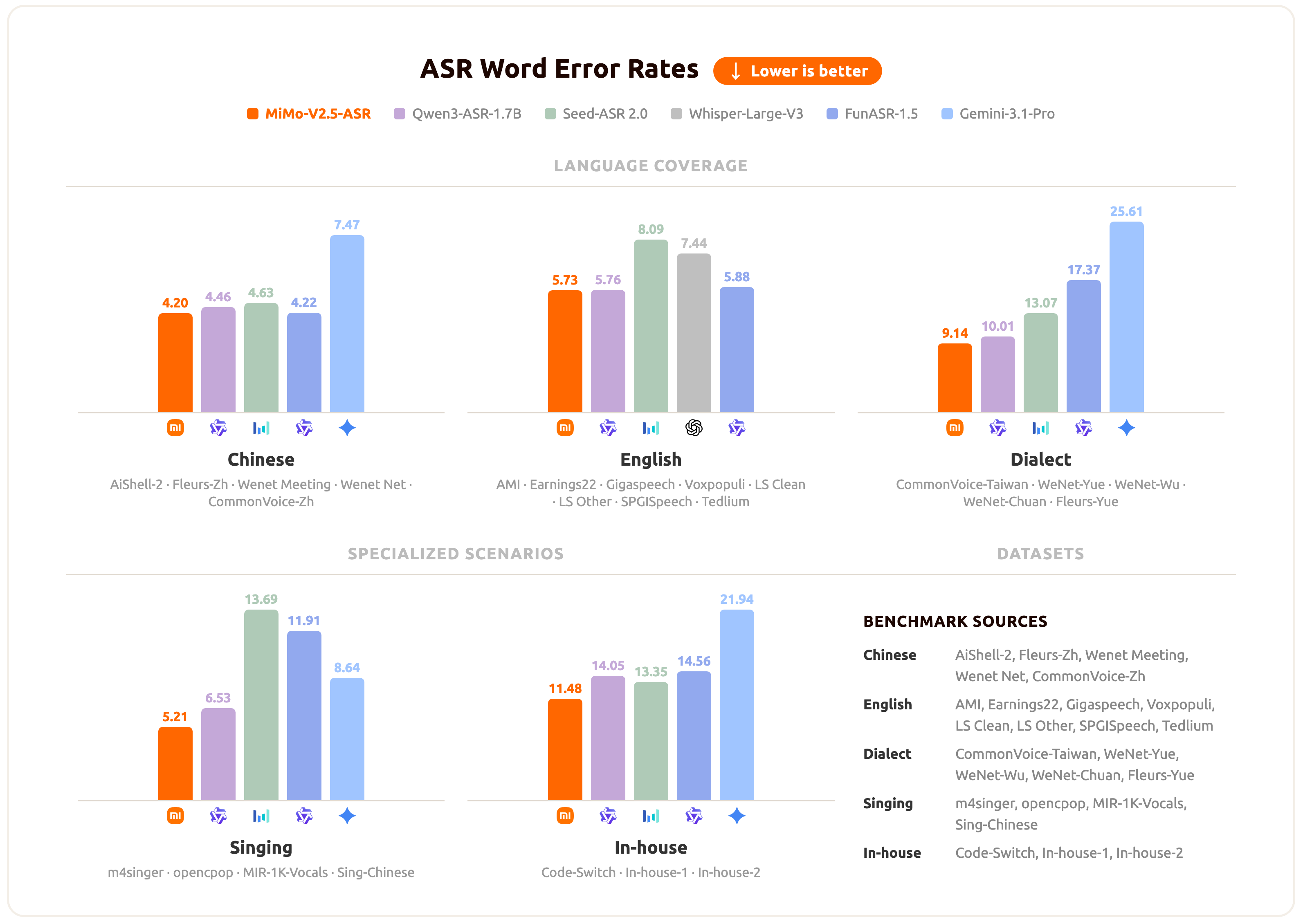
For per-benchmark numbers and specific qualitative cases, please refer to our blog.
Model Download
| Models | 🤗 Hugging Face |
|---|---|
| MiMo-Audio-Tokenizer | XiaomiMiMo/MiMo-Audio-Tokenizer |
| MiMo-V2.5-ASR | XiaomiMiMo/MiMo-V2.5-ASR |
pip install huggingface-hub

hf download XiaomiMiMo/MiMo-Audio-Tokenizer --local-dir ./models/MiMo-Audio-Tokenizer
hf download XiaomiMiMo/MiMo-V2.5-ASR --local-dir ./models/MiMo-V2.5-ASR
Getting Started
Spin up the MiMo-V2.5-ASR demo in minutes with the built-in Gradio app.
Prerequisites (Linux)
- Python 3.12
- CUDA >= 12.0
Installation
git clone https://github.com/XiaomiMiMo/MiMo-V2.5-ASR.git
cd MiMo-V2.5-ASR
pip install -r requirements.txt
pip install flash-attn==2.7.4.post1
[!Note] If the compilation of flash-attn takes too long, you can download the precompiled wheel and install it manually:
pip install /path/to/flash_attn-2.7.4.post1+cu12torch2.6cxx11abiFALSE-cp312-cp312-linux_x86_64.whl
Run the Demo
python run_mimo_asr.py
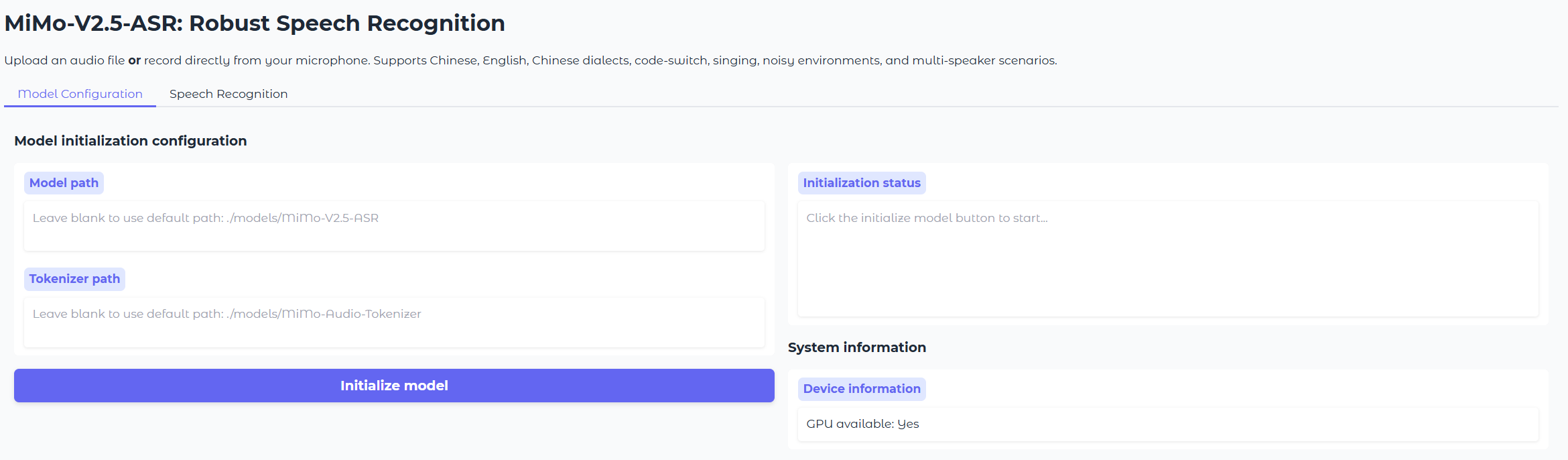
This launches a local Gradio interface for MiMo-V2.5-ASR. You can:
- Upload an audio file or record directly from your microphone.
- Optionally specify a language tag (Chinese / English / Auto) to bias the model for a specific language, or leave it to Auto for automatic language detection (recommended for code-switched speech).
- The demo calls the
asr_sft()interface under the hood.
To load the model and tokenizer automatically at startup, pass their paths on the command line:
python run_mimo_asr.py \
    --model-path ./models/MiMo-V2.5-ASR \
    --tokenizer-path ./models/MiMo-Audio-Tokenizer
Otherwise, enter the local paths for MiMo-Audio-Tokenizer and MiMo-V2.5-ASR in the Model Configuration tab, then start transcribing!
Python API
Basic usage with the asr_sft interface:
from src.mimo_audio.mimo_audio import MimoAudio

model = MimoAudio(
    model_path="./models/MiMo-V2.5-ASR",
    tokenizer_path="./models/MiMo-Audio-Tokenizer",
)

# Automatic language detection (recommended for code-switching)
text = model.asr_sft("path/to/audio.wav")
print(text)

# With explicit language tag
text_zh = model.asr_sft("path/to/audio.wav", audio_tag="<chinese>")
text_en = model.asr_sft("path/to/audio.wav", audio_tag="<english>")
Citation
@misc{coreteam2026mimov25asr,
      title={MiMo-V2.5-ASR: Robust Speech Recognition Across Languages, Dialects, and Complex Acoustic Scenarios},
      author={LLM-Core-Team Xiaomi},
      year={2026},
      url={https://github.com/XiaomiMiMo/MiMo-V2.5-ASR},
}
Contact
Please contact us at mimo@xiaomi.com or open an issue if you have any questions.