Solar Forecast ML V32 "Hubble"
The World's 1st Local Transformer-AI Solar Forecast for Home Assistant — 100% Local, 100% Private





Your roof. Your data. Your AI. Solar Forecast ML builds a digital twin of your specific solar setup using a custom Transformer architecture that runs entirely on your Home Assistant hardware. It learns your roof geometry, local shading, microclimate, and inverter behavior — delivering 3-day hourly forecasts with up to 97% accuracy. Version 32 introduces the SFML Source-of-Truth architecture: critical production and energy calculations are handled inside SFML's own database instead of relying on Home Assistant's recorder-derived energy helpers. No cloud, no subscriptions, no data leakage. Just pure local intelligence.
Fuel my late-night ideas with a coffee? I'd really appreciate it — keep this project running!

☀️ Stop Guessing. Start Knowing.

While others provide generic solar estimates, Solar Forecast ML uses the Hubble AI Stack to build a digital twin of your specific roof. It's the first native Attention & Transformer AI designed to run entirely on your Home Assistant hardware — learning your unique setup from the ground up: roof geometry, local shading, microclimate, and inverter behavior.
Powered by proprietary AI models, a local machine learning engine, and a solar physics backbone, it delivers 3-day hourly forecasts with up to 97% accuracy after calibration. Everything runs on your hardware with a transactional SQL database for reliability. No cloud dependencies, no subscriptions, no data leakage. Your smart home gains foresight, optimizing energy use before the sun even rises.
🚀 Why Is This Different From Other Solar Forecasts?
Most integrations (like Forecast.Solar or Solcast) use static cloud models. They don't know about your neighbor's tree or why your yield drops every November. Solar Forecast ML is the evolution:
| Feature | Standard Cloud Forecasts | Solar Forecast ML (Hubble AI) |
|---|---|---|
| Logic | Static APIs / Generic Formulas | SOTA Transformer & Attention AI |
| Privacy | Data sent to the cloud | 100% Local & Private |
| Shadows | None or very basic | Dynamic Seasonal Shadow Mapping |
| Environment | Ignores local anomalies | Detects Snow, Fog, Pollution & Altitude |
| Adaptability | One size fits all | Learns your specific inverter/panel quirks |
| Reliability | "Black Box" predictions | Physics-Backbone + AI Safeguard |
🧭 Version 32.0.2 — Source of Truth Architecture
Version 32 makes SFML the authoritative runtime layer for solar production data. Home Assistant remains the interface, but SFML now owns the critical calculations, validation, and persistence path for its solar truth.
- SFML-owned database truth — Actual production, panel-group values, forecast rows, diagnostics, and companion-module reads are backed by the SFML database.
- Panel-group power first — Configuration is built around the power sensors (W) of the individual strings or panel groups. Daily-reset energy helpers are no longer required for the core solar setup.
- Internal energy integration — SFML derives hourly and daily kWh values from validated group power data, reducing recorder drift, reset issues, and rounding errors.
- Read-only Home Assistant relationship — SFML reads configured sensors from Home Assistant but keeps its own validated solar state, so HA recorder issues do not become SFML truth.
- SOT sensors for automations — Total and per-group power/energy sensors mirror the SFML database state back into Home Assistant for dashboards, rules, and energy automations.
- HA event-loop protection — Heavy EOD and forecast work is moved away from the main Home Assistant event loop where possible, keeping the UI responsive during model training and daily processing.
🏗️ The "Hubble" AI Stack — Enterprise Intelligence built for Home Assistant
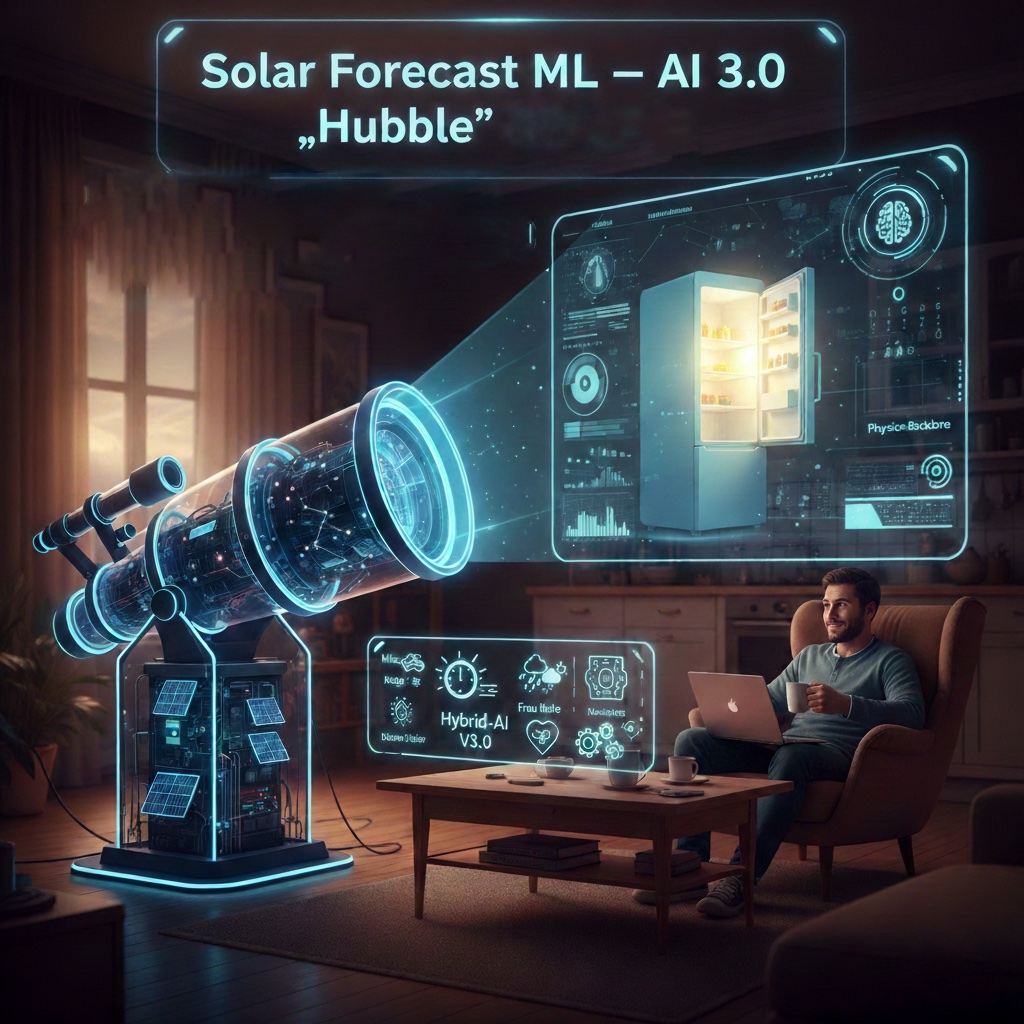
"It's kind of like building a Hubble telescope in your living room just to check if the fridge light is on in the kitchen… simply because it's cool." — Basti, Tester
The heart of this integration is the AI-Stack codename Hubble, a custom-built AI ensemble. I didn't just wrap a library — I built a native Transformer architecture from the ground up to fit into Home Assistant's resource limits, without needing TensorFlow or PyTorch.
This isn't a single model. It's a sophisticated ensemble of specialized AIs working in harmony:
| Component | Purpose | What It Does |
|---|---|---|
| Hybrid-AI V8.0 | Core Neural Engine | Stacked LSTM with Multi-Head Attention and Transformer elements. Analyzes 24-hour sequences for per-panel-group forecasts, capturing complex temporal patterns. |
| Miss Ridge | Quick-Start Model | High-stability model for early-phase predictions (from Day 10 onward), bridging the gap to full ensemble activation. |
| Frau Holle | Weather Correction AI | Multi-layer perceptron that non-linearly adjusts weather data based on local sensors and historical biases. |
| Kalman Tracker | Real-Time Adjustment | Adaptive filter monitoring minute-by-minute bias, dynamically responding to weather volatility. |
| Physics Backbone | Geometric Foundation | Calculates theoretical output with a PhysicsCalibrator that learns deviations from real production (shading, efficiency, aging). |
| Graduated Safeguard | Ensemble Oversight | Monitors model agreement; blends confidently when aligned, falls back to physics during divergence. No hallucinations. |
| Subprocess Trainer | HA Performance Guard | Runs CPU-intensive EOD model training (LSTM/MLP) in an isolated Python worker process, preventing HA event-loop blockages. |
🧠 How Hubble "Sees" Your Energy
Multi-Head Attention — Instead of looking at weather as a simple list, Hubble understands temporal context: how a cloudy morning should influence your battery strategy for the afternoon. It reasons across time, not just snapshots.
Graduated Safeguard — No AI "hallucinations." If the models diverge too strongly, the Physics-Backbone (pure solar geometry) steps in as a safety anchor. The AI knows when to be confident — and when to step back.
Efficiency Drift Detection — Most forecasts go wrong because they don't know your panels are dirty or aging. Hubble tracks your real-world efficiency over time and tells you when it's time to clean them.
Additional self-monitoring layers ensure long-term accuracy:
- Drift Monitor & Seasonal Adjuster — Detects biases and learns seasonal patterns from real data, not calendars.
- Grid Search "The Professor" — Fully automated hyperparameter optimization, extracting the maximum from your specific hardware.
- Subprocess training (HA-Performance-Fix) — CPU-intensive model training runs in a separate Python process to prevent Home Assistant UI lags.
🌍 Real-World Awareness — Beyond the Horizon
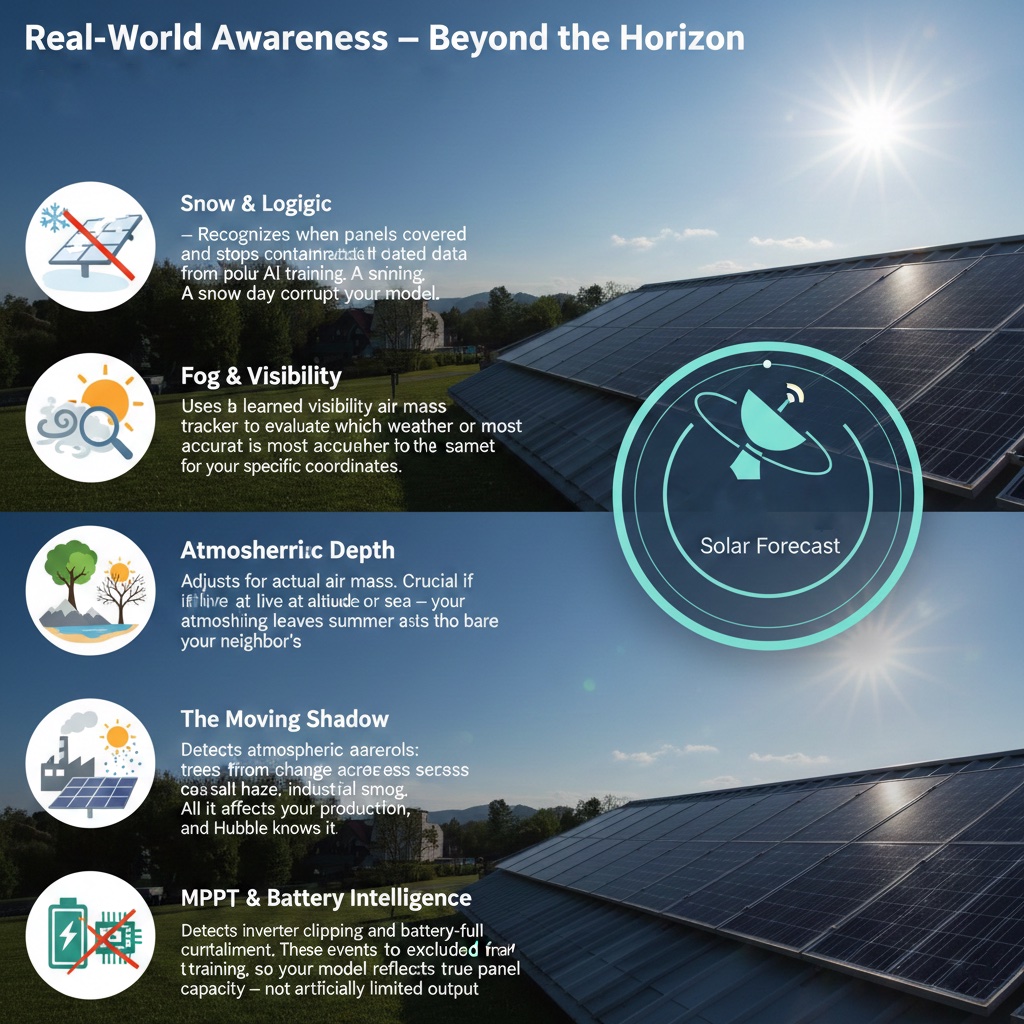
Solar Forecast ML is the only solar forecast integration that understands the messy reality of your environment. While other systems treat every roof as identical, Hubble monitors the real-world conditions that actually impact your production — from snow-covered panels to seasonal shadows, from coastal salt haze to altitude-dependent air mass. Every factor is learned, tracked, and applied automatically.
❄️ Snow Logic — Recognizes when panels are covered and stops contaminated data from polluting your AI training. A snow day doesn't corrupt your model.
烟 Fog & Visibility — Uses a learned visibility tracker to evaluate which weather source is most accurate for your specific coordinates.
🌬️ Atmospheric Depth — Adjusts for actual air mass. Crucial if you live at altitude or near the sea — your atmosphere is not the same as your neighbor's.
🌳 The Moving Shadow — Learns how shadows from trees and buildings change across seasons, accounting for leaves in summer and bare branches in winter.
🌿 Air Pollution Awareness — Detects atmospheric aerosols: rapeseed pollen, coastal salt haze, industrial smog. All of it affects your production, and Hubble knows it.
🔋 MPPT & Battery Intelligence — Detects inverter clipping and battery-full curtailment. These events are excluded from AI training, so your model reflects true panel capacity — not artificially limited output.
⚡ Key Capabilities
🔮 Forecasting
- 72-hour hourly forecasts for today, tomorrow, and the day after.
- Dynamic scheduling tied to actual sunrise.
- Adaptive midday re-forecasts when conditions shift significantly.
- Per-panel-group predictions with confidence scores.
- Clean forecast evaluation separates real physical production from curtailed or excluded hours, so MPPT throttling, clipping, and weather-alert exclusions do not distort forecast-quality metrics.
- Rain-Gating for Similar Weather Relaxation: Automatically suppresses historical similarity scaling when rain is forecast (precipitation > 0.3 mm or rain overcast regime), preventing overoptimistic spikes on wet days.
- Service-Triggered Reforecast Coupling: Instantly recalculates rest-of-day operational snapshots (
ops_tables) upon service call activation of hybrid or operational reforecast modes.
🧠 AI & Machine Learning
- Hubble ensemble with Attention mechanisms for temporal reasoning.
- Automatic daily training and hyperparameter tuning.
- Feature importance analysis to reveal what drives your predictions.
- 28 engineered features: time, weather, astronomy, history, panel geometry.
- Data filtering for anomalies (MPPT throttling, inverter clipping, zero-export limits, weather alerts, outliers, snow days).
- Temporal lag features use clean historical production context, reducing contamination from technically curtailed or excluded bad-weather hours.
- Out-of-Process Subprocess Training: Offloads CPU-intensive training of LSTM and MLP models to a separate background worker process to guarantee Home Assistant UI responsiveness.
- Panel Group Topology Epochs: Versions capacity configurations historically to prevent capacity splits (e.g. adding panels) from polluting model training data.
- Forced AI-Floor Removal: Deactivates the mandatory 30% AI floor in rule-based blending on dark/overcast days if physics MAE is superior to AI MAE, allowing the engine to adaptively scale down to a 12% cap.
🌦️ Weather Intelligence
- Blends 5 sources (Open-Meteo, Bright Sky, Pirate Weather, wttr.in, ECMWF) with expert weighting.
- Multi-stage corrections: rolling biases, hourly adjustments, condition-specific tweaks.
- Learned cloud correction applies local weather-precision factors back into corrected forecasts.
- Fog/haze detection, cloud trend/volatility tracking, and daily forecast-vs-actual weather diagnostics.
🕵️ Detection & Protection
- Shadow mapping and pattern learning for fixed and moving obstacles.
- Frost/fog warnings via dew point and visibility analysis.
- Full zero-export & battery-full curtailment support with weather/radiation plausibility checks before MPPT exclusions are applied.
- Self-healing transactional SQLite database with crash recovery and 30-day backup retention.
- Self-Healing & Diagnostics (Hubble Persona): Automatically validates configuration parameters on boot, monitors live sensor data for spikes, generates Repairs notifications, and performs daily EOD data hygiene checkups.
❄️ Seasonal Intelligence
- Automatic Winter Mode (Nov–Feb) with low sun-angle adjustments.
- Rolling DNI tracking for real-time atmospheric clearness monitoring.
📐 Panel Group Support
- Up to 4 independent panel groups with different orientations, tilts, capacities, and live power sensors.
- Individual efficiency learning, per-group AI predictions, and per-group Source-of-Truth actuals.
- Total live power and daily energy are derived from the validated panel-group state.
🧠 Transformer AI Integration — 20.5M Parameter Multihead Transformer (Toorox ForeSight HA Add-on)
- Seamless integration with the Toorox ForeSight HA companion add-on — a 20.5M-parameter Multihead Transformer trained on multi-year solar history and reanalysis weather data.
- Adaptive ensemble blend: SFML's physics+AI forecast is fused with the Transformer's 72-hour P10/P50/P90 predictions, dynamically weighted per hour and per panel group.
- Three live modulators steer the blend in real time:
- MAE-Factor — tracks 7-day rolling accuracy of both models, shifts weight toward whichever is currently winning
- Cloud-Factor — boosts Transformer influence under overcast/stratus/fog conditions where physics struggles
- Shadow-Factor — increases Transformer weight for panel groups with fixed obstructions or frequent shading
- Effective weight range clamped to 10%–55% (base 35%), ensuring neither model can dominate outliers.
- Up to 4 independent panel groups with different orientations, tilts, and capacities — each blended individually.
- Per-group efficiency learning and per-group AI predictions for maximum precision.
- Optional component — SFML works standalone without the Transformer; if the add-on is installed, the blend activates automatically.
📊 Sensors
Forecast
| Sensor | Description |
|---|---|
solar_forecast_ml_today | Today's forecast (kWh) |
solar_forecast_ml_tomorrow | Tomorrow's forecast (kWh) |
solar_forecast_ml_day_after_tomorrow | Day after tomorrow (kWh) |
solar_forecast_ml_next_hour | Next hour prediction (kWh) |
solar_forecast_ml_peak_production_hour | Best production hour today |
Production
| Sensor | Description |
|---|---|
solar_forecast_ml_production_time | Production hours (start/end/duration) |
solar_forecast_ml_max_peak_today | Peak power today (W) |
solar_forecast_ml_max_peak_all_time | All-time peak power (W) |
solar_forecast_ml_expected_daily_production | Daily production target |
solar_forecast_ml_conservative_planning_forecast | Conservative planning forecast for safe energy scheduling |
Source of Truth
| Sensor | Description |
|---|---|
solar_forecast_ml_total_power | Current total power derived from validated panel-group power (W) |
solar_forecast_ml_total_yield | Current day's SFML-owned actual energy total (kWh) |
| Panel-group SOT sensors | Per-group power and daily energy values backed by the SFML database |
Planning Sensor Note
Planungsprognose (P10-Blend) is a planning-only helper sensor for users who
prefer a more conservative daily value for battery charging, EV charging, and
other energy-management automations.
Core idea:
- SFML remains the primary operational forecast truth
- the planning sensor blends SFML hourly panel-group values with TFS hourly
p10values to shift the result toward the safer side - the current weighting is
65% SFML / 35% TFS p10 - the sensor is intentionally separated from
expected_daily_production, learning, and forecast-truth ownership
Operational behavior:
- the planning value is created only once the official
todayforecast is locked by Morning Routine - after that it is persisted and does not roll continuously with normal coordinator refreshes
- this makes it suitable as a stable day-planning value instead of a rolling intraday truth signal
Statistics
| Sensor | Description |
|---|---|
solar_forecast_ml_average_yield | Cumulative average yield |
solar_forecast_ml_average_yield_7_days | 7-day rolling average |
solar_forecast_ml_average_yield_30_days | 30-day rolling average |
solar_forecast_ml_monthly_yield | Current month total |
solar_forecast_ml_weekly_yield | Current week total |
AI & Diagnostics
| Sensor | Description |
|---|---|
solar_forecast_ml_model_state | Active prediction model (AI / Rule-Based) |
solar_forecast_ml_model_accuracy | Current prediction accuracy (%) |
solar_forecast_ml_ai_rmse | Model quality (Excellent / Very Good / Good / Fair) |
solar_forecast_ml_training_samples | Available training samples |
solar_forecast_ml_ml_metrics | MAE, RMSE, R² metrics |
Shadow & Weather
| Sensor | Description |
|---|---|
solar_forecast_ml_shadow_current | Current shadow level (Clear / Light / Moderate / Heavy) |
solar_forecast_ml_performance_loss | Shadow-related production loss (%) |
solar_forecast_ml_cloudiness_trend_1h | 1-hour cloud trend |
solar_forecast_ml_cloudiness_trend_3h | 3-hour cloud trend |
solar_forecast_ml_cloudiness_volatility | Weather stability index |
📈 Learning Lifecycle
Phase 1 — Day 0: Physics-Backbone active immediately. Solid baseline (~70% accuracy) from the very first day.
Phase 2 — Day 10+: "Miss Ridge" AI activates. Early-stage learning begins, geometry converges. (~85–90% accuracy)
Phase 3 — Day 30+: Full Hubble Transformer activation. Complete ensemble blending at peak precision. (93–97% accuracy)
| Phase | Timeline | Accuracy |
|---|---|---|
| Fresh Install | Day 0 | ~70% — Physics backbone active |
| Early Learning | Day 1–10 | Miss Ridge activates, geometry learning |
| Calibration | Day 10–30 | Ensemble blending, tilt/azimuth to ±3° |
| Full Activation | Day 30+ | Hubble at peak, 93–97% accuracy |
💡 Note: Solar Forecast ML learns from the data it records after setup. There is currently no Home Assistant service for importing historical Home Assistant data into the learning model.
🚀 Installation
HACS (Recommended)
- HACS > Integrations > Custom repositories
- Add
https://github.com/Zara-Toorox/ha-solar-forecast-ml(Integration category) - Install Solar Forecast ML
- Restart HA, wait 10–15 minutes, then restart once more.
Manual
- Download the latest release.
- Copy to
config/custom_components/solar_forecast_ml. - Restart HA twice as above.
Configuration
Add via Settings > Devices & Services. Key inputs:
- Panel-group power sensors (W) — required for each active string or panel group
- System capacity (kWp) + Panel groups (
Power(Wp)/Azimuth(°)/Tilt(°)/PowerSensor) — required for accurate SOT operation - Optional sensors: temperature, lux, radiation, humidity, wind
Daily-reset energy helpers and manually built sum sensors are no longer required for the core solar setup. SFML calculates hourly and daily energy from the configured power sensors and persists the validated result in its own database.
🧩 Companion Modules
Install via the install_extras service:
| Module | Description | Platform |
|---|---|---|
| SFML Stats | Complete solar & energy dashboard: real-time flows, historical charts, forecast vs. actual, cost tracking, surplus detection, smart charging, and beta Lovelace cards. | x86_64 only |
| Grid Price Monitor | Dynamic electricity spot prices for DE/AT, including time-of-use tariff support. | All |
📋 Requirements
- Home Assistant 2026.3.0+
- Power sensors (W) for the active panel groups or strings
- Correct panel-group capacity, azimuth, and tilt values
- ~50 MB disk space · ~200 MB RAM during AI training
- Runs on x86_64, ARM, Raspberry Pi 4/5 (SFML Stats: x86_64 only)
- Optional but recommended: lux sensor, temperature sensor, solar radiation sensor
❓ Troubleshooting
- Low predictions? Verify kWp, panel-group capacity, azimuth, tilt, and the configured panel-group power sensors.
- No daily actuals? Check that every active panel group has a valid power sensor in watts. SFML derives kWh from these power signals.
- AI stalled? Check
solar_forecast_ml_training_samples— minimum 10 needed. Allow 3–7 days for initial collection. - Shadows off? Add a lux sensor. System needs clear-sky days to establish baseline patterns.
- Logs:
/config/solar_forecast_ml/logs/solar_forecast_ml.log
🛡️ Your Data Stays Yours — A Privacy Commitment
Solar Forecast ML was designed from day one with one non-negotiable principle: your data never leaves your home.
This isn't a marketing claim. It's an architectural fact:
No Large Language Models involved — There is no connection to ChatGPT, Claude, Gemini, Grok, or any other AI service. Every calculation, every prediction, every learning step happens entirely within your own Home Assistant instance. The "AI" in Solar Forecast ML is your AI — running on your hardware, trained on your data.
No telemetry, no analytics, no tracking — The integration contains no usage tracking, no error reporting endpoints, no analytics libraries, and no background callbacks of any kind. I have no visibility into whether you've installed this, how you use it, or what your system produces.
No data shared with me or anyone else — Your production data, your sensor readings, your location, your learned model weights — none of it is ever transmitted anywhere. Not to me as the developer, not to third parties, not to weather services beyond the standard forecast requests that you explicitly configure.
Free weather APIs only — The integration fetches raw weather forecasts from public APIs (Open-Meteo etc.). These requests contain only coordinates — no personal data, no identifiers, no usage metadata.
Fully offline-capable — Once installed, Solar Forecast ML operates entirely within your local network. No internet connection is required for the AI to learn, predict, or correct forecasts.
In short: What happens in your Home Assistant, stays in your Home Assistant.
🔐 Protected Code Notice
Some files in this integration are obfuscated (encrypted) with an official PyArmor version.
Why is the code protected?
- Protection against AI Training — I want to prevent my source code from being used to train AI models like ChatGPT, Claude, Gemini, or other Large Language Models (LLMs) without permission.
- Intellectual Property Protection — The algorithms for solar forecasting, AI-learning, and weather analysis were developed with considerable effort and represent my intellectual property.
- Open Source with Limits — This integration is free for personal use, but the source code is proprietary and subject to a Non-Commercial License.
- Unfortunately necessary — Since code has been copied without my consent, incorporated into commercial applications, and attempts have been made to read and modify it using AI in the past, I unfortunately feel compelled to protect the source code.
- Transparency — If you have a legitimate interest, I'm happy to provide information about the code or disclose it. Just contact me via GitHub Issues or Discussions.
The obfuscation has no impact on functionality. The integration works identically to the non-obfuscated version. Runtime overhead is minimal.
Solar Forecast ML — Copyright (C) 2026 Zara-Toorox · Protected with PyArmor 9.2.4
📄 License
Proprietary Non-Commercial — free for personal and educational use. See LICENSE.
👤 Credits
Developer: Zara-Toorox
Thanks to Simon42 and the users & contributors of the German-speaking HA Forum "simon42" for their testing, feedback, and discussion.
Support-Forum: simon42 Community | Issues | Discussions
Developed with ☀️, late-night passion, and a stiff glass of Grog during Germany's wintertime.