








What is Go2TV?
Go2TV lets you play video, audio, and image files on your Smart TV or Chromecast device directly from your computer or phone. It works with:
- Smart TVs - Samsung, LG, Sony, and others that support DLNA/UPnP
- Chromecast - Google Chromecast, Chromecast with Google TV, and compatible devices
- Apps - BubbleUPnP, GMediaRender, and other media receiver apps
No need to copy files to a USB drive or set up a media server. Just select your file, pick your device, and play.
Features
- Auto-discovery - Automatically finds Smart TVs and Chromecast devices on your network
- Transcoding - Converts incompatible video formats on-the-fly (requires FFmpeg)
- Subtitles - Supports external SRT/VTT files and embedded MKV subtitles
- Seek support - Jump to any position in the video
- Playlist playback - Single-file and multi-file playlists with add/remove/reorder/select support
- Loop and auto-play - Loop the current file or auto-play through the playlist
- Gapless playback - Supported for DLNA devices
- RTMP Server - Cast live streams from OBS directly to Chromecast (requires FFmpeg)
- Cast Desktop (experimental) - Cast desktop as live stream to Chromecast (requires FFmpeg)
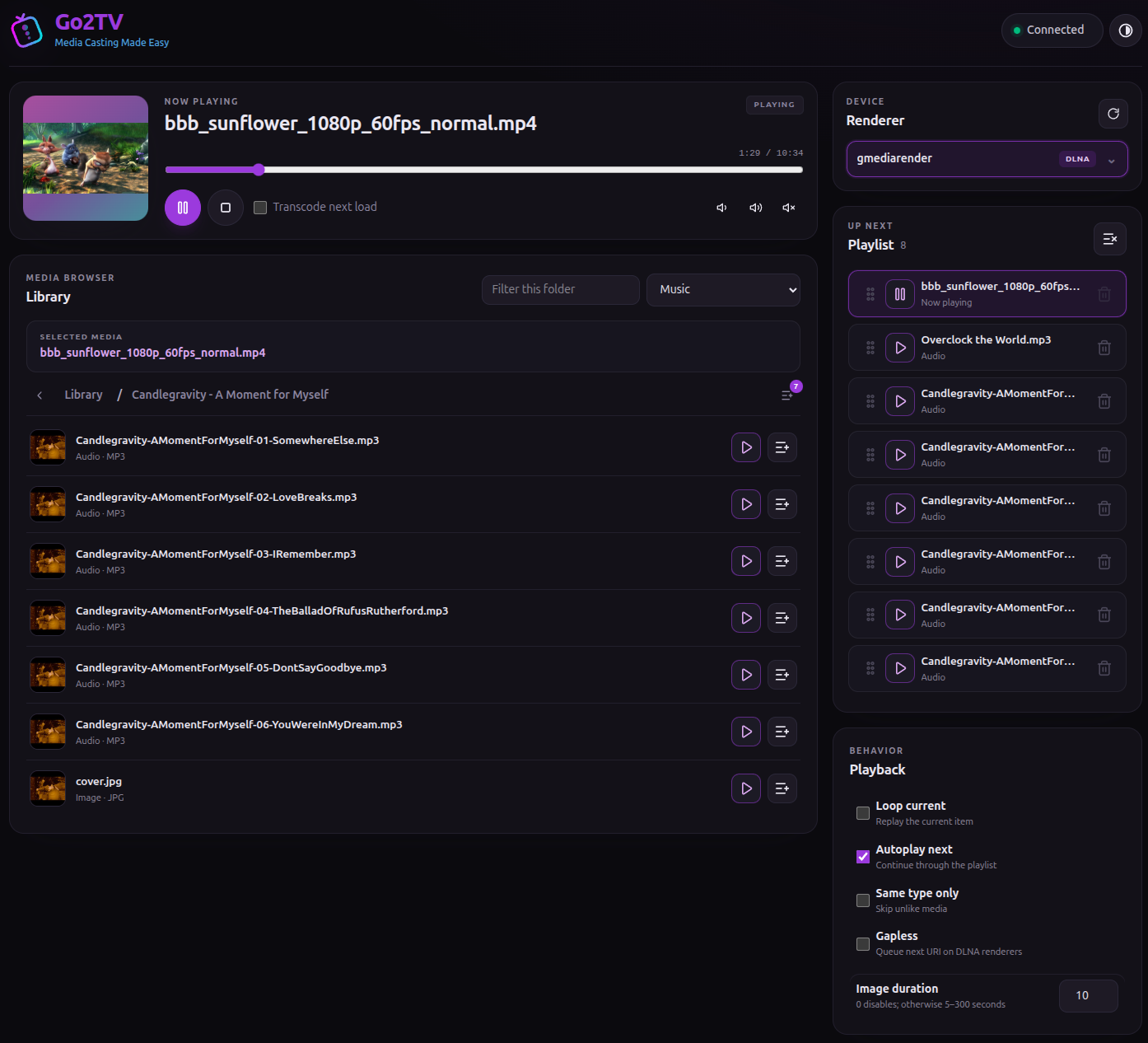
- Web UI (server mode) - Browse media roots and control casting from any browser on your network
- GUI and CLI - Use the graphical interface or command line
Screenshots
GUI Mode


CLI Mode

Web UI (Server Mode)
Installation
macOS: Install with Homebrew:
brew install --cask go2tvLinux: Install from Flathub:
flatpak install flathub app.go2tv.go2tvOr download the latest release from the releases page.
- Windows GUI: Download
go2tv_vX.Y.Z_windows_amd64.zip, extract, and rungo2tv.exe - Windows CLI: Download
go2tv_vX.Y.Z_windows_amd64_lite.zip, extract, and rungo2tv-lite.exe - macOS: Download
go2tv_vX.Y.Z_macOS_amd64.zip(Intel) orgo2tv_vX.Y.Z_macOS_arm64.zip(Apple Silicon), extract, and run the app - Linux: Download
go2tv_vX.Y.Z_linux_amd64.zip(or appropriate arch), extract, and rungo2tv - Android: Download
go2tv_vX.Y.Z.apkfor the arm64 build with bundled FFmpeg transcoding
For release downloads, Go2TV is a single executable with no installation required. Just download and run.
Optional: FFmpeg for Transcoding
For maximum compatibility with all devices and file formats, install FFmpeg. Go2TV will automatically use it when needed.
When transcoding is enabled, Go2TV probes available GPU H.264 encoders first and falls back to libx264 if hardware encoding is unavailable or fails at startup.
- Linux:
sudo apt install ffmpegor equivalent for your distro - macOS:
brew install ffmpeg - Windows: Download from ffmpeg.org and add to PATH
- Flatpak: FFmpeg is bundled automatically
- Android: FFmpeg is bundled in the default APK. It is arm64-only and requires Android 9.0+.
Usage
GUI
Select a media file (or drag and drop it onto the main window), pick a device from the list, and click Play.
Playlist
The Playlist window lets you add, remove, reorder, and select files. Dragging files onto the main window replaces the playlist; dragging them onto the Playlist window appends them. Next, Previous, and Auto-Play Next File follow the playlist order.
CLI
Run go2tv -h for all options. Common commands:
# List available devices
go2tv -l

# Play a local file
go2tv -v movie.mp4 -t http://192.168.1.100:8060/

# Play with subtitles and transcoding
go2tv -v movie.mkv -s movie.srt -tc -t http://192.168.1.100:8060/

# Play a remote file
go2tv -u https://example.com/movie.mp4 -t http://192.168.1.50:8009

# Stream from another command
yt-dlp -o - "https://youtu.be/..." | go2tv -t http://192.168.1.50:8009

# Transcode with a custom FFmpeg binary
go2tv -tc -ffmpeg /path/to/ffmpeg -v movie.mkv -t http://192.168.1.50:8009
Web UI (Server Mode)
Run Go2TV as a web server to browse selected media folders and control casting from a browser. The Web UI has separate device, playlist, and playback state from the desktop GUI.
From the GUI, open Settings → Remote Web Session…, add media folders, choose local or LAN access, and start the session.
For headless use, pass -server and at least one -media-root:
go2tv -server -media-root /path/to/MediaUse -ffmpeg /path/to/ffmpeg when FFmpeg is not available on PATH. CLI,
go2tv-lite, and the Web UI verify and use the supplied binary.
The default URL is http://127.0.0.1:9666/. Repeat -media-root to expose multiple
directories:
go2tv -server \
  -media-root /path/to/Movies \
  -media-root /path/to/Music \
  -media-root "/path/to/TV Shows"
For LAN access, set a non-loopback -listen address and allow each browser origin:
go2tv -server \
  -listen 0.0.0.0:9666 \
  -allowed-origin http://192.168.1.20:9666 \
  -media-root /path/to/Media
LAN mode uses HTTP without TLS. Use it only on trusted networks.
RTMP Streaming (Chromecast only)
Select a Chromecast, enable RTMP Server, and click Play. Use the displayed URL in OBS or other streaming software. Requires FFmpeg.
Cast Desktop (Experimental, Chromecast only)
Select a Chromecast, enable Cast Desktop (experimental), and click Cast. Requires FFmpeg and is not supported on audio-only Chromecast devices.
Supported File Types (GUI)
mp4, avi, mkv, mpeg, mov, webm, m4v, mpv, mp3, flac, wav, jpg, jpeg, png
The CLI accepts any file type.
Companion Project: mcp-beam MCP Server (Powered by Go2TV)
mcp-beam is a companion MCP server (stdio transport) built on top of Go2TV core packages.
It lets MCP clients discover Chromecast and DLNA/UPnP devices, cast local files or remote URLs, and stop playback. For direct control, use the Go2TV GUI or CLI.
Troubleshooting
Firewall Configuration
If you're behind a firewall, allow inbound traffic from devices on your local network:
3339-3438/udpfor DLNA/UPnP device discovery3500-4499/tcpfor the local HTTP media server used by DLNA and Chromecast playback
Notes
Chromecast receiver
Go2TV uses a custom Chromecast receiver hosted at https://cast-receiver.go2tv.app/. It is not part of this open-source repository and is not currently published. Functionality matches the default receiver, with minor branding differences.
Building from Source
Requirements: Go 1.26
git clone https://github.com/alexballas/go2tv
cd go2tv
make build
AppImage builds (Linux)
make appimage          # Without FFmpeg
make appimage-ffmpeg   # With FFmpeg
For the FFmpeg build, APPIMAGE_FFMPEG_MODE supports auto (default), system,
download, or none. Override binary paths with APPIMAGE_FFMPEG_BIN and
APPIMAGE_FFPROBE_BIN.
Android builds
make androidmake android builds the arm64 APK and bundles Android ffmpeg/ffprobe executables as native libraries. Set ANDROID_NDK_HOME and ANDROID_HOME.
Using Docker
Build the image:
docker build --force-rm -t go2tv .Run the container (Linux with X11):
xhost +local:docker
docker run -it --network host -e DISPLAY=$DISPLAY -v /tmp/.X11-unix:/tmp/.X11-unix go2tv go2tv
Author
Alexandros Ballas alex@ballas.org
License
MIT
Artifacts that bundle FFmpeg inherit the bundled FFmpeg build's license obligations. The Android FFmpeg APK uses an Android NDK-built LGPL FFmpeg package by default; AppImages built with the default bundled FFmpeg use GPL builds.