
An orchestrated agent system for production-grade GPU kernel development
Overview
Atrex Kernel Agent (AKA) turns an evaluator-owned operator into a measured, optimized GPU kernel. It coordinates coding agents, GPU profiling, correctness checks, performance verification, Git isolation, recovery, and final packaging while keeping acceptance and termination under mechanical supervisor control.
The repository has one supported entry point, orchestrator/optimize.py. The internal
long_horizon/ package supplies the episode engine; it is not a second CLI.
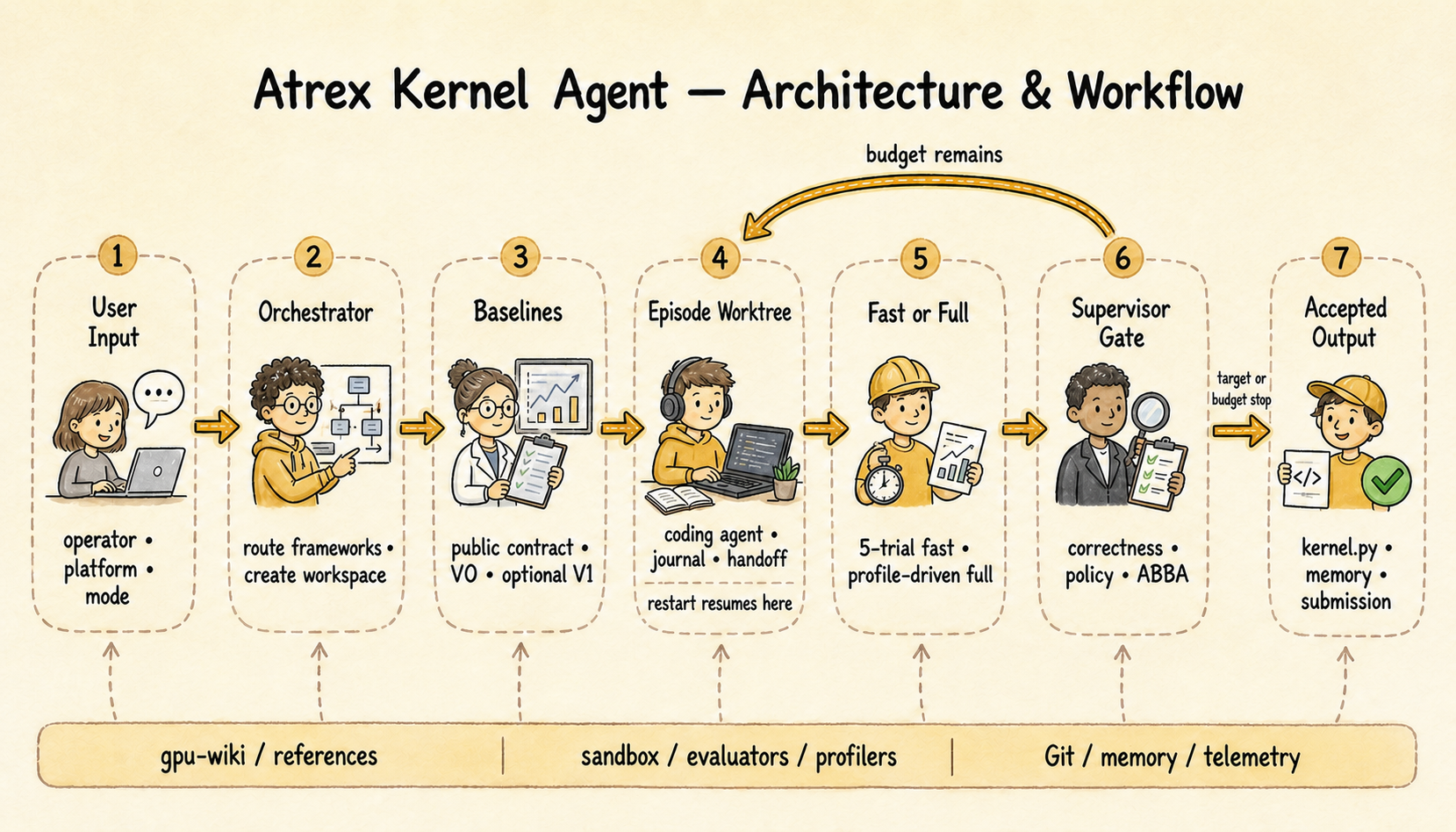
AKA supports:
- SOL-ExecBench and native Atrex-Bench operator layouts;
- NVIDIA, AMD, and T-Head PPU (zwm890p) targets through isolated sandbox execution;
- gateway and Bubblewrap-isolated OpenSSH GPU execution, with automatic environment recovery;
- Triton, CuteDSL, CUDA, FlyDSL, and TileLang campaigns;
- Claude, Qoder, Codex, and Pi coding-agent backends;
- leaderboard and fail-closed production modes;
- resumable, Git-isolated optimization with canonical measurement history.
News
- [2026-08] We slimmed down Atrex Kernel Agent by consolidating on a single orchestrated workflow and removing legacy paths and redundant context for a smaller context footprint and lower token usage.
- [2026-07] We helped Qwen3.8 rank No. 1 on the SOL-ExecBench FlashInfer operator optimization leaderboard.
- [2026-07] We released Atrex Kernel Agent v0.2.0 with an orchestrated clean-session loop, native SOL-ExecBench operator workflow, Triton-to-Gluon conversion support, and a fuller NVIDIA profiling toolchain. [Release]
- [2026-07] We released the Atrex paper: Are LLM-Generated GPU Kernels Production-Ready? A Trace-Driven Benchmark and Optimization Agent.
- [2026-06] We released Atrex Kernel Agent v0.1.0 as the initial open-source version, with the GPU Wiki knowledge base, profile-driven optimization workflow, profiling tools, and reference templates. [Release]
Quick Start
See the Quick Start guide for prerequisites and complete runnable examples of the orchestrated optimization loop.
Or start a coding agent such as Claude Code, Codex, or Qoder in this repository and ask it to launch an AKA optimization task. We recommend the following prompt:
Use AKA's orchestrator/optimize.py to start one optimization task for atrex-bench/xx. Put the workspace under ~/aka-opt, set the platform to H20, use the local sandbox, use claude as the Agent CLI, set max-iters to 300, specify cuda as the framework, and run in production mode.Documentation
| Document | Contents |
|---|---|
| Quick Start | Setup, commands, campaign steps, configuration, and outputs |
| Architecture Design | Components, authority boundaries, state machine, verification, and recovery |
| GPU Wiki | Structured hardware/kernel knowledge, queries, and trace mining |
Run python orchestrator/optimize.py --help for the authoritative CLI interface and defaults.
For a GPU server reachable through OpenSSH, use a dedicated low-privilege account and pass
--sandbox-ssh user@gpu-host --sandbox-ssh-gpu 0 with an explicit --framework. AKA keeps Agent,
Git, memory, and episode state local, transfers only
the sandbox allowlist to a fresh remote temporary directory, and runs it in a mandatory networkless
Bubblewrap namespace before copying back requested artifacts. Use --sandbox-ssh-runtime-bind for
read-only venv or toolchain trees outside the minimal system mounts. Runtime sources are checked
against sensitive host paths after remote symlink resolution, and only the assigned physical NVIDIA
GPU is visible; MIG execution fails closed until capability-node assignment is supported.
If the remote environment fails its GPU health probe, AKA stops, preserves the active worktree, and
starts a detached monitor that resumes the original command after the server recovers. See
Quick Start: Isolated OpenSSH GPU host.
The generated stop-recovery.sh also stops a recovered optimizer and leaves automatic recovery
disabled until the generated recover.sh is run explicitly. The recovery monitor stays with the
restarted optimizer: an unexpected exit returns to health polling and automatic restart, while only a
durably clean zero exit completes recovery.
Acknowledgements
AKA builds on and learns from many open-source projects, including:
- GPU kernel projects: CUTLASS, cutex, cuLA, FlashAttention, FlashInfer, FlyDSL, Triton, DeepGEMM, LeetCUDA, FlashMLA, Composable Kernel, cute-gemm, hpc-ops, AIter, quack, and TileLang.
- Knowledge and agent tooling: KernelWiki, modern-gpu-programming-for-mlsys, ncu-report-skill, humanize, AKO4ALL, and KDA.
Citation
If AKA is useful in your work, please cite the Atrex paper:
@misc{atrex2026,
  title         = {Are LLM-Generated GPU Kernels Production-Ready? A Trace-Driven Benchmark and Optimization Agent},
  author        = {Lingyun Yang and Yuxiao Wang and Shenghao Liang and Linfeng Yang and Daocheng Ying and Chunbo You and Rui Zhang and Luping Wang and Yinghao Yu and Guodong Yang and Liping Zhang},
  year          = {2026},
  eprint        = {2607.14541},
  archivePrefix = {arXiv},
  primaryClass  = {cs.AI},
  url           = {https://arxiv.org/abs/2607.14541}
}
License
Licensed under the Apache License 2.0.