Grok Bot 0.18 — reconstructed and extended
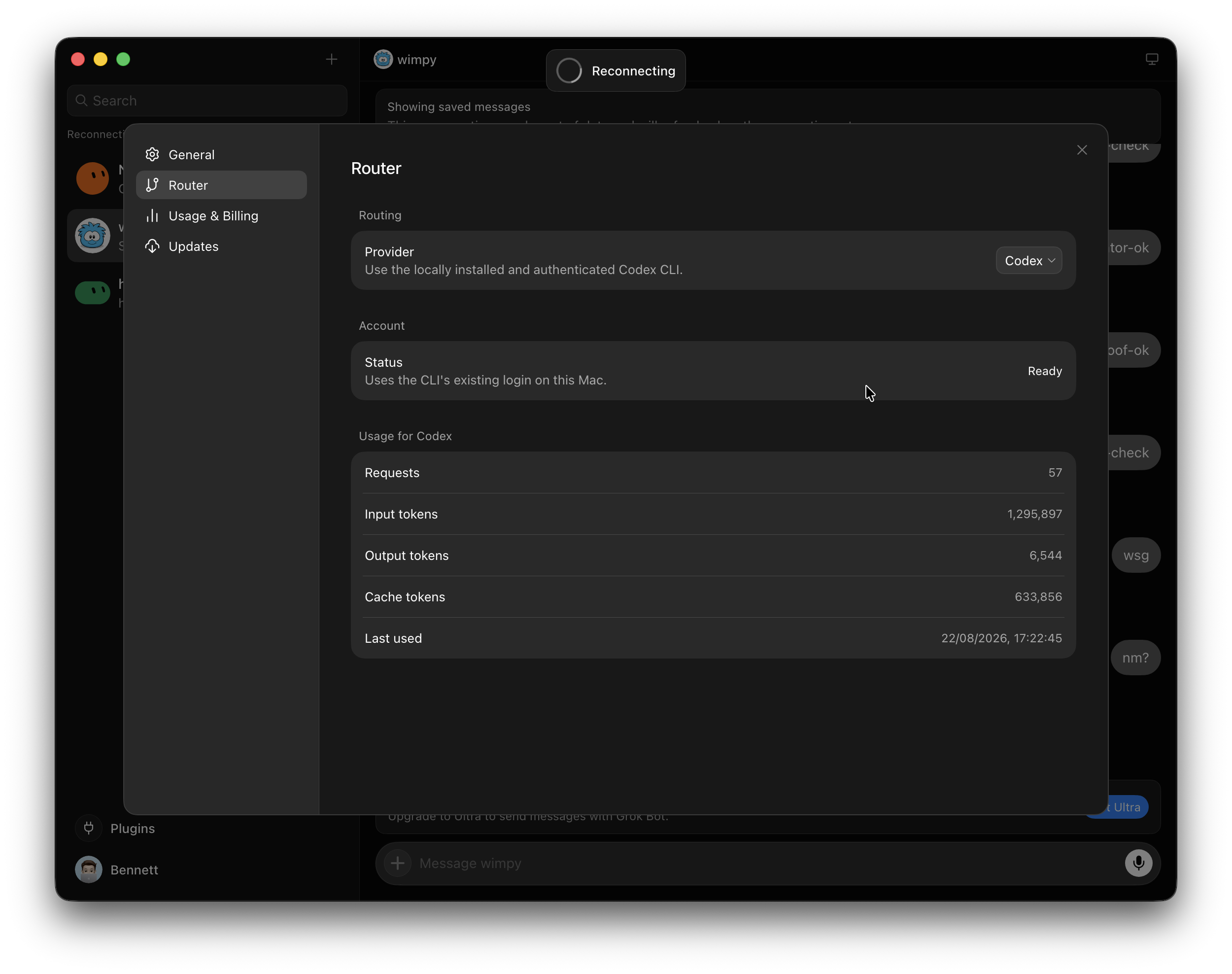
This repository is an unofficial, source-oriented reconstruction of the publicly shipped Grok Bot 0.18.0 macOS app.
The project began as an attempt to understand how the desktop app was put together. It now contains readable TypeScript implementations of its Electron, host, coordinator, local-execution, protocol, and renderer boundaries, plus a deterministic toolchain for turning those sources back into a working macOS application.
It also adds a few practical experiments:
- an inference router for Cursor, Claude Code, Codex, and OpenRouter;
- Grok Bot plugin/MCP tools across the routed providers;
- local usage tracking for routed inference;
- an optional local Docker sandbox in place of the remote box; and
- a reconstructed settings surface integrated into the polished shipped UI.
This is a hacking and research project, not Anysphere's original monorepo and not an official Grok Bot release. Names and module boundaries inferred from a compiled application may differ from the original source.
What is in the repository?
The checked-in tree contains the reviewed reconstruction, tests, manifests, build scripts, and Git LFS preservation copies of the original macOS arm64 and Windows x64 installers. It deliberately does not commit the extracted upstream application, build output, local credentials, or the large forensic recovery workspace.
The public Grok Bot 0.18.0 application is instead treated as a pinned build input. During bootstrap, the toolchain downloads it, verifies its SHA-256 identity, and extracts the pieces required to assemble the reconstruction.
The resulting app is a hybrid by design:
- application runtimes are compiled from the readable sources under
source/; - the polished shipped renderer remains the UI baseline;
- a narrow deterministic transform adds the reconstructed Router settings UI;
- original and patched renderer chunk hashes are recorded and verified; and
- the finished app uses a separate bundle identifier and an ad-hoc signature.
The upstream app installed on the machine is never overwritten.
Why retain the shipped renderer?
The distributed application did not include the original frontend source or source maps. It contained optimized, minified production JavaScript and CSS chunks: enough to inspect behavior and recover contracts, but not the authored React components, names, comments, file structure, or design-system source.
Recreating the complete frontend with the same polish and behavior would have been a separate, much larger reverse-engineering project. It was not a realistic goal for a weekend build. The practical choice was therefore to reconstruct the runtime and control-plane code, retain the checksum-pinned shipped renderer, and make the smallest auditable UI patch needed for the new Router settings.
frontend/ is a readable partial reconstruction and design workspace. It is
useful for understanding UI contracts and experimenting with clean components,
but it should not be mistaken for Anysphere's missing original frontend source
or a pixel-perfect replacement for the packaged renderer.
Preserved original installers
Research copies of the exact 0.18.0 installers live under
research-archives/original/0.18.0/ and are stored with Git LFS:
| Platform | File | SHA-256 |
|---|---|---|
| macOS arm64 | macos-arm64/Grok_Bot_0.18.0.dmg | a253ccd8aab01e083f9812a0264354c5034d8ba7f0610bbb557e82ae77d203eb |
| Windows x64 | windows-x64/Grok_Bot_0.18.0_Setup.exe | 464079a15ef5fa8b61ccea8fffcc78f63cfcf6df65fb0ad5e725d8b95f7e437e |
See research-archives/README.md for source URLs, sizes, verification commands, and the machine-readable artifact manifest.
Current features
Inference Router
Open Settings → Router to choose the backend used for new turns:
| Provider | Authentication | Tool support |
|---|---|---|
| Cursor | Existing Grok Bot/Cursor session | Native Grok Bot tools and plugins |
| Claude Code | Existing Claude Code login | Routed Grok Bot MCP tools |
| Codex | Existing local ChatGPT/Codex login | Direct Responses transport with Grok Bot tools |
| OpenRouter | API key saved through the desktop secrets bridge | Grok Bot tool-execution loop |
Cursor is the default. Claude Code and Codex do not require separate API keys when their local clients are already authenticated. The application preserves streaming responses, thinking state, reactions, rich plugin mentions, and MCP tool execution across routed conversations.
Usage & Billing shows the locally recorded request and token totals for providers that return usage data. These figures are activity records, not an authoritative provider invoice.
Local Docker sandbox
The Router page also has a Use local Docker VM toggle. When enabled, Grok Bot runs its box host and execution daemon in an owned local container instead of connecting to the remote sandbox.
The container:
- is bound only to loopback ports;
- mounts content-addressed host and daemon artifacts read-only;
- reuses the user's existing provider authentication where needed;
- is validated before the coordinator connects; and
- is stopped or replaced through the same settings lifecycle.
Docker Desktop, or another compatible local Docker daemon, must be running. Remote mode remains the default.
Requirements
- macOS on Apple Silicon
- Node.js 26.5.x
- Xcode Command Line Tools
- Git LFS
- Docker Desktop (optional, only for the local sandbox)
- local Claude Code or Codex authentication for those router choices
Quick start
git clone <your-repository-url>
cd grok-bot-0.18-reconstructed
git lfs install
git lfs pull
npm ci
npm run bootstrap
npm run check
npm run package
open "dist/Grok Bot 0.18 Reconstructed.app"
npm run bootstrap first uses the Git LFS preservation copy of the pinned
0.18.0 DMG. If that archive is absent, it falls back to the original public URL;
GROK_BOT_018_APP can also point to an existing application copy. Bootstrap
verifies both the DMG and app.asar, caches the matching Electron runtime, and
hydrates the ignored src/app/dist build input.
npm run package compiles the reconstructed runtimes, applies the narrow
renderer/settings transform, creates the app bundle, assigns the reconstructed
bundle identity, ad-hoc signs it, and verifies the result. Output is written to:
dist/Grok Bot 0.18 Reconstructed.appReconstructed packages disable the upstream updater at the packaging boundary and default upstream Sentry and telemetry emission off. Explicitly supplied environment configuration is still respected.
Architecture
polished shipped renderer
          │
          │ desktop preload / RPC
          ▼
     Electron main
          │
          ├── settings, secrets, auth and plugin lifecycle
          ├── remote box connector
          └── owned local Docker connector
                       │
                       ▼
              coordinator + host
                       │
              inference router
           ┌───────────┼───────────┐
        Cursor      Claude       Codex / OpenRouter
                       │
                 Grok Bot MCP tools
The main source areas are:
source/electron-main/— desktop lifecycle, settings, auth, box connectors, coordinator ownership, and RPC handlers;source/electron-preload/— the narrow trusted bridge exposed to the UI;source/host/— inference, tools, MCP, settings, and turn execution;source/node-agent-coordinator/— transcript routing, streaming activity, reactions, and the routed MCP bridge;source/shared/— shared contracts, settings, protocol, and provider helpers;frontend/— readable React/TypeScript renderer reconstruction and design workspace;scripts/— bootstrap, compilation, renderer patching, packaging, signing, and verification; andtests/— publication and router regressions.
See docs/ARCHITECTURE.md for more detail.
Development commands
npm test                  # focused regression tests
npm run typecheck         # renderer TypeScript
npm run source:typecheck  # runtime TypeScript
npm run frontend:build    # build the readable renderer reconstruction
npm run package           # build, sign, and verify the macOS app
npm run verify            # verify an existing packaged app
npm run smoke             # bounded native smoke check
npm run publication:check # prove a fresh-history export is lossless
Generated directories including .cache, .build, dist, src/app/dist,
recovered, recovery, and local probe roots are ignored.
Project status
The app launches and the core reconstructed flows are usable, including routed inference, connected plugins, and the local Docker sandbox. This is still an experimental reconstruction: it targets one pinned macOS/arm64 release, depends on external provider sessions, and does not promise compatibility with future Grok Bot versions.
For changes, read CONTRIBUTING.md. For the clean-history export procedure, see docs/PUBLISHING.md. Technical provenance and retained upstream boundaries are described in PROVENANCE.md and NOTICE.md.