
Browser Use Terminal
Automate the boring stuff in the browser.
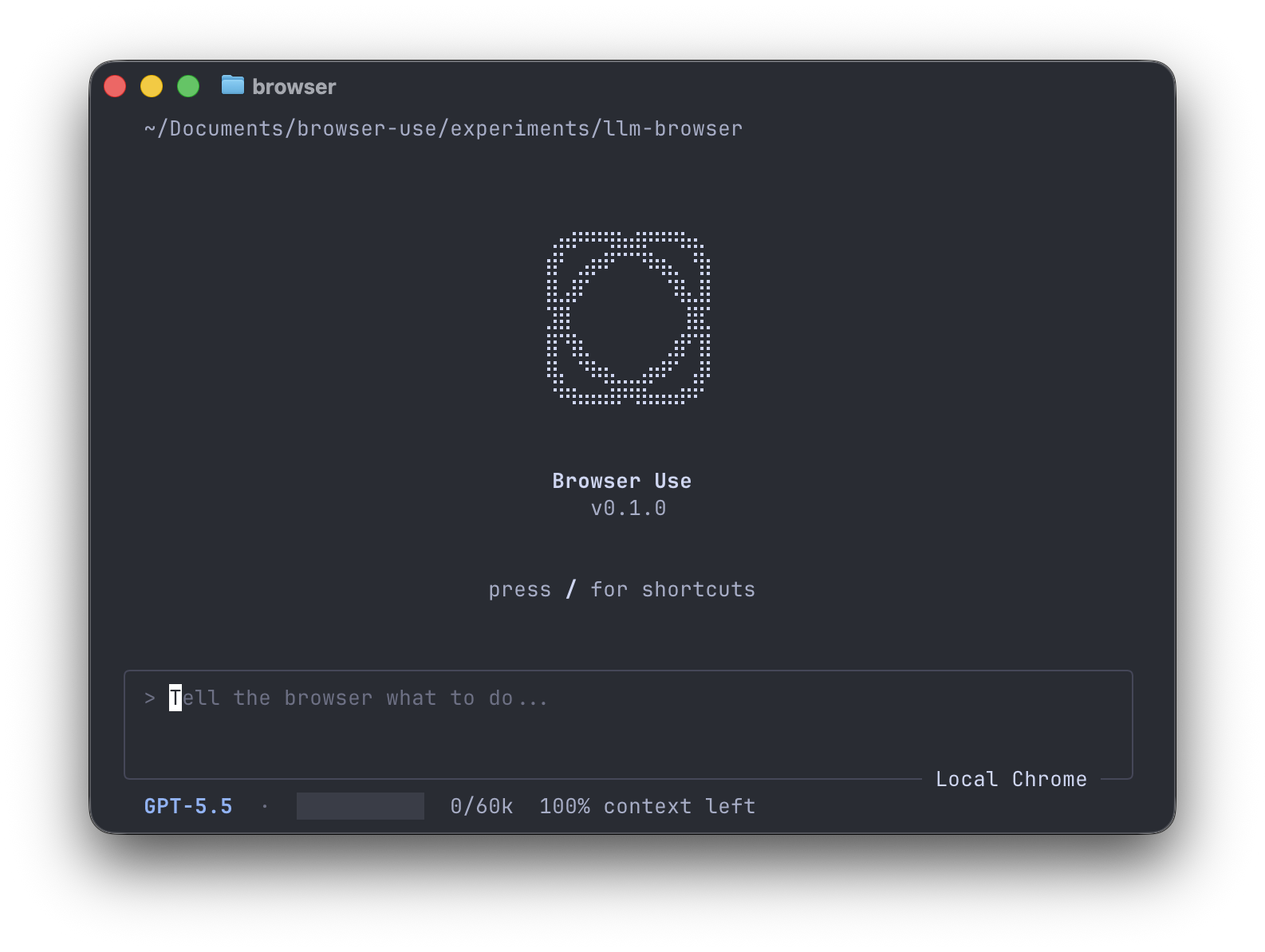
Browser Use Terminal is a Rust TUI for browser agents. It combines a new LLM harness, Browser Harness-style CDP control, real Chrome sessions, and a terminal UI you can actually steer.
curl -fsSL https://browser-use.com/terminal/install.sh | sh
browser
What It Does
- runs browser tasks from a terminal UI
- works with your logged-in Chrome when the task needs real account state
- supports headless Chromium and Browser Use cloud for clean or remote runs
- lets you watch, steer, stop, retry, and resume tasks
- keeps local history, screenshots, artifacts, and follow-ups
- uses a new LLM harness built to be 2x cheaper and 2x faster than Browser Harness
How It Works
Browser Use Terminal is a browser-first LLM harness: Rust owns the agent loop and durable state, while the browser runtime gives the model direct CDP control over Chrome.
you
 │
 ▼
browser terminal
 │
 ├─ custom Ratatui UI      watch · steer · stop · resume
 ├─ Rust LLM harness       tools · subagents · compaction · cancellation
 ├─ SQLite event log       history · screenshots · artifacts · traces
 └─ CDP browser runtime    profiles · doctor · recovery · ownership
      │
      ▼
real Chrome | headless Chromium | Browser Use cloud- The model gets raw browser capability: CDP, page JavaScript, screenshots, files, and helper code.
- The terminal stays controllable: history, artifacts, follow-ups, browser recovery, and a custom Ratatui renderer for live work.
Try It
Get my San Francisco parking permit.Give this employee admin permission in Azure.Find the cancellation policy for my current hotel reservation.Setup
Launch the app:
browserUse slash commands inside the TUI:
/auth      sign in
/model     choose a model
/browser   choose local, headless, or cloud browser
/update    update the app
Useful shell commands:
browser auth status
browser config show
browser diagnostics
Use It From Claude Code, Codex, or OpenCode
Browser Use Terminal plugs into any coding assistant that can run shell commands, browser-harness style: a skill teaches the assistant the CLI, and the CLI hands it the whole browser runtime.
browser-use-terminal skill install # registers the skill for detected assistantsThen ask your assistant to browse:
browser-use-terminal browser exec <<'PY'
new_tab("https://example.com")
wait_for_load()
print(capture_screenshot())
PY
Screenshots are saved as files and the path is printed, so assistants view them with their native file-reading tools (Claude Code Read, Codex view_image, OpenCode read). The browser persists between calls. See docs/assistant-plugins.md.
Development
cargo fmt --check
cargo test
uv run --with pytest python -m pytest -q
scripts/verify-terminal-ui.sh
Terminal UI changes must pass the full verification script. It runs Rust tests, Python tests, deterministic Ratatui dumps, and a real tmux smoke test.
Agent Tools
Release archives include a managed ripgrep binary at bin/agent-tools/rg.
Agent shell commands prepend Browser Use Terminal's temporary tool shim and
managed tools directory to PATH, so rg, rg --version, and rg --files
work without depending on the user's shell dotfiles or DotSlash. Source
checkout entry points and local dev wrappers install the same managed ripgrep
under target/debug/agent-tools/rg; run
scripts/install-agent-ripgrep.sh target/debug/agent-tools to refresh it
manually.
Telemetry
You can disable (100% completely anonymous) telemetry with BUT_TELEMETRY=0.
Docs
docs/terminal-ui-product-ux.mddocs/terminal-ui-testing.mddocs/terminal-renderer-architecture.mddocs/assistant-plugins.md
License
MIT