bigpowers — Best-in-Class Agentic Skills


Agent skills synthesizing 17 years of software engineering discipline — from Clean Code to AI-native architecture — into a single, prescriptive methodology for solo developers.
bigpowers provides a prescriptive, vertical-slice methodology for building software with AI agents (Claude Code, Gemini CLI, Cursor, pi). It bridges the gap between raw LLM capabilities and professional engineering standards.
It is not a random collection of best practices. It is a chronological layer cake of ideas — each wave of thinking (Uncle Bob → Ousterhout → Karpathy → Wasowski → Akita) builds on and resolves tensions from the last, culminating in a 6-phase lifecycle with hard gates, a 94% quality threshold, and a YAML cockpit (specs/state.yaml) that keeps both human and agent aligned across sessions.
Published on npm: bigpowers. The skill count in the badge above is stamped automatically by sync-skills.sh; the canonical catalog is SKILL-INDEX.md.
Docs: bigpowers docs site — searchable, Google-discoverable reference for all skills, guides, and ADRs.
This methodology publishes its own evidence — see the live receipts page.
See it working: bigpowers-showcase — a real URL shortener (CLI + SQLite) built from scratch with the full spec trail committed from day one.
🗺 How to Read This README
This README is a guided path, not a wall of reference. Start where you are:
| You want to… | Go to |
|---|---|
| Try it in 30 seconds | Quick Start |
| Understand what it actually does | Features and The v2.0.0 Lifecycle |
| Learn the ideas behind it | Philosophical Stack |
| Look something up | Hierarchy of Truth and Project Structure |
| Wire it into pi or MCP | pi Support and MCP Server |
| Contribute or hack on it | Development and Contributing |
After installing, ask your agent to run the using-bigpowers skill — it is the one-time bootstrap that explains the lifecycle and tells you which skill to call first for your situation.
🚀 Quick Start
npm (recommended)
# Global install (no lifecycle scripts — npm v10+ safe)
npm install -g bigpowers@latest
bigpowers setup     # runs sync + install, links skills to your tools

# Or one-shot with npx (always fetches the newest release)
npx bigpowers@latest setup
Both commands sync skill artifacts and link them to Claude Code, Gemini CLI, and Cursor (see Prerequisites).
Always pin
@latest. With bigpowers already installed globally, a barenpx bigpowers setupreuses the stale global binary andnpm update -g bigpowersdoesn't reliably cross to the newest release.npm install -g bigpowers@latestandnpx bigpowers@latest setupforce a registry fetch every time.
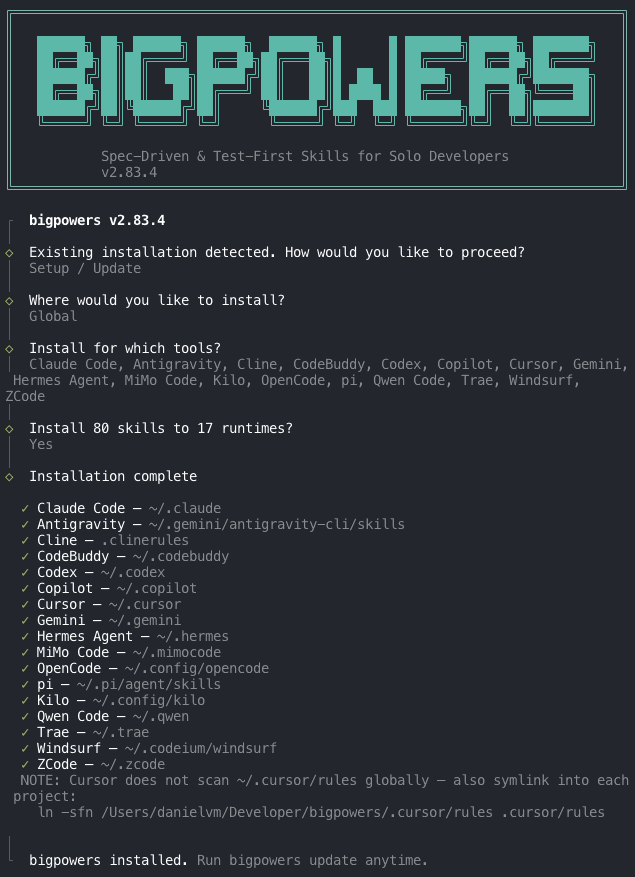
Interactive Installer
The npx bigpowers setup command launches an interactive menu where you can:
- Choose install mode: Setup/Update or Uninstall
- Select location: Global (available everywhere) or Local (current project only)
- Pick tools: Select which AI tools to install skills for (Claude Code, Cursor, Gemini, pi, etc.)
- Confirm: Review and confirm the installation
Use arrow keys to navigate, space to select, and Enter to confirm.
From source (contributors)
git clone https://github.com/danielvm-git/bigpowers.git && cd bigpowers
npm install
bash scripts/install.sh
🛠 Prerequisites
- Bash: Required for all scripts.
- Node.js: v14+ (required for npm/npx).
- jq: (Highly Recommended) Used for robust configuration of tool settings.
- AI Tools: One or more of:
- Claude Code
- Gemini CLI
- Cursor
- pi — coding agent harness
✨ Features
- Purpose-Built Skills: From
survey-contexttodevelop-tdd, each skill is a targeted tool for a specific phase of development. SeeSKILL-INDEX.mdfor the full auto-generated catalog. - Spec-Driven Cockpit: Uses
specs/state.yamlandrelease-plan.yamlto maintain state across agent sessions, preventing context drift. - Native IDE Support: Automatically generates configurations for Cursor (
.cursor/rules), Gemini CLI, and pi. - Model Context Protocol (MCP): Dynamic tool discovery and invocation via the included MCP server.
- Built-in Quality Gates: Strict verification standards (e.g., F.I.R.S.T tests, BCP accounting) enforced before any code is merged.
🏗 The v2.0.0 Lifecycle
Every project follows the orchestrate-project 6-phase model (full SOP: docs/WORKFLOW-SOP-v2.md):
ONE TIME    seed-conventions  (CLAUDE.md, .claude/, .gemini/, agents/, skill sync)
              ↓
ONCE/PROJECT orchestrate-project
              │
              ├─ Ph1 DISCOVER   survey-context, research-first, elaborate-spec
              ├─ Ph2 ELABORATE  model-domain, grill-me, define-language, deepen-architecture
              ├─ Ph3 PLAN       scope-work, slice-tasks, plan-work → release-plan.yaml (BCP baseline)
              ├─ Ph4 BUILD      build-epic × N stories
              │
              │  Per story — 8-step build-epic cycle:
              │   1. survey-context   ← stamps story_start in state.yaml
              │   2. plan-work        ← [BCP N] tasks + verify: commands
              │   3. kickoff-branch   ← worktree + feature branch
              │   4. develop-tdd      ← RED → GREEN → REFACTOR
              │   5. verify-work      ← UAT gate
              │   6. audit-code       ← quality gate ≥ 94%
              │   7. commit-message   ← Conventional Commits + semver
              │   8. release-branch   ← land to main; writes story_end + cycle-times.yaml
              │
              ├─ Ph5 VERIFY     run-evals, verify-work (project-level)
              └─ Ph6 RELEASE    semantic-release → v1.0.0 MVP tag
Semver: projects start at 0.0.0-β; each feat: story → minor bump; developer declares MVP → 1.0.0.
BCP accounting: every task labeled [BCP N]; story total in state.yaml; BCP/hr logged to specs/metrics/cycle-times.yaml.
next_skill signaling: each critical-path skill writes handoff.next_skill to state.yaml. Call survey-context after any interruption to resume exactly where you left off.
🧠 Philosophical Stack — How These Ideas Concatenate
bigpowers is not a flat list of influences. It is a chronological layer cake — each wave of thinking builds on and resolves tensions from the previous one. No layer replaces the last; each addresses a problem the prior one created.
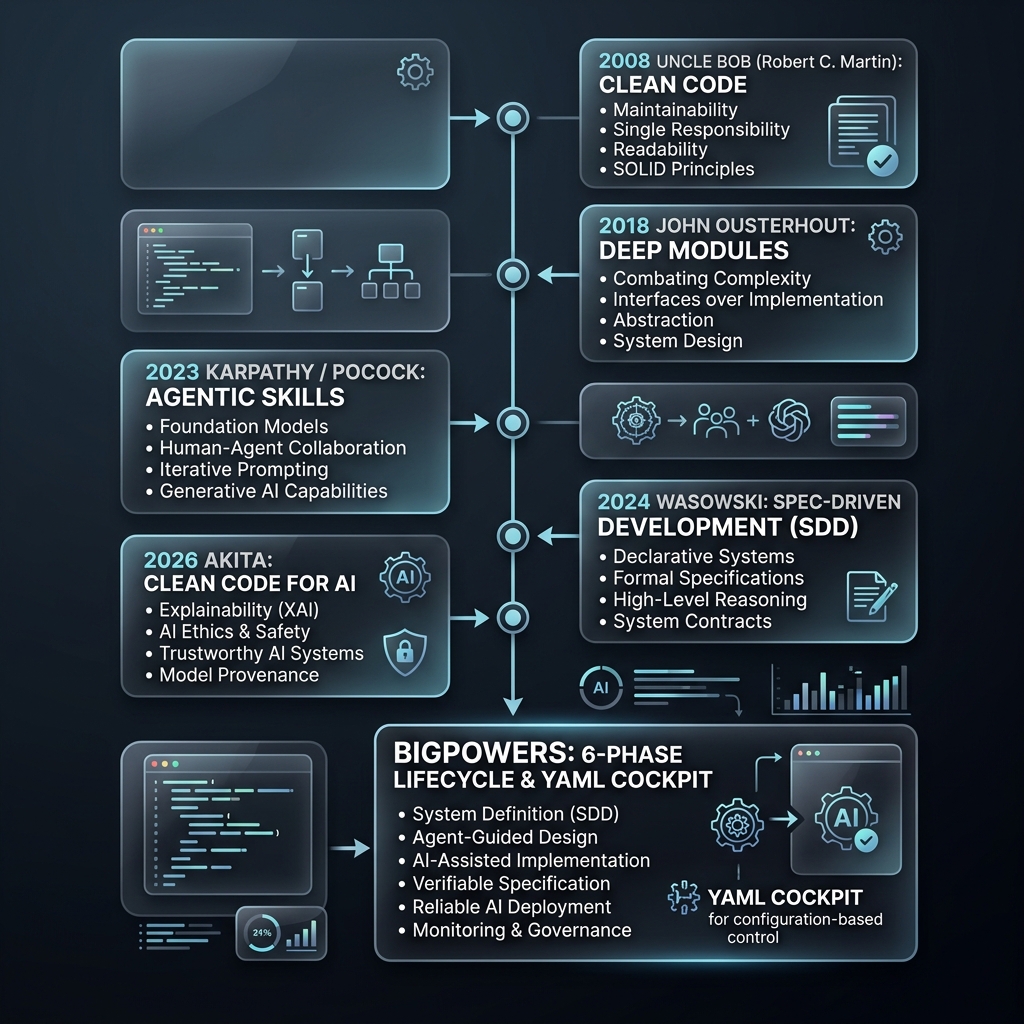
| Era | Source | Contribution | Tension Resolved |
|---|---|---|---|
| 2008 | Uncle Bob (Clean Code) | SRP, Boy Scout Rule, F.I.R.S.T. tests, intention-revealing names | — (foundation) |
| 2018 | Ousterhout (A Philosophy of Software Design) | Deep modules, information hiding, define errors out of existence | Small functions alone create shallow modules with bloated interfaces |
| 2023–24 | Karpathy, Superpowers, Pocock | Think-first planning, verb-noun skill architecture, zoom-out strategy | Raw LLMs have no discipline — they need orchestration, not raw prompting |
| 2024 | Wasowski (SDD), BCP | Specs as the human-agent interface; business complexity as a pre-build sizing unit | Agents drift without a verifiable spec — BDD Gherkin closes the loop |
| 2026 | Akita (Clean Code for AI Agents) | Grep-ability, structured JSON logging, token economy, remediation hints in errors | Uncle Bob's rules were written for humans — agents need different code hygiene |
| Synthesis | BMAD + GSD (self-authored) | 6-phase lifecycle, hard gates, 94% quality threshold, specs/state.yaml cockpit | All the above are principles; bigpowers turns them into an executable discipline |
How to see the concatenation in action
Each philosophical pillar has a corresponding Gherkin .feature file in specs/verifications/features/ that empirically proves compliance:
| Pillar | Verification |
|---|---|
| Classical Craftsmanship | cleancode.feature |
| Complexity Management | pocock.feature |
| Behavioral Integrity | karpathy.feature |
| Spec-Driven Development | Implicit in SDD workflow |
| Agentic Standard | akita.feature |
| Project Conventions | conventions.feature |
| Original Baseline | superpowers.feature |
Run npm run compliance to audit all features. Score < 94% = hard stop.
📖 Hierarchy of Truth
| Level | Document | Responsibility |
|---|---|---|
| Vision | docs/PRINCIPLES.md | Philosophical foundations and evolution. |
| Context | specs/tech-architecture/TECH_STACK_LATEST.md | Tech stack, architecture, and domain notes. |
| Scope | specs/product/SCOPE_LATEST.yaml | In-scope / out-of-scope and success criteria. |
| Vision | specs/product/VISION_LATEST.yaml | North star and initiative success criteria. |
| Decisions | specs/adr/ | Architectural Decision Records (irreversible choices). |
| Roadmap | specs/release-plan.yaml + specs/epics/ | WSJF-prioritized epics and stories with BCP baseline. |
| Current | specs/state.yaml | Session flow, active epic, handoff.next_skill, timestamps. |
| Metrics | specs/metrics/cycle-times.yaml | Per-story BCPs, cycle minutes, BCP/hr (v2.0.0). |
| Index | SKILL-INDEX.md | Canonical list of all active skills (auto-generated). |
| Style | CONVENTIONS.md | Coding, testing, and naming standards. |
📁 Project Structure
skills/[skill-name]/: Source files for each of the 80 skills.scripts/: Installation, syncing, and compliance tools.specs/: YAML cockpit —state.yaml,release-plan.yaml,epics/,execution-status.yaml,requirements/.specs/metrics/: Cycle-time ledger (cycle-times.yaml) — per-story BCPs, timestamps, BCP/hr (v2.0.0).dashboard/: Live monitoring tool — TUI (npm run dashboard) and web (npm run dashboard:web, port 7742).docs/: Guides includingWORKFLOW-SOP-v2.md(full SDLC SOP) andusing-bigpowers.md.docs/references/: Theoretical foundations (Uncle Bob, Ousterhout, Karpathy, etc.).
🔌 pi Support
bigpowers generates pi Agent Skills and prompt templates alongside Cursor and Gemini artifacts via sync-skills.sh.
Install as a pi package
# Clone and sync to generate pi artifacts
cd bigpowers
bash scripts/sync-skills.sh

# Install from local path as a pi package
pi install .

# Or install as a pi npm package (once published with pi-package keyword)
pi install npm:bigpowers
Provision a consumer project (bigpowers init)
pi's package contract registers skills and prompts only — it has no resource
type for arbitrary project files, and no lifecycle script runs on install. Skills
reference the package's scripts/*.sh tooling project-relative (e.g.
bash scripts/run-skill-verify.sh, verify gates like test -f scripts/... && test -d specs/bugs), so after installing the package, run one command per
consumer project to provision what the skills expect:
cd <your-project>
npx bigpowers init        # or: bigpowers init
This symlinks <project>/scripts → the installed package's scripts/ tree and
scaffolds specs/bugs/ + specs/verifications/. It refuses (never clobbers) a
scripts/ you already own; bigpowers init --remove undoes it. The same step
applies to npm i -g bigpowers / npx bigpowers setup consumers.
What you get:
- pi skills in
.pi/skills/(one per SKILL.md) — loaded automatically into pi's system prompt as<available_skills> - pi prompt templates in
.pi/prompts/— slash commands like/survey-context,/plan-work - pi package manifest in
.pi/package.json— enablespi installwith auto-discovery
Skills are loaded on-demand via progressive disclosure: only descriptions are always in context; the full SKILL.md loads when the agent reads it. Prompt templates expand in pi's editor with autocomplete.
🔧 MCP Server (Model Context Protocol)
bigpowers includes an MCP server (scripts/mcp-server.js) that exposes the skill catalog as callable MCP tools, so agents can discover and invoke skills dynamically instead of relying on a static system prompt. It is not active until you register it with your agent — see below.
Start the server
node scripts/mcp-server.jsAdd to Claude Code
claude mcp add bigpowers node /path/to/bigpowers/scripts/mcp-server.jsOr add manually to .claude/settings.json:
{
  "mcpServers": {
    "bigpowers": {
      "command": "node",
      "args": ["/path/to/bigpowers/scripts/mcp-server.js"]
    }
  }
}
Available MCP tools
| Tool | Description |
|---|---|
bigpowers_list_skills | List all skills with name, description, phase. Optional phase filter. |
bigpowers_get_skill | Get full SKILL.md content for any skill by name. |
bigpowers_search_skills | Keyword/semantic search — returns ranked matches for a query. |
bigpowers_get_state | Get current specs/state.yaml (active flow, epic, step). |
bigpowers_invoke_skill | Get skill instructions with optional context for agent invocation. |
🔄 Maintenance (Update & Uninstall)
Update
npm install:
bigpowers update # fetches bigpowers@latest (global installs), then re-syncs + refreshes symlinksbigpowers update now runs npm install -g bigpowers@latest for you when bigpowers is installed globally, so running it alone is enough to reach the newest release. Prefer to do it by hand? npm install -g bigpowers@latest && bigpowers update. (Avoid npm update -g bigpowers — it does not reliably cross to @latest.)
git clone:
git pull
npm run sync
bash scripts/install.sh
Install uses symlinks — re-running setup refreshes links without duplicating files.
Uninstall
npm install:
bash "$(npm root -g)/bigpowers/scripts/install.sh" --uninstall
npm uninstall -g bigpowers
git clone:
bash scripts/install.sh --uninstallReinstall
npx bigpowers@latest setup
# or, if installed globally:
bigpowers update
🧪 Development
git clone https://github.com/danielvm-git/bigpowers.git
cd bigpowers
npm install
# Sync artifacts from SKILL.md sources
npm run sync
Tests
# Run compliance verification against Gherkin features
npm run compliance

# Validate YAML specifications and doctrine
npm run doctrine
npm run validate-specs
🤝 Contributing
- Fork the repo.
- Create a feature branch (
git checkout -b feature/my-thing). - Make your changes using the
bigpowersmethodology. - Commit using Conventional Commits (
git commit -am 'feat: add my thing'). - Push to the branch (
git push origin feature/my-thing). - Open a Pull Request.
Changelog
See CHANGELOG.md for the auto-generated commit history, or Releases for GitHub release notes.
For an executive narrative of the project's history — 98 releases across 41 days, 4 phases, 19 epics delivered — read RELEASE-HISTORY.md.
Links
- Repository: https://github.com/danielvm-git/bigpowers
- Issue Tracker: https://github.com/danielvm-git/bigpowers/issues
🙏 Acknowledgements
This project is a synthesis of decades of software engineering thought. It would not be possible without the foundational work of the authors who wrote the inspirational articles and books that shaped this methodology:
- Robert C. Martin (Uncle Bob) for establishing the baseline of code hygiene and the F.I.R.S.T principles in Clean Code.
- John Ousterhout for his paradigm-shifting views on Deep Modules and complexity management in A Philosophy of Software Design.
- Andrej Karpathy and Matt Pocock for their pioneering work on agentic skills and structuring context for LLMs.
- Jarek Wasowski for identifying Spec-Driven Development (SDD) as the missing link for AI agents.
- AkitaOnRails for adapting classical clean code principles to the reality of the AI token economy.
Community Contributors
bigpowers has been shaped by contributors who extended it in their own forks. See CONTRIBUTORS.md for the full list.
- Kevin Oberlies (favilo) — Jujutsu VCS support across lifecycle skills +
project-runtime.shconfigurable settings library. - XcluEzy7 — OMP plugin extension (
extensions/omp-hooks.ts): native skill discovery, unified skill tooling, and git-safety hooks for the oh-my-pi runtime.
📄 License
This project is licensed under the MIT License - see the LICENSE file for details.
“Simplicity is the ultimate sophistication, but integrity is the ultimate requirement.”