

Ornith-1.0
Aloha! 🌺 Ornith-1.0 is a self-improving open-source models for agentic coding.
Highlights:
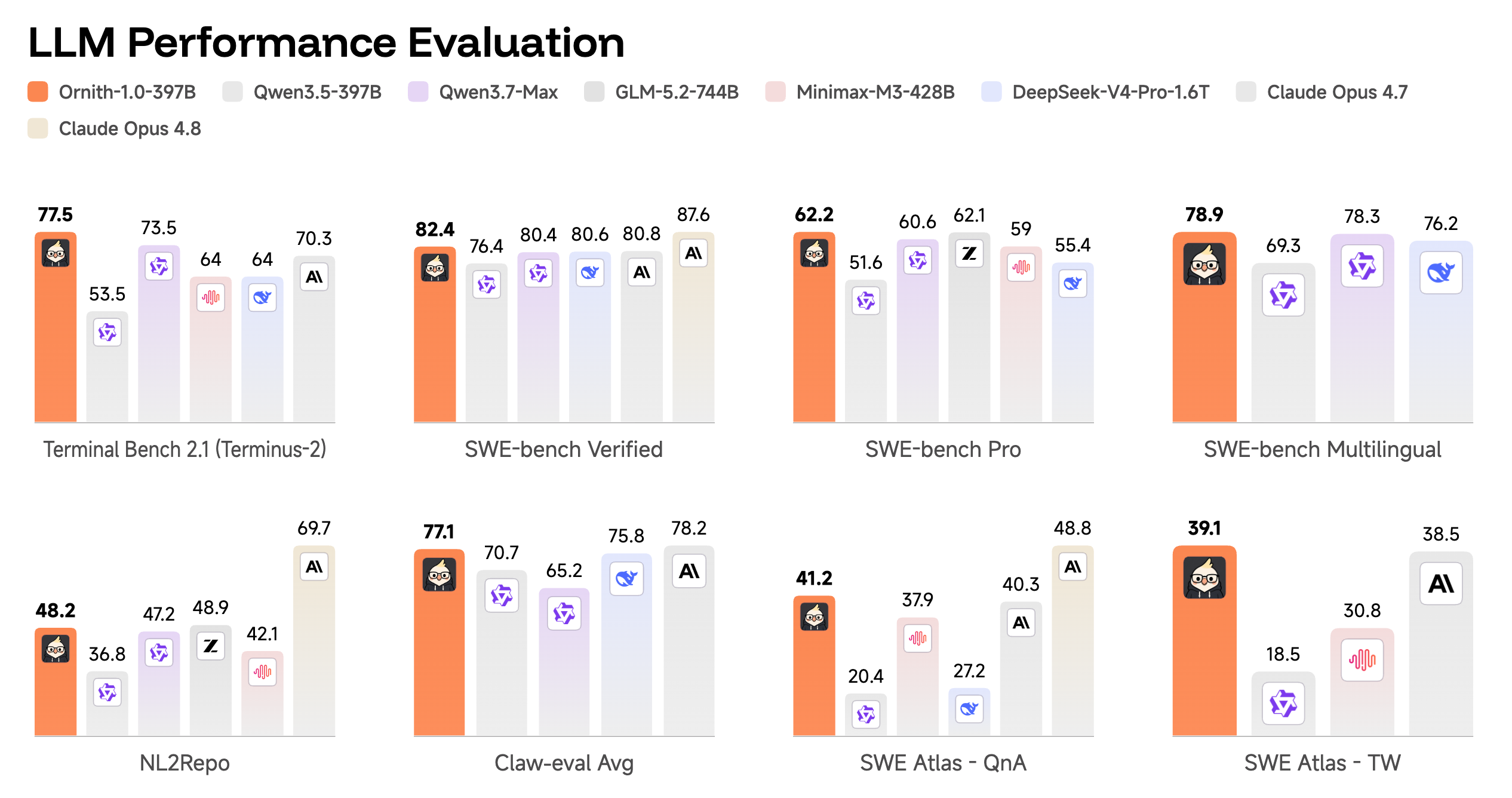
- State-of-the-Art Coding Agents: Available in 9B-Dense, 31B-Dense, 35B-MoE, and 397B-MoE (post-trained on top of Gemma 4 and Qwen 3.5), achieving state-of-the-art performance among open-source models of comparable size on coding benchmarks such as Terminal-Bench 2.1, SWE-Bench, NL2Repo and OpenClaw.
- Self-Improving Training Framework: Ornith-1.0 employs RL to learn to generate not only solution rollouts, but also the scallfold that drive those rollouts. By jointly optimizing the scaffold and the resulting solution, the model discovers better search trajectories and generates higher-quality solutions.
- Licence: MIT licensed, globally accessible, and free from regional limitations.
Benchmarks
Each model is evaluated against its size-appropriate baselines. All three use the same harnesses and decoding setup (see the notes under the tables).
Ornith-1.0-9B
| Ornith-1.0-9B | Qwen3.5-9B | Qwen3.5-35B | Gemma4-12B | Gemma4-31B | |
|---|---|---|---|---|---|
| Agentic Coding | |||||
| Terminal-Bench 2.1 (Terminus-2) | 43.1 | 21.3 | 41.4 | 21 | 42.1 |
| Terminal-Bench 2.1 (Claude Code) | 40.6 | 18.9 | 38.9 | - | - |
| SWE-bench Verified | 69.4 | 53.2 | 70 | 44.2 | 52 |
| SWE-bench Pro | 42.9 | 31.3 | 44.6 | 27.6 | 35.7 |
| SWE-bench Multilingual | 52 | 39.7 | 60.3 | 32.5 | 51.7 |
| NL2Repo | 27.2 | 16.2 | 20.5 | 10.3 | 15.5 |
| Claw-eval Avg | 63.1 | 53.2 | 65.4 | 32.5 | 48.5 |
| SWE Atlas - QnA | 17.9 | 9.2 | 13.2 | - | - |
| SWE Atlas - RF | 16.6 | 4.3 | 10.2 | - | - |
| SWE Atlas - TW | 15.3 | 4.4 | 9.8 | - | - |
Ornith-1.0-35B
| Ornith-1.0-35B | Qwen3.5-35B | Qwen3.6-35B | Gemma4-31B | Qwen3.5-397B | |
|---|---|---|---|---|---|
| Agentic Coding | |||||
| Terminal-Bench 2.1 (Terminus-2) | 64.2 | 41.4 | 52.5 | 42.1 | 53.5 |
| Terminal-Bench 2.1 (Claude Code) | 62.8 | 38.9 | 49.2 | - | 48.6 |
| SWE-bench Verified | 75.6 | 70 | 73.4 | 52 | 76.4 |
| SWE-bench Pro | 50.4 | 44.6 | 49.5 | 35.7 | 51.6 |
| SWE-bench Multilingual | 69.3 | 60.3 | 67.2 | 51.7 | 69.3 |
| NL2Repo | 34.6 | 20.5 | 29.4 | 15.5 | 36.8 |
| Claw-eval Avg | 69.8 | 65.4 | 68.7 | 48.5 | 70.7 |
| SWE Atlas - QnA | 37.1 | 13.2 | 15.5 | - | 20.4 |
| SWE Atlas - RF | 29.7 | 10.2 | 11.4 | - | 18.4 |
| SWE Atlas - TW | 27.8 | 9.8 | 13.3 | - | 18.5 |
Ornith-1.0-397B
| Ornith-1.0-397B | Qwen3.5-397B | Qwen3.7-Max | GLM-5.2-744B | Minimax-M3-428B | DeepSeek-V4-Pro-1.6T | Claude Opus 4.7 | Claude Opus 4.8 | |
|---|---|---|---|---|---|---|---|---|
| Agentic Coding | ||||||||
| Terminal-Bench 2.1 (Terminus-2) | 77.5 | 53.5 | 73.5 | 81.0 | 64 | 64 | 70.3 | 85 |
| Terminal-Bench 2.1 (Claude Code) | 78.2 | 48.6 | 69.8 | 82.7 | - | 66.5 | 69.7 | 78.9 |
| SWE-bench Verified | 82.4 | 76.4 | 80.4 | - | - | 80.6 | 80.8 | 87.6 |
| SWE-bench Pro | 62.2 | 51.6 | 60.6 | 62.1 | 59 | 55.4 | 64.3 | 69.2 |
| SWE-bench Multilingual | 78.9 | 69.3 | 78.3 | - | - | 76.2 | - | - |
| NL2Repo | 48.2 | 36.8 | 47.2 | 48.9 | 42.1 | - | - | 69.7 |
| Claw-eval Avg | 77.1 | 70.7 | 65.2 | - | - | 75.8 | 78.2 | - |
| SWE Atlas - QnA | 41.2 | 20.4 | - | - | 37.9 | 27.2 | 40.3 | 48.8 |
| SWE Atlas - RF | 42.6 | 18.4 | - | - | - | - | 48.6 | 46.7 |
| SWE Atlas - TW | 39.1 | 18.5 | - | - | 30.8 | - | 38.5 | - |
* Terminal-Bench 2.1 (Terminus-2): evaluated with the Harbor/Terminus-2 framework, parser=json, temperature=1.0, top_p=1.0, 128K context window. Each run uses a 4-hour timeout with 32 CPU cores and 48GB RAM, averaged over 5 runs. We adjust the Qwen chat template to keep training and inference consistent and modify Harbor to align with vLLM's reasoning_content key.
* Terminal-Bench 2.1 (Claude Code): evaluated with Claude Code 2.1.126, parser=json, temperature=1.0, top_p=1.0, max_new_tokens=131072, averaged over 5 runs (Qwen chat template likewise modified).
* SWE-bench Verified / Pro / Multilingual: OpenHands harness, temp=1.0, top_p=0.95, 256K context window.
* SWE Atlas QnA / RF / TW: mini-SWE-agent harness, temp=1.0, top_p=0.95, 128K context window, averaged over 5 runs.
* NL2Repo: temperature=1.0, top_p=1.0, 400K context, 48K output, anti-hacking filters.
* ClawEval: an agentic code benchmark over real-user task distributions; temp=0.6, 256K context.
Quickstart
NOTE
Ornith-1.0 is a reasoning model: by default the assistant turn opens with a
<think> … </think>block before the final answer. The serving recipes below enable a reasoning parser so the chain-of-thought is returned in a separatereasoning_contentfield, and a tool-call parser so the model's<tool_call>blocks are surfaced as OpenAI-styletool_calls.Serving Ornith-1.0 requires recent runtimes:
- Transformers ≥ 5.8.1
- vLLM ≥ 0.19.1
- SGLang ≥ 0.5.9
Recommended sampling parameters:
temperature=0.6,top_p=0.95,top_k=20(usetemperature=1.0to reproduce the reported benchmark setup).
Serving Ornith-1.0
Ornith-1.0 ships as a dense 9B model plus two Mixture-of-Experts models (35B, 397B). All checkpoints expose the same OpenAI-compatible interface and support a 256K (262,144-token) context window; the dense 9B fits on a single 80GB GPU, while the MoE checkpoints are sharded across a multi-GPU node with tensor parallelism. Each size is published in multiple precision / format variants:
| Checkpoint | Architecture | Format | Best for |
|---|---|---|---|
| Ornith-1.0-9B | Dense (~9B) | bf16 | Single-GPU serving & fine-tuning |
| Ornith-1.0-9B-GGUF | Dense (~9B) | GGUF (quantized) | Local inference via llama.cpp / Ollama |
| Ornith-1.0-35B | MoE (35B) | bf16 | Full-precision multi-GPU serving |
| Ornith-1.0-35B-FP8 | MoE (35B) | FP8 | ~Half the VRAM on FP8-capable GPUs |
| Ornith-1.0-35B-GGUF | MoE (35B) | GGUF (quantized) | Local inference via llama.cpp / Ollama |
| Ornith-1.0-397B | MoE (397B) | bf16 | Full-precision serving on a multi-GPU node |
| Ornith-1.0-397B-FP8 | MoE (397B) | FP8 | Memory-efficient serving on FP8-capable GPUs |
The recipes below stand up an OpenAI-compatible server under the shared alias Ornith-1.0. Set MODEL to the checkpoint you want, and match --tensor-parallel-size / --tp to your GPU count.
vLLM
# Pick a checkpoint — dense 9B, or MoE 35B / 397B (append -FP8 for lower-VRAM serving):
MODEL=deepreinforce-ai/Ornith-1.0-397B

# MoE checkpoints (35B / 397B): shard across the node with tensor parallelism.
# Dense checkpoint (9B): fits on a single 80GB GPU — drop --tensor-parallel-size.
vllm serve $MODEL \
    --served-model-name Ornith-1.0 \
    --tensor-parallel-size 8 \
    --host 0.0.0.0 --port 8000 \
    --max-model-len 262144 \
    --gpu-memory-utilization 0.90 \
    --enable-prefix-caching \
    --enable-auto-tool-choice --tool-call-parser qwen3_xml \
    --reasoning-parser qwen3 \
    --trust-remote-code
SGLang
# Pick a checkpoint — dense 9B, or MoE 35B / 397B (append -FP8 for lower-VRAM serving):
MODEL=deepreinforce-ai/Ornith-1.0-397B

# MoE checkpoints (35B / 397B): shard with --tp ; dense 9B: drop --tp for a single GPU.
python -m sglang.launch_server \
    --model-path $MODEL \
    --served-model-name Ornith-1.0 \
    --tp 8 \
    --host 0.0.0.0 --port 8000 \
    --context-length 262144 \
    --mem-fraction-static 0.85 \
    --tool-call-parser qwen3_coder \
    --reasoning-parser qwen3
Hugging Face Transformers
For a quick local test (or to script offline generation), load the model directly with Transformers. Make sure you have a recent release installed — see the Transformers installation guide; Ornith-1.0 requires transformers >= 5.8.1. The dense 9B checkpoint is the easiest to run locally.
from transformers import AutoModelForCausalLM, AutoTokenizer

model_name = "deepreinforce-ai/Ornith-1.0-9B"  # or -35B / -397B

tokenizer = AutoTokenizer.from_pretrained(model_name)
model = AutoModelForCausalLM.from_pretrained(
    model_name,
    dtype="auto",
    device_map="auto",
)

messages = [
    {"role": "user", "content": "Write a Python function is_prime(n). Keep it short."}
]
text = tokenizer.apply_chat_template(
    messages,
    tokenize=False,
    add_generation_prompt=True,
)

inputs = tokenizer(text, return_tensors="pt").to(model.device)
generated = model.generate(
    **inputs,
    max_new_tokens=512,
    do_sample=True,
    temperature=0.6,
    top_p=0.95,
    top_k=20,
)
output_ids = generated[0][inputs.input_ids.shape[1]:]

# The reply contains a <think> ... </think> reasoning block followed by the answer.
content = tokenizer.decode(output_ids, skip_special_tokens=True)
print(content)
To split the reasoning trace from the final answer, parse on the </think> marker:
text = tokenizer.decode(output_ids, skip_special_tokens=True)
if "</think>" in text:
    reasoning, answer = text.split("</think>", 1)
    reasoning = reasoning.replace("<think>", "").strip()
    answer = answer.strip()
else:
    reasoning, answer = "", text.strip()
Using Ornith-1.0 via the Chat Completions API
Once a vLLM or SGLang server is running, talk to it with any OpenAI-compatible client.
Basic Usage
from openai import OpenAI

client = OpenAI(
    base_url="http://localhost:8000/v1",
    api_key="EMPTY",  # any non-empty string works for a local server
)

response = client.chat.completions.create(
    model="Ornith-1.0",
    messages=[
        {"role": "user", "content": "Write a one-line Python lambda that squares a number."}
    ],
    temperature=0.6,
    top_p=0.95,
    max_tokens=1024,
)

message = response.choices[0].message
# reasoning_content holds the <think> trace; content holds the final answer.
print("reasoning:", getattr(message, "reasoning_content", None))
print("answer:", message.content)
You can also stream tokens, or hand the model tools — Ornith-1.0 emits well-formed function calls that the server parses into the standard tool_calls field:
tools = [
    {
        "type": "function",
        "function": {
            "name": "get_weather",
            "description": "Get the current weather for a city",
            "parameters": {
                "type": "object",
                "properties": {"city": {"type": "string"}},
                "required": ["city"],
            },
        },
    }
]

response = client.chat.completions.create(
    model="Ornith-1.0",
    messages=[{"role": "user", "content": "What is the weather in Paris right now?"}],
    tools=tools,
    tool_choice="auto",
    temperature=0.6,
    max_tokens=2048,
)

tool_call = response.choices[0].message.tool_calls[0]
print(tool_call.function.name, tool_call.function.arguments)
# -> get_weather {"city": "Paris"}
You can point any OpenAI-compatible SDK (Python, Node.js, etc.) or curl at the same /v1/chat/completions endpoint.
Agentic Usage
Ornith-1.0 excels in tool-calling and agentic coding capabilities.
Agent Frameworks
Because Ornith-1.0 exposes an OpenAI-compatible endpoint with tool calling, it works out of the box with standard agent frameworks. Below is a minimal example that connects Ornith-1.0 to tools through an MCP server.
import os
from openai import OpenAI

client = OpenAI(
    base_url=os.getenv("OPENAI_BASE_URL", "http://localhost:8000/v1"),
    api_key=os.getenv("OPENAI_API_KEY", "EMPTY"),
)

tools = [
    {
        "type": "function",
        "function": {
            "name": "run_shell",
            "description": "Run a shell command and return its output.",
            "parameters": {
                "type": "object",
                "properties": {
                    "command": {"type": "string", "description": "The command to run"}
                },
                "required": ["command"],
            },
        },
    }
]

messages = [{"role": "user", "content": "List the Python files in the current directory."}]

response = client.chat.completions.create(
    model="Ornith-1.0",
    messages=messages,
    tools=tools,
    temperature=0.6,
    top_p=0.95,
)
print(response.choices[0].message)
Examples of using Ornith with agent harness:
Hermes Agent
# Hermes talks to any OpenAI-compatible endpoint — point it at your Ornith server.
export OPENAI_BASE_URL="http://localhost:8000/v1"
export OPENAI_API_KEY="EMPTY"
export MODEL="Ornith-1.0"
OpenHands
pip install openhands-ai

# OpenHands routes through LiteLLM; the "openai/" prefix selects the OpenAI-compatible path.
export LLM_MODEL="openai/Ornith-1.0"
export LLM_BASE_URL="http://localhost:8000/v1"
export LLM_API_KEY="EMPTY"

# Launch the CLI (or run the official OpenHands Docker image with the same env vars).
openhands
llama.cpp / Ollama
# Both runtimes load a GGUF build — available for the 9B and 35B checkpoints (swap -9B for -35B).

# llama.cpp — serve an OpenAI-compatible API on port 8000.
llama-server -hf deepreinforce-ai/Ornith-1.0-9B-GGUF --port 8000 -c 262144

# Ollama — pull and chat with the same GGUF straight from Hugging Face.
ollama run hf.co/deepreinforce-ai/Ornith-1.0-9B-GGUF
Unsloth Studio
pip install unsloth

# Load Ornith for fast local inference or fine-tuning (Python):
#   from unsloth import FastLanguageModel
#   model, tokenizer = FastLanguageModel.from_pretrained(
#       "deepreinforce-ai/Ornith-1.0-9B",
#       max_seq_length=262144,
#       load_in_4bit=True,
#   )
OpenClaw
# OpenClaw talks to any OpenAI-compatible endpoint — point it at your Ornith server.
export OPENAI_BASE_URL="http://localhost:8000/v1"
export OPENAI_API_KEY="EMPTY"
export OPENAI_MODEL="Ornith-1.0"
Coding CLIs
Ornith-1.0 is optimized for terminal-based coding agents. Point any OpenAI-compatible coding CLI at your Ornith-1.0 endpoint (set OPENAI_BASE_URL and OPENAI_API_KEY) to understand large codebases, automate tedious work, and ship faster.
OpenCode
# Register your local Ornith endpoint as a provider in ~/.config/opencode/opencode.json:
#
# {
#   "$schema": "https://opencode.ai/config.json",
#   "provider": {
#     "ornith": {
#       "npm": "@ai-sdk/openai-compatible",
#       "name": "Ornith (local)",
#       "options": { "baseURL": "http://localhost:8000/v1", "apiKey": "EMPTY" },
#       "models": { "Ornith-1.0": { "name": "Ornith-1.0" } }
#     }
#   }
# }

opencode
Citation
If you find our work helpful, feel free to give us a cite.
@misc{ornith-1.0,
    title = {{Ornith-1.0}: Agentic Coding, Open to All},
    url = {https://deep-reinforce.com/ornith_1_0.html},
    author = {{DeepReinforce Team}},
    year = {2026}
}