Lossless memory for Hermes Agent: every turn kept in a local store, not compacted away, and searchable by your agent. Watch the demo
https://github.com/user-attachments/assets/c215bf7f-e8c8-428f-9510-ba1da3571f53




Install
hermes plugins install hermes-lcm-x --enable
hermes config set context.engine lcm-x
This installs the version the Hermes catalog currently pins, which can trail the latest release by a few days (see catalog payload). The default local setup needs no API key; optional cloud embeddings and Voyage reranking use configured provider keys (see embeddings setup). The first line installs and enables the plugin; the second selects it as the context engine (both checked on a clean Hermes 0.23.0 home). Restart Hermes afterwards.
Activate it
The plugin has two names:
- plugin manifest name:
hermes-lcm-x - runtime context engine name:
lcm-x
Both must be configured. The two commands above write this; you can also edit the config by hand:
plugins:
  enabled:
    - hermes-lcm-x

context:
  engine: lcm-x
Restart Hermes after changing plugin or context-engine config.
Claude Code
For Claude Code, use LCM-X for Claude Code, which we recommend for every Claude Code user on macOS
and Linux. It captures your Claude Code sessions into their own local, lossless store and gives the
agent the same five recall tools. Download the asset from the newest
release titled
LCM-X for Claude Code
(these releases are never marked Latest, which stays with the Hermes plugin), unpack it, and start Claude Code
with claude --plugin-dir <unpacked folder>; the steps are in the release notes and in
its README. The read-only server under
Use LCM-X memory from Claude Code is a different
thing: it reads a Hermes profile's store from Claude Code.
Try it
- Run the two commands above and restart Hermes.
- Send a message, then ask your agent to call
lcm_status. - You will see runtime health, context pressure, configuration, and storage counts for the active session.
Bounded context, unbounded memory. Nothing is ever lost.
Two opt-ins discard content by design: durable sensitive-pattern redaction (LCM_SENSITIVE_PATTERNS_ENABLED) and message ignore patterns (LCM_IGNORE_MESSAGE_PATTERNS); the operator's /lcm doctor clean apply deletes on purpose (off by default, takes a backup first). Sessions matched by LCM_IGNORE_SESSION_PATTERNS or LCM_STATELESS_SESSION_PATTERNS (both empty by default) are not stored at all.
Benchmark highlights (OmniMemEval, contributor-run, accepted upstream)
| Benchmark | LCM-X | Placement |
|---|---|---|
| BEAM 100K | 71.84 | 1st of 12 |
| BEAM 10M | 63.32 | 1st of 12 |
| LongMemEval | 87.00 | 2nd of 13 |
| LoCoMo | 78.83 | 5th of 15 |
| HaluMem | 81.68 | 5th of 13 |
| PersonaMem v2 | 33.96 | 8th of 13 |
Configuration, evidence and disclosures: benchmarks/RESULTS.md.
LCM-X replaces one-shot active-context compression with a SQLite-backed, DAG-based context engine. It keeps the live prompt bounded, preserves raw messages, and gives the agent tools to recover exact detail after compaction. The promise says exactly what "nothing is ever lost" covers; known exceptions are bugs against it, listed in the latest release's Known issues.
The project name is LCM-X. From v0.24.0 the plugin is named
hermes-lcm-x and the runtime context engine lcm-x
(#471); this is a
breaking change for existing installs — see
Migrating from hermes-lcm.
Unchanged: lcm.db, the lcm: config block, LCM_* environment variables,
the lcm_* tools, /lcm, and the bundled skill name hermes-lcm.
Based on the LCM paper by Ehrlich & Blackman (Voltropy PBC, Feb 2026). Inspired by lossless-claw for OpenClaw. For an interactive visualization of the LCM idea, see losslesscontext.ai. Project site: losslesscontext.com.
What we are building and why: VISION.md. What ships when: ROADMAP.md and the tracker #658.
Table of contents
- What it does
- Project status
- LCM vs built-in compression
- Quick start
- Commands and tools
- Recall skill and policy
- Configuration
- Retrieval contract
- Use LCM-X memory from Claude Code (read-only)
- OpenClaw/lossless-claw import
- Troubleshooting
- Architecture
- How it works
- Documentation
- Development
- Contributing
- License
What it does
Hermes Agent's built-in compressor is a practical continuity layer: when the
prompt crosses its configured threshold, it prunes older tool results, asks an
auxiliary model to summarize the middle/older conversation, and rebuilds the
active prompt from that summary plus a protected recent tail. The original
session rows can still live in Hermes state.db and remain searchable through
host tools such as session_search, but the model's active context no longer
contains the compacted turns verbatim or a structured drill-down path back to
them.
LCM-X instead:
- Persists messages in a plugin-local SQLite store with FTS metadata.
- Compacts older context into depth-aware summary nodes.
- Condenses summaries into a hierarchical DAG as they accumulate.
- Assembles active context from system prompt, highest-value summaries, and the protected fresh tail.
- Provides recall tools so agents can search, inspect, and expand compacted material without flooding the main prompt.
Nothing is lost in normal operation. Raw messages stay recoverable in bounded
pages, summaries retain source lineage, and oversized externalized payloads keep
stable refs for later expansion.
Two opt-ins discard content by design: durable sensitive-pattern redaction (LCM_SENSITIVE_PATTERNS_ENABLED) and message ignore patterns (LCM_IGNORE_MESSAGE_PATTERNS); the operator's /lcm doctor clean apply deletes on purpose (off by default, takes a backup first). Sessions matched by LCM_IGNORE_SESSION_PATTERNS or LCM_STATELESS_SESSION_PATTERNS (both empty by default) are not stored at all.
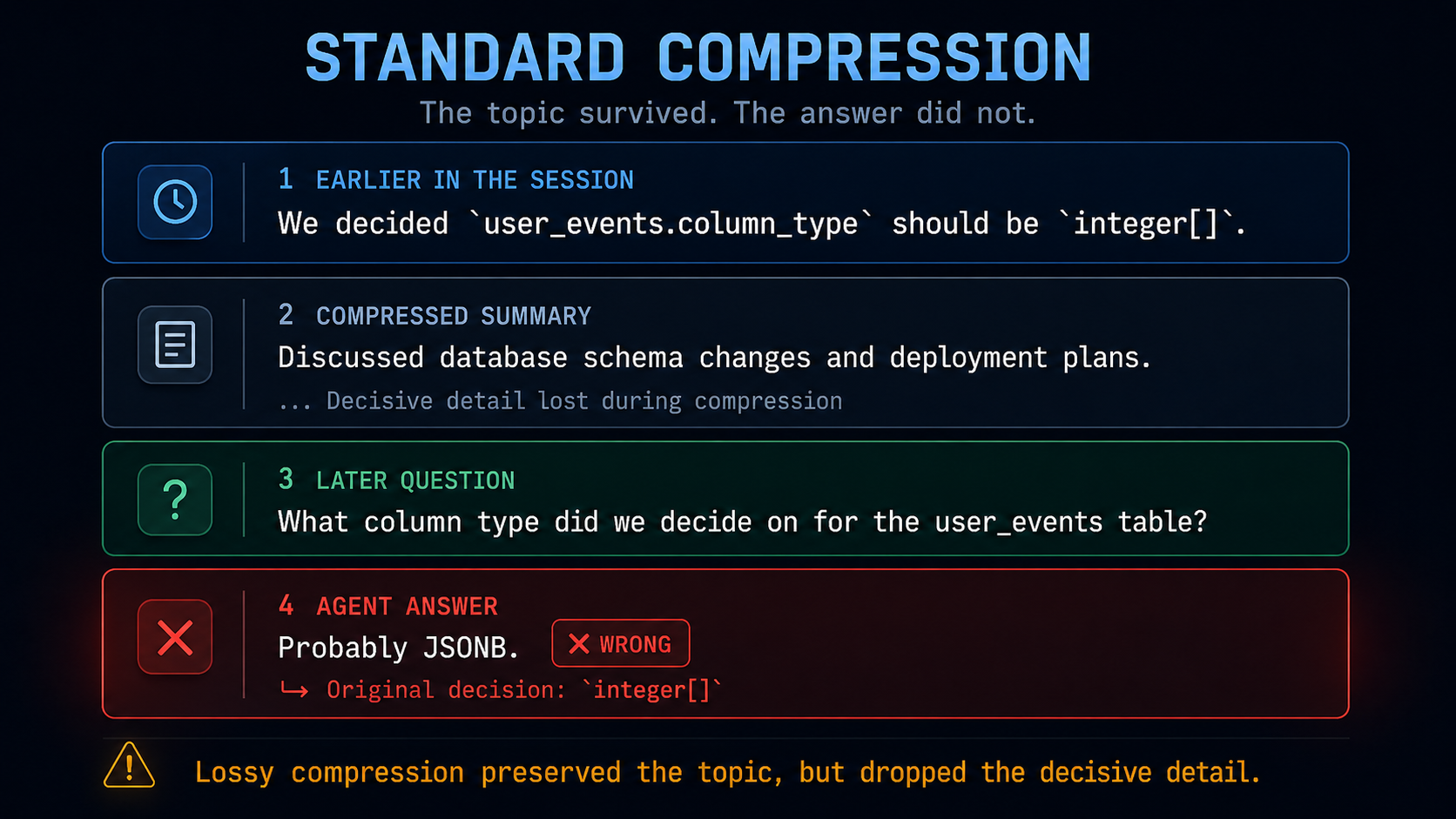
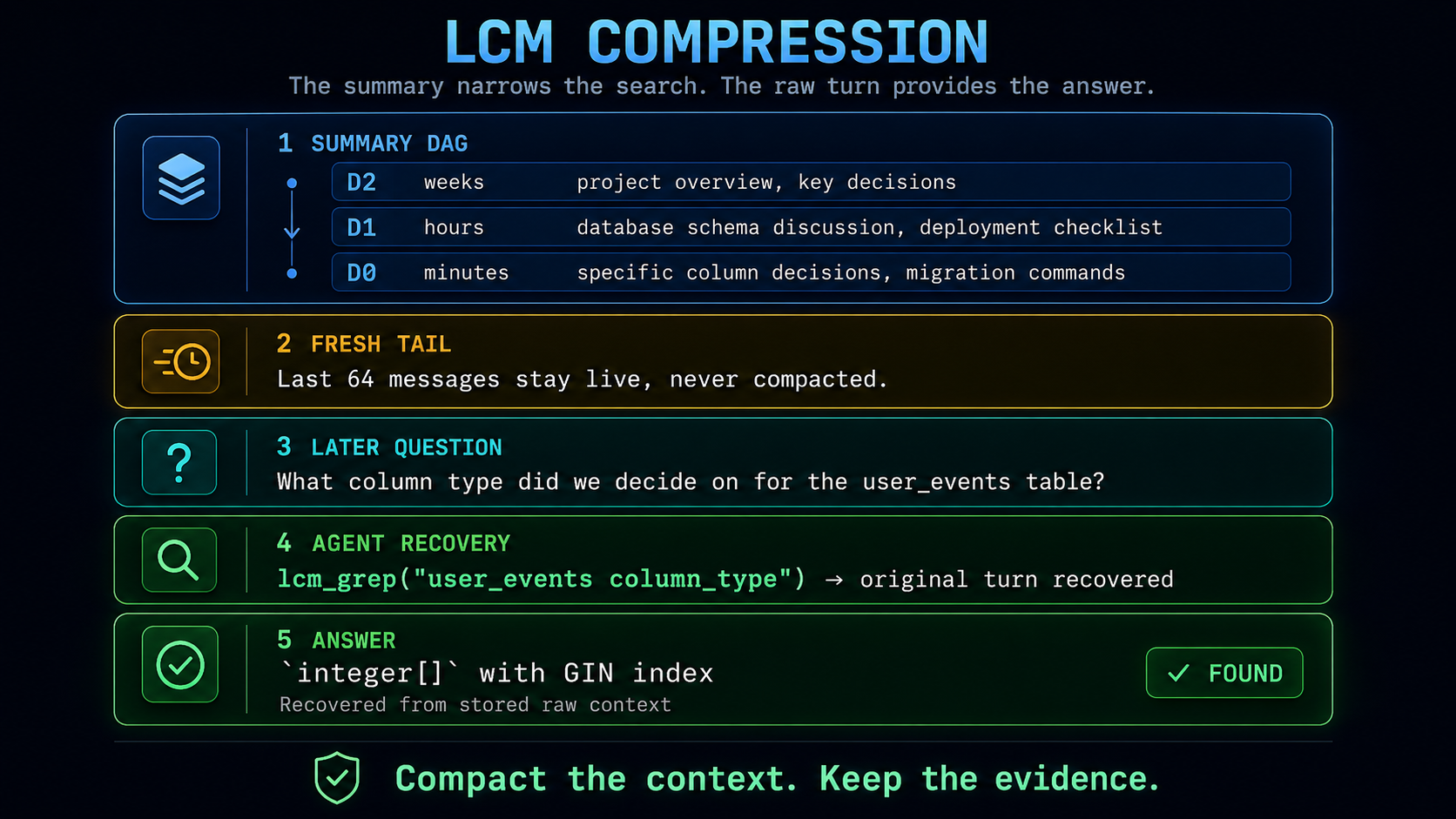
Illustration. The protected fresh tail is configurable: by default it is the last 24 messages (LCM_FRESH_TAIL_COUNT) within a token cap (LCM_FRESH_TAIL_MAX_TOKENS). Under host-observed context pressure it yields once it alone has blocked compaction three times in a row (the default). See Common settings.
Core capabilities:
- SQLite message store - preserves raw messages before compaction
- Summary DAG - builds depth-aware summary nodes over compacted history
- Bounded recovery - pages raw messages, child summaries, and externalized payloads instead of dumping everything into the prompt
- Agent tools -
lcm_grep,lcm_recall,lcm_query_state,lcm_compute,lcm_compile_evidence,lcm_evidence_pack,lcm_retrieve,lcm_recent,lcm_load_session,lcm_describe,lcm_expand,lcm_expand_query,lcm_status,lcm_inspect,lcm_doctor, and the opt-inlcm_memory - Source-aware retrieval - filters raw rows and summaries by descendant source lineage
- Session controls - ignore noisy sessions or keep sessions read-only with glob patterns
- Large payload controls - externalize oversized tool/media/raw payloads and protect SQLite from inline media-ish base64 blobs
- Sensitive-pattern controls - two independent layers: opt-in durable redaction of API keys, bearer tokens, passwords, and private keys before LCM stores or summarizes them and a separate experimental opt-in filter for copies sent to known cloud embedding providers. Both flags default to off
- Diagnostics - runtime health, database checks, optional
/lcmslash commands, backup-first repair/rotate paths
Beyond the core loop, three feature families extend LCM
from a compression layer into a memory system: large-output externalization
and context-budget controls (giant tool results move to recoverable refs
instead of crowding the prompt), temporal memory (day/week/month rollups
plus natural-time recall through lcm_recent), and semantic retrieval
(automatic local recall with in-process FastEmbed, plus lcm_grep
semantic/hybrid modes and explicit Voyage, OpenAI-compatible or Ollama options). See the
Feature overview for what each family does and
why, and Agent configuration profiles for
copy-paste setups per agent type. Externalization and temporal rollups are on by default.
Project status
The latest stable release is
v0.29.2
at 261d41ea928eec3dc5b8db13c70f044392adf124, released 2026-11-09 (plugin hermes-lcm-x, engine lcm-x).
Compaction retries past a contiguity stop at the scan limit and keeps its exit
headroom, shutdown waits for a running compaction, and a profile's storage opens
only when that profile is used. See project status for the release summary,
the disclosed qualification decisions and current work.
It requires Hermes 0.21.3 or newer (#1080). It carries
the v0.23.2 lossless
default (durable sensitive-pattern redaction is opt-in; cloud-embedding privacy
is an independent flag that transforms only the provider-bound copy — see
"Sensitive-pattern redaction" below), the PEM private-key redaction hardening,
loud privacy-policy failures on the recall path, and the rc-first release
gauntlet, while preserving schema-5 core storage and
default-off experimental features.
Stable release identity and the continuing main development line are
separate proof planes; do not describe an arbitrary main checkout as the
installed stable product.
v0.29.1 was cut from the release/v0.29.x maintenance branch, not from main; v0.29.x
patch releases are cut from that branch. The main line carries the forward identity
hermes-lcm-x v0.30.0 — nothing lost — which the v0.30.0-rc1 tag carries first.
That tag is cut from main, while v0.29.2 comes from release/v0.29.x.
An identity is never a restamp of any past commit's own recorded identity
(#385 fixed the earlier drift).
The manifest declares 16 tools; runtime discovery advertises 13 by default.
LCM_ASSERTIONS_ENABLED adds lcm_query_state, LCM_ADAPTIVE_RETRIEVAL_ENABLED
adds lcm_retrieve, and LCM_ENTITIES_ENABLED adds lcm_memory: 16 with all three on,
unless LCM_DISABLED_TOOLS hides tools.
Every compaction LCM-X starts today runs on the turn thread, so the user waits for it. v0.25.0 makes a hidden backlog drain at turn pace (#597); v0.31.0 removes the wait by preparing summaries in the background and publishing them at the threshold (#787). Recall is re-baselined on the shipped default configuration. See VISION.md, the roadmap, the tracker #658, Current project state and Benchmark methodology for current identities, gaps, and proof boundaries.
AML Cycle 2
Both entries ran the LCM-X v0.28.0 engine (v0.28.0, 709099b3) behind our AML gateway, bench/aml/aml_server.py. They used the OmniMemEval client adapter in our OmniMemEval fork (scripts/client_factory/lcmx_client.py, commit 16264031).
- Coding: tag
v0.28.0-coding-r3at9917c35b. The gateway file is byte-identical to the one that ran. - Textual: tag
v0.28.0-aml-textualat533c5956. The gateway file is content-equivalent: the deployed copy differed only in how it found the OmniMemEval checkout. - Embedder: a local BAAI/bge-small-en-v1.5 through FastEmbed, with no generative LLM in the memory path. We disclosed this deviation to AML, which acknowledged it in writing on 6 November 2026.
- Prior work: the LCM paper by Ehrlich & Blackman; lossless-claw; and stephenschoettler/hermes-lcm, the repository LCM-X continues (its root commit is
d6c32609).
Results
BEAM 100K 1st of 12; BEAM 10M 1st of 12 among backends in the upstream reproduced Result Summary. See the benchmark highlights above and results, configuration, evidence and disclosures.
LCM vs built-in compression
Hermes core may persist original conversation history in state.db before
built-in compression rewrites the active prompt. Built-in compression can still
be lossy in the active context, but previous content may be recoverable later
through host-level history tools such as session_search.
LCM-X is different because recall is part of the active context engine:
- plugin-local store and DAG built specifically for drill-down
- current-session retrieval through LCM tools, not an auxiliary cross-session search step
- explicit source-lineage and session-boundary rules
Position LCM around retrieval quality, autonomy, and drill-down behavior. Do not claim that Hermes core has no persisted record of pre-compression history.
Quick start
Prerequisites
- Hermes Agent 0.21.3 or later (
requires_hermesinplugin.yaml; LCM-X needs the pluginregister_hookAPI) - Python 3.11+
- No required third-party runtime dependencies
tiktoken is used if available; otherwise LCM falls back to character-based
token estimates. /lcm status and /lcm doctor show which one is active
(token_counter: tiktoken or token_counter: char_estimate; not_loaded before
anything has been counted in the process).
regex is used if available to apply timeouts to message ignore
patterns; without it, message-level regex filtering is disabled with a warning
rather than running unbounded stdlib re matches.
Install the plugin
Catalog installs use the generated runtime payload pinned to an immutable dist commit.
Developers and profile installs
Clone LCM-X as a general user plugin into
plugins/hermes-lcm-x.
git clone https://github.com/electricsheephq/lcm-x \
  "${HOME}/.hermes/plugins/hermes-lcm-x"
For a profile-specific install:
git clone https://github.com/electricsheephq/lcm-x \
  "${HOME}/.hermes/profiles/myprofile/plugins/hermes-lcm-x"
From an existing checkout, install a symlink:
./scripts/install.sh

# Optional profile-aware install:
HERMES_PROFILE=myprofile ./scripts/install.sh
The installer requires canonical lowercase, unpadded ASCII profile names
(1–64 letters/digits, with _ or - allowed after the first character).
Use HERMES_PROFILE=default ./scripts/install.sh for Default, or
HERMES_PROFILE=work ./scripts/install.sh for padded Work. Other spellings
are refused before links or host calls; the native Hermes CLI still accepts its aliases.
Run scripts/install.sh even when the checkout already lives at the canonical
plugin path. It leaves that checkout in place and exposes the bundled
hermes-lcm skill in the matching global/profile skills/ directory. The
installer preflights both paths and refuses conflicts before creating links.
When it finds a pre-0.24 install (plugins/hermes-lcm, or a config.yaml that
enables hermes-lcm / selects context.engine: lcm), it prints the migration
steps below and never deletes the old directory. With Hermes available it enables
the core through the host (which updates config.yaml) and natively installs the
optional local-embeddings companion with host-owned consent. A separate older copy
prevents automatic core enablement until migration. HERMES_PROFILE selects a named
profile; with a root-shaped home, unset or default selects the root, even with a sticky active profile.
HERMES_HOME sets that install root. Printed host commands preserve both selections.
A profile-shaped HERMES_HOME=<root>/profiles/<name> selects that profile; a conflicting HERMES_PROFILE is refused before links.
Companion failure leaves a successful core install usable with full-text recall
and prints a retry command; context-engine selection remains manual.
Local semantic recall is enabled by default with fastembed. The model config
stays empty; FastEmbed resolves it to BAAI/bge-small-en-v1.5. An explicit model
wins with an explicit provider; a runtime model alone stays disabled/unconfigured.
Non-local providers require LCM_EMBEDDINGS_ENABLED=true, an explicit model and
their existing privacy/consent steps. Invalid enable values fall back to OFF with
a warning; a set-but-blank value also means OFF, without a warning, so leave the
variable unset to keep the local default. The companion uses the host's normal dependency consent;
see installation and recovery.
After it is enabled and Hermes restarts, model warmup and index catch-up run in
the background. While the dependency, model or index is unavailable or preparing,
recall uses full text with degraded=true, a reason and actual arm coverage;
queries never wait for a model download or a backfill (a recall that finds no
local model starts the background preparation, which may download it). /lcm doctor distinguishes model
readiness from summary/chunk coverage. Existing rows and vectors are preserved.
Set LCM_EMBEDDINGS_ENABLED=false to opt out without loading or downloading a model.
Under the product default, hosts with at most 2 effective CPUs use full-text recall
immediately while background catch-up continues. An explicit
LCM_EMBEDDINGS_ENABLED value or programmatic config keeps control;
see small-host behavior.
Optional: free Voyage AI embeddings
For stronger recall, Voyage AI offers every account free tokens per model; local FastEmbed stays the default and needs no account.
export LCM_EMBEDDINGS_ENABLED=true
export LCM_EMBEDDING_PROVIDER=voyage
export LCM_EMBEDDING_MODEL=voyage-4-lite
export VOYAGE_API_KEY=...
export LCM_ENABLE_SLASH_COMMAND=1   # registers /lcm for the setup commands
After setting these in Hermes' environment and restarting, run /lcm embed warmup, /lcm embed backfill (dry run), /lcm embed backfill --apply, then /lcm status. See Voyage setup and key creation and cloud privacy.
Verify it loaded
Run:
hermes plugins listExpected signals:
- plugin list includes
hermes-lcm-x - selected context engine is
lcm-x - tool list includes
lcm_grep,lcm_recall,lcm_recent,lcm_load_session,lcm_describe,lcm_expand,lcm_expand_query,lcm_compute,lcm_compile_evidence,lcm_evidence_pack,lcm_status,lcm_inspect, andlcm_doctor(13 by default) - the normal available-skills index includes
hermes-lcm; current hosts can also resolve the explicit plugin-qualified skillhermes-lcm-x:hermes-lcm
On the main line, output with all three opt-in flags enabled is:
Plugins (1):
  ✓ hermes-lcm-x v0.30.0 (16 tools)

Provider Plugins:
  Context Engine: lcm-x
Older v0.23.x stable tags instead report plugin hermes-lcm
and engine lcm; verify the loaded commit before treating either name as
release proof.
For source checkouts, lcm_status, /lcm status, lcm_inspect,
lcm_doctor, and /lcm doctor also report the loaded plugin path and
best-effort git identity:
plugin_git_commit, plugin_git_branch, and plugin_git_dirty.
If startup logs say LCM tools are available through context-engine schemas or
mention the Path B fallback, that is expected on older Hermes hosts such as
Hermes Agent v0.16. The 13 default lcm_* tools and any flag-enabled tools
remain available through the context-engine path; standalone plugin-registry registration is not required
there.
Update it
If you cloned directly into the plugin directory:
cd "${HOME}/.hermes/plugins/hermes-lcm-x" && git pull --ff-onlyFor a profile-specific install:
cd "${HOME}/.hermes/profiles/myprofile/plugins/hermes-lcm-x" && git pull --ff-onlyA clone from v0.23.x or earlier still lives at plugins/hermes-lcm. Stop
Hermes, update that clone in place (Hermes matches the manifest name, not the
directory), then make the config change in
Migrating from hermes-lcm
before you start Hermes again:
cd "${HOME}/.hermes/plugins/hermes-lcm" && git pull --ff-only
# profile-specific:
cd "${HOME}/.hermes/profiles/myprofile/plugins/hermes-lcm" && git pull --ff-only
If you installed a symlink from a separate checkout, update that checkout and rerun the installer (it is idempotent):
git -C /path/to/lcm-x pull --ff-only && /path/to/lcm-x/scripts/install.shA catalog install (hermes plugins install hermes-lcm-x) updates only through
the reviewed catalog pin: hermes plugins update hermes-lcm-x. LCM-X ships no
self-updater. An install pinned with --ref <sha> (outside the catalog) refuses
hermes plugins update; move it to the new reviewed commit with
hermes plugins install https://github.com/electricsheephq/lcm-x --force --ref <40-character commit SHA>
(the refusal prints that command).
Restart Hermes after updating — and restart every other long-running process
that imports Hermes or LCM-X, not only the gateway: for example a separately
launched web UI, dashboard, or custom runner. This applies after hermes update
as well as after an LCM-X update. A process that keeps running holds the old
modules in memory and mixes them with the new files on disk the next time it
imports one lazily. See
Troubleshooting.
Before upgrading to v0.23.1, resolve the effective database path from
LCM_DATABASE_PATH or lcm_status. For an online backup, set
LCM_ENABLE_SLASH_COMMAND=true in the old runtime's launch environment,
restart that runtime so /lcm is registered, then run /lcm backup.
Otherwise stop every SQLite writer and copy that configured database with its
WAL/SHM companions as one cold set. Check out the exact stable tag/SHA, restart
Hermes, and verify the loaded path, version, database path, schema 5, and the
tools advertised by that release and its enabled flags. No manual core migration
is required for the upgrade itself. Existing cloud vectors from a pre-v0.23.1 identity require privacy-policy warmup, an
identity check from the warmup/profile output, and the finite monotonic
dry-run/apply loop in the operator guide before semantic coverage is complete.
Cloud embeddings are a separate opt-in. The experimental provider-input filter
defaults to off, which sends unfiltered copies under the privacy:off vector
revision. Set LCM_EMBEDDING_PRIVACY_ENABLED=true to opt in to filtering through
the configured sensitive-pattern catalog. When the filter is on, the
catalog must be nonempty and contain only supported pattern names (any unknown
name fails warmup and dispatch loudly). Dry-run the backfill first;
raw-chunk cloud backfill also requires explicit raw-text consent.
See the operator upgrade and privacy notes
before selecting a cloud embedding provider.
Migrating from hermes-lcm (v0.23.x and earlier)
BREAKING in v0.24.0. The plugin manifest is now hermes-lcm-x and the
context engine lcm-x (#471). Hermes matches plugins.enabled against the
manifest name, not the install directory, so a config that enables only
hermes-lcm stops loading LCM-X after an update. Run exactly one LCM copy, and
change the config while Hermes is stopped:
-
Stop Hermes (every process that uses this profile).
-
Update the code:
git pull --ff-onlyin the existing clone (it may stay atplugins/hermes-lcm; see Update it), or install a new checkout withscripts/install.sh. -
Config: in
plugins.enabled, replacehermes-lcmwithhermes-lcm-x, and setcontext.engine: lcm-x:plugins: enabled: - hermes-lcm-x context: engine: lcm-x- If a separate older copy is still installed (for example v0.23.x left at
plugins/hermes-lcmnext to a newplugins/hermes-lcm-x), do not keep both names enabled: both copies would load. LCM-X detects that state, logsAnother LCM generation is already loaded, and stays inert so only one copy writeslcm.db, but LCM-X itself is then not running. - Keeping
hermes-lcmlisted next tohermes-lcm-xis harmless only whenplugins/hermes-lcmis this same checkout (an in-place clone, or the linkscripts/install.shreuses): there is one physical copy. - The legacy
context.engine: lcmstill selects LCM-X through an alias, but logs a once-per-processDEPRECATED LCM-X configwarning and reports anidentity_migrationfield inlcm_statusand awarncheck inlcm_doctornaming the exact change.
- If a separate older copy is still installed (for example v0.23.x left at
-
Start Hermes and verify:
hermes plugins listshowshermes-lcm-xas enabled andhermes-lcmas not enabled (an old directory kept for rollback may still be listed), and the log showsLCM plugin loaded — lossless context management active. -
Later, by hand: after verifying, remove a separate old directory (and its
skills/hermes-lcmlink). Keep it until then for rollback (a rollback also needs the steps in the operator guide). The installer never deletes anything. Host-owned core enablement updatesconfig.yaml, except when a separate older copy requires the manual migration above first.
If the config is not updated: Hermes logs
Context engine 'lcm' not found — falling back to built-in compressor and runs
without LCM-X. The existing lcm.db is untouched, but turns handled while
Hermes runs without LCM-X (built-in compressor) are not in lcm.db and their
compacted content may not be recoverable. Therefore update the config before
restarting Hermes after the update.
Managed fleets (PCS / managed-plugin payloads) stay pinned to v0.23.x until
their config stages hermes-lcm-x in plugins.enabled. That staging is a
separate fleet-migration change owned outside this repository.
Hermes plugin catalog and install-scanner notes
The catalog build follows the plugin-catalog admission rules: no self-updater
(scripts/update.sh was removed; catalog installs update only through
hermes plugins update hermes-lcm-x), provides_hooks matches what
register() registers (pre_llm_call, post_llm_call, subagent_start,
subagent_stop, all through ctx.register_hook), and hermes plugins validate
reports the install scanner verdict safe: zero dangerous and zero caution
(high-severity) findings. Planted-secret fixtures build their PEM markers by
string concatenation and the bench env captures avoid piping the env listing, so test
data is not read as a real key or an environment dump.
The scanner still lists informational (medium/low) findings; none affects the verdict:
embedded_private_key,hardcoded_secret,openai_key_leaked— planted, non-functional fixtures intests/that prove redaction and privacy controls.python_subprocess,hex_encoded_string,uv_run,path_traversal— benchmark and release-gauntlet harnesses underbench/andbenchmarks/that drive local Hermes runs; not loaded by the plugin.git_clone,unpinned_pip_install,dump_all_env— install/contributor docs and CI (pip install pytest numpy), plus one doc describing an env dump; documentation only.eval_string,proc_access,system_passwd_access— test assertions that such strings are rejected or handled.oversized_file,oversized_bundle,too_many_files— the repository ships docs images, large test modules, and benchmark tooling with the plugin.agent_config_ref,hermes_config_ref,hardcoded_ip_port(low) — maintainer skills and config examples that referenceAGENTS.md,config.yaml, or loopback endpoints.
hermes plugins validate also warns that the 16 provides_tools are not
registered by register(): LCM-X serves its tools through the context-engine
tool schemas (ContextEngine.get_tool_schemas), which is the intended path.
Commands and tools
Agent tools
Use these tools for recall after compaction; their default scopes differ
(see Retrieval contract). Use Hermes session_search
for cross-session history outside the LCM database.
Both host paths hide lcm_query_state until LCM_ASSERTIONS_ENABLED=true
and lcm_retrieve until LCM_ADAPTIVE_RETRIEVAL_ENABLED=true, plus
lcm_memory until LCM_ENTITIES_ENABLED=1. The other 13
schemas remain advertised by default. LCM_DISABLED_TOOLS hides any named
tool, including a flag-enabled tool. Restart after changing the loaded flags.
The manifest still declares all 16 tools.
| Tool | Use |
|---|---|
lcm_grep | Search current-session raw messages and summaries. Opt into `content_scope='externalized' |
lcm_recall | Search the entire memory across ALL conversations and all time by meaning. Fuses full-text, summary-vector, and chunk-vector arms with RRF, then applies a soft current-conversation (scope_bias) and recency prior. Returns bounded summary and verbatim-excerpt hits with lcm_expand handles; uses full text with visible coverage/reason while local semantic recall prepares or is unavailable, and when embeddings are disabled. |
lcm_query_state | Query the opt-in V4 assertion sidecar for bounded current or historical facts, preferences, recommendations, commitments, actions, and status. Every result carries an exact message ref/span/quote; conflicts stay visible. |
lcm_compute | Execute supported dates, distinct counts, compatible-unit sums, directed/absolute differences, ordering, and latest-state operations over exact cited evidence. Planning, arithmetic, and trace verification are dependency-free and provider-neutral; ambiguous or incomplete inputs fail closed. |
lcm_compile_evidence | Validate one bounded provider-neutral semantic proposal against exact stored refs and return a compact evidence brief with explicit sufficiency state and an optional canonical computation. It never returns final prose or treats model claims as finite-coverage proof. |
lcm_evidence_pack | Hydrate and validate bounded baseline exact refs in the same lcm.db, repair only unique in-window quote spans, preserve occurrence/observation time separation, and optionally emit an immutable canonical computation trace without prose. |
lcm_retrieve | Opt-in bounded controller for one continuous answerer tool turn. It tracks typed evidence slots, permits at most three targeted calls to existing retrieval tools, accepts only exact observed refs, caps the evidence context, and can finish through lcm_compute. It persists evidence views and traces, never final prose. |
lcm_recent | Retrieve recent summaries by natural UTC period, preferring ready rollups and transparently falling back to time-bounded leaf summaries. |
lcm_load_session | Load one ordered raw-message transcript page for an explicit session_id. Continues with after_store_id from next_cursor; opt into exact slice refs with include_exact_ref=true. |
lcm_describe | Inspect the current-session DAG or preview an externalized_ref without loading full content. |
lcm_expand | Recover source messages, child summaries, or externalized payloads with pagination. Use store_id to fetch a single raw message from a cross-session lcm_grep result and include_exact_ref=true when its returned slice must be cited or computed. |
lcm_expand_query | Answer a question using expanded current-session LCM context while returning a bounded answer. |
lcm_status | Show runtime health, context pressure, config, source lineage, and lifecycle stats. hidden_only_streak counts passes that publish summaries but free no host row. It clears on a session reset, a conversation change, a pass that consumes a host row, or when pressure falls under the trigger. While the streak is positive, hidden_only_last_pass shows the latest frontier store ID, leaves, and hidden rows. |
lcm_inspect | Read-only operator inventory for current-session lineage, frontier/fresh-tail metadata, externalized refs/readability, compaction skip/no-op reasons, and matched ignore/stateless patterns. Returns metadata only; use retrieval tools for content. |
lcm_doctor | Run database, FTS, lifecycle, config, and context-pressure diagnostics. compaction_progress warns at three hidden-only passes because the host context can only shrink once compaction reaches rows the host still holds. |
lcm_memory | Default-off read-only lookup/list over this profile. Lookup accepts a name and up to 8 aliases; returns mention counts, event/write-labelled first/last times (carried times marked time_uncertain: carried) and sessions over all matching rows, plus capped cited snippets and compatible assertion facts. Optional question ranks up to 5 mentions across all entity matches, independently of the card limit. List groups assertion subjects by namespace; without assertions there is no registry until E2. No writes or model calls. |
Recall skill and policy
LCM-X ships skills/hermes-lcm/SKILL.md plus progressive-disclosure
references for configuration, architecture, diagnostics, recall routing, and
session lifecycle. The installer links that directory into the active Hermes
profile so it appears in ordinary skill discovery. On hosts with plugin skill
registration, it is also available explicitly as hermes-lcm-x:hermes-lcm.
The canonical policy is distributed through that bundled skill. It is not
injected through pre_llm_call: current Hermes persists hook context in the
current user's api_content and replays it as user-authored history. Keeping
policy out of that seam prevents attribution errors and one-copy-per-user-turn
replay growth while preserving clean transcript and LCM ingest. The policy:
- treats summaries as recall cues rather than exact proof;
- prefers newer source-backed evidence and verifies contradictions;
- teaches narrow FTS query construction and bounded scope selection;
- routes current compacted, cross-conversation, and recent/time-bounded recall through the appropriate existing tools;
- does not force a tool call when the current context is already sufficient.
The canonical bytes live in
skills/hermes-lcm/references/recall-policy.md. The active-LCM
pre_llm_call hook remains available for bounded pre-answer evidence when that
feature is explicitly enabled, but it never prepends the recall policy. Older
hosts without skill or hook registration keep their existing schema-driven
behavior.
Slash commands
Slash commands are disabled by default. Enable them only in trusted operator contexts:
export LCM_ENABLE_SLASH_COMMAND=1Available commands:
/lcmor/lcm status- current runtime/session status/lcm doctor- read-only health checks/lcm doctor clean- read-only scan for obvious junk/noise session candidates/lcm doctor clean apply- backup-first cleanup for safe pattern-matched candidates; requiresLCM_DOCTOR_CLEAN_APPLY_ENABLED=true/lcm doctor repair- read-only SQLite/FTS repair diagnostics/lcm doctor repair apply- backup-first SQLite/FTS repair/lcm doctor source- read-only scan for legacy blank-source rows/lcm doctor source apply- backup-first normalization of legacy blank-source rows tounknown/lcm doctor retention- read-only retention analysis/lcm backup- timestamped SQLite backup. The snapshot holds the database only; copy the externalized payload directory named in the output alongside it when moving a backup to another host./lcm rotate- read-only preview of an in-place tail-preserving compact of the active session/lcm rotate apply- refused on Hermes (#1141); use/compress here N/lcm help- command help
Apply paths are intentionally narrow and backup-first. Start with diagnostics before cleanup or repair.
Rotate: read-only preview
/lcm rotate previews the tail-preserving frontier for the active session
without changing session_id or conversation_id. It reports the configured
fresh tail, pre-tail message count, current and planned lifecycle frontier, and
rolling backup path. The preview refuses ignored or stateless sessions.
/lcm rotate apply is refused on Hermes (#1141): Hermes reloads its own
transcript after a restart, so advancing the frontier without summaries leaves
rows LCM-X cannot map. No backup is created and no lifecycle state is changed.
Use /compress here N to summarise everything except the most recent N messages.
If an earlier LCM-X already rotated this session and Hermes restarted since, compaction can stop on rows below that frontier and /compress here N will not repair it: start a new session with /new (raw rows stay recoverable via lcm_load_session; in-place fix tracked in #1184).
Raw source rows remain recoverable through lcm_load_session and lcm_expand.
lcm_status and /lcm status still surface last_rotate_at and the rolling
backup path for existing stores.
Configuration
The generated scalar environment reference lists every scalar registry key, type, declared default, diagnostic range/choice, and deprecation release. The tables below provide behavior and tuning guidance.
Most installs only need plugins.enabled and context.engine: lcm-x.
In Hermes Desktop, Settings ▸ Plugins ▸ hermes-lcm-x offers masked inputs for VOYAGE_API_KEY and LCM_EMBEDDING_API_KEY; secret values are stored in the profile's .env, never config.yaml.
LCM_SQLITE_MMAP_SIZE sets the SQLite memory-map size in bytes (default
268435456, unchanged). On SD-card or single-board hosts, set
LCM_SQLITE_MMAP_SIZE=0: a storage read error on a mapped page kills the process
with SIGBUS, while 0 returns a catchable I/O error. Invalid or negative values
use the default with one WARNING per process. /lcm doctor shows the effective
sqlite_mmap_bytes value; SQLite may cap it below the requested size.
Common settings
| Variable | Default | Use |
|---|---|---|
LCM_CONTEXT_THRESHOLD | 0.75 | Fraction of the context window that triggers LCM compaction; the survival fit (LCM_SURVIVAL_FIT) protects against overflow, so the trigger does not need to be low for safety |
LCM_TURN_START_DEFER_CEILING | 0 | Opt-in share of the model window below which automatic compaction waits during a tool turn. Requires host response stop reasons. Use 0 to disable or a finite ratio greater than zero and below 1 - LCM_SURVIVAL_RESERVE. |
LCM_ABSOLUTE_THRESHOLD_TOKENS | 0 | If > 0, force compaction at this absolute prompt-token count instead of context_length × LCM_CONTEXT_THRESHOLD. Cross-model context-health setpoint (common coding default: 130000) so large windows do not delay compaction and degrade recall. Also settable as lcm.context_threshold_tokens in config.yaml; the environment variable wins when it holds an integer (0 turns the YAML value off); an empty or non-integer value falls back to the YAML key. |
LCM_MODEL_THRESHOLDS | empty | Per-model threshold overrides. Format: "glm-5.2:0.70,glm-5.2-1M:0.25". Keys matched as substrings (longest wins). Also settable as lcm.model_thresholds in config.yaml. |
LCM_FRESH_TAIL_COUNT | 24 | Recent messages protected from compaction |
LCM_FRESH_TAIL_MAX_TOKENS | 24000 | Token cap for the protected fresh tail; while LCM_FRESH_TAIL_COUNT is nonzero it always retains the newest message and complete assistant/tool-result groups (LCM_FRESH_TAIL_COUNT=0 keeps no fresh tail, whatever the cap). 0 removes the explicit cap (on a window of 50k tokens or more the engine then derives one at half the window) |
LCM_FRESH_TAIL_PRESSURE_YIELD_ENABLED | true | Default-on: when compaction is deadlocked because the count-protected tail covers the whole over-threshold session (#441), the tail yields to a derived token bound so compaction can progress; false restores the strict count tail (rollback switch) |
LCM_FRESH_TAIL_PRESSURE_YIELD_MIN_OBSERVATIONS | 3 | Consecutive tail-blocked compaction attempts under host-observed pressure before the yield engages; any attempt not blocked by the tail resets the count; 1 yields on first observation |
LCM_INCREMENTAL_MAX_DEPTH | 3 | Max DAG condensation depth (-1 = unlimited, 0 = leaf only); enables hierarchical summarization |
LCM_LEAF_CHUNK_TOKENS | 24000 | Raw-backlog floor before leaf compaction; with dynamic chunking enabled, the base chunk target |
LCM_LEAF_TARGET_RATIO | 0.20 | Leaf summary target as a share of the leaf's source tokens (> 0 and <= 1); target = min(MAX, max(MIN, int(source_tokens * RATIO))) and the first summary call gets max_tokens = 2 × target (#614). Setting only the ratio has no effect while MIN equals MAX and emits a warning; set LCM_LEAF_TARGET_MAX_TOKENS above MIN to enable the ratio |
LCM_LEAF_TARGET_MIN_TOKENS | 2000 | Floor of the leaf summary target (>= 1); a minimum above the default cap also needs LCM_LEAF_TARGET_MAX_TOKENS, otherwise it resets with a warning naming that key |
LCM_LEAF_TARGET_MAX_TOKENS | 2000 | Cap of the leaf summary target (>= the floor); an out-of-range value of any of the three keys falls back to its default with a config warning |
LCM_DYNAMIC_LEAF_CHUNK_ENABLED | false | Enable backlog-sized leaf chunk targets; when off, one leaf takes at most max(LCM_LEAF_CHUNK_TOKENS, LCM_DYNAMIC_LEAF_CHUNK_MAX) of the oldest non-tail raw backlog, capped at 40% of a known window |
LCM_DYNAMIC_LEAF_CHUNK_MAX | 40000 | Upper bound for dynamic leaf chunk targets |
LCM_THRESHOLD_FULL_SWEEP_ENABLED | true | At threshold, run one synchronous bounded sweep that drains chunked raw history before publishing one new active context; false compacts only until pressure falls below the trigger |
LCM_SUMMARY_PREFIX_TARGET_TOKENS | 0 | Positive values override the ratio. When the tokens setting is not positive and the ratio is 0, the sweep uses one leaf budget capped at a quarter of the compaction threshold |
LCM_SUMMARY_PREFIX_TARGET_RATIO | 0 | Summary-frontier budget as a share of the model window, used when the tokens setting is not positive. Env only, valid from 0 up to but excluding 1 |
LCM_BACKGROUND_LEAF_PREP_ENABLED | false | #787 slice 1: after each turn, summarise the oldest raw backlog above the frontier off-turn (never the fresh tail) once the host count passes P = threshold − 0.15 × window, and at the threshold crossing publish those prepared leaves through the fenced publication, with no model call, down to L = threshold − max(2 × chunk, 0.1 × window); still above L, the turn runs the normal path. Prepared leaves are in memory only. Off on windows where P ≤ 0.30 × window or L ≤ 0, when auxiliary.compression.max_concurrency is 1, and while ignore-message patterns are set. /lcm status reports background_leaf_prep counters while on |
LCM_BACKGROUND_LEAF_PREP_MAX_CALLS | 8 | The background preparation's own spend guard: summariser calls per window (it also waits while the foreground guard has fewer than 2 calls left, and uses its own prep: circuit keys) |
LCM_BACKGROUND_LEAF_PREP_WINDOW_S | 600 | The window of that guard, in seconds |
LCM_FOREGROUND_SOFT_SECONDS | 60 | Sweep soft target, counted from compress() entry: after the first stored leaf or condensed node, no summariser call starts unless its recent duration says it ends by then (0 = none; at most the hard bound) |
LCM_FOREGROUND_HARD_SECONDS | 120 | Sweep hard bound, counted from compress() entry: no summariser call starts unless it is expected to end, with a finalize reserve, by then, and none gets a timeout past it (0 or invalid = 120) |
LCM_NEW_SESSION_RETAIN_DEPTH | 2 | DAG depth retained after manual /new (-1 all, 0 none) |
LCM_DATABASE_PATH | auto | SQLite database path. Empty config resolves to HERMES_HOME/lcm.db; plugin installs or operators may set this env var to another profile-scoped path such as ${HOME}/.hermes/hermes-lcm.db. |
LCM_FTS_INTEGRITY_CHECK_INTERVAL_HOURS | 24 | Minimum hours between startup FTS5 deep integrity-checks (O(index size)). 0 checks every startup; a negative value never checks on startup. Structural checks always run regardless. |
LCM_ENABLE_SLASH_COMMAND | false | Enable the optional /lcm operator command surface |
When LCM_FRESH_TAIL_MAX_TOKENS is above 0, the protected suffix must satisfy
both the message-count and token bounds. While LCM_FRESH_TAIL_COUNT is nonzero
the newest message is never dropped (0 keeps no fresh tail), and a boundary
that would begin inside an assistant tool-call/result group is moved back to that
assistant even when doing so exceeds a configured bound.
Filtering and storage settings
Recall experiments can opt into a different recency floor or stemmed full-text
grep through config.yaml (the corresponding environment variables take precedence):
lcm:
  recall_recency_floor: 0.5  # LCM_RECALL_RECENCY_FLOOR; 0..1, 1 disables decay
  recall_grep_stemmed: false  # LCM_RECALL_GREP_STEMMED; ready Porter index, OR relevance
These values preserve existing recall and grep answers. Invalid recency floors
warn and use 0.5. Enabling stemmed grep also sorts a top-level uppercase OR
query by relevance when sort is omitted; an explicit sort is preserved.
The configuration reference
describes index fallback and timestamp handling.
What is stored where
- Raw messages and summaries live in the local SQLite store,
lcm.db. - Large tool outputs move to separate plugin-managed JSON payload files under the Hermes home by default.
- Keep those payload files with the database: they are needed to recover externalized content.
- Local FastEmbed runs in process; non-local embedding providers receive copies only when configured and enabled.
- Optional Voyage reranking sends the query and candidate snippets; cloud-copy privacy is separate from durable redaction.
| Variable | Default | Use |
|---|---|---|
LCM_IGNORE_SESSION_PATTERNS | empty | Comma-separated session globs excluded from LCM storage |
LCM_STATELESS_SESSION_PATTERNS | empty | Comma-separated session globs kept read-only |
LCM_IGNORE_MESSAGE_PATTERNS | empty | Comma-separated regex patterns; matching message content is excluded from LCM storage |
LCM_SENSITIVE_PATTERNS_ENABLED | false | Unsupported/experimental: not maintained; do not enable. Opt in to durable deterministic redaction before LCM storage, FTS indexing, summarization, active replay, and externalized ingest payloads; it does not control cloud embedding privacy |
LCM_EMBEDDING_PRIVACY_ENABLED | off (unset or false) | Experimental filter for provider-bound copies on known cloud embedding providers. Opt in with true. The default sends unfiltered input under the privacy:off vector revision |
LCM_SENSITIVE_PATTERNS | api_key,bearer_token,password_assignment,private_key | Comma-separated named sensitive pattern catalog entries to apply when redaction is enabled |
LCM_HOST_ROW_RECOVERY_ENABLED | false | Off by default because of two known issues: live-child recovery duplicates (#2624) and task-list user-row loss during catch-up reconciliation (#2042). true enables host-row recovery, recent unended failed-turn catch-up, and the ingest guard together; recovery uses background host reads and a strict durable proof. |
LCM_LARGE_OUTPUT_EXTERNALIZATION_ENABLED | true | Store oversized ingest payloads, including tool results, media blocks, and generic raw content, in plugin-managed JSON files |
LCM_LARGE_OUTPUT_EXTERNALIZATION_THRESHOLD_CHARS | 12000 | Externalization threshold for normalized payload text |
LCM_LARGE_OUTPUT_ACTIVE_REPLAY_STUBBING_ENABLED | true | Externalize token-heavy textual tool results at ingest; below-threshold size-only host adoption waits for a real compression boundary; historical assembly respects the protected fresh tail; requires large-output externalization |
LCM_LARGE_OUTPUT_ACTIVE_REPLAY_STUB_THRESHOLD_TOKENS | 10000 | First-sight threshold: a new tool result over this many tokens is stubbed at ingest |
LCM_LARGE_OUTPUT_ACTIVE_REPLAY_STUB_AGED_THRESHOLD_TOKENS | 2000 | Aged tier: at a compaction, a tool result outside the fresh tail is stubbed from this many tokens (0 = the first-sight threshold; never above it) |
LCM_STUB_FIRST_EXIT_TARGET_RATIO | 0 | Lowers the stub-first exit's target (#671) to min(built-in, int(ratio x threshold)); 0 keeps the built-in min(threshold - LCM_LEAF_CHUNK_TOKENS, 0.95 x threshold); >= 0 and <= 1, else the built-in target with a config warning |
LCM_DEPTH_TARGET_RATIO | 0 | Stop a threshold sweep when the estimated whole prompt reaches this share of the model window. Env only, off at 0, and active only below the compaction trigger. Active sweeps calibrate estimated token savings against the host prompt figure after subtracting booked fixed load, using a scale from 1 to 4. Setting the ratio also enables bounded catch-up with the default foreground budgets. |
LCM_LARGE_OUTPUT_TRANSCRIPT_GC_ENABLED | false | Removed in v0.30.0; parsed and ignored (#1246). Setting it true logs one warning per process; summarized tool rows are no longer rewritten |
LCM_DOCTOR_CLEAN_APPLY_ENABLED | false | Permit destructive /lcm doctor clean apply in trusted operator contexts |
LCM_EMPTY_LIFECYCLE_GC_ENABLED | true | Master toggle for automatic pruning of lifecycle rows for sessions that never ingested any messages or summary nodes |
LCM_EMPTY_LIFECYCLE_GC_THRESHOLD | 200 | Number of lifecycle rows at which the GC pass fires |
LCM_EMPTY_LIFECYCLE_GC_MAX_AGE_HOURS | 24 | Automatic GC only deletes empty lifecycle rows at least this old; set 0 only in trusted/test environments that intentionally want immediate empty-row pruning |
LCM_DISABLED_TOOLS | empty | Comma-separated lcm_* tool names excluded from injected tool schemas, refused in handle_tool_call before message ingest, and filtered from plugin-registry registration — disabled tools cost zero tokens per turn. Unset to restore all tools. |
Model and timeout settings
| Variable | Default | Use |
|---|---|---|
LCM_SUMMARY_MODEL | auxiliary | Override summarization model |
LCM_SUMMARY_REASONING_EFFORT | task/provider default | Summary reasoning override: none, minimal, low, medium, high, or xhigh; YAML key: lcm.summary_reasoning_effort. An unsupported value is ignored (falling back to this default) and reported by /lcm status and /lcm doctor |
LCM_SUMMARY_FALLBACK_MODELS | empty | Comma-separated summarization models tried after LCM_SUMMARY_MODEL or the auxiliary task default fails |
LCM_SUMMARY_CIRCUIT_BREAKER_FAILURE_THRESHOLD | 2 | Consecutive failed summarization calls before a route is skipped temporarily |
LCM_SUMMARY_CIRCUIT_BREAKER_COOLDOWN_SECONDS | 300 | Seconds to skip an open summary route before retrying it |
LCM_SUMMARY_CIRCUIT_BREAKER_REJECTION_THRESHOLD | 6 | Consecutive rejected summary results (no usable text, or not shorter than the source) before a route is skipped temporarily |
LCM_EXPANSION_MODEL | summary model / auxiliary | Override lcm_expand_query synthesis model |
LCM_EXPANSION_REASONING_EFFORT | task/provider default | Expansion synthesis reasoning override with the same supported values and the same ignore-and-report handling; YAML key: lcm.expansion_reasoning_effort |
LCM_EXPANSION_CONTEXT_TOKENS | 32000 | Context budget used by the auxiliary LLM for lcm_expand_query |
LCM_SUMMARY_TIMEOUT_MS | 120000 | Timeout for one summarization call (inherits auxiliary.compression.timeout when that is set); the foreground time budget can cut a call shorter |
LCM_SHUTDOWN_COMPACTION_WAIT_S | 10.0 | Seconds shutdown waits for active compaction after taking the lifecycle lease; on timeout connections stay open for a later shutdown retry. New compactions return the host messages unchanged once shutdown starts. Finite nonnegative float, capped at 86400; invalid values use the default. |
LCM_SUMMARY_PROMPT_VERSION | 1 | 1 = today's prompts; 2 = the frontier prompt with the focus directives in the policy and a 3× output ceiling |
LCM_NATIVE_RECOVERY | false | removed in v0.25.0; ignored if set (true logs one WARNING each time the plugin loads) |
LCM_SURVIVAL_FIT | true | When compaction cannot bring the returned list under the model window (a publication failure, a sweep deadline, a lock), drop the oldest whole user turns from live context until it fits; an oversized newest turn gets a bounded projection. Nothing is deleted: the rows stay stored and reachable with lcm_grep / lcm_load_session. Logs LCM survival fit applied, warns the user once, and /lcm doctor reports survival_fit as history without changing its status. The lcm_doctor tool returns it in the top-level survival_fit field, or null when no fit is recorded |
LCM_SURVIVAL_RESERVE | 0.15 | Share of the model window the survival fit keeps free for the response and host overhead (the fit target is window x (1 - reserve), minus the observed host overhead) |
LCM_EXPANSION_TIMEOUT_MS | 120000 | Timeout for one lcm_expand_query synthesis call |
LCM_CRITICAL_BUDGET_PRESSURE_RATIO | 0.0 | Disabled at 0.0; when set, permits critical-pressure bypasses for bounded deferred catch-up only |
Advanced compaction, assembly, and extraction knobs are defined in config.py.
Sensitive-pattern redaction
Unsupported/experimental: not maintained; do not enable. Durable sensitive-pattern redaction (
LCM_SENSITIVE_PATTERNS_ENABLED) stays off by default. It is no longer maintained, and a bug that occurs only with it enabled is not fixed. The cloud embedding privacy filter (LCM_EMBEDDING_PRIVACY_ENABLED) is a separate setting, and this note does not cover it. If you already enabled it, set it tofalse; rows it already redacted stay redacted, and new content is then stored without redaction.
LCM is lossless by default: durable messages, FTS rows, summaries, and payloads
remain untouched by redaction unless LCM_SENSITIVE_PATTERNS_ENABLED=true is explicitly set.
Two opt-ins discard content by design: durable sensitive-pattern redaction (LCM_SENSITIVE_PATTERNS_ENABLED) and message ignore patterns (LCM_IGNORE_MESSAGE_PATTERNS); the operator's /lcm doctor clean apply deletes on purpose (off by default, takes a backup first). Sessions matched by LCM_IGNORE_SESSION_PATTERNS or LCM_STATELESS_SESSION_PATTERNS (both empty by default) are not stored at all.
The experimental cloud embedding privacy filter defaults to off. Set
LCM_EMBEDDING_PRIVACY_ENABLED=true to opt in for known cloud providers.
Warmup, backfill, and semantic-query dispatch require a nonempty catalog
of known patterns when the filter is enabled. The default privacy:off
vector revision sends unfiltered provider input. Local providers receive
byte-identical input.
When LCM_SENSITIVE_PATTERNS_ENABLED=true, matched
secret values are replaced with metadata-only placeholders before SQLite, FTS,
summaries, active replay, and externalized payload JSON receive the content. This
is intentionally not lossless for matching values: the raw matched secret is
unrecoverable after redaction.
Supported named catalog entries are:
api_key:api_key,api_token,access_token,secret_key, andclient_secretassignments or JSON keys.bearer_token:Bearer ...strings and token-like JSON keys.password_assignment:password,passwd,pwd, andpassphraseassignments or JSON keys, including quoted values with spaces.private_key: PEM private-key blocks.
Redaction is forward-only. Enabling it does not rewrite existing SQLite rows,
FTS shadow tables, DAG summaries, or externalized payload JSON that were written
before the setting was enabled. Non-password placeholders include a short
truncated SHA-256 digest for correlation. password_assignment placeholders omit
the digest to avoid making password-like values easier to dictionary-check.
lcm_status, lcm_inspect, and lcm_doctor expose the enabled state, configured pattern names,
unknown names, source, and placeholder format without exposing raw secret values.
The experimental cloud embedding filter applies to provider input only.
It is off by default. Set LCM_EMBEDDING_PRIVACY_ENABLED=true to opt in.
While it is on, cloud warmup, summary/chunk
backfill, and semantic-query dispatch require a nonempty, known
LCM_SENSITIVE_PATTERNS catalog; matching provider input becomes pattern-only
placeholders, residual matches are rejected, and the transform version plus
active-pattern-name hash bind into the vector profile revision.
The default binds the privacy:off revision. Recall falls back to full
text while the configured revision and stored vector identity differ. See the
operator guide for how to
rebuild the affected vectors.
FastEmbed is in-process. The shipped Ollama provider does not apply the cloud
gate, so use it only with a trusted local/loopback endpoint; #337 tracks
endpoint-aware locality for remote Ollama configurations.
Threshold ownership
When context.engine: lcm-x is active, LCM takes its compaction threshold from,
in order: LCM_CONTEXT_THRESHOLD, then lcm.context_threshold in config.yaml,
then the Hermes core compression.threshold raised to at least the LCM default
(0.75). A bare Hermes install seeds compression.threshold: 0.50, so without
an LCM setting LCM uses 0.75; /lcm status reports the source
config_yaml:compression.threshold(floored) and a config warning when the
inherited value was raised. To go lower, set LCM_CONTEXT_THRESHOLD or
lcm.context_threshold. When Hermes core compression.enabled is false, LCM
uses its own default; that flag is still the global gate that allows
compaction, so leave it enabled when using LCM.
If LCM_ABSOLUTE_THRESHOLD_TOKENS is set to a positive integer, it overrides the
ratio-derived trigger after window math runs. Use this when you want a fixed
context-health setpoint across model switches (for example 130000 for coding
agents) so a larger window does not silently delay compaction, lower recall, or
let long sessions accumulate more noise before LCM intervenes. Leave it at 0
to keep ratio-based behavior. When the absolute override is active, Codex
GPT-5.5 ratio auto-raise is suppressed so the absolute setpoint stays pinned.
The same pin can be set as lcm.context_threshold_tokens in config.yaml;
LCM_ABSOLUTE_THRESHOLD_TOKENS takes precedence, and lcm_status reports which
one applied under config_sources.absolute_threshold_tokens.
A single fraction scales the trigger with each route's window. That is fine when
you want each route to use the same share of its window, but on a profile that
switches between windows of very different sizes it can put the trigger much
later than you want. With LCM_CONTEXT_THRESHOLD=0.75, a 200k primary route
triggers at 150k tokens, but a backup route that resolves to a 1,000,000-token
window triggers at 750k, so compaction does not run there until a prompt reaches
750k tokens. If you want a smaller prompt budget on that route, either give it
its own fraction (LCM_MODEL_THRESHOLDS="glm-5.3:0.115" gives about 115k on a
1M window and leaves every other route unchanged), or pin one trigger for every
route with LCM_ABSOLUTE_THRESHOLD_TOKENS. The pin also applies to routes with
a smaller window, so keep it below the smallest window you use. /lcm status
reports the resolved context_length, threshold_tokens and
context_threshold_source for the active route.
If startup/status output shows a host-side compression percentage that disagrees with LCM, trust live LCM status after a normal message has initialized the session.
For the 2026-08-31 gpt-5.4 Codex-auth retirement, migrate to gpt-5.6-sol
(quality) or gpt-5.6-luna (cost); codex_gpt_long_context remains correct for
their 272K effective window.
Tuning for large context windows
Long-context models change the tuning problem. A 1M-token model does not mean
you always want to spend 750k prompt tokens before LCM starts compacting. Start
with the active prompt budget you are willing to pay for, then tune the threshold
around that budget. If the budget itself should stay fixed across models, set
LCM_ABSOLUTE_THRESHOLD_TOKENS instead of recomputing a ratio per window.
compaction trigger = effective context window * LCM_CONTEXT_THRESHOLD
LCM_CONTEXT_THRESHOLD = desired compaction trigger / effective context window
# or, model-independent:
# LCM_ABSOLUTE_THRESHOLD_TOKENS = desired compaction trigger
Examples, as math rather than universal recommendations:
| Effective context window | Desired trigger | Threshold |
|---|---|---|
128000 | 96000 | 0.75 |
200000 | 140000 | 0.70 |
400000 | 240000 | 0.60 |
1000000 | 250000 | 0.25 |
1000000 | 400000 | 0.40 |
1000000 | 600000 | 0.60 |
With a host that passes response stop reasons, this profile example defers eligible mid-turn passes from 500,000 up to 700,000 prompt tokens on a 1M-token window. At 700,000, on forced overflow, or at the next turn start, the normal gates decide whether to compact.
LCM_CONTEXT_THRESHOLD=0.50
LCM_TURN_START_DEFER_CEILING=0.70
LCM-X checks the ceiling against the live compaction trigger, including after
Hermes or the LCM assembly cap lowers it. The effective ceiling is the lower of
the configured ceiling and any assembly cap, where forced overflow takes over.
An effective ceiling at or below the trigger warns as inert. An effective
ceiling above an absolute or lowered trigger warns as unanchored. Global and
per-model ratio triggers below the effective ceiling are quiet while they
retain their window-derived value. Both warnings show the effective ceiling and
trigger in tokens and name the cap when it limits deferral. The first deferral
in an episode logs at INFO and subsequent deferrals log at DEBUG. With the
ceiling enabled, /lcm status shows the configured share and its token value
alongside turn_start_deferred_checks, the number of gate checks deferred
since the last session bind or reset (a side-channel session's bind resets it
too). A foreground pass at or above the ceiling, or on forced overflow, clears the
tool-turn phase, so if it leaves the prompt above the trigger, the host's next
check in the same turn can start another pass, as with the setting off. The
host's progress latch and attempt cap bound it; that pass logs no deferral line
and does not move the counter.
A reasonable first pass for a true 1M effective window is:
| Goal | Desired trigger | Threshold | Notes |
|---|---|---|---|
| Lower spend / earlier DAG building | 200000 to 300000 | 0.20 to 0.30 | Good when cost and latency matter more than maximum live context |
| Balanced large-context use | 350000 to 500000 | 0.35 to 0.50 | Good starting point for many long-running agents |
| Keep more raw context active | 600000+ | 0.60+ | Higher token burn, later compaction |
The default 0.75 suits windows up to about 272k tokens. On a true 1M window it
starts compaction at 750000 prompt tokens, so pick a row above, or set
LCM_MODEL_THRESHOLDS / LCM_ABSOLUTE_THRESHOLD_TOKENS, if that is later than
you want.
Tune against your effective context_length if Hermes caps the provider's
advertised window.
Start with LCM_CONTEXT_THRESHOLD, LCM_FRESH_TAIL_COUNT, and large output
externalization. Only tune leaf chunking after checking lcm_status and
understanding whether your workload is dominated by huge raw backlog passes.
LCM_THRESHOLD_FULL_SWEEP_ENABLED (default true) is a cache-shape policy. Once
threshold pressure triggers compaction, the invocation keeps summarizing the
oldest raw chunks outside the protected fresh tail even after pressure falls
below the trigger. With LCM_DEPTH_TARGET_RATIO set, the sweep can stop the leaf
passes early when the estimate reaches the target, including the host's fixed
load. The sweep then condenses an oversized summary frontier toward the prefix
budget. A positive LCM_SUMMARY_PREFIX_TARGET_TOKENS takes precedence over
LCM_SUMMARY_PREFIX_TARGET_RATIO.
By default, one invocation is bounded to 12 total leaf plus
condensation calls and 120 seconds between calls, persists each completed DAG
pass, and publishes one newly assembled active context at the end. It is
synchronous and independent of deferred/background maintenance.
Cache policy boundary
LCM_CACHE_FRIENDLY_CONDENSATION_ENABLED and
LCM_CACHE_FRIENDLY_MIN_DEBT_GROUPS were removed in v0.30.0 (#1246); both are
parsed and ignored. Setting the flag true logs one warning per process.
LCM is not fully cache-aware. Current cache usage counters are retrospective status data only; they do not tell the plugin whether the next prompt mutation will break a hot provider cache.
LCM_CRITICAL_BUDGET_PRESSURE_RATIO is a narrow escape hatch. It is disabled by
default (0.0). When set, LCM compares prompt pressure against the context
window and only at or above that ratio may bypass existing polite gates for
bounded deferred maintenance catch-up.
Revisit full cache-aware deferred compaction only after Hermes core exposes
reliable cache state / cache-break signals.
Session pattern syntax
Pattern matching checks multiple keys: raw session_id, platform, and
platform:session_id.
*matches within one colon-delimited segment**can span across colons
Example: cron:* can match Hermes cron sessions, while exact raw session IDs
still work.
Noise suppression
LCM offers two layers of noise filtering:
- Session-level filters (
LCM_IGNORE_SESSION_PATTERNS,LCM_STATELESS_SESSION_PATTERNS) catch noisy traffic that arrives as its own session or platform. - Message-level patterns (
LCM_IGNORE_MESSAGE_PATTERNS) catch cron alerts or other noise injected into a normal Telegram or WhatsApp conversation as ordinary visible messages.
Message-level patterns are comma-separated Python regex strings compiled once at engine start. They run against plain text first; structured multimodal payloads use concatenated text parts first, then normalized JSON fallback when there are no text parts. Matching messages are skipped before storage.
Example operator config:
LCM_IGNORE_MESSAGE_PATTERNS=^Cronjob Response:,^>>>Cronjob Response<<<:Invalid regex entries are logged at warning level and dropped. Pattern matching
uses a 50 ms per-pattern timeout when the optional regex package is installed.
If regex is not installed, LCM logs a warning and disables message-level regex
filtering rather than running unbounded stdlib re matches in the ingest path.
Known limitation: the filter runs at ingest time. When a matching message is part of the chunk summarized in the same turn it arrived, the text may appear inside the resulting summary node. The filtered message is still not written to the message store, so DAG lineage stays clean; only serialized summary text can carry it.
lcm_status surfaces the full filter contract under session_filters, including
pattern sources, whether the current session is ignored/stateless, and a
process-lifetime ignored_message_count.
Ignored/stateless sessions are a storage ownership boundary, not a context-window
opt-out. LCM does not ingest raw messages or create DAG nodes for sessions that
match LCM_IGNORE_SESSION_PATTERNS, LCM_STATELESS_SESSION_PATTERNS, or the
in-process auxiliary/thread stateless marker. If those sessions cross the normal
context threshold, LCM delegates the compaction call to Hermes' native
ContextCompressor so the active request is still bounded before model overflow.
If the native compressor is unavailable, LCM falls back to a deterministic
head/tail trim as a last-resort safety net, still without writing the bypassed
session to lcm.db.
Known limitation (v0.30.0, #2070): a delegated child of an ignored or stateless session that rotated by compression is still stored when the child runs on a cloned or prototype engine; only the shared engine refuses it. Rows are kept, never lost; the fix is planned for v0.30.x.
Delegated subagents (sessions the host's delegate tool starts) are stored under
their own session ids, with a link to the parent session in session_lineage,
but LCM does not manage their context: no compaction, summaries or context
rewriting, so the native fallback above still bounds a child's window. Their
rows are found from the parent by lcm_grep with the default
session_scope='current' (the current session plus its delegated subagents), by
session_scope='all', by session_scope='session' with the child's id, and by
lcm_recall; a hit from a child carries lineage: "subagent of <parent id>".
Auxiliary sessions (background memory review, memory/skills-only toolsets and
auxiliary model calls such as compaction and titles) stay excluded and store
nothing. If a child's rows cannot be stored, LCM logs one warning naming the
child and the reason.
Large tool-output handling
Storage-boundary payload guard contract: LCM prevents media-ish inline payloads from being written into plugin-local SQLite rows at the storage boundary.
Externalization for ordinary large tool output is on by default. When enabled,
oversized tool results are written to plugin-managed JSON files and referenced
from summaries. They remain inspectable through
lcm_describe(externalized_ref=...) and lcm_expand(externalized_ref=...).
Active-replay stubbing is a second replay policy, on by default. When
both externalization and active-replay stubbing are enabled, newly ingested
textual tool results above the first-sight token threshold (10,000) are durably externalized at ingest,
including results in the protected fresh tail. When both original and replay token estimates
are below the compaction threshold, size-only changes wait for the next threshold,
overflow or independently required maintenance boundary before the host adopts the stubs.
The host can keep carrying the original payload until then. Quarantine, ignore and
sensitive-redaction cleanup still request immediate adoption; direct compress() callers
still receive the cleaned replay. At a compaction, a historical assembly pass
stubs older tool results from the aged threshold (2,000 tokens) before budgeting,
while respecting the protected fresh tail. Tool-call ids and compatible structured text block types/keys are
retained; raw SQLite rows and DAG lineage are not rewritten by the historical
pass. Structured image/media results remain inline, preserving the provider
replay contract established by upstream Hermes-LCM PR #226. If durable externalization
cannot be confirmed, replay keeps the original payload inline. Results from
lcm_describe and lcm_expand also remain inline so recovery does not
recursively produce another ref.
An automatic compaction whose input reached the threshold first tries these free
cuts (#671): it assembles the summary prefix, the externalized placeholders and the
aged-tier stubs without a model call and, when the host-measured list is at or under
min(threshold - LCM_LEAF_CHUNK_TOKENS, 0.95 x threshold), returns it with no leaf,
no condensation and no summariser call. The rows no leaf summarised stay stored and
are recorded as raw backlog; the stop reason stub_first_exit is a partial stop in
lcm_status (last_stub_first_exit, and the threshold sweep record when the sweep is
on), the doctor and the LCM compaction stop: line, with the tokens before and after,
the target and the backlog rows left. On error stops, reason=error stays unchanged
and a trailing failure= field names the known cause (#1180). Recovery attempts, forced overflow and calls
below the threshold never take this exit; when the cuts miss the target the
compaction runs as before.
LCM_STUB_FIRST_EXIT_TARGET_RATIO (default 0, env only) lowers that target to a
share of the threshold: the exit is taken only when the list is at or under
min(threshold - LCM_LEAF_CHUNK_TOKENS, 0.95 x threshold, int(ratio x threshold)),
and cuts that stay over it take the leaf path as before. 0 keeps the built-in
target and a value of 0.95 or more changes nothing; a negative value, a value over
1 or a non-number keeps the built-in target with a config warning. The target in
last_stub_first_exit and on the stop line is the one applied. It matters on a large
window: with a 750,000-token threshold the built-in target is 712,500, so an exit can
leave a live list of 600,000 tokens that reaches the threshold again soon, while 0.2
takes the exit only at 150,000 tokens or under. The share follows the active model's
threshold, so a smaller window gets a smaller target and takes the leaf path more often.
The storage-boundary payload guard is separate from that configurable policy. LCM always
scans messages at the store boundary before writing messages.content or
messages.tool_calls to SQLite. Inline data:*;base64,... payloads and
conservative long base64-looking runs are replaced with compact placeholders and
written to the same plugin-managed externalized-payload directory.
This avoids duplicating media-ish payload bytes into lcm.db, FTS shadow tables,
WAL files, or ordinary SQLite backups while preserving lossless recovery via the
placeholder ref and lcm_expand(externalized_ref=...). If externalization
fails, LCM logs a warning and leaves the original text inline rather than
dropping data.
lcm_doctor reports SQLite journal_mode, quick_check, database/WAL sizes,
largest content/tool-call rows, suspicious inline payload rows, and aggregate
externalized-payload stats. Doctor output is metadata-only for these scans.
This guard is scoped to LCM's own lcm.db write boundary. It does not prevent
Hermes core, or any other host layer, from writing inline payloads to Hermes
state.db, and it does not rewrite historical rows already present in lcm.db.
If bytes already landed in Hermes state.db, that is upstream/outside LCM scope;
use backup-first cleanup or migration procedures before mutating historical host
rows.
Transcript GC was removed in v0.30.0 (#1246). Summarized tool rows are no
longer rewritten. Existing GC placeholders and their payload files remain
readable through externalized_ref, lcm_expand, and lcm_expand_query.
Retrieval contract
Default scopes in Hermes (all reads stay within this profile's local LCM store):
| Tool | Default scope |
|---|---|
lcm_grep | Active session and its delegated descendants; session_scope='all' or 'session' opts into broader archive search. |
lcm_recall | All conversations and all time; the current conversation gets a soft ranking boost, not a scope restriction. |
lcm_recent | Active conversation; leaf fallback includes its last-finalized session. |
lcm_load_session | Requires an explicit session_id; no implicit scope. |
lcm_describe | Current-session DAG or payload; explicit session_id selects another DAG. |
lcm_expand | Current-session node or payload; explicit session_id selects another session, while store_id works across sessions. |
lcm_expand_query | Current session; explicit session_ids selects up to 20 sessions. |
lcm_memory (opt-in) | Entity mentions across this profile's sessions. |
lcm_query_state (opt-in) | This profile's assertions for the required subject; optional scope_key filters them. |
lcm_compute | Supplied exact evidence refs. |
lcm_compile_evidence, lcm_evidence_pack | Baseline exact refs; any retrieval probe uses cross-conversation lcm_recall. |
lcm_retrieve (opt-in) | Uses the scope of each retrieval tool it dispatches. |
Payload reads also include compression-rotation predecessors; node expansion can follow source rows from earlier sessions.
lcm_grep accepts
session_scope='all' or session_scope='session' as an explicit opt-in for
bounded archive search over rows already present in lcm.db (raw-message hits
only). Once a session id is known, lcm_load_session can enumerate that
session's raw transcript in chronological store_id pages without a search
query. Use Hermes session_search for broad cross-session history outside the
LCM database.
Within the current session, source filters raw rows directly and filters
summary nodes by descendant raw-message source lineage. unknown is a real
source value, not a wildcard. Legacy blank-source rows are treated as unknown.
role, time_from, and time_to are raw-message filters applied in the message
search query before result limiting. When a raw-message filter is active,
lcm_grep returns raw rows only and reports summary_results_omitted.
Tool responses are bounded so one retrieval call cannot flood the main context.
Lossless raw recovery contract
Lossless recovery means raw content is stored with stable source lineage and can be recovered in deterministic pages:
lcm_expand(node_id=...)pages immediate sources withsource_offsetandsource_limitlcm_load_session(session_id=...)pages ordered raw session rows withafter_store_idandnext_cursor- oversized raw messages continue with
content_offset lcm_expand(externalized_ref=...)pages payload content withcontent_offsetlcm_expand_queryusescontext_max_tokensfor auxiliary context and reports truncation/pagination hints when needed
Carried-over summary nodes can become current-session content after /new, but
their source eligibility still comes from descendant raw messages. Expanding a
carried-over current-session node recovers the original raw message sources even
when those sources still belong to a previous session.
Use LCM-X memory from Claude Code (read-only)
To keep a memory of your Claude Code sessions themselves, use LCM-X for Claude Code (Install). This section reads a Hermes profile's store from Claude Code.
scripts/lcm_x_mcp.py is a stdio MCP server over one Hermes profile's LCM-X
store. It serves lcm_recall, lcm_grep, lcm_expand, lcm_load_session and
lcm_describe with the same schemas and outputs as inside Hermes. It is not in
the Hermes catalog payload, so a catalog install has no scripts/lcm_x_mcp.py:
run it from a source checkout of this repository (git clone https://github.com/electricsheephq/lcm-x), with the Hermes venv Python (3.10 or
newer):
claude mcp add lcm-x -- <hermes-venv-python> <lcm-x-checkout>/scripts/lcm_x_mcp.py \
--store <path/to/lcm.db> --hermes-home <HERMES_HOME>- Reads only. The store is opened read-only, with a fresh connection per tool
call; the server never migrates, repairs, backfills, checkpoints or creates
tables, so Hermes stays the only writer, and Hermes' new rows show up on the next
call. It also reads the profile's externalized payload files and
<HERMES_HOME>/.env, which it reads whole but of which it parses and keeps only theLCM_*lines andFASTEMBED_CACHE_PATH. - No active session.
lcm_grepdefaults tosession_scope='all', anode_idwithoutsession_idresolves in the node's own session, and externalized payloads resolve from any session of the store when the payload directory is inside the profile (outside it, a lookup without a session filter returns not found). - Flags. Every result starts with
store_uuidand areaderobject.reader.degradedlistsembedding_identity_mismatchorprovider_unavailablewhen vectors are off and only full text answers; vectors are used only when the locally cached embedding model matches the store's active identity in full, and cloud providers are never called.reader.tokenizerisestimateuntil the tokenizer has loaded.reader.capabilitiesshows optional tables the store lacks. Ids may be sent bare or as<store_uuid>:<id>; another store's prefix is refused. - Offline. If the store's writer is not running and the store's
-wal/-shmcoordination files are gone (the header is read twice, about 50 ms apart), a call returns astore_offlineerror without opening the store (so the reader never creates those files), and the next call retries. A reader that opens in the instant the agent stops may recreate the two empty coordination files; the agent's next start handles them. A store stamped newer than the plugin, or below schema v5, is refused withschema_refused.
See the operator guide for details.
OpenClaw/lossless-claw import
LCM-X includes an opt-in operator script for backfilling OpenClaw history into the local LCM-X SQLite store. It supports two source shapes:
- SQLite LCM database (
--source-db) for migrations from an existing lossless-claw/OpenClawlcm.db. - JSONL session exports (
--source-jsonl/--source-jsonl-dir) for fresh installs, plugin-off catch-up, or migrations where no source SQLite database is available.
SQLite source example:
python scripts/import_lossless_claw.py \
  --source-db "${HOME}/.openclaw/path/to/lcm.db" \
  --target-db "${HOME}/.hermes/lcm.db" \
  --agent sammy
JSONL source example:
python scripts/import_lossless_claw.py \
  --source-jsonl "${HOME}/.openclaw/agents/sammy/sessions/session-a.jsonl" \
  --target-db "${HOME}/.hermes/lcm.db" \
  --agent sammy \
  --json
For a directory of session exports:
python scripts/import_lossless_claw.py \
  --source-jsonl-dir "${HOME}/.openclaw/agents/sammy/sessions" \
  --target-db "${HOME}/.hermes/lcm.db" \
  --agent sammy
The script is intentionally conservative:
- dry-run is the default; pass
--applyto write - run it against an explicit target DB path, preferably while Hermes is stopped for that profile
- writes create a timestamped target DB backup first when the target already exists
- SQLite imports can include OpenClaw summaries with
--include-summaries; this migrates compatible summary rows into Hermessummary_nodes - JSONL imports migrate raw message rows only; JSONL does not carry a summary DAG
- imported rows keep explicit provenance in
session_idandsource, for exampleopenclaw-lcm:agent:example:<source-session>oropenclaw-jsonl:agent:example:<source-session> - the SQLite default provenance identity is the source
conversations.session_id, preserving source session boundaries even when many conversations share onesession_key - pass
--session-identity session_keyonly for SQLite imports when you intentionally want conversations with the same source session key grouped into one imported LCM session - reruns are idempotent for the same
--import-id; the defaultimport_idis source-path-derived, so pass a stable--import-idif you may import the same copied DB or JSONL export set from different paths --jsonprints a reconciliation report withscanned,eligible,would_import,imported,skipped_existing,skipped_empty,invalid_rows,warnings, and summary counters- changing
--agent,--namespace, or--session-identityunder the same--import-idis treated as the same import and will skip already-tracked source messages; use a new--import-idfor a different mapping - no OpenClaw config or separate secret tables are imported, but raw transcripts, summaries, and tool payloads may contain sensitive user data
This is a local archive migration path. It does not make LCM a general memory provider, and it does not change the per-tool retrieval scopes above.
For databases that already contain large historical tool rows,
scripts/backfill_externalized_tool_outputs.py can pre-create native recovery
sidecars without rewriting SQLite. It is dry-run by default, writes a scrubbed
digest/count manifest, is idempotent on repeat apply, and supports guarded
manifest-based rollback. See the operator guide.
Troubleshooting
hermes plugins shows lcm-x (not found) but LCM tools exist
If plugins.enabled contains hermes-lcm-x, context.engine: lcm-x is set, and
the runtime exposes LCM tools, LCM is loaded. The lcm-x (not found) line is a
Hermes host discovery/status mismatch, not an LCM storage or compaction failure.
/lcm status looks unbound after restart
Compatible Hermes gateway hosts expose task-local lane metadata while
dispatching /lcm. Once that lane has constructed an agent, /lcm status
resolves the same active LCM runtime as lcm_status, including its foreground
view while an ignored or stateless side channel is bound. Before the first
normal message constructs an agent, or in a genuinely sessionless process,
session_id: (unbound) and threshold_tokens: (uninitialized) remain expected.
Errors in one process after hermes update or an LCM-X update
If one process fails after an update while others work, for example with
ImportError: cannot import name ..., TypeError: ... got an unexpected keyword argument ..., or Context engine '...' not found — falling back to built-in compressor, check how long that process has been running. A process started
before the update still holds the old Hermes or LCM-X modules in memory and
mixes them with the new files on disk. Restart that process (and the Hermes
gateway). This is separate from the
config case in the migration section, where Context engine 'lcm' not found means
config.yaml still names the old engine.
Reporting a bug
Run the read-only /lcm status and /lcm doctor diagnostics, or ask your agent to use
lcm_status and lcm_doctor with default arguments if slash commands are unavailable.
Slash commands are disabled by default; never run repair or apply modes to reproduce a bug.
From the next release, ask your Hermes agent to "report a problem with LCM-X"; it shows a draft for your approval.
Search existing issues, then use the bug report form.
Include versions and short, redacted excerpts from hermes logs -n 300 | grep -i lcm.
For security problems, use the private advisory form.
Architecture
The engine sits between Hermes context assembly and the backing conversation store. It records raw messages, compacts old material into a summary DAG, and exposes retrieval tools that can drill back into exact stored sources.
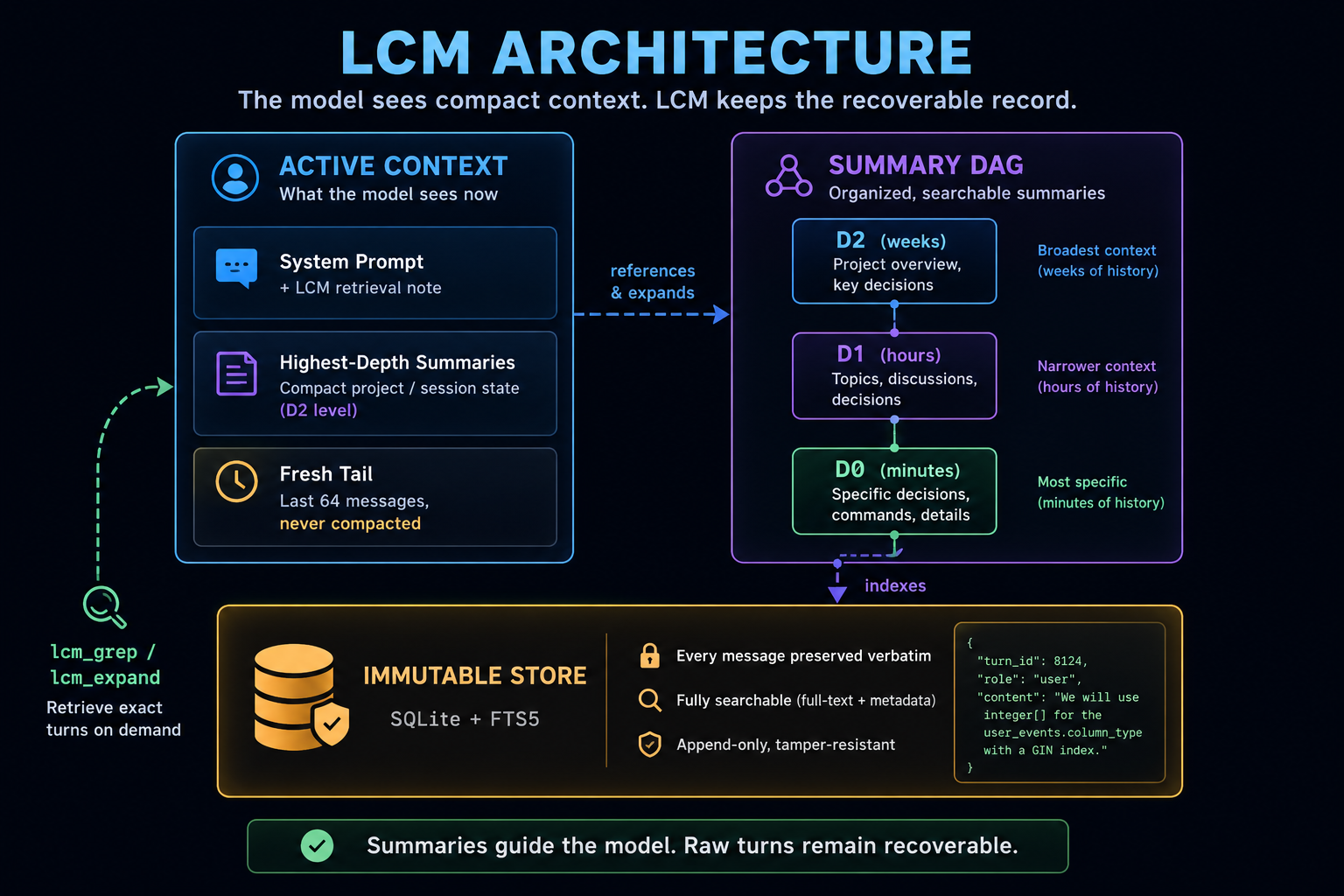
Illustration. The fresh tail defaults to the last 24 messages (LCM_FRESH_TAIL_COUNT) within a token cap (LCM_FRESH_TAIL_MAX_TOKENS). The store is a local SQLite file that keeps every raw message by default. It is not write-protected. The opt-ins listed under Try it (sensitive-pattern redaction, message ignore patterns and the operator's /lcm doctor clean apply) remove content on purpose, and sessions matched by the ignore or stateless session patterns are not stored at all.
How it works
- Ingest - persist each message in SQLite with FTS metadata
- Compact - summarize older messages outside the fresh tail into D0 leaf nodes
- Condense - merge same-depth nodes into higher-depth summaries
- Escalate - shrink oversize summaries from detailed to bullets to deterministic truncate
- Assemble - combine system prompt, highest-depth summaries, and fresh tail
- Retrieve - use LCM tools to drill into compacted history or synthesize from expanded context
Documentation
- Feature overview — every feature family, what it does, why it exists, and the switch that enables it
- Agent configuration profiles — copy-paste env profiles: coding agent, long-horizon assistant, fully-local, cost-guarded
- Operator guide — install, activation, full configuration reference, diagnostics
- Retrieval tools reference — exact tool contracts
- Current project state — stable release, separate main-development identity, active work, and proof boundaries
- Benchmark methodology and results — retrieval and judged-QA evaluation contracts, reproduction, and landed result index
- Embeddings setup — free-tier and local embedding providers, warmup, backfill
- LCM paper
- Architecture diagram
- Standard compression diagram
- LCM compression diagram
- Contributing guide
- Code of conduct
- Security policy
- Tags
Development
Important files:
plugin.yaml      manifest
__init__.py      plugin registration and optional slash-command registration
engine.py        LCMEngine main orchestrator
store.py         SQLite message store and FTS
dag.py           summary DAG and FTS
config.py        env var defaults and overrides
command.py       /lcm command handlers
tools.py         lcm_grep, lcm_load_session, lcm_describe, lcm_expand, lcm_expand_query
schemas.py       tool schemas shown to the model
tests/           standalone pytest coverage
Run tests:
pip install pytest numpy
python -m pytest tests/ -v
No Hermes Agent checkout is required for the test suite; tests include a lightweight ABC stub.
Contributing
Issues and PRs welcome. Bug fixes and correctness improvements are highest priority. New features should be scoped, backwards-compatible, and tested.
See CONTRIBUTING.md for branch, validation, and PR guidance.
See CODE_OF_CONDUCT.md for project conduct expectations
and SECURITY.md for vulnerability reporting.
See the releases page,
tags page, and
CHANGELOG for version history. v0.29.2 is the latest stable
GitHub Release; verify its exact SHA before installation.