rust-anything
by erKam Yaman
English · Türkçe · Українська · 简体中文 · 繁體中文 · Deutsch · Français · Русский · 日本語 · 한국어 · Azərbaycanca · Oʻzbekcha · Қазақша · Кыргызча · Türkmençe · Татарча · ئۇيغۇرچە · Português
Rewrite your whole app in Rust. Keep it working the whole way.
CLIs, servers and libraries, piece by piece, checked against the original at every step.
Node.js and TypeScript · Python · C · Go · Ruby · Java · PHP and C# in preview






Quick start · Languages · How it works · The loop · Port a whole app · Hot paths · Install · What it can't catch · FAQ
up to 20x faster · 38,251 recorded cases replayed · 0 mismatches · one command
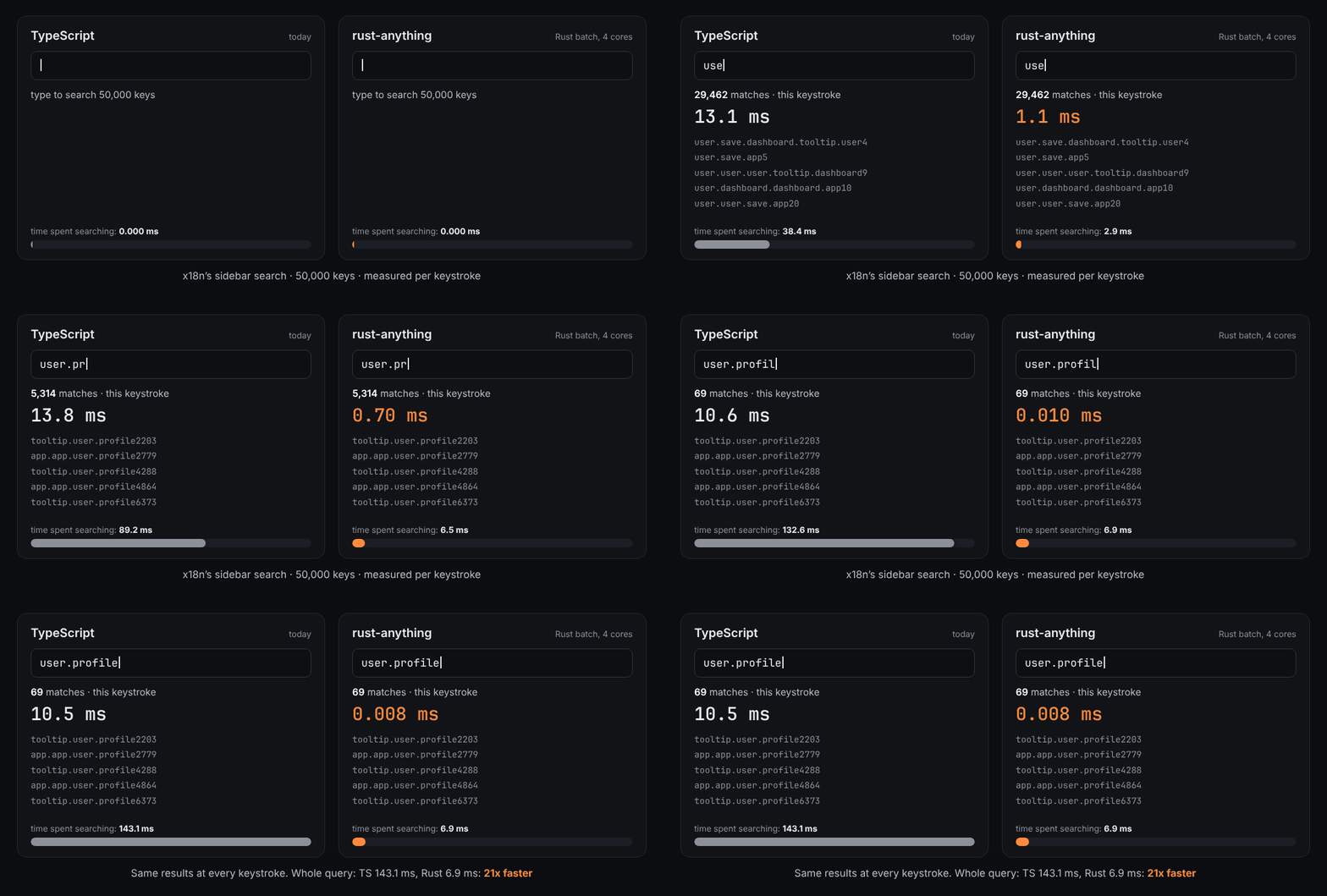
Typing a query into x18n's search over 50,000 keys: the TypeScript original against the rust-anything batch, same results at every keystroke.
Recordrecord runs the original on generated edge cases, semantic traps and your own inputs, and saves what it returns or throws.
|
Portbridge generates the Rust crate and a wrapper, so callers keep the original API. You or your agent write the Rust.
|
Checkdiff replays every recorded case against the Rust, and nothing ships until they all match and gate passes.
|
Lift When replay passes with no fallback and every unit passes gate, app lift makes it a pure Rust app. The original is never touched.
|
Rewrite your whole app in Rust, one piece at a time. rust-anything records what your Node.js (TypeScript/JavaScript), Python, C, Go, Ruby or Java app does today, then checks every piece of the Rust rewrite against that recording before it moves on, until the app is pure Rust. CLIs, HTTP servers and libraries; your coding agent (or you) writes the Rust. It can only catch what the recording covers: see What it can't catch. Only need the slow part fast? Port just that, one hot path at a time:
| Real workload, same results as the original | Original | With rust-anything |
|---|---|---|
| x18n's sidebar search, 50,000 keys (TypeScript, Node) | 10 ms per query | 0.5 ms: 20x faster |
| The same search in the browser (wasm, one thread) | 10 ms | 0.95 ms: 11.5x |
slugify over 20,000 strings (Python) | 98 ms | 17x faster |
Shellwords.shellescape from Ruby's standard library, 50,000 values | 88 ms | 11.8x faster |
Slugify over 50,000 strings (Go) | 49 ms | 4x faster |
slugify over 50,000 strings (Java) | 43 ms | 3x faster |
Measured on 4 cores; every number has a benchmark in demo/ that first checks the
results are identical. Calling Rust once per small function is usually slower than a JIT;
rust-anything finds the loop worth moving, and moves it.
rust-anything is an independent project, not affiliated with or endorsed by the Rust Project or the Rust Foundation. "Rust" is a trademark of the Rust Foundation.
[!WARNING]
recordandapp recordrun your original code, calling each function (or the whole app) on many generated inputs, andapp recordruns every case twice.diff,gateandapp replayrun the same cases again, on the port or the original. Code that writes files, talks to a database or calls the network does that once per case. Run them on a copy of the project, with a test database and no production credentials in the environment.
Quick start
Paste this into Claude Code, Codex, Cursor or Gemini CLI and let your agent install it:
Install rust-anything: run `cargo install rust-anything`, then `rust-anything setup`.
Tell me when to restart you.
Or yourself:
cargo install rust-anything   # from crates.io
rust-anything setup           # registers it with Claude Code, Codex, Cursor and Gemini CLI
No Rust toolchain yet? Prebuilt binaries for macOS, Linux and Windows are attached to each
GitHub release, and for JavaScript
projects npm install -g rust-anything installs the same binary.
In Claude Code you can also install it as a plugin (the MCP server and the skill; the CLI above
must be on your PATH):
/plugin install rust-anything --marketplace erkamyaman/rust-anythingsetup adds the MCP server to each agent it finds and installs the workflow skill where the agent
reads skills. It keeps your other settings, is safe to run again, and --remove undoes it.
Then ask your agent, for example:
- "Rewrite this CLI in Rust with rust-anything, end to end, and prove it behaves the same."
- "This search feels slow. Profile it with rust-anything and move the hot loop to Rust."
- "Plan a migration of
src/parser/to Rust with rust-anything; port the first unit and prove it." - "Bench the Rust port in
rust/text-rsagainst the original and tell me whether to ship it."
Works with
| Agent | rust-anything setup adds |
|---|---|
| Claude Code | MCP server in ~/.claude.json, skill in ~/.claude/skills/ |
| Codex | MCP server in ~/.codex/config.toml, skill in ~/.codex/skills/ |
| Cursor | MCP server in ~/.cursor/mcp.json |
| Gemini CLI | MCP server in ~/.gemini/settings.json |
| Any other MCP client | add rust-anything mcp as a stdio server by hand (see Install) |
Before changing a file that exists, setup saves a copy beside it (<file>.rust-anything.bak).
Or run the steps yourself:
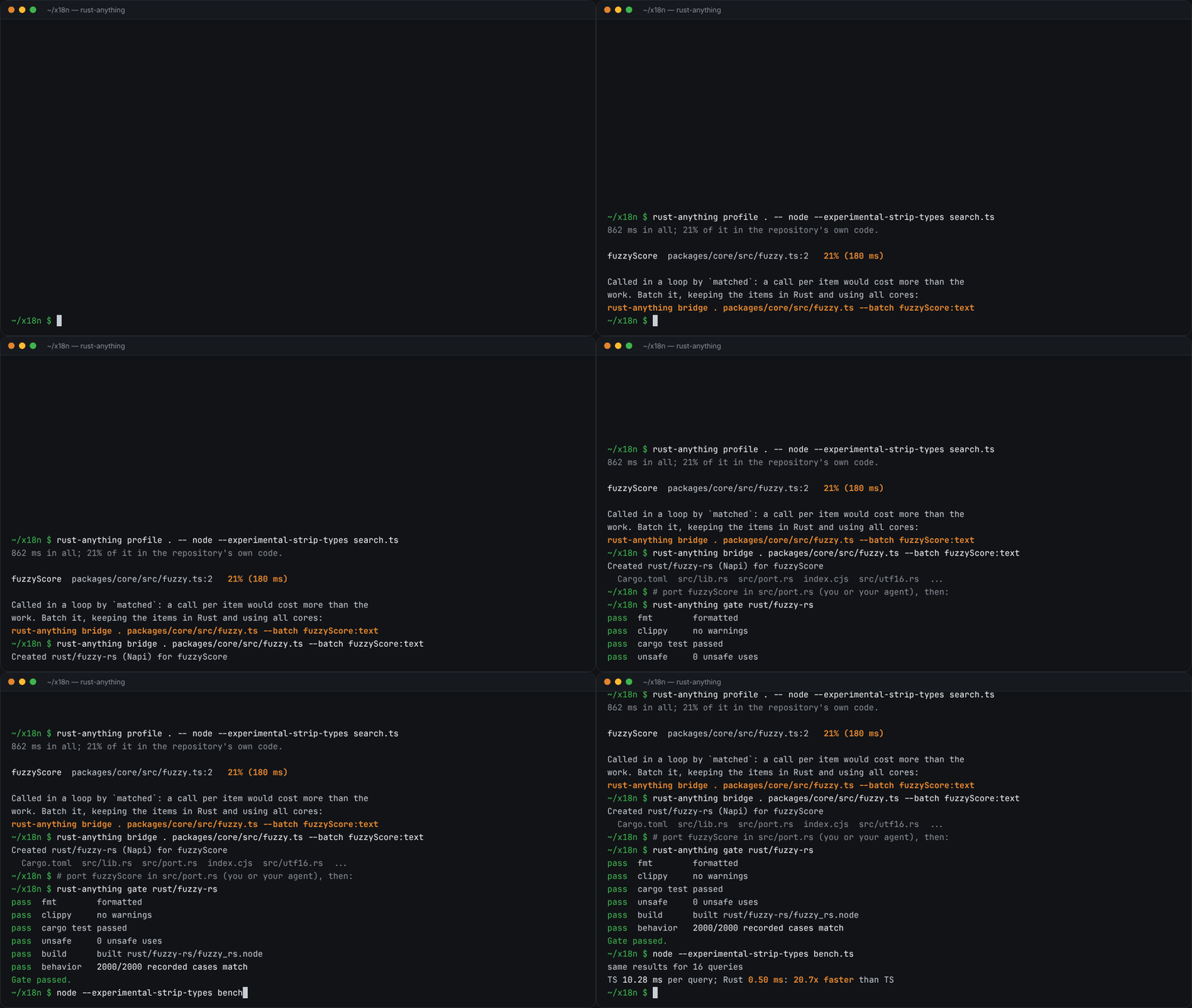
The steps on x18n's fuzzyScore: profile finds the hot loop, bridge --batch generates the crate, gate passes, and the benchmark compares it with the TypeScript.
rust-anything profile . -- node bench.mjs              # what is hot, and who calls it
rust-anything bridge . src/fuzzy.ts --batch fuzzyScore:text
# write src/port.rs (or let your agent), then:
rust-anything record rust/fuzzy-rs && rust-anything build rust/fuzzy-rs
rust-anything diff rust/fuzzy-rs                       # every recorded case must match
rust-anything bench rust/fuzzy-rs                      # faster? the verdict says
rust-anything gate rust/fuzzy-rs                       # done means this passes
rust-anything does not translate code: your coding agent (Claude Code, Codex, Cursor, ...) or you write the Rust. rust-anything supplies what an agent cannot guess reliably: where the time goes, what to port first and in which order, a bridge so the rest of the code calls the Rust with its API unchanged, the exact behavior the port must match, a safe way to ship it, and a gate that says when a port is done.
Languages
| Language | Unit | Bridge | Recorded and replayed by |
|---|---|---|---|
| TypeScript/JavaScript | folder or file | napi-rs or wasm-bindgen with a generated binary wire; classes and async included | Node, running the .ts sources |
| Python | package or module | PyO3 (abi3), direct conversion, typed exceptions | Python, importing the original |
| C | .c file | extern "C" functions with the original names and a header | the original compiled to a shared library, called through ctypes, one fork per case |
| Go | package | typed cgo calls and a generated binary wire, in a package with the original API | a generated Go driver, built as its own module |
| Ruby | file or folder of module functions | a magnus extension under the original modules | a generated Ruby driver |
| Java | package of public static methods | typed JNI and a generated binary wire, in wrapper classes with the original methods | a generated reflection driver |
| PHP (preview) | folder of functions and public static methods | coming next: PHP FFI over a C ABI | whole apps today: app record, app replay and the front door, for CLIs and servers (php -S) |
| C# (preview) | folder of public static methods | coming next: P/Invoke over a C ABI | whole apps today: app record, app replay and the front door, for CLIs and ASP.NET servers (dotnet <app>.dll) |
Every language except C also gets batch classes (--batch): the items cross once and stay in
Rust, and each call runs over all of them on all cores.
The language is detected from the repository (go.mod, pom.xml, a .csproj or .sln,
pyproject.toml, Gemfile, composer.json, package.json, else the most common source files);
--lang overrides it. Types come from the source: TS types, Python hints, C, Go, Java and C#
signatures, Ruby YARD tags, PHP types and phpdoc; untyped parameters used as numbers are inferred
as numbers.
PHP is in preview: analyze plans a PHP app (Composer packages and PSR-4 autoloading, risks
such as loose comparison and integer overflow into floats, Composer packages mapped to crates),
and a PHP CLI or server can be recorded, replayed and put behind a Rust front door. Porting its
units into Rust through PHP's FFI is the next step (issue #2).
C# is in preview the same way: analyze reads .csproj projects and their NuGet packages
(mapped to crates), resolves using directives to folders, and flags what C# does differently
(decimal, dynamic, LINQ's deferred queries, Task, lock, reflection). A C# CLI or ASP.NET
server can be recorded, replayed and put behind a Rust front door; porting units through P/Invoke
comes next.
Learn more
- How it works: the loop, what
bridgeandanalyzedecide, hot paths, and what it can't catch - Port a whole app: servers, CLIs and libraries, from the front door to
app lift - Examples and case studies: x18n, and real code in six languages
- Real-world ports: json-server, Fuse.js, vercel/ms, with benchmarks
- Install, update and develop: every install method, Windows, and building from source
- FAQ · Status · MCP tools
Sponsors
rust-anything is free and open source. If it helps your work, please consider sponsoring it.
Your support keeps development going.



Contributing
Issues and pull requests are welcome; CONTRIBUTING.md covers the setup, where tests go, and how to add a language. Design choices and their reasons are in DECISIONS.md. Case studies of real ports are especially welcome. Please report security problems privately (SECURITY.md), and see the code of conduct.
License
MIT © Erkam Yaman. Ports and generated code in your repository are yours.