Astra Flash Orchestrator
Save Astra for the decisions that need it. Let DeepSeek V4.1 Flash do the volume.
A personal Codex skill designed to preserve Astra usage without giving up Astra's judgment. Astra stays responsible for planning, architecture, high-stakes decisions and final review. DeepSeek V4.1 Flash takes the high-volume work: repository discovery, implementation, testing, debugging and routine verification.
Bring an existing plan or start with a feature request. The workflow turns it into coherent implementation bundles, sends those bundles to Flash, then returns the completed patch and evidence to Astra for one focused acceptance pass.
Status: early release. Offline installation tests pass, and the workflow has completed a measured local field build. Results below describe that run, not guaranteed savings. A new installation still needs runtime routing verification on its first authorized task. Installation never runs paid inference.
Measured efficiency
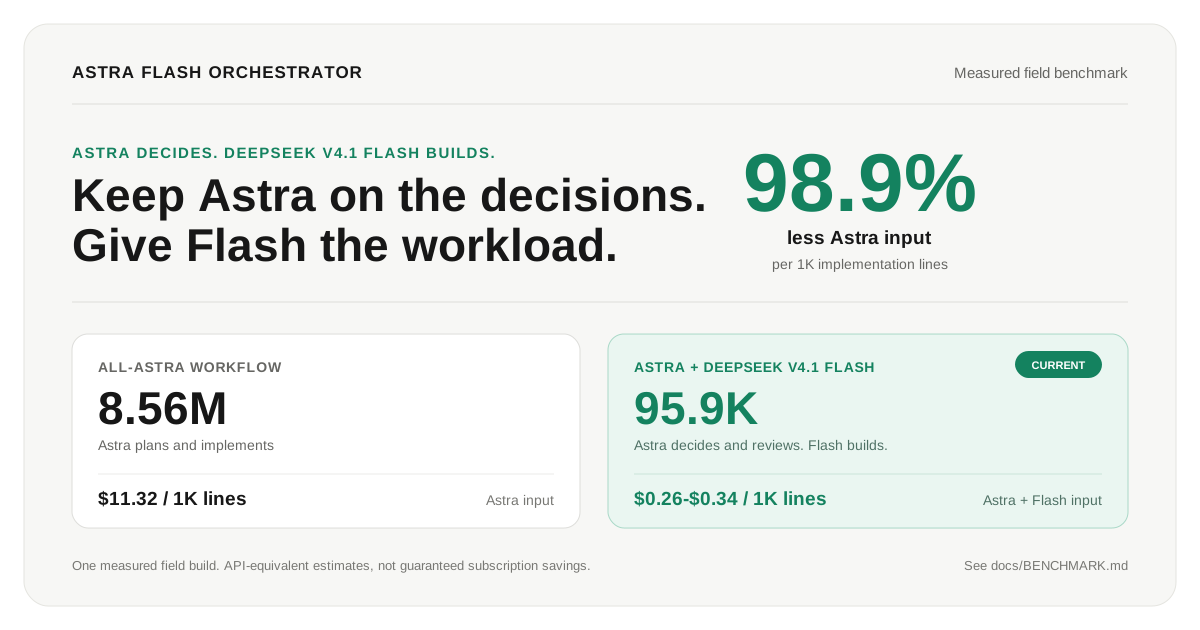
In one substantial field build, Astra Flash Orchestrator used 98.9% less Astra input per 1,000 implementation and test lines than the all-Astra baseline. It did that by moving the implementation loop—not the important decisions—to Flash. Total API-equivalent compute per 1,000 lines was 97.0–97.7% lower, while the measured phase produced 39% more implementation and test lines.
| Workflow | Astra input per 1K implementation lines | Total compute per 1K lines |
|---|---|---|
| All Astra | 8.56M | $11.32 |
| Astra + DeepSeek V4.1 Flash | 95.9K | $0.26–$0.34 |
The per-token price difference explains why delegating implementation has so much leverage:
| Cost per 1M tokens | Astra estimator | DeepSeek V4.1 Flash | Astra premium |
|---|---|---|---|
| Uncached input | $10.00 | $0.15–$0.30 | 33–67× |
| Cached input | $1.00 | $0.003–$0.006 | 167–333× |
| Output | $50.00 | $0.60–$1.20 | 42–83× |
Astra does not have a public API SKU; its values above are API-equivalent estimates, not ChatGPT or Codex subscription charges. Flash values use published off-peak and peak API rates. See the benchmark methodology for sources, exact measurements and limitations.
How it works
Astra  →  scope + design + task brief
Flash  →  implement + test + report
Astra  →  review + verify + accept or request fixes
→ integrate + checkpoint + next task- Native delegation: uses the
astra_flash_builderrole, not a separate agent CLI. - Coherent assignments: one feature slice can include many edit/test/fix steps.
- Focused Astra root: normally one planning batch, one dispatch, one wait, one batched acceptance review and one final response.
- Worker-owned execution: Flash handles in-scope discovery, implementation, testing, debugging and routine browser/visual QA without progress polling.
- Review before acceptance: the builder submits evidence; Astra decides whether it is complete.
- Existing plans welcome: works with repository plans, Superpowers/GSD artifacts, or the included templates.
- Controlled parallel work: one writer by default; two only with independent tasks and verified separate workspaces.
- Reversible installation: dry run, backups and a guarded undo receipt.
This is workflow guidance, not a deterministic scheduler, a security sandbox, or a guarantee of model quality or cost savings. It is independent of OpenAI, DeepSeek and Codex Router.
One orchestration workflow
There is no mode setting or mode-switch command. The package always uses the usage-saving Astra → Flash → Astra workflow for substantial implementation.
Three routing outcomes remain intentionally different:
- Substantial implementation uses Astra to plan and review while Flash builds.
- Trivial work and explicit single-agent requests stay with the root session.
- Concrete security, architecture, payments, tenancy, secrets, migration or production risk can justify targeted additional Astra review.
Those are scope and safety decisions, not user-selectable performance modes.
Requirements
Before installing, you need:
- A Codex client that supports native subagents and standalone custom agent TOML files under
$CODEX_HOME/agents/. - GPT-6 Astra selected as the root model.
- Python 3.11 or newer. No third-party Python dependencies are needed.
- An existing Codex Router installation, configured and authenticated for one reviewed DeepSeek V4.1 Flash route below.
- A local Codex model catalog advertising that exact route with
multi_agent_version: "v2".
| Provider | Worker route |
|---|---|
| DeepSeek API (default) | deepseek/deepseek-v4.1-flash |
| OpenRouter | openrouter/deepseek-v4.1-flash |
| opencode Go | opencode-go/deepseek-v4.1-flash |
| Command Code | commandcode/deepseek-v4.1-flash |
| Nous Research | nousresearch/deepseek-v4.1-flash |
| Ollama Cloud | ollama-cloud/deepseek-v4.1-flash |
Provider credentials are entered by you through Codex Router's private local prompt before installing this package. Never paste an API key into an assistant chat. This installer never asks for, reads, stores or validates provider keys.
Do not spend API credit during installation. Installing this package does not authorize an assistant to run
subagents certify,test-model --live, a Router smoke test or any other paid inference probe. If the selected route is absent or is not already advertised asv2, the installer stops and reports the prerequisite. Decide separately whether to certify a route yourself.
Do not add or change [agents].default_subagent_model for this package. The
installer creates a named astra_flash_builder role that pins its own route and
catalog-supported effort, so unrelated subagents keep their existing defaults.
The installer does not install the Router, add credentials, select your root
model, or rewrite config.toml. Direct DeepSeek remains the default. Any other
provider requires an explicit --worker-route; if that route is unavailable,
installation stops instead of silently choosing another provider.
The installer supports loopback Router URLs using /v1 or /_codex-router/<capability>/v1. It rejects remote hosts, embedded credentials, queries, fragments and unexpected paths. Client/project/UI overrides still need checking in your actual session. Router subagent selection enables discovery; it does not prove successful inference. Some Router enable commands automatically launch paid verification, so inspect the installed version before changing selection. This installer never enables routes or runs those probes.
Install
Download this repository as a ZIP and extract it, or clone it:
git clone https://github.com/ethanplusai/astra-flash-orchestrator.git
cd astra-flash-orchestrator
Run the following commands from that repository folder.
Fastest safe terminal install
The installer performs its own prerequisite checks before writing. Preview the exact destinations, then apply:
python3 -B install.py
python3 -B install.py --apply
That is the normal installation path. The first command changes nothing. The second repeats preflight, installs atomically, backs up existing instructions and prints a guarded undo receipt. It does not change your root model, Router, credentials, permissions or reasoning effort.
To use an already-configured alternate provider, pass its exact route to both commands. For OpenRouter:
python3 -B install.py --worker-route openrouter/deepseek-v4.1-flash
python3 -B install.py --worker-route openrouter/deepseek-v4.1-flash --apply
The option selects an existing catalog route; it does not configure the provider, collect a key, certify the model or make an inference request.
With Codex
Ask Codex:
Read INSTALL-IN-CODEX.md in this folder and install the package following it.
Preserve my root model, reasoning effort, Router, config and authentication.
Do not launch workers or run paid inference during installation.
Verify the package locally
Release archives are tested before publication. If you also want to run the offline suite yourself:
python3 -B -m unittest discover -s tests -vFor a nondefault profile, pass --profile PROFILE to the dry run, apply and doctor consistently. --home and --codex-home are available for explicit location overrides. Use the same locations for undo.
What changes
| Location | Installed content |
|---|---|
~/.agents/skills/astra-flash-orchestrator/ | Skill, references, templates, doctor, plan validator and routing binding |
$CODEX_HOME/agents/astra_flash_builder.toml | Native builder pinned to Flash; nested agents disabled |
$CODEX_HOME/AGENTS.md | A marked, scoped workflow policy block |
$CODEX_HOME/astra-flash-install-backups/ | Original files and an undo receipt |
CODEX_HOME defaults to ~/.codex. An existing nonempty AGENTS.override.md receives the policy instead of AGENTS.md. Other instructions are preserved. The policy keeps trivial work single-agent and honors explicit no-delegation requests, repository restrictions and managed policies. Use --no-policy for a skill/role-only installation.
Root model/effort, provider configuration, authentication and existing permissions stay unchanged. Installation does not start services, workers or model requests, and does not commit, push or deploy anything.
Start your first task
Fully quit and reopen the host app (ChatGPT or Codex), then start an Astra session. A new chat alone may reuse a cached model catalog. Use:
$astra-flash-orchestrator Use the existing plan in docs/plan.md to implement
this feature. Keep Astra focused on planning and final review. Use one installed
Flash builder for a coherent implementation and verification bundle. Do not poll
the worker; review its completed patch and evidence in one batched pass.
Replace the example plan path with your actual plan or describe the feature. Your first authorized useful task should verify the child model and provider using host/router request metadata. A worker saying its model name is not proof.
If the session does not expose the custom role or exact worker model, do not substitute another model or launch a second CLI. Check client support and session configuration first.
Check your setup
From the repository folder:
python3 -B skill/astra-flash-orchestrator/scripts/doctor.py
python3 -B skill/astra-flash-orchestrator/scripts/doctor.py --check-local-router
An installed copy reads its generated routing.json, so doctor checks the same
route automatically. Pass --worker-route only when running doctor from a fresh
source checkout or intentionally checking a different reviewed route.
The first checks local configuration/catalog data. The optional second command makes only a local /models GET, with proxies and redirects disabled. It does not read authentication files or attach credentials; an authenticated Router may reject it even when normal Codex requests work. Do not disable Router authentication to make this check pass.
Neither check proves paid inference works. See troubleshooting and validation evidence.
Updating and uninstalling
For an update, download the new source, run its tests, and preview python3 -B install.py --replace. Review the differences before applying with --replace --apply. Existing package-owned files are backed up; unrelated files are not deleted. An existing valid routing.json preserves the installed provider when --worker-route is omitted. Pass the option explicitly only to change providers, and review that replacement before applying it. Do not edit generated routing.json or the agent model to force a different provider through preflight.
Preview undo using the exact receipt printed during installation:
python3 -B install.py --undo /path/to/receipt.jsonAdd --apply to restore. Undo refuses if a managed file changed afterward, protecting later edits. Backups remain available. Keep a copy of the installer and receipt; receipts may contain private paths and original instructions and should never be published.
Contributing and distribution
- Contributing: tests, changes and evidence expectations.
- Security: privacy boundaries and safe reporting.
- Sources: provenance and upstream references.
- Release preparation: GitHub description, topics and release checks.
- Changelog: changes from the original package.
To validate the synthetic plan example:
python3 -B skill/astra-flash-orchestrator/scripts/validate_plan.py examples/invoice-filter/plan.jsonThe example is a planning fixture, not a runnable application. Markdown plans work without the optional manifest validator.