



A high-performance Polymarket Rust client with latency-optimized data structures and allocator-conscious hot paths. The 0.4.x line is V2-native and intentionally breaking for authenticated trading flows.
At the time that this project was started, polymarket-rs-client was a Polymarket Rust Client with a few GitHub stars, but which seemed to be unmaintained. I took on the task of creating a Rust client which could beat the benchmarks quoted in the README.md of that project, with the added constraint of also maintaining zero alloc hot paths.
I also want to take a moment to clarify what zero-alloc means because I've now recieved double digit messages about this on twitter/x and telegram. In this repository the strict claim is limited to tested, warmed hot paths: existing-level book updates and selected read-side calculations are covered by no-heap-traffic tests that count allocations, reallocations, and deallocations. Snapshot churn, first-seen books, and new price levels can still touch the allocator by design.
Notably order book paths that can touch the allocator by design:
- First time seeing a token/book (HashMap insert + key clone):
src/book.rs - New price levels when a sorted side needs to grow:
src/book.rs - Book removal/drop paths that release owned buffers:
src/book.rs
Quick Start
Add to your Cargo.toml:
[dependencies]
polyfill-rs = "0.4.0"
Replace your imports:
// Before: use polymarket_rs_client::{ClobClient, Side, OrderType};
use polyfill_rs::{ClobClient, Side, OrderType};

#[tokio::main]
async fn main() -> Result<(), Box<dyn std::error::Error>> {
    let client = ClobClient::new("https://clob.polymarket.com");
    let markets = client.get_sampling_markets(None).await?;
    println!("Found {} markets", markets.data.len());
    Ok(())
}
Performance Comparison
Real-World API Performance (with network I/O)
Real-world Polymarket API latency broken down by request phase:
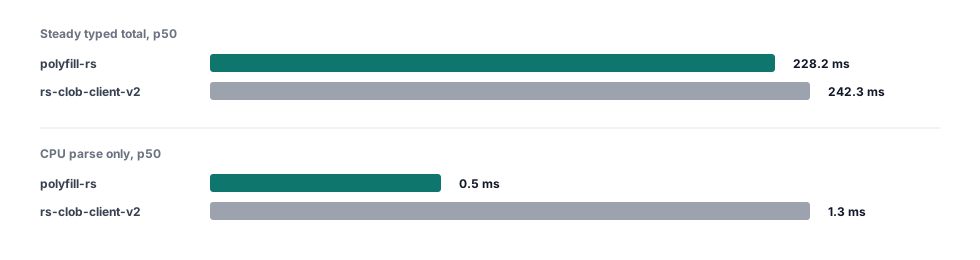
| Operation | Metric | polyfill-rs | rs-clob-client-v2 | polymarket-rs-client | Official Python Client |
|---|---|---|---|---|---|
| Fetch Markets | mean ± sd | 321.6 ms ± 92.9 ms | - | 409.3 ms ± 137.6 ms | 1.366 s ± 0.048 s |
| Cold Start | single run | 759.3 ms | 568.0 ms | - | - |
| Warm Connection | single run | 153.0 ms | 191.9 ms | - | - |
| Steady Typed Total | p50 / p95 / p99 | 228.2 / 509.9 / 611.2 ms | 242.3 / 514.2 / 641.3 ms | - | - |
| Network-Only Byte Fetch* | p50 / p95 / p99 | 200.0 / 327.3 / 518.6 ms | 123.3 / 456.9 / 867.2 ms | - | - |
| CPU Parse Only | p50 / p95 / p99 | 0.5 / 1.1 / 1.3 ms | 1.3 / 1.6 / 1.7 ms | - | - |
Performance vs polymarket-rs-client:
- 21.4% faster
- 32.5% more consistent
- 4.2x faster than Official Python Client
Benchmark Methodology: The rs-clob-client-v2 comparison separates cold start, warm connection, steady-state typed requests, network-only byte fetches, and CPU-only parsing. The latest local live-network run was on June 22, 2026 against https://clob.polymarket.com/simplified-markets?next_cursor=MA==. Steady-state rows use 40 paired iterations with alternating order and 100ms delay after 5 warmups; parse rows use 300 iterations from a cached 480KB payload. The network-only row is a selected raw HTTP diagnostic, not a typed SDK method result: it compares polyfill's actual HTTP client with a reqwest client using the rs-clob-client-v2 default headers and no typed deserialization. The benchmark now prints a full network-only transport matrix covering default reqwest, rs-clob-client-v2 headers, polyfill's actual client, and polyfill-tuned header variants. The CPU parse row compares polyfill's SIMD-backed typed parser against the rs-clob-client-v2 request-helper parse path; direct serde parsing of the SDK response type measured 0.5 / 0.6 / 0.6 ms. Run it with cargo run --release --example official_client_side_by_side_benchmark --features official-client-benchmark. See examples/side_by_side_benchmark.rs in commit a63a170: https://github.com/floor-licker/polyfill-rs/blob/a63a170/examples/side_by_side_benchmark.rs for the original legacy benchmark implementation.
Computational Performance (pure CPU, no I/O)
| Operation | Performance | Notes |
|---|---|---|
| Order Book Updates (1000 ops) | 69.6 µs | ~14.4M updates/sec, no allocator traffic for warmed existing-level paths |
| Spread/Mid Calculations | 26.6 ns | best bid/ask + spread + mid over sorted-vector book sides |
| JSON Parsing (480KB) | ~0.5 ms | SIMD-backed parsing for large REST market responses and benchmarked polyfill typed parse path |
WS book hot path (decode + apply) | ~0.24 µs / 1.56 µs / 5.92 µs | 1 / 16 / 64 levels-per-side, strict fixed-point tape parser with generation-marked snapshot retention (see benches/ws_hot_path.rs) |
Run the WS hot-path benchmark locally with cargo bench --bench ws_hot_path.
Parsing paths: polyfill-rs keeps two parsing layers on purpose. The allocation-sensitive WS book path uses WsBookUpdateProcessor in src/ws_hot_path.rs, which walks a reusable simd-json tape and applies fixed-point book levels directly. The generic stream parser in src/decode.rs is an ergonomic compatibility path: it parses through serde_json::Value so it can tolerate batches, unknown event types, and mixed message shapes. Likewise, several generic numeric/decimal deserializers in src/decode.rs accept string-or-number API fields through serde_json::Value; they are not the zero-allocation hot path.
WebSocket snapshot ordering: Polymarket book messages expose a millisecond timestamp and optional hash, but no monotonic server sequence/version. The book applier treats newer timestamps as newer, rejects older timestamps, suppresses exact same-timestamp/same-hash duplicates, and accepts same-timestamp/different-hash snapshots in websocket arrival order. The hash distinguishes duplicate vs distinct state; it is not a logical ordering key.
Key Performance Optimizations:
The 21.4% performance improvement comes from HTTP/2 tuning with 512KB stream windows optimized for 469KB payloads, explicit Polymarket request headers, SIMD-backed parsing where the client uses the typed fast-response helper for large REST market responses, and opt-in connection prewarming/keep-alive support.
Memory Architecture
Configurable book depth limiting prevents memory bloat. Hot data structures group frequently-accessed fields for cache line efficiency. Allocation-sensitive hot paths are covered by targeted no-heap-traffic tests where the implementation currently avoids allocation, reallocation, and deallocation.
Architectural Principles
Price data converts to fixed-point at ingress boundaries while maintaining tick-aligned precision. The critical path uses integer arithmetic with branchless operations. Data converts back to IEEE 754 at egress for API compatibility. This enables deterministic execution with predictable instruction counts.
Measured Network Improvements
| Optimization Technique | Performance Gain | Use Case |
|---|---|---|
| Optimized HTTP client | 11% baseline improvement | Every API call |
| Connection pre-warming | 70% faster subsequent requests | Application startup |
| Request parallelization | 200% faster batch operations | Multi-market data fetching |
| Circuit breaker resilience | Better uptime during instability | Production trading systems |