🚀 NEW (2025): ID-Consistent, Precise Expression Generation with Blendshape-Guided Diffusion
📄 Check out our latest extension!
We introduce a fine-grained Expression Adapter, enabling Arc2Face to generate any subject under any facial expression (even rare, asymmetric, subtle, or extreme ones). See details below.


Arc2Face: A Foundation Model for ID-Consistent Human Faces
Foivos Paraperas Papantoniou1 Alexandros Lattas1 Stylianos Moschoglou1
Jiankang Deng1 Bernhard Kainz1,2 Stefanos Zafeiriou1
1Imperial College London, UK
2FAU Erlangen-Nürnberg, Germany




This is the official implementation of Arc2Face, an ID-conditioned face model:
✅ that generates high-quality images of any subject given only its ArcFace embedding, within a few seconds
✅ trained on the large-scale WebFace42M dataset offers superior ID similarity compared to existing models
✅ built on top of Stable Diffusion, can be extended to different input modalities, e.g. with ControlNet

News/Updates

- [2025/10/07] 🔥 We release an extension for accurate and ID-consistent facial expression transfer. See details below!
- [2024/08/16] 🔥 Accepted to ECCV24 as an oral!
- [2024/08/06] 🔥 ComfyUI support available at caleboleary/ComfyUI-Arc2Face!
- [2024/04/12] 🔥 We add LCM-LoRA support for even faster inference (check the details below).
- [2024/04/11] 🔥 We release the training dataset on HuggingFace Datasets.
- [2024/03/31] 🔥 We release our demo for pose control using Arc2Face + ControlNet (see instructions below).
- [2024/03/28] 🔥 We release our Gradio demo on HuggingFace Spaces (thanks to the HF team for their free GPU support)!
- [2024/03/14] 🔥 We release Arc2Face.
Installation
conda create -n arc2face python=3.10
conda activate arc2face

# Install requirements
pip install -r requirements.txt
Download Models
- The models can be downloaded manually from HuggingFace or using python:
from huggingface_hub import hf_hub_download

hf_hub_download(repo_id="FoivosPar/Arc2Face", filename="arc2face/config.json", local_dir="./models")
hf_hub_download(repo_id="FoivosPar/Arc2Face", filename="arc2face/diffusion_pytorch_model.safetensors", local_dir="./models")
hf_hub_download(repo_id="FoivosPar/Arc2Face", filename="encoder/config.json", local_dir="./models")
hf_hub_download(repo_id="FoivosPar/Arc2Face", filename="encoder/pytorch_model.bin", local_dir="./models")
-
For face detection and ID-embedding extraction, manually download the antelopev2 package (direct link) and place the checkpoints under
models/antelopev2. -
We use an ArcFace recognition model trained on WebFace42M. Download
arcface.onnxfrom HuggingFace and put it inmodels/antelopev2or using python:
hf_hub_download(repo_id="FoivosPar/Arc2Face", filename="arcface.onnx", local_dir="./models/antelopev2")
- Then delete
glintr100.onnx(the default backbone from insightface).
The models folder structure should finally be:
  . ── models ──┌── antelopev2
                ├── arc2face
                └── encoder
Usage
Load pipeline using diffusers:
from diffusers import (
    StableDiffusionPipeline,
    UNet2DConditionModel,
    DPMSolverMultistepScheduler,
)

from arc2face import CLIPTextModelWrapper, project_face_embs

import torch
from insightface.app import FaceAnalysis
from PIL import Image
import numpy as np

# Arc2Face is built upon SD1.5
# The repo below can be used instead of the now deprecated 'runwayml/stable-diffusion-v1-5'
base_model = 'stable-diffusion-v1-5/stable-diffusion-v1-5'

encoder = CLIPTextModelWrapper.from_pretrained(
    'models', subfolder="encoder", torch_dtype=torch.float16
)

unet = UNet2DConditionModel.from_pretrained(
    'models', subfolder="arc2face", torch_dtype=torch.float16
)

pipeline = StableDiffusionPipeline.from_pretrained(
        base_model,
        text_encoder=encoder,
        unet=unet,
        torch_dtype=torch.float16,
        safety_checker=None
    )
You can use any SD-compatible schedulers and steps, just like with Stable Diffusion. By default, we use DPMSolverMultistepScheduler with 25 steps, which produces very good results in just a few seconds.
pipeline.scheduler = DPMSolverMultistepScheduler.from_config(pipeline.scheduler.config)
pipeline = pipeline.to('cuda')
Pick an image and extract the ID-embedding:
app = FaceAnalysis(name='antelopev2', root='./', providers=['CUDAExecutionProvider', 'CPUExecutionProvider'])
app.prepare(ctx_id=0, det_size=(640, 640))

img = np.array(Image.open('assets/examples/joacquin.png'))[:,:,::-1]

faces = app.get(img)
faces = sorted(faces, key=lambda x:(x['bbox'][2]-x['bbox'][0])*(x['bbox'][3]-x['bbox'][1]))[-1]  # select largest face (if more than one detected)
id_emb = torch.tensor(faces['embedding'], dtype=torch.float16)[None].cuda()
id_emb = id_emb/torch.norm(id_emb, dim=1, keepdim=True)   # normalize embedding
id_emb = project_face_embs(pipeline, id_emb)    # pass through the encoder

Generate images:
num_images = 4
images = pipeline(prompt_embeds=id_emb, num_inference_steps=25, guidance_scale=3.0, num_images_per_prompt=num_images).images

LCM-LoRA acceleration
LCM-LoRA allows you to reduce the sampling steps to as few as 2-4 for super-fast inference. Just plug in the pre-trained distillation adapter for SD v1.5 and switch to LCMScheduler:
from diffusers import LCMScheduler

pipeline.load_lora_weights("latent-consistency/lcm-lora-sdv1-5")
pipeline.scheduler = LCMScheduler.from_config(pipeline.scheduler.config)
Then, you can sample with as few as 2 steps (and disable guidance_scale by using a value of 1.0, as LCM is very sensitive to it and even small values lead to oversaturation):
images = pipeline(prompt_embeds=id_emb, num_inference_steps=2, guidance_scale=1.0, num_images_per_prompt=num_images).images
Note that this technique accelerates sampling in exchange for a slight drop in quality.
Start a local gradio demo
You can start a local demo for inference by running:
python gradio_demo/app.py
Arc2Face + ControlNet (pose)
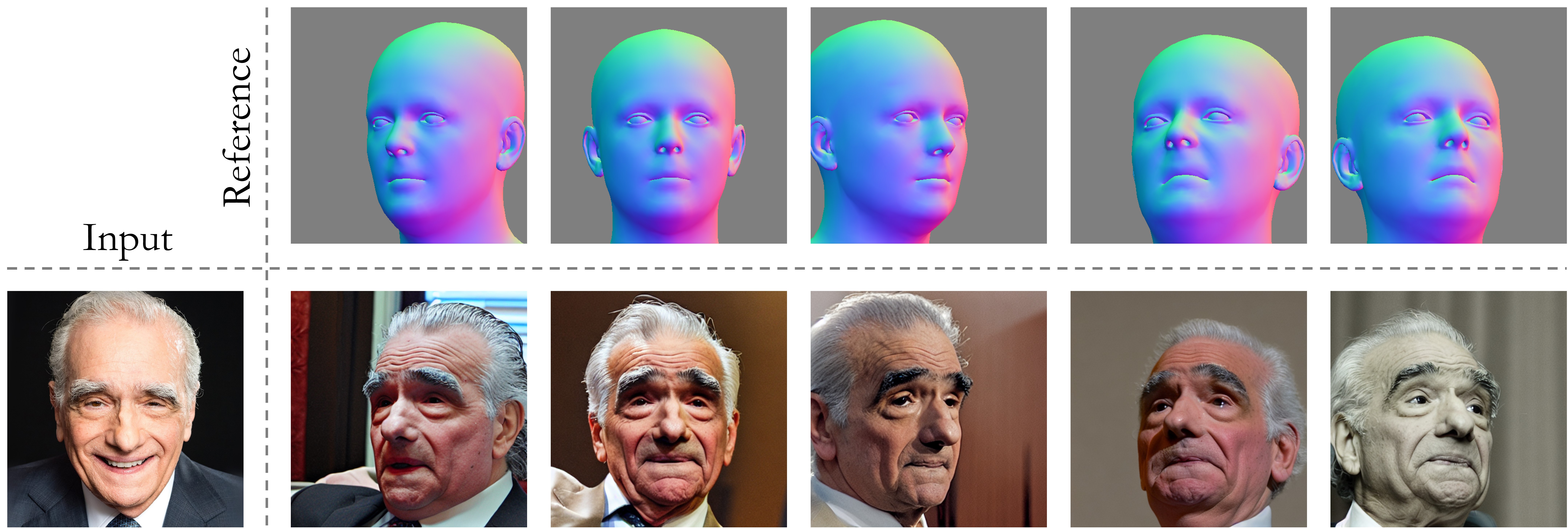
We provide a ControlNet model trained on top of Arc2Face for pose control. We use EMOCA for 3D pose extraction. To run our demo, follow the steps below:
1) Download Model
Download the ControlNet checkpoint manually from HuggingFace or using python:
from huggingface_hub import hf_hub_download

hf_hub_download(repo_id="FoivosPar/Arc2Face", filename="controlnet/config.json", local_dir="./models")
hf_hub_download(repo_id="FoivosPar/Arc2Face", filename="controlnet/diffusion_pytorch_model.safetensors", local_dir="./models")
2) Pull EMOCA
git submodule update --init external/emoca
3) Installation
This is the most tricky part. You will need PyTorch3D to run EMOCA. As its installation may cause conflicts, we suggest to follow the process below:
- Create a new environment and start by installing PyTorch3D with GPU support first (follow the official instructions).
- Add Arc2Face + EMOCA requirements with:
pip install -r requirements_controlnet.txt
- Install EMOCA code:
pip install -e external/emoca
- Finally, you need to download the EMOCA/FLAME assets. Run the following and follow the instructions in the terminal:
cd external/emoca/gdl_apps/EMOCA/demos
bash download_assets.sh
cd ../../../../..
4) Start a local gradio demo
You can start a local ControlNet demo by running:
python gradio_demo/app_controlnet.py
Arc2Face + Expression Adapter
Our extension "ID-Consistent, Precise Expression Generation with Blendshape-Guided Diffusion" combines Arc2Face with a custom IP-Adapter designed for generating ID-consistent images with precise expression control based on FLAME blendshape parameters. We also provide an optional Reference Adapter which can be used to condition the output directly on the input image, i.e. preserving the subject's appearance and background (to an extent). You can find more details in the report.
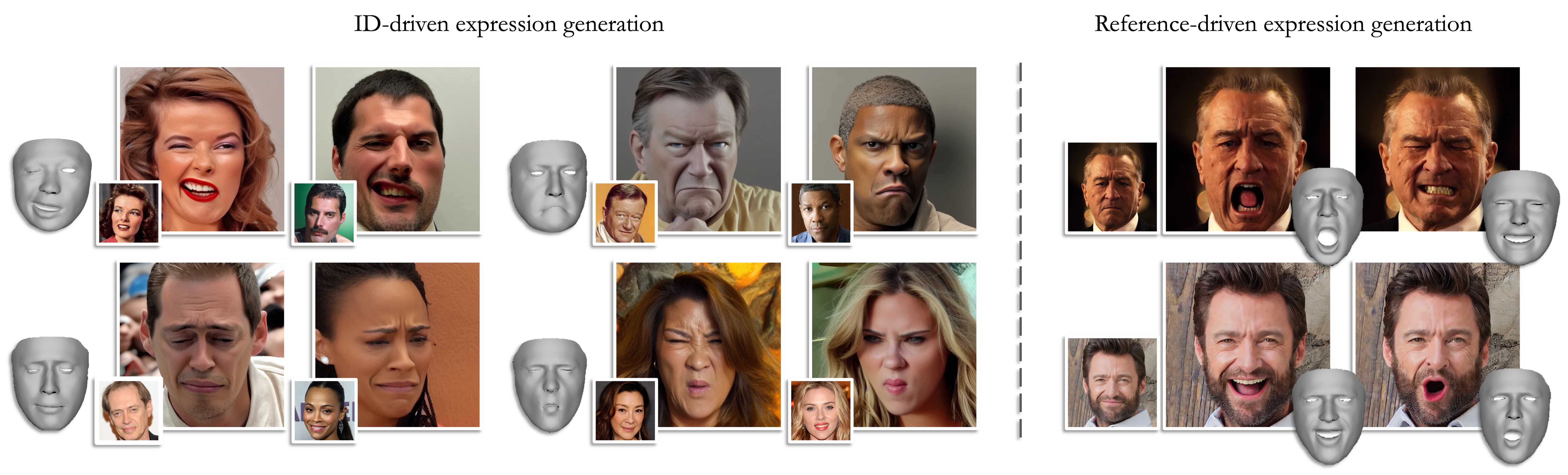
Here's how to run it:
1) Download Model
Download the Expression and Reference Adapters manually from HuggingFace or using python:
from huggingface_hub import hf_hub_download

hf_hub_download(repo_id="FoivosPar/Arc2Face", filename="exp_adapter/exp_adapter.bin", local_dir="./models")
hf_hub_download(repo_id="FoivosPar/Arc2Face", filename="ref_adapter/pytorch_lora_weights.safetensors", local_dir="./models")
2) Download third-party models (SMIRK)
We use the SMIRK method to extract FLAME expression parameters from the target image. Download the required checkpoints face_landmarker.task and SMIRK_em1.pt and put them under models/smirk:
mkdir models/smirk
wget https://storage.googleapis.com/mediapipe-models/face_landmarker/face_landmarker/float16/latest/face_landmarker.task --directory-prefix models/smirk
pip install gdown
gdown --id 1T65uEd9dVLHgVw5KiUYL66NUee-MCzoE -O models/smirk/
3) Start a local gradio demo
Then, just run the demo and follow the instructions:
python gradio_demo/app_exp_adapter.py
Test Data
The test images used for comparisons in the paper (Synth-500, AgeDB) are available here. Please use them only for evaluation purposes and make sure to cite the corresponding sources when using them.
Community Resources
Replicate Demo
- Demo link by @camenduru.
ComfyUI
Pinokio
- Pinokio implementation by @cocktailpeanut (runs locally on all OS - Windows, Mac, Linux).
Acknowledgements
- Thanks to the creators of Stable Diffusion and the HuggingFace diffusers team for the awesome work ❤️.
- Thanks to the WebFace42M creators for providing such a million-scale facial dataset ❤️.
- Thanks to the HuggingFace team for their generous support through the community GPU grant for our demo ❤️.
- We also acknowledge the invaluable support of the HPC resources provided by the Erlangen National High Performance Computing Center (NHR@FAU) of the Friedrich-Alexander-Universität Erlangen-Nürnberg (FAU), which made the training of Arc2Face possible.
Citation
If you find Arc2Face useful for your research, please consider citing us:
@inproceedings{paraperas2024arc2face,
      title={Arc2Face: A Foundation Model for ID-Consistent Human Faces},
      author={Paraperas Papantoniou, Foivos and Lattas, Alexandros and Moschoglou, Stylianos and Deng, Jiankang and Kainz, Bernhard and Zafeiriou, Stefanos},
      booktitle={Proceedings of the European Conference on Computer Vision (ECCV)},
      year={2024}
}
Additionally, if you use the Expression Adapter, please also cite the extension:
@inproceedings{paraperas2025arc2face_exp,
      title={ID-Consistent, Precise Expression Generation with Blendshape-Guided Diffusion},
      author={Paraperas Papantoniou, Foivos and Zafeiriou, Stefanos},
      booktitle={Proceedings of the IEEE/CVF International Conference on Computer Vision (ICCV) Workshops},
      year={2025}
}