r0re
English guide: docs/README.en.md
中文文档:docs/README.zh-CN.md
r0re is a local orchestration service for Android reverse engineering and CTF analysis. It provides a Web UI, keeps project state, and dispatches containerized Android analysis workers powered by Kimi Code.
Project Lineage
r0re started as a secondary development effort based on oritera/Cairn. Cairn is an AI general-purpose state-space search engine first validated on autonomous penetration testing. Cairn is maintained by 起零衍迹 / oritera, an open-source organization focused on AI applications and Agent engineering, with security offense and defense as one of its long-term directions.
During r0re's own development, this project also learned from FishCodeTech/muteki, especially its shared blackboard approach for multi-agent CTF collaboration.
What You Need
- Docker or Docker Desktop
- Java 17+
- Gradle, or a project-local
./gradlew curlpython3- A Kimi API key
Check your environment:
./scripts/check-env.shQuick Start
git clone https://github.com/fyrlove/r0re.git
cd r0re
./scripts/setup-dev.sh
Edit .env and fill your Kimi key:
KIMI_MODEL_API_KEY=your_kimi_keyModel Configuration
During development and testing, r0re was used with GPT-5.4, GPT-5.5, GLM-5.1, and Kimi K3. The public repository only keeps the Kimi K3 configuration template.
If you want to use another AI provider or model, clone the project first and ask your local AI coding assistant to add the corresponding dispatch configuration based on dispatch.kimi.swarm.example.yaml.
Worker Count
The number of active workers is configurable in dispatch.kimi.swarm.yaml. The default template uses 3 Kimi workers:
runtime:
  max_workers: 3
  max_project_workers: 3

workers:
  - name: "kimi_swarm"
    max_running: 3
You can set these values to 1, 2, or 3 based on your machine and API quota. The current project has only been tested up to 3 workers.
Start r0re:
source .env
./start-r0re.sh --no-bridge --config=dispatch.kimi.swarm.yaml
Open the Web UI:
http://127.0.0.1:8001Analyze APKs
Put APK files under:
container-android/test_apk/Then create or resume a project in the Web UI. The dispatcher will start Docker workers according to dispatch.kimi.swarm.yaml.
Example Result
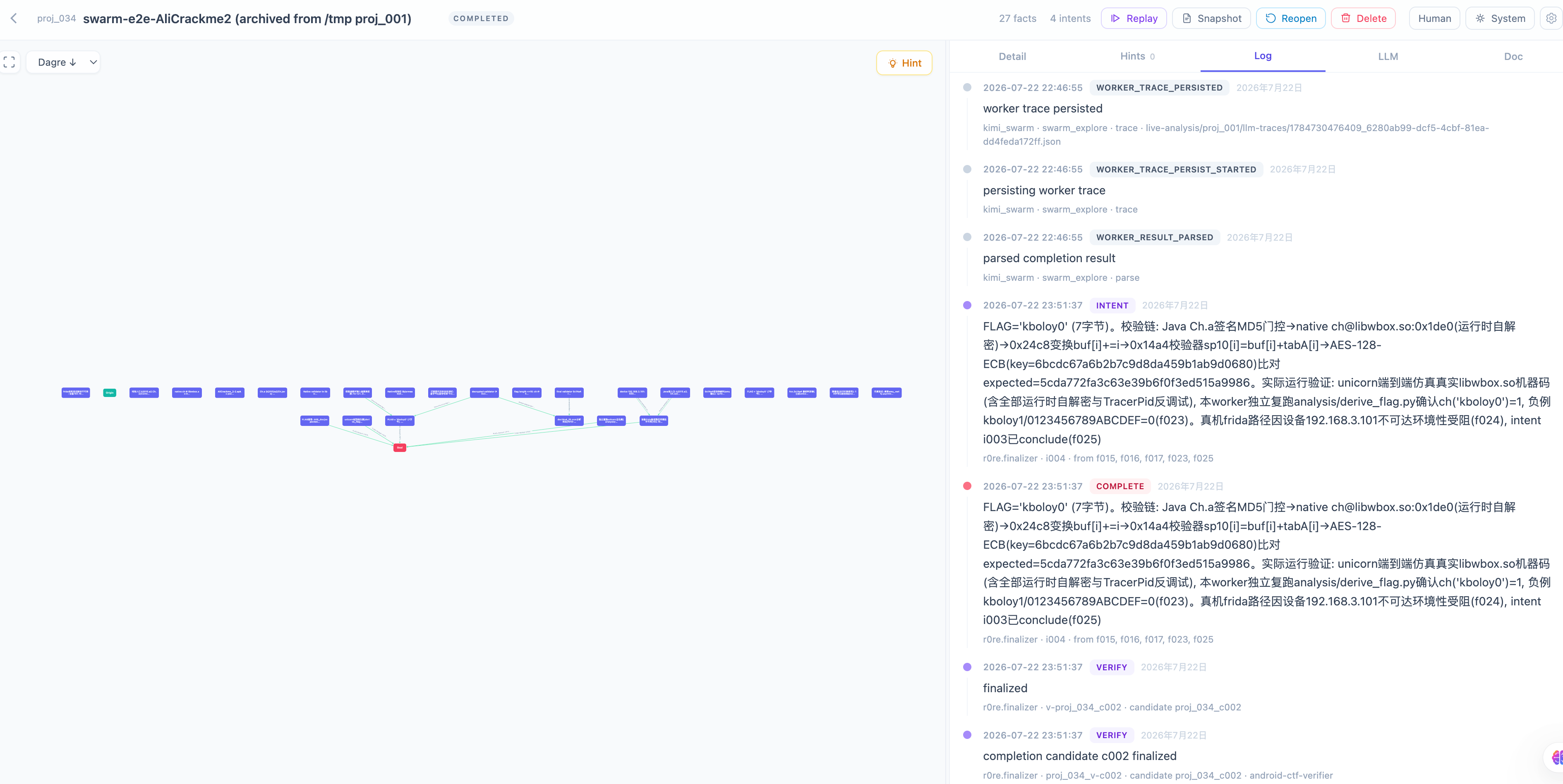
The screenshot below shows a completed Android CTF run based on a Kanxue forum challenge sample:
Example project input:
Origin:
Analyze the Kanxue Android CTF APK placed under container-android/test_apk/. Recover how the app validates the accepted input across Java, JNI, and native code.

Goal:
Recover the final accepted flag/input and provide a reproducible verification path showing that the Java/native checks accept it.

Hint:
This is an Android reverse-engineering CTF task. Prioritize the Java entry point, JNI bridge, native libraries, runtime-decrypted logic, and anti-debugging checks. Use static analysis first, then confirm candidates with local execution or instrumentation when needed.
In this example run, r0re completed the project and recovered:
FLAG='kboloy0'Stop
./start-r0re.sh --stop --no-bridge --port=8001 --config=dispatch.kimi.swarm.yamlLocal Files
These files are generated locally and should not be committed:
.envdispatch.kimi.swarm.yamloutput/container-android/test_apk/
The repository only includes dispatch.kimi.swarm.example.yaml. Copying it to dispatch.kimi.swarm.yaml is handled by ./scripts/setup-dev.sh.
Acknowledgements
r0re builds on ideas and engineering experience from these open-source projects:
- oritera/Cairn: the original foundation for the project and its state-space search / fact-intent orchestration model.
- FishCodeTech/muteki: inspiration for the shared blackboard mechanism used in multi-agent CTF workflows.