
Memdoor
Your daemon agents on every door.
A coding and automation agent in one CLI binary. No Docker or Python. Runs on this machine or over SSH on another. Clients: terminal, IDE, phone, script, CI, schedule. On your gateway. On your key.
A headless CLI with multi-agent harness




Five Qwen3.8-27B agents beat Fable 5 on LiveCodeBench Hard, as a Memdoor workflow. GVS5H's harness rebuilt with the authors' exact prompts and loop. The first ten problems of their list, five passes each: a mean of 9.8 of 10. The authors' own harness scored 9.6 and Fable 5 in a single call 8.0, the gap the authors measured on these ten (across their full 100: 92.4 and 90.4). All 50 runs are published: every request, reply, program and grader output. The workflow is YAML and names no model. Point it at yours, or at a local one with
memdoor connect local(Ollama, llama.cpp, vLLM, LM Studio; how to run it on an open-weight model, no key). examples/workflows/team-solve · the result page · the HN thread
On this machine:
curl -fsSL https://memdoor.ai/install.sh | bash
export OPENROUTER_API_KEY=sk-or-...    # or ANTHROPIC_API_KEY, OPENAI_API_KEY, GEMINI_API_KEY, …
# or no key: memdoor connect local    # an open-weight model on this machine — https://memdoor.ai/docs/open-weight
cd your-project && memdoor             # the first run sets the machine up
On a box reachable by ssh, nothing installed there:
curl -fsSL https://memdoor.ai/install.sh | bash          # here, once
memdoor --gateway ssh://you@box                           # installs memdoor on the box, starts its gateway, opens the window on it
memdoor --gateway ssh://you@box connect openrouter        # your key, kept on the box; every turn there runs on it
memdoor --gateway ssh://you@box run "fix the failing test" # the same box from a script or CI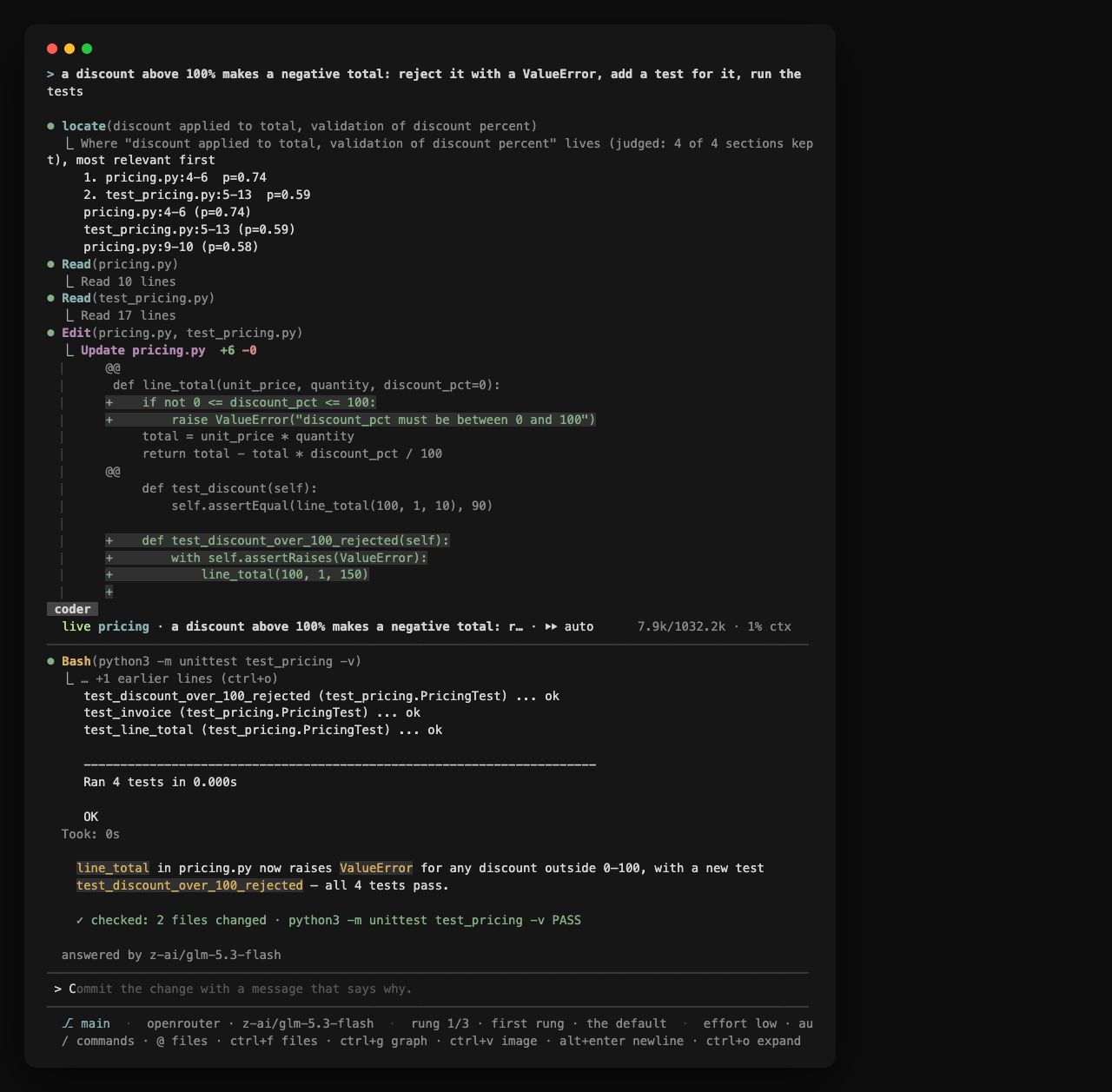
Decision model. Jev (TypeSafe) answers a typed question about a turn
with a calibrated probability in under half a second. Judged reads: search,
file and log reads return what counts. Per-turn toolbox: only the tools the
turn needs are sent. Stall detection: a turn that stops making progress ends.
44 paired runs, decisions off and on: 22 of 22 passed each way; a codebase
question 54,661 to 14,367 input tokens (−74%); an edit with a test and ten
one-file fixes read the same files either way (within ±11%)
(docs/features/DECIDE.md).
Workflows, the deterministic harness. Say the steps; the coder writes one
YAML per step. mario runs the graph.
Independent steps run in parallel. A step is done when its check passes. A
gate waits for approval with the diff. A failed run resumes at the failed
step. Started by hand, from CI or on local cron
(docs/features/WORKFLOWS.md). Workflows, not
skills: the write-up.
Examples, each run before it was added:
examples/workflows/. The nightly grade step,
examples/workflows/nightly-rule/steps/grade.yaml:
type: agent
prompt: |
  Today's partition is {{.partition}}.
  Read rules/{{.partition}}.md and grade today's trading rule: assess it
  briefly (clarity, risk profile, plausibility) and write a JSON object
  {"score": <0-100 integer>, "verdict": "<one sentence>"} into
  grades/{{.partition}}.json (create grades/ if needed).
requires:
  - table_pattern: build
target:
  # run by the engine, not by the agent: the grade must exist and be newer than step 1's start stamp
  command: test "grades/{{.partition}}.json" -nt "rules/{{.partition}}.start" && test -s "grades/{{.partition}}.json"
timeout: 10m
The review loop recorded (findings verified by running, a gate, the fixes applied): memdoor.ai/workflows.
In the window
| Command | What it does |
|---|---|
/model | The agent's ladder, cheapest rung first. Pin any model of your providers. List prices |
/connect | Add a provider: OpenRouter, Anthropic, OpenAI, Gemini, DeepSeek, Baseten, Groq, xAI, any OpenAI-compatible endpoint, a company AI gateway. /connect local: a runtime on this machine or the box (Ollama, llama.cpp, janis), no key. /connect chatgpt: a ChatGPT Plus/Pro plan, no key |
/workflow | The project's workflows and runs. Enter opens a run's graph, a approves a gate, /workflow:<name> runs one |
/usage | This month on your key, per model, and what the decision model kept out of the bill |
/remote | This conversation on your phone: a link and a QR code, the terminal itself, end-to-end encrypted |
/remote view | A watch-only link: live, no typing, no account, up to 200 viewers. ?live=1 is the terminal alone, for a stream or OBS |
/share | A read-only link to the conversation, encrypted, secrets removed. /unshare deletes it |
/files or ctrl+f | The project's files, the ones this conversation read or changed first, each with what happened to it. Enter previews, ctrl+d diffs, ctrl+e opens in $EDITOR, tab puts @path in the prompt |
/graph or ctrl+g | The turn as a graph: the reads, the edits that depended on them, the runs that depended on the edits, the failing check in red |
/mcp | MCP servers from a URL, a command or a .mcp.json snippet |
/help | The rest |
Esc interrupts. ctrl+o expands tool frames. Shift+Tab sets reasoning
effort. @path mentions a file. MEMDOOR_APPROVE=changes asks before every
command and write.
In your editor
memdoor acp serves the coder over the Agent Client
Protocol. Zed and JetBrains host it
natively. VS Code: an ACP client extension (for example "ACP Client") and one
setting:
"acp.agents": { "Memdoor": { "command": "memdoor", "args": ["acp"] } }A session is a conversation on the local gateway. A prompt is a turn in the editor's workspace folder. Text, tool calls and approvals show as the editor's own. Steps: memdoor.ai/docs/editor.
From a script
memdoor run "make the retry wait configurable and add a test"     # a headless turn, no window
git diff | memdoor run "review this diff; one line per finding"    # stdin is the input
memdoor run --json "fix the failing test" | jq 'select(.event=="done")'
memdoor workflow run release --wait                                 # progress on stderr, results on stdout
memdoor remote --last                                               # the link /remote gives, on stdout; the gateway holds the run for your phone
memdoor remote --view --last                                        # the watch-only link: an audience, or a pair of eyes
Exit code: 0 checked, 2 unverified or a failing check, 3 a question nobody
answered (--yes answers it), 1 an error, 130 interrupted. The gateway starts
if none is running. memdoor resume opens any run.
Headless, then attached.
In GitHub Actions
One step. Your key as the secret. Nothing added to the repo (Marketplace):
on: pull_request
jobs:
  review:
    runs-on: ubuntu-latest
    steps:
      - uses: actions/checkout@v5
      - uses: guregodevo/memdoor-action@v1
        with:
          workflow: pr-review
          openrouter-api-key: ${{ secrets.OPEN_ROUTER_API_KEY }}
Built in:
pr-triage: ready for review, needs work, or likely slop, from checks run in the job (the tests, claimed tests that are not there, functions nothing calls).pr-review: findings verified by running the code; the job fails only on a blocker.security-review: secrets, injection, path traversal, missing authorization.write-tests: tests for what the change touches; the job fails when one shows the change is wrong.pr-description: title, What, Why, How to test, Risk.explain-failure: a failed run's logs and the diff; the cause, file:line, the fix.issue-triage: labels, kind, summary, duplicates.fix-tests: finds the test command, fixes the code until the tests pass, leaves the fix in the working tree.release-notes: commits since the last tag as Added / Changed / Fixed.
local-model: Qwen3-8B-4bit in place of the key: the model runs inside the
runner (janis, one file, cached), one
call. On a free runner: an obvious and a subtle bug found in about a minute
each; a correct change can be flagged as a blocker. A first pass.
workflow: <name> runs yours from .memdoor/workflows/<name>/. Exit code:
0 done, 2 failed, 1 stopped, 3 stopped at an approval gate. The job summary
holds the review, the fix or the notes. Trigger on pull_request, never
pull_request_target: a fork's pull request gets no secrets.
Keys and models
A provider key in the environment (OPENROUTER_API_KEY, ANTHROPIC_API_KEY,
OPENAI_API_KEY, GEMINI_API_KEY, …) or memdoor connect. No key: the
first memdoor signs in with OpenRouter in the browser, from this machine,
over ssh or on a box. No credit: a free model, 50 requests a day; its hosts
train on what they are sent. For a trial, not private code.
Local: memdoor connect local connects a model on this machine
(janis, Ollama, llama.cpp, LM Studio).
Nothing leaves it. janis: one Go server, open models on a Mac's GPU through
MLX or an NVIDIA box through CUDA, serves chat and the decision model, no
key; Qwen3-Coder-30B-A3B on a $0.71-an-hour Google L4. On a box: memdoor --gateway ssh://you@box connect local. Peers: memdoor peers add box http://box:18789 --dir ~/app names the box; @box:coder … in any
conversation runs the turn there and returns the answer.
Where your data goes
Files, sessions and commands stay on your machine. What the model reads goes
to the provider. OpenRouter: every request carries data_collection: deny;
hosts that train on paid inputs are kept out of the ladders. Exception: a
:free model, pinned or answering for an account with no credit; its hosts
train on what they are sent, the request says so (allow), Memdoor warns at
the pin or at connect. Vendor key or company gateway: nothing else is
contacted. docs/SECURITY.md lists the hosts the binary
can name; a test fails the build on a new one.
Build from source
Go 1.25:
git clone https://github.com/guregodevo/memdoor && cd memdoor
make build                             # ./memdoor, stamped with the tag it was built from
cp memdoor ~/.local/bin/               # or anywhere on your PATH
Documentation
- Getting started
- Workflows · Scheduled checks · MCP servers
- Providers · Security · Decisions
- CLI reference · Architecture · Skills · ADRs
- The served docs: memdoor.ai/docs
Repository layout
cmd/cli/       the CLI (cobra): tui, model, workflow, cron, account, …
gateway/       the local gateway: agent runtime, tools, providers, workflows
pkg/           the domain: decision, metering, plan, workflow (the mario task factory), …
web/           the memdoor.ai site and the served docs (React, Vite)
scripts/       install.sh, install.ps1, deploy.sh
docs/          features, reference, ADRs
examples/      workflows built by the coder and run, to copy into a project
License
Apache License 2.0: LICENSE, NOTICE. Public repository: github.com/guregodevo/memdoor. Issues go there.