Awesome Agent Architecture
Learn how modern AI agents are built around the LLM.




The model reasons. The harness gives it action, state, and limits: it runs tools, keeps state across calls, gates side effects, and coordinates loops, none of which a model call does by itself.
This repo explains the harness section by section: loop, tools, memory, permissions, context, tasks, and interfaces. Learn it once and you can read many agents, since a coding tool, chat assistant, and autonomous runner mostly differ in harness choices.
Contents: Loop · Method · Systems · Sections · Structure · Running
The Agent Loop
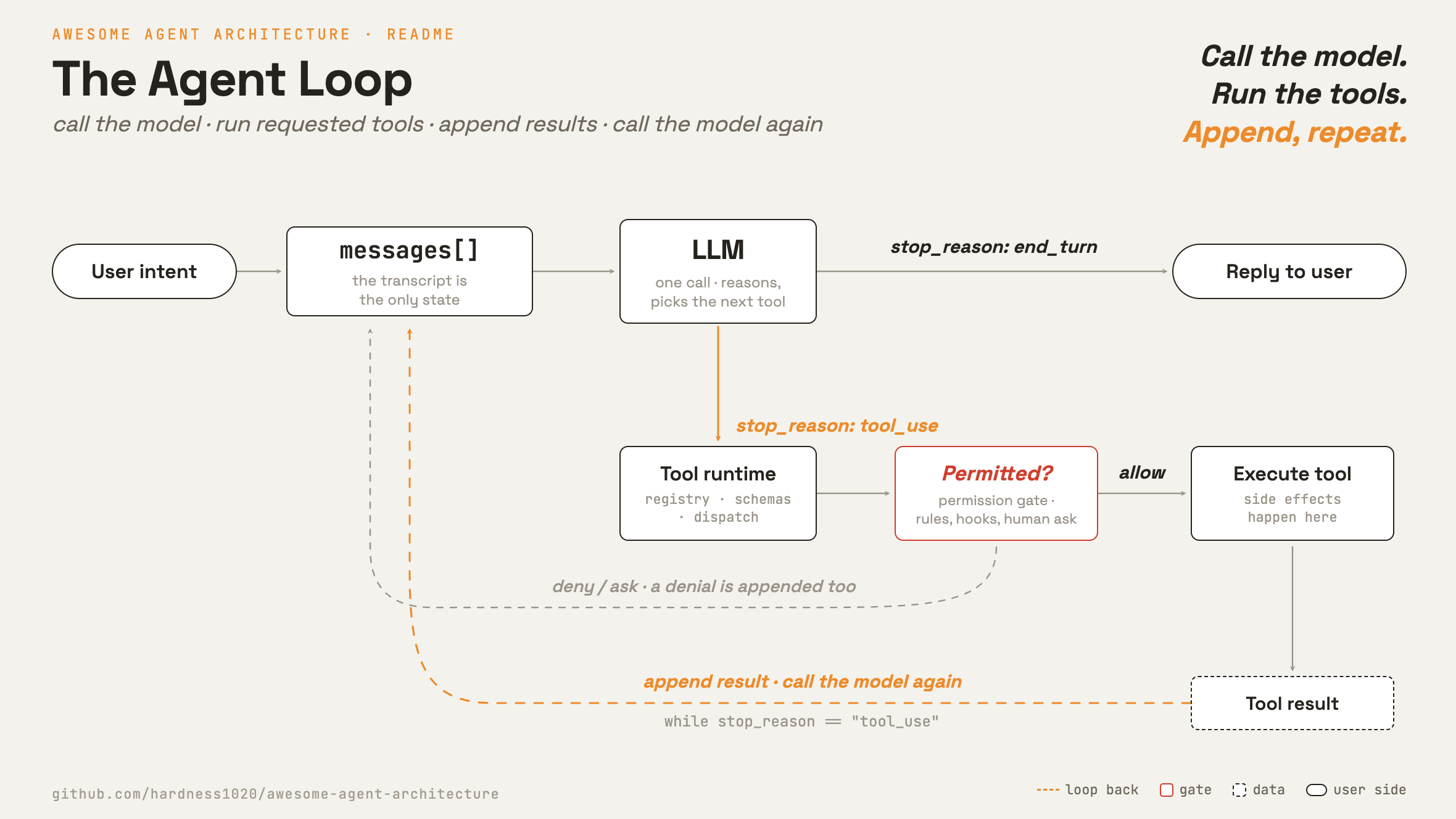
Most agents share the same control flow: call the model, run requested tools, append results, and call the model again.
The loop is small. Most engineering is around it: dispatch tools, gate side effects, manage context, persist state, and coordinate other loops.
How to learn
Every section is self-contained and uses the same four-part lens:
- Opening. What problem this layer solves.
- Mechanism. The general design and control flow.
- Per system. How real systems implement it.
- Failure modes. What breaks and how to mitigate it.
To learn from this repo:
- Read the sections in order. Each builds on the layer before it.
- For a runnable section, read
src/loop.py, then run itsdemo.py. - Diff a section's
src/against the section before it. The diff is the one mechanism that section adds.
Systems Under Study
Each system is a worked example for the sections below.
| System | Why people use it | Read it for | Sections | Version studied |
|---|---|---|---|---|
| Claude Code | Frontier coding agent: edits files, runs commands, ships changes in real repos. | The full harness, start here | 0 to 21 (all) | v2.1.88 |
| Hermes Agent | Long-term assistant: remembers you, learns workflows, runs anywhere. | Memory, skills, always-on channels | 7, 9, 14, 16, 19, 21 | v2026.7.1 |
| mini-swe-agent | Research baseline: one bash tool, about 150 lines. | The smallest complete loop, budgets, eval harness | 0 to 3, 8, 10, 11, 20, 21 | v2.4.5 |
| (more soon) |
More systems can be added later, including OpenClaw and aider.
Sections
Eight layers, from the basic loop to a harness that runs itself. Each row links to one self-contained writeup.
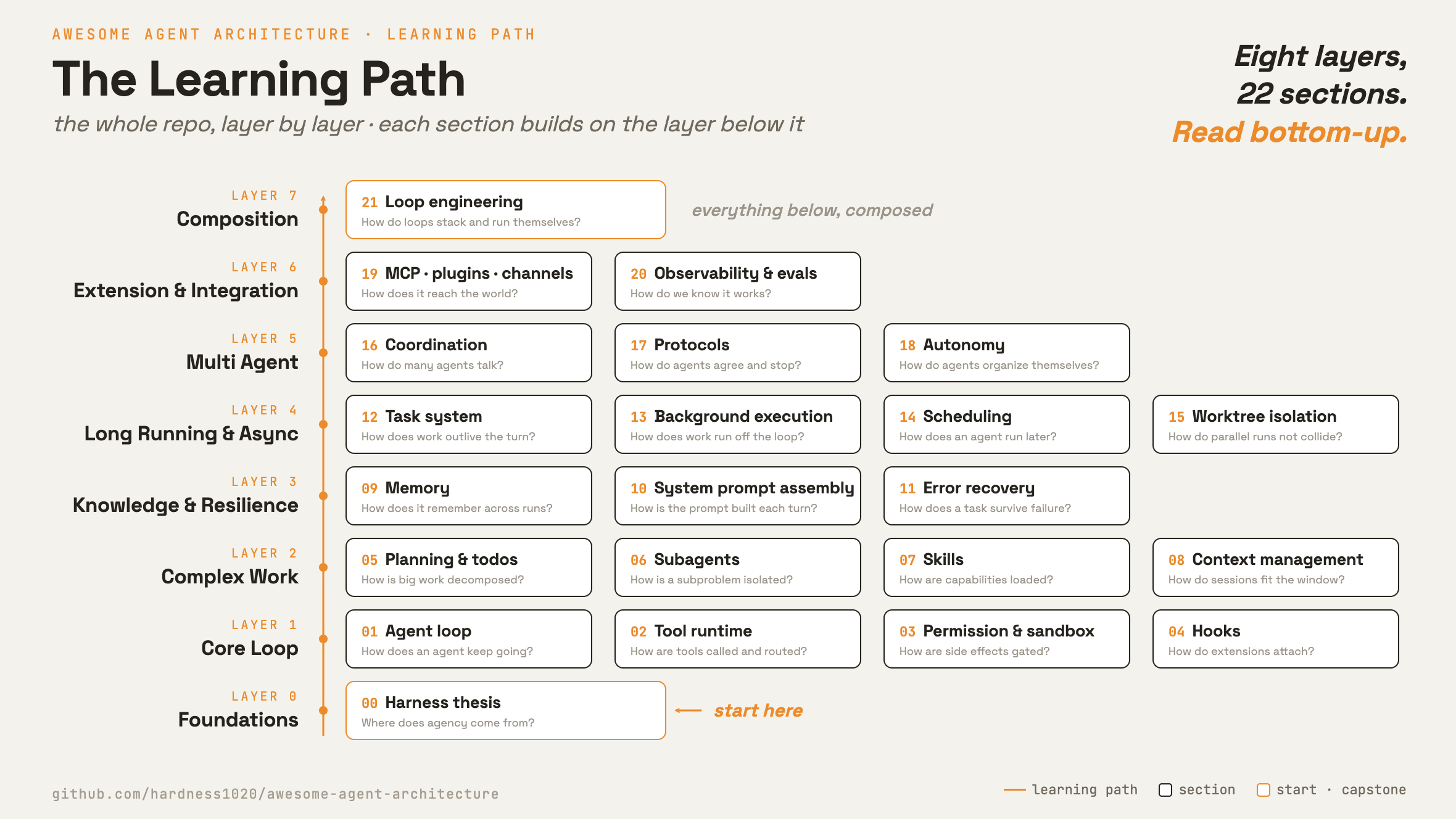
| # | Section | Question | Key mechanisms |
|---|---|---|---|
| Layer 0 · Foundations | |||
| 0 | Harness thesis | Where does agency come from? | Model vs harness, actions, observations, permissions |
| Layer 1 · Core Loop | |||
| 1 | Agent loop | How does an agent keep going? | messages[], loop, stop_reason |
| 2 | Tool runtime | How are tools called and routed? | Registry, schemas, dispatch, deferred search |
| 3 | Permission & sandbox | How are side effects gated? | Permission modes, approvals, sandboxing |
| 4 | Hooks | How do extensions attach to the loop? | PreToolUse, PostToolUse, lifecycle events |
| Layer 2 · Complex Work | |||
| 5 | Planning & todos | How is big work decomposed? | Plan mode, todo list, approval before edits |
| 6 | Subagents | How is a subproblem isolated? | Freshmessages[], delegation, child loop |
| 7 | Skills | How are capabilities loaded on demand? | SKILL.md, catalog, progressive disclosure |
| 8 | Context management | How do long sessions fit the window? | Budgeting, stubs, compaction, summaries |
| Layer 3 · Knowledge & Resilience | |||
| 9 | Memory | How does it remember across runs? | Selection, recall, extraction, consolidation |
| 10 | System prompt assembly | How is the prompt built each turn? | Prompt sections, live state, cache boundaries |
| 11 | Error recovery | How does a long task survive failure? | Retries, overflow recovery, fallback model |
| Layer 4 · Long Running & Async | |||
| 12 | Task system | How does work persist beyond a turn? | Task records, dependencies, locks |
| 13 | Background execution | How does work run off the main loop? | Handles, task state, notification queue |
| 14 | Scheduling | How does an agent run later? | Cron, sleep, remote triggers, queues |
| 15 | Worktree isolation | How does parallel work avoid collisions? | Git worktrees, cwd binding, safe cleanup |
| Layer 5 · Multi Agent | |||
| 16 | Coordination | How do many agents talk? | Inboxes, broadcasts, permission bubbling |
| 17 | Protocols | How do agents agree and stop cleanly? | Plan approval, shutdown handshakes |
| 18 | Autonomy | How do agents organize themselves? | Idle cycle, task claiming, self organization |
| Layer 6 · Extension & Integration | |||
| 19 | MCP / plugins / channels | How does the harness reach the world? | Transports, channels, tool pool assembly |
| 20 | Observability & evaluation | How do we know it works? | Tracing, metrics, evals, failure analysis |
| Layer 7 · Composition | |||
| 21 | Loop engineering | How do loops stack into a system that runs itself? | Verification loop, triggers, budgets, maturity levels |
Repository Structure
All 22 section writeups are present, from 00-harness-thesis/ through 21-loop-engineering/.
awesome-agent-architecture/
├── README.md                  # top-level map
├── sections/                  # one folder per section
│   ├── 00-harness-thesis/     # README.md per section
│   ├── 01-agent-loop/src/     # runnable chain starts here
│   ├── ...
│   └── 21-loop-engineering/
└── references/                # primary sources and prior art
Each section folder is NN-name/ and contains a README.md.
Sections 1 to 21 also carry a runnable src/. The code accumulates section by section.
Each section adds one mechanism and evolves loop.py, so a diff between adjacent sections shows what changed.
Running the Demos
Sections 1 to 21 ship runnable demos. Set up once from the repo root:
uv venv
uv pip install -r requirements.txt
cp .env.example .env        # then add your ANTHROPIC_API_KEY
Pinned dependencies are in requirements.txt. .env is gitignored and holds:
ANTHROPIC_API_KEY- optional
ANTHROPIC_MODEL - optional
ANTHROPIC_BASE_URL
Each runnable section has:
test.py: offline checks, no key needed.demo.py: live demo against the API.
python sections/01-agent-loop/src/test.py         # offline
uv run python sections/01-agent-loop/src/demo.py  # live
Contributing
- Add a system. Slot a new agent into the same section structure.
- Deepen a section. Add a mechanism, clearer diagram, or sharper failure mode.
- Correct the record. These are reconstructions from source, docs, and behavior. Sourced corrections are welcome.
Favor named, verifiable mechanisms over speculation. Cite sources. See CONTRIBUTING.md for the full PR checklist.
References
- claude-code: Claude Code source backup used for mechanism names and implementation paths.
- hermes-agent: Open-source agent harness (MIT) used as the second system under study.
- mini-swe-agent: Minimal SWE agent (MIT) used as the third system under study.
- learn-claude-code: Code-first harness reconstruction and section framing.
- Anthropic Agent Skills best practices: Progressive disclosure levels for skills.
- Anthropic prompt caching: Cache breakpoints, TTLs, pricing, and token minimums.
- cobusgreyling/loop-engineering: Loop building blocks and readiness levels.
- LangChain · The art of loop engineering: The four stacked loops.
- Addy Osmani · Loop engineering: Composed building blocks for agent loops.
- MindStudio · What is loop engineering: Goal conditions for autonomous workflows.
- Lilian Weng · Harness engineering for self-improvement: The improvement loop, with gates outside the loop.