





Hire Google's Antigravity CLI (agy) as a staffer for Claude Code, OpenAI Codex, and Pi.
Install · Examples · Core design · Upgrade
What & Why
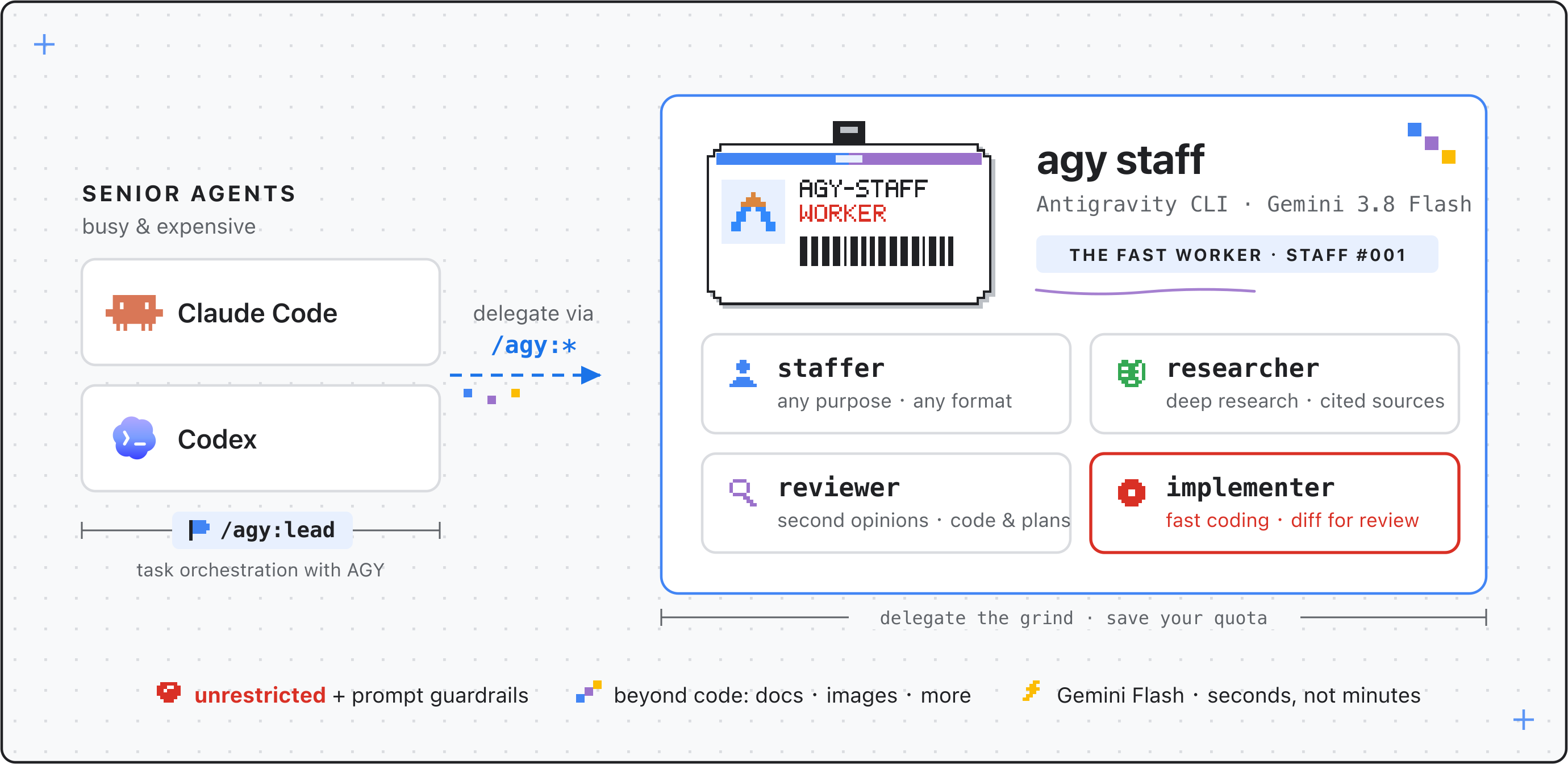
agy-staff lets your senior agents delegate to agy, which ships fast Gemini 3.8 Flash. Five personas: staffer (general-purpose), researcher, reviewer (code and plans/decisions), implementer, and ask — plus a model-facing jobs skill. Claude Code uses /agy:<persona> and Codex uses $agy:<persona>.
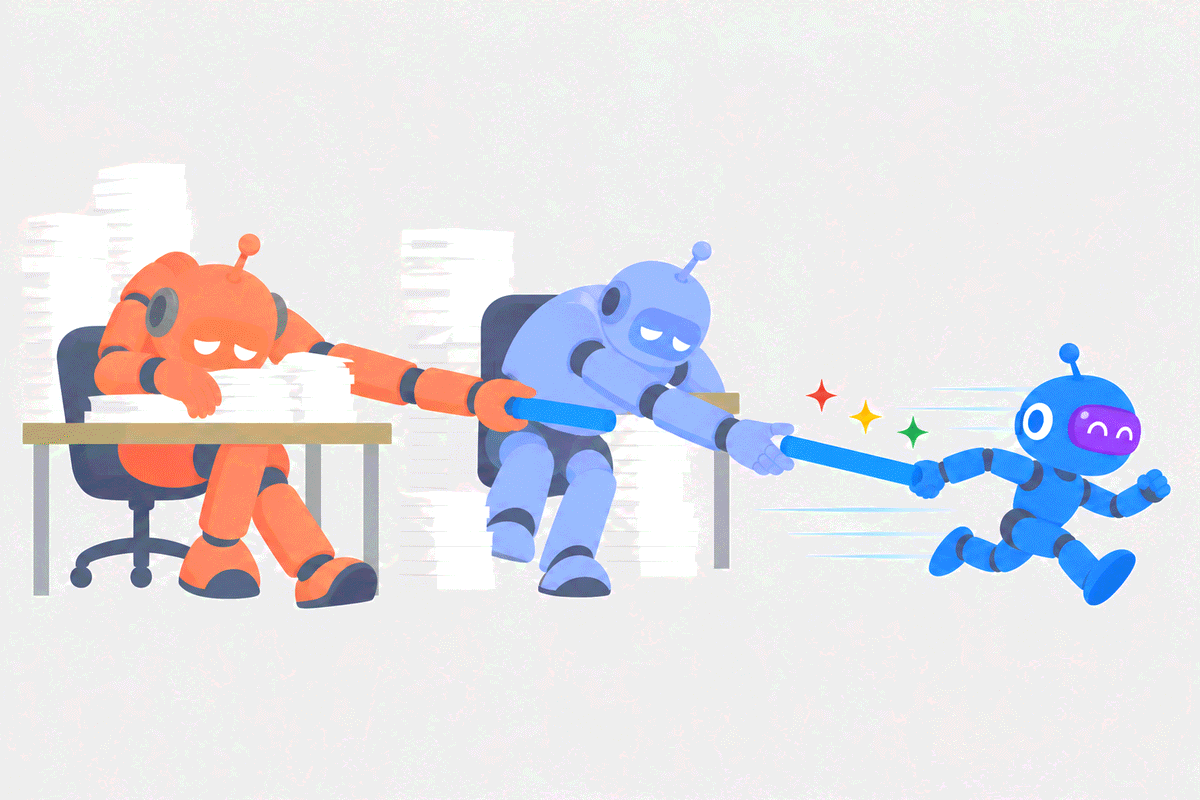
If you use Codex you know the feeling: GPT-5.6-Sol is slow even with fast mode on. Claude Code is quicker but still not fast, and Fable quota is scarce enough that you want it orchestrating subagents, not grinding through every survey and review itself. An agy worker gives you a fast lane — second opinions in seconds, research and reviews at Flash speed, scoped implementation handled off to the side while you keep moving. And where speed isn't the point, a second model family looking at the same code buys coverage and robustness your main agent can't give itself.
How
Invoke a persona
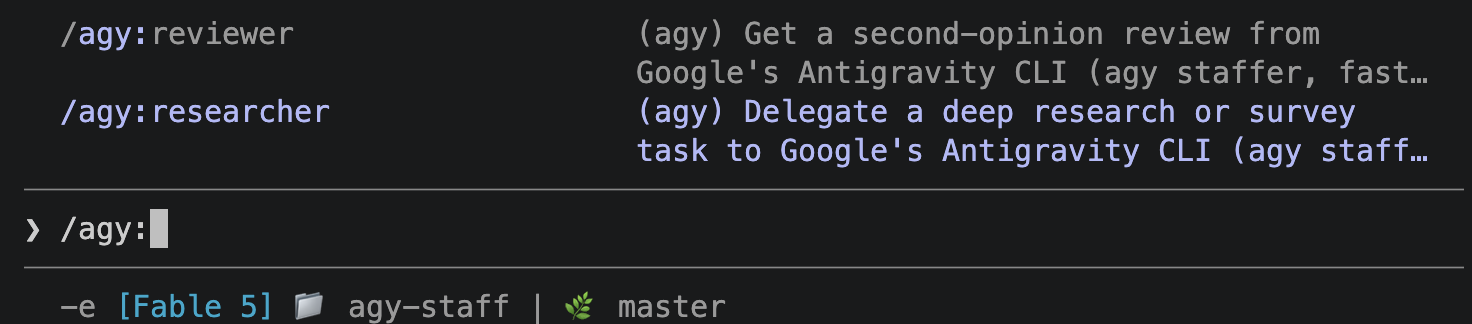
Type /agy: in Claude Code and the five personas are right there:
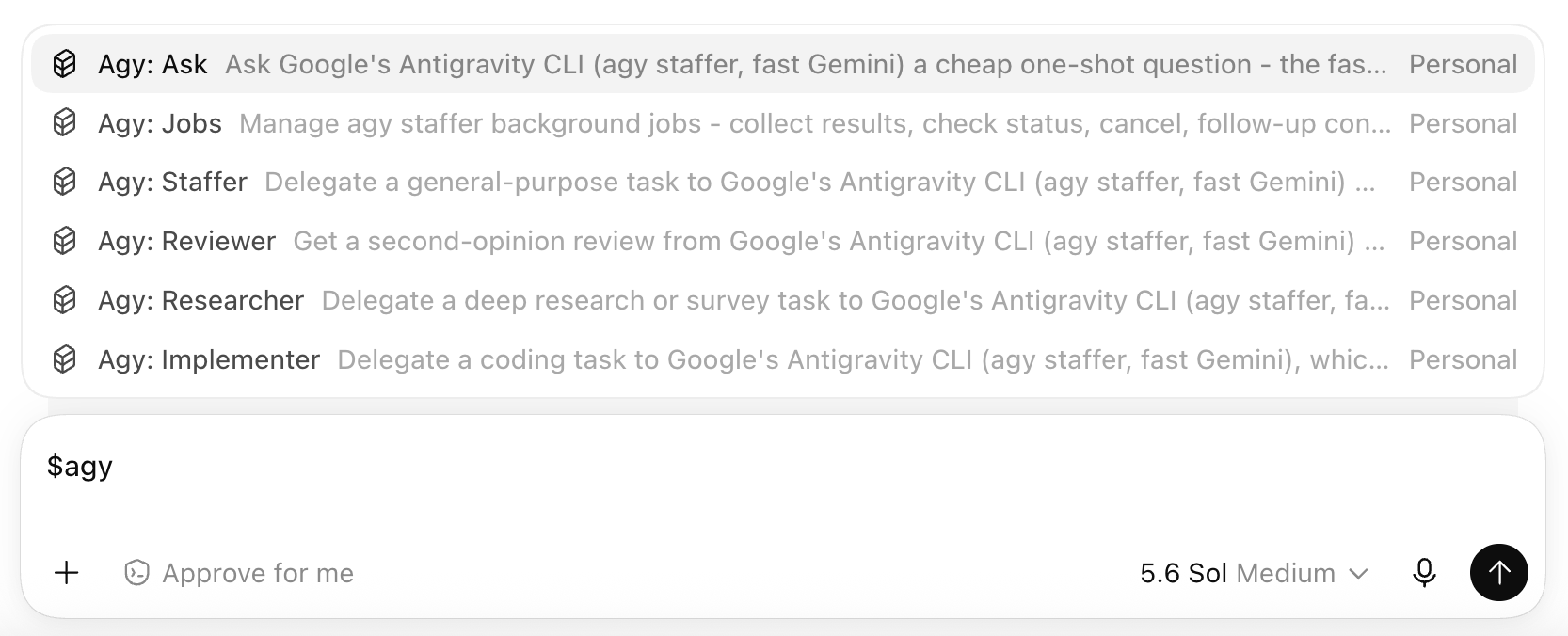
Same plugin in Codex, invoked with $agy:
Install
For humans
Step 1 — install the Antigravity CLI (official docs), then verify with agy --version. Node.js is also required:
curl -fsSL https://antigravity.google/cli/install.sh | bashStep 2 — install the plugin into your harness:
claude plugin marketplace add keli-wen/agy-staff
claude plugin install agy@agy-staff
codex plugin marketplace add https://github.com/keli-wen/agy-staff
codex plugin add agy@agy-staffUsing Pi?
Install: pi install git:github.com/keli-wen/agy-staff.
Skills are prefixed as /skill:agy-<persona> (e.g. /skill:agy-ask reply with OK), with /skill:agy-jobs for job management.
Update with pi update --extension git:github.com/keli-wen/agy-staff, then run /reload.
Restart Claude Code or Codex afterwards. First run: /agy:ask reply with OK (Claude Code) or $agy:ask reply with OK (Codex). Ask is tool-free and needs no setup.
[!IMPORTANT] There is no mandatory setup step.
staffer,researcher,reviewerandimplementerrun unrestricted by default: agy can inspect the repo, run commands, and edit files. agy-staff keeps that practical with prompts that adapt to the current repo state. For example, whenimplementerstarts in a dirty workspace, the companion tells agy which files already had changes and reminds it not to overwrite or deliver unrelated user work. If the task asks for a commit, push, or PR, agy can do that delivery; otherwise it leaves a working-tree diff for review. These prompt instructions do not provide permission isolation.setup+--restrictedis optional hardening for untrusted input — per run (--restricted) or as a per-repo default (setup --restrict review,research).setupdry-runs and asks before writing anything ("set up agy" triggers it); read the permission notes first — the allowlist is prefix-matched, applies machine-wide, and a restricted run can return less than an unrestricted one.
For agents
Paste this into any coding agent:
Read the raw text of https://raw.githubusercontent.com/keli-wen/agy-staff/master/docs/INSTALL_FOR_AGENTS.md (curl it — do not
work from a summary) and follow it to install and verify the agy-staff plugin for the harness you are running in.
Respond in the user's language.
Upgrade
Claude Code and Codex install a copy, so a new version only reaches you when you pull it in yourself:
claude plugin marketplace update agy-staff && claude plugin update agy@agy-staffcodex plugin marketplace upgrade && codex plugin add agy@agy-staff # then restart CodexClaude Code and Codex cache per version directory, so an upgrade lands only if the plugin version changed; restart the harness afterwards. If a fix does not show up, see upgrading — it has the force-refresh command.
CUJs
Examples below use Claude Code's /agy:…; in Codex use $agy:….
| Use case | Invocation |
|---|---|
| Lead an ongoing task | /agy:lead investigate the options, draft a proposal, and revise it with my feedback |
| Quick second opinion | /agy:ask what's your backend model |
| A general task | /agy:staffer summarize the open TODOs in this repo |
| Generate an image | /agy:staffer generate a pixel-art robot mascot, save it as assets/mascot.png |
| Review the working tree | /agy:reviewer Review the current working tree |
| Review a PR | /agy:reviewer Review PR #730 |
| Review a plan or decision | /agy:reviewer Challenge the migration plan in docs/plan.md |
| Survey a topic | /agy:researcher how does auth work in this repo |
| Implement a scoped fix | /agy:implementer fix the flaky retry test |
| Job ops (wait/status/cancel/continue) | natural language: "is the agy job done?", "continue: also check the error path" |
reviewer is fully prompt-based: you describe the subject and agy gathers the evidence itself (gh pr view, git diff, reading the file) — there is no flag for handing it a diff. It has two flavors, routed by subject: code review (severity-ranked findings) and general review (a multi-angle challenge of a plan, design, or decision).
staffer also covers agy's native tools without a dedicated specialist persona, including image generation (generate_image). A trial on agy v1.1.15 produced a 1024×1024 PNG in about 30 seconds; actual time depends on the task and environment.
Core design
lead adds task orchestration guidance for your current agent. Within lead, orient enough to frame the assignment, delegate substantive work to staffer by default, wait for the result, then assess it and integrate or follow up. Specialists provide dedicated guidance when useful, while ask is reserved for testing. The host owns cross-task decisions, acceptance, integration, and delivery, using the existing jobs workflow. Invoke /agy:lead in Claude Code, $agy:lead in Codex, or /skill:agy-lead in Pi.
ask answers in the same call. The other personas return a job id and a collection command, such as wait <id> --timeout 10m. Your agent waits using the host's available capabilities, with one independent background wait per job where supported.
The main agent waits for the final result by default. If you explicitly ask about progress, it can use observe to read a snapshot of recent tool activity and response text; it does not query progress for routine updates. Once the task finishes, wait or result delivers the full report. Expiring a wait leaves the worker running.
The timeline below follows a background task from delegation to completion. The host agent waits for the final result by default (or advances already-identified independent work), checks progress when asked, and collects the report.
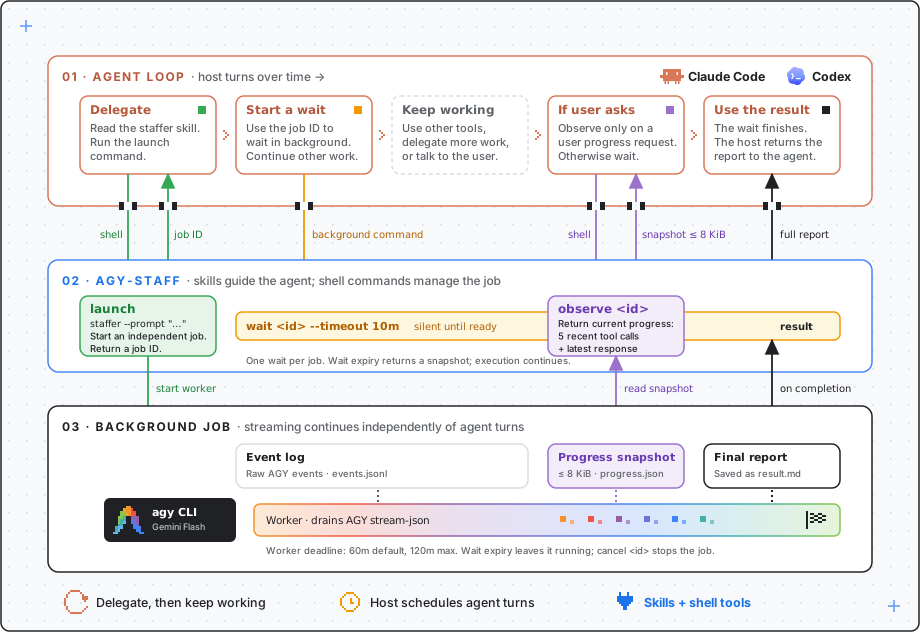
Jobs have a separate execution deadline: default 60 minutes, configurable at launch with --timeout up to 120 minutes. Use cancel to stop execution, or explicitly request continue or restart after inspecting the existing work. The host harness controls when your agent receives a background result.
Full reference → docs/REFERENCE.md (flags, permission model, jobs/state, troubleshooting, upgrading). Release notes → docs/releases/.
Community
- LINUX DO — A next-generation Linux community.
Contributing
Contributions are welcome — issues, bug reports and pull requests all help.
A few things worth knowing before you open a PR:
- Run the tests:
npm test. The standard suite uses temporary repos and HOME directories with fakeagy, plus focused module tests. Keep regression tests offline and independent of personal settings. Real AGY validation is a separate opt-in suite described in tests/README.md. - Docs come in pairs:
README.md/README.zh-CN.mdanddocs/REFERENCE.md/docs/REFERENCE.zh-CN.mdare kept in sync. Change one, change its counterpart. - Runtime code lives in
companion/: the entrypoint handles modes and job commands; separate modules handle streaming execution, observations and state locking. Skills call the companion, andtemplates/holds the shared prompts. - Canonical skills are the source of truth: edit personas in
skills/, never inpi-skills/. Runnpm run generate:pito generate Pi entrypoints, andnpm run check:pito verify consistency.
Adding a mode or a flag changes the public surface, so please open an issue first and we can agree on the shape.
License
MIT — see LICENSE.