Which Programming Language Is Best for AI Coding Agents?
A quantitative benchmark comparing how efficiently Claude Code generates code across 13 programming languages.
For a detailed discussion, see the blog post: Which Programming Language Is Best for Claude Code? / 日本語版
TL;DR
At least for prototyping-scale tasks, Ruby, Python, and JavaScript (not TypeScript) appear to be the best fit for Claude Code — fastest, cheapest, and most stable.
Motivation
"Static typing prevents AI hallucination bugs!" vs. "Dynamic typing saves tokens!" — qualitative arguments abound, but quantitative data is scarce. This experiment aims to fill that gap.
Experiment
We asked Claude Code (Opus 4.6) to implement a mini-git — a simplified version of Git — in various programming languages, and measured the time, cost, and lines of code for each.
The task is split into two phases:
- v1 (New project): Implement
init,add,commit, andlog. - v2 (Feature extension): Add
status,diff,checkout,reset,rm, andshow.
The prompt is simply: "Read SPEC-v1.txt, implement it, and make sure test-v1.sh passes." v2 is analogous.
Languages
| Category | Languages |
|---|---|
| Dynamic | Python, Ruby, JavaScript, Perl, Lua |
| Dynamic + type checker | Python/mypy, Ruby/Steep |
| Static | TypeScript, Go, Rust, C, Java |
| Functional | Scheme (dynamic), OCaml (static), Haskell (static) |
Python/mypy writes fully type-annotated Python verified with mypy --strict. Ruby/Steep writes RBS type signatures verified with steep check. These allow direct comparison of type-checking overhead within the same language.
Each language was run 20 times. A custom hash algorithm (not SHA-256) is used to avoid library-dependent variation.
Results
| Language | Tests passed (v1+v2) | Time (v1+v2) | Avg. cost | LOC (v2) |
|---|---|---|---|---|
| Ruby | 40/40 | 73.1s ± 4.2s | $0.36 | 219 |
| Python | 40/40 | 74.6s ± 4.5s | $0.38 | 235 |
| JavaScript | 40/40 | 81.1s ± 5.0s | $0.39 | 248 |
| Go | 40/40 | 101.6s ± 37.0s | $0.50 | 324 |
| Rust | 38/40 | 113.7s ± 54.8s | $0.54 | 303 |
| Java | 40/40 | 115.4s ± 34.4s | $0.50 | 303 |
| Python/mypy | 40/40 | 125.3s ± 19.0s | $0.57 | 326 |
| OCaml | 40/40 | 128.1s ± 28.9s | $0.58 | 216 |
| Perl | 40/40 | 130.2s ± 44.2s | $0.55 | 315 |
| Scheme | 40/40 | 130.6s ± 39.9s | $0.60 | 310 |
| TypeScript | 40/40 | 133.0s ± 29.4s | $0.62 | 310 |
| Lua | 40/40 | 143.6s ± 43.0s | $0.58 | 398 |
| C | 40/40 | 155.8s ± 40.9s | $0.74 | 517 |
| Haskell | 39/40 | 174.0s ± 44.2s | $0.74 | 224 |
| Ruby/Steep | 40/40 | 186.6s ± 69.7s | $0.84 | 304 |
Out of 600 runs (15 configurations × 2 phases × 20 trials), only 3 failed: Rust (2) and Haskell (1).
Total Time and Cost (v1 + v2)
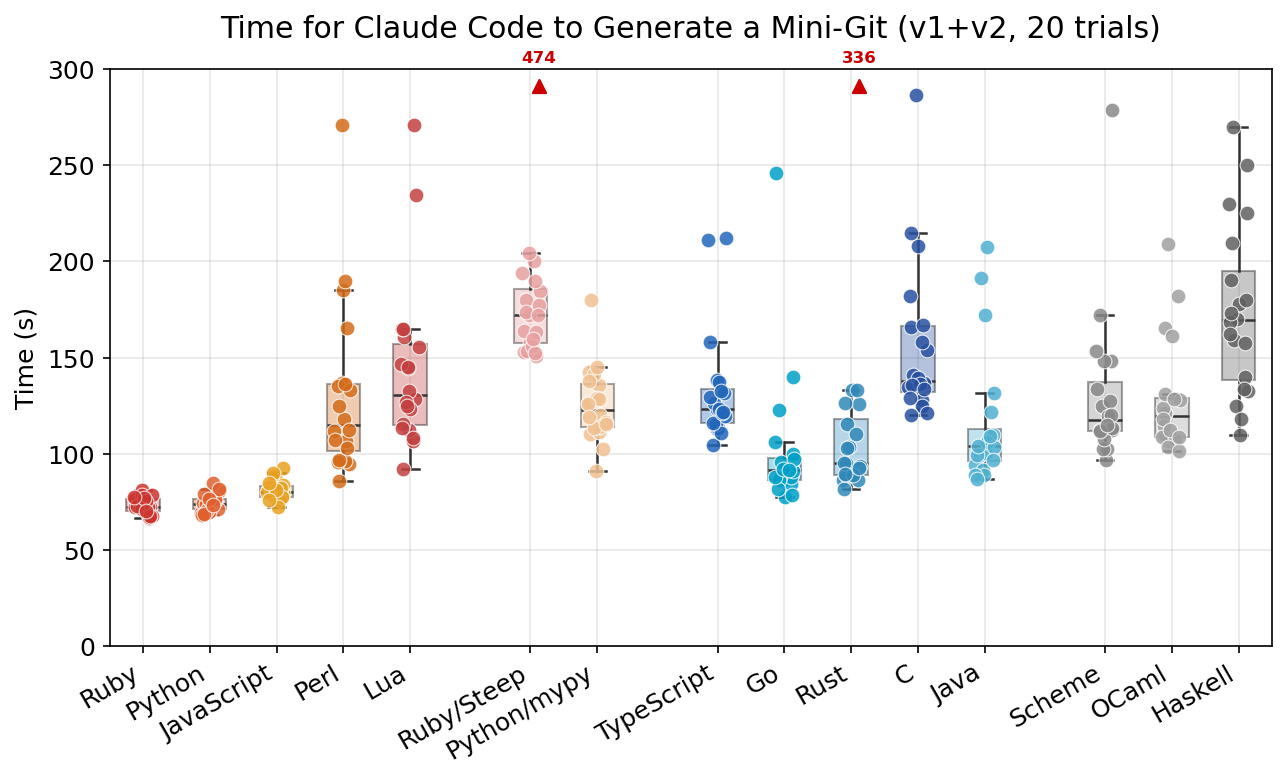
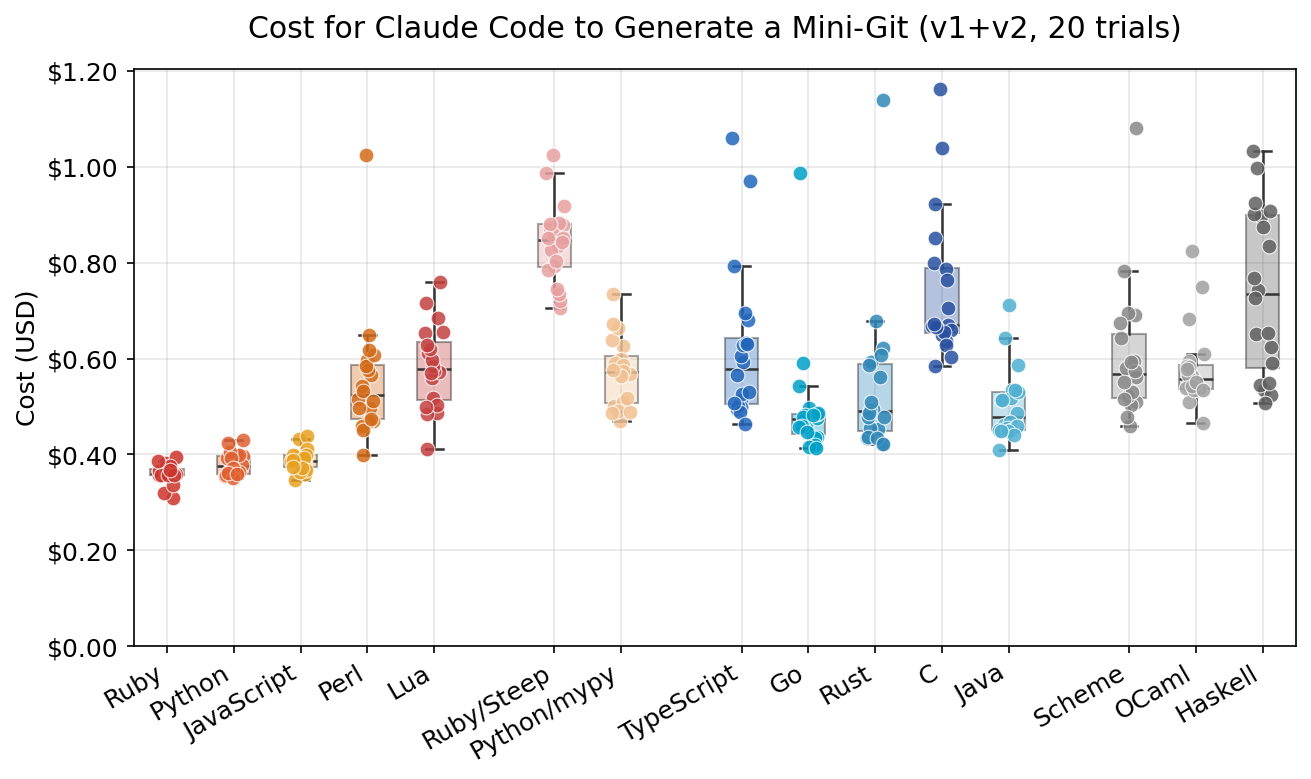
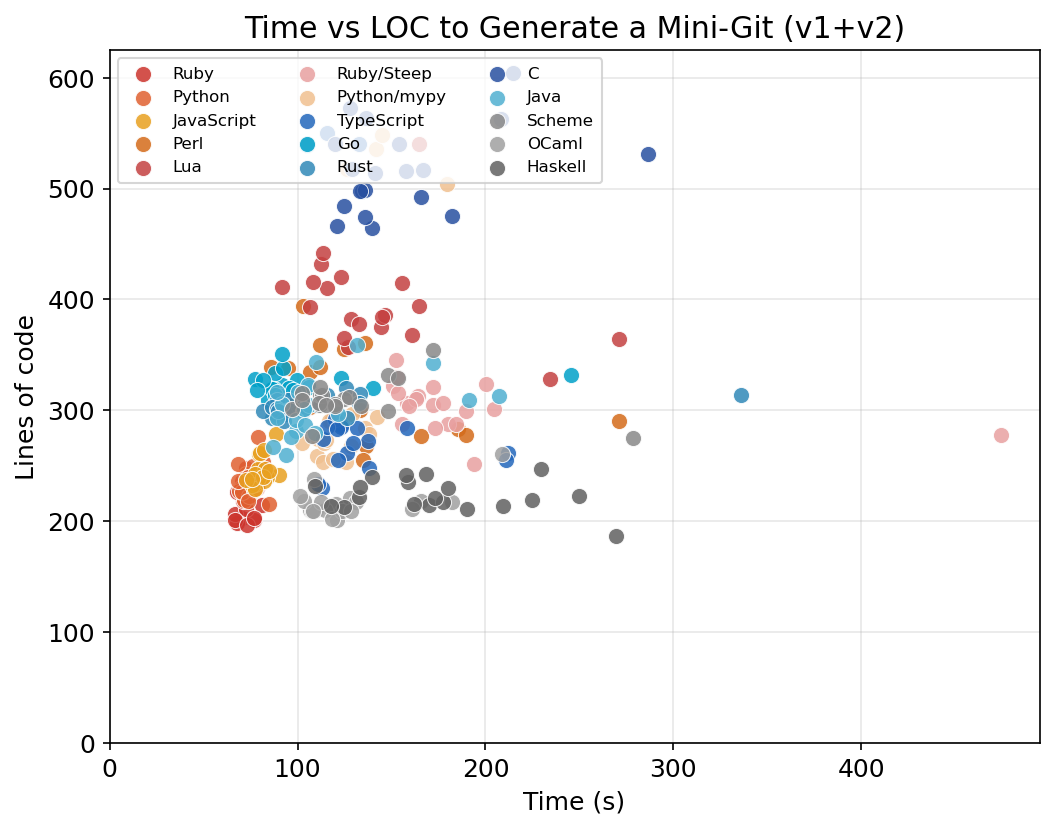
Ruby, Python, and JavaScript are the top 3 — fast (73–81s), cheap ($0.36–0.39), and stable (low stddev). From 4th place onward, variance increases sharply.
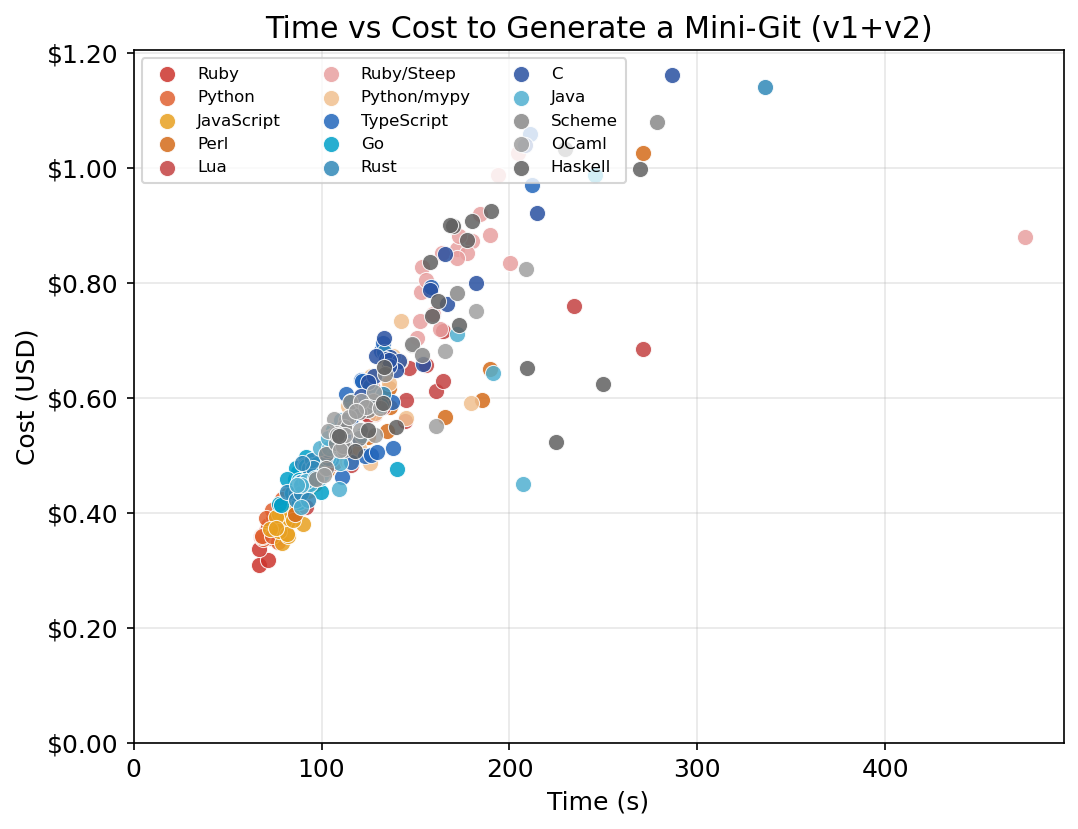
Time and cost are strongly correlated:
Lines of Code (v2)
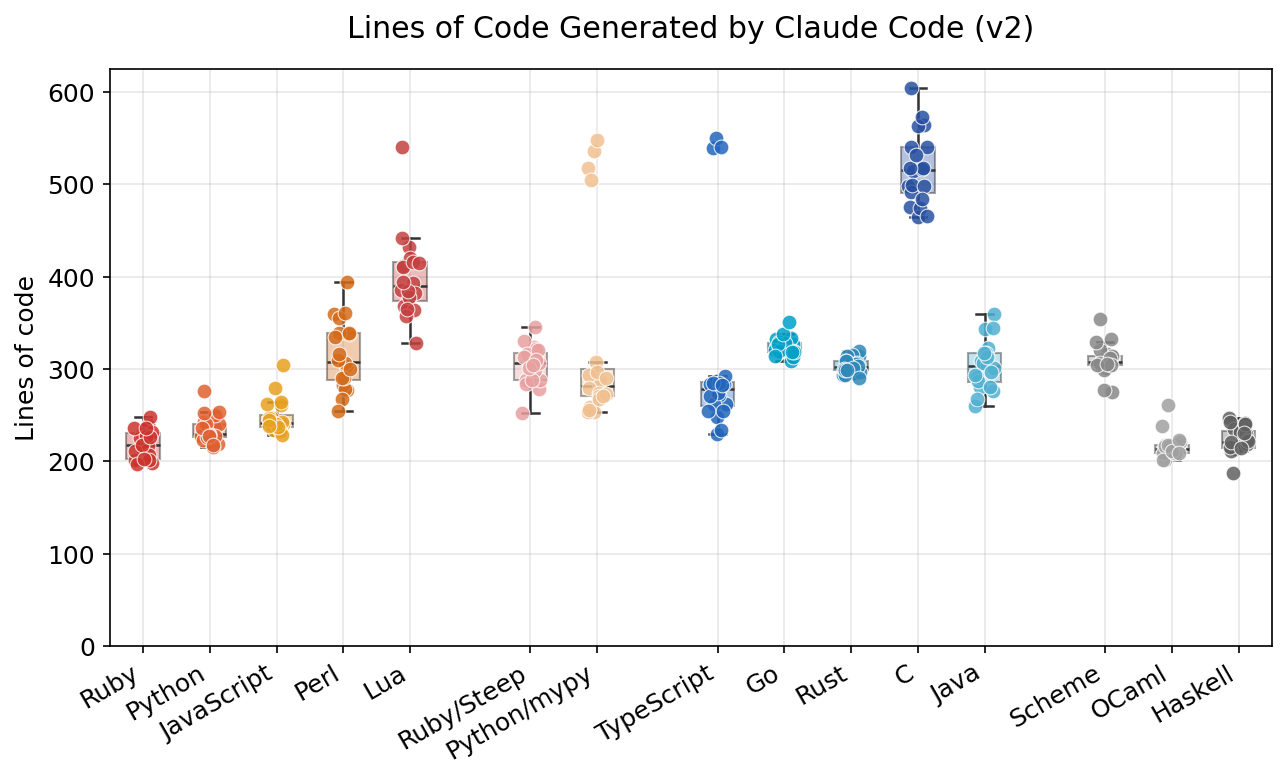
OCaml (216), Ruby (219), and Haskell (224) are the most compact. C stands out at 517 lines. Notably, fewer LOC does not imply faster/cheaper generation — OCaml and Haskell are compact but mid-to-low in speed.
v1 (New Project)
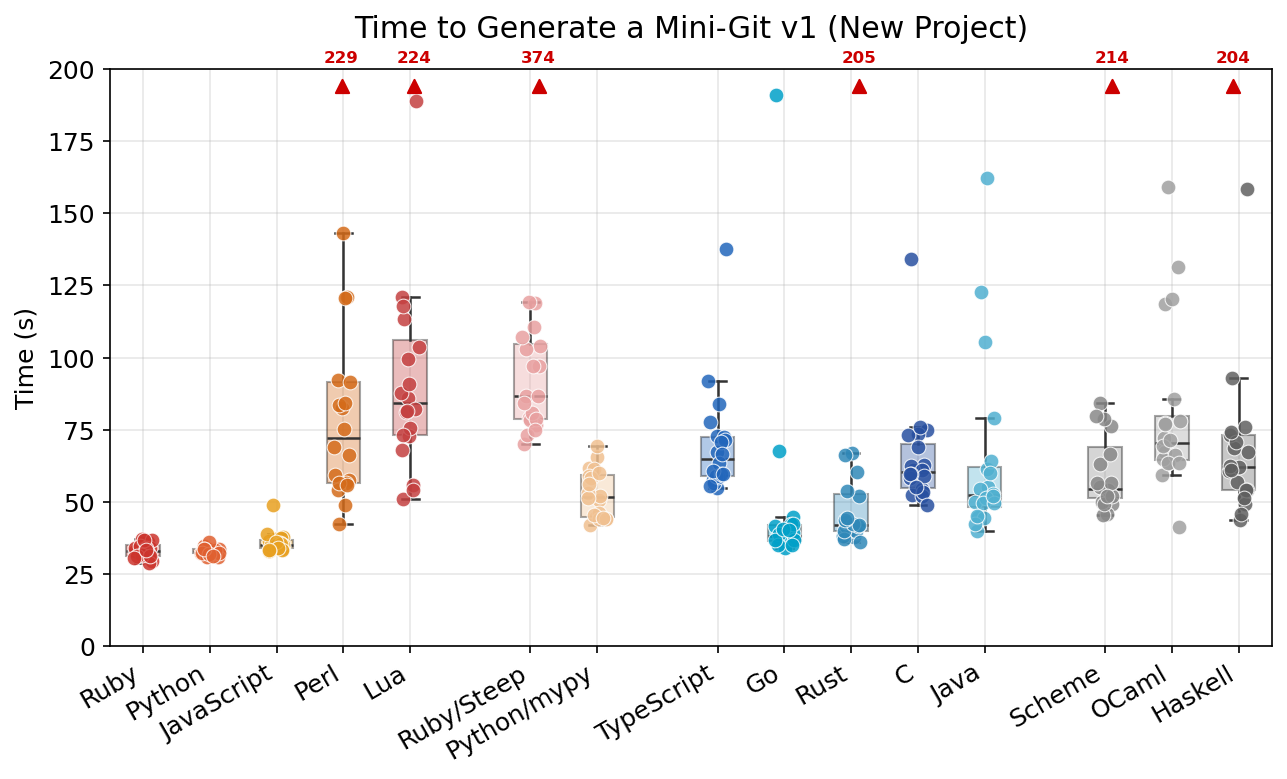
Python (32.9s) and Ruby (33.2s) lead, followed by JavaScript (36.0s). Ruby/Steep takes 105.0s — 3.2× slower than plain Ruby. v1 starts from an empty directory, so languages requiring project config files (Cargo.toml, package.json, etc.) incur additional overhead.
v2 (Feature Extension)
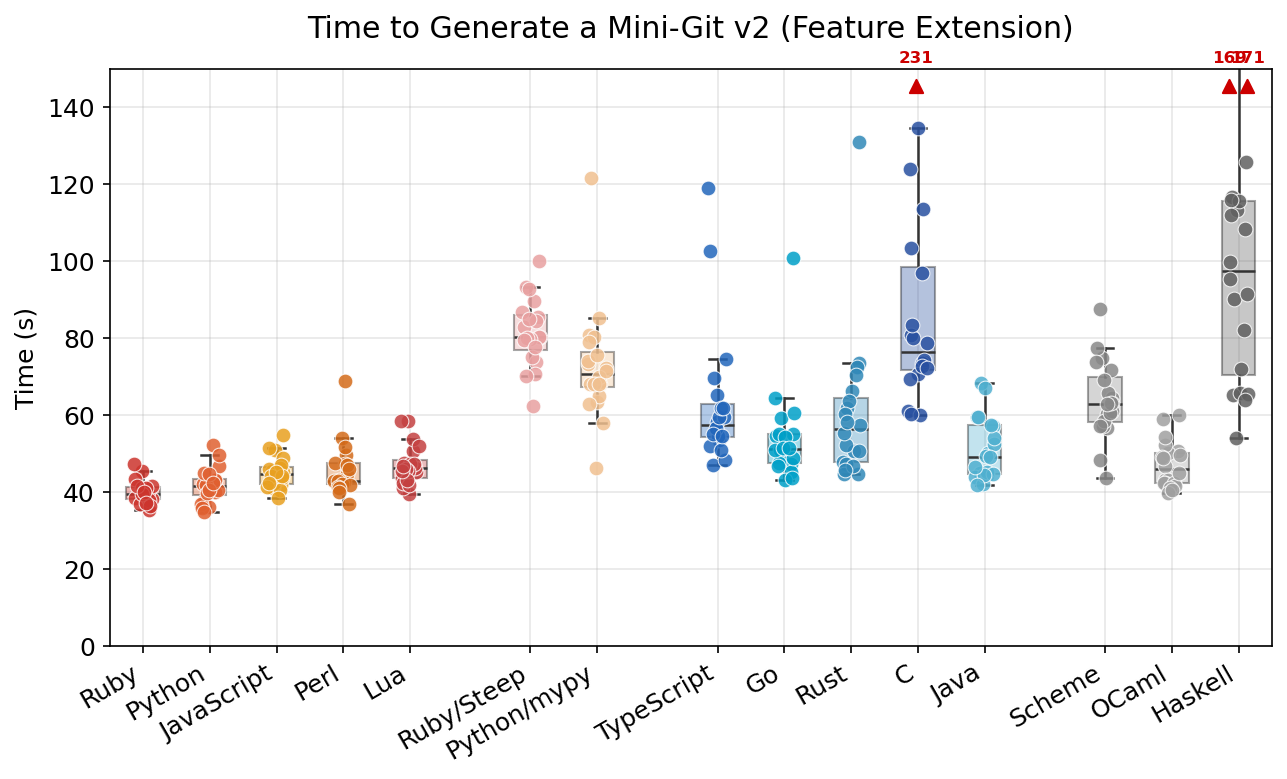
The gap narrows in v2. The top 3 remain Ruby (40.0s), Python (41.8s), JavaScript (45.1s). Perl (45.7s), OCaml (47.1s), and Lua (47.2s) follow closely. Haskell is the slowest at 99.6s despite having the fewest LOC.
Type-checker overhead: Python/mypy is 1.6–1.7× slower than Python; Ruby/Steep is 2.0–3.2× slower than Ruby.
Discussion
The author is a Ruby committer, so take interpretations with a grain of salt. Data and code are available in this repository — verify for yourself if you're skeptical.
What causes the speed/cost differences?
No single factor explains the results. Likely contributors:
- Type system: In this benchmark, dynamic languages are consistently faster and more stable.
- Conciseness: Shorter code generally means faster generation, but OCaml/Haskell are compact yet slow (high thinking-token usage).
- Procedural vs. functional: Excluding the top 3, there isn't a large gap between procedural and functional languages. OCaml notably achieved 47.1s in v2, rivaling JavaScript.
- Language difficulty: C's memory management, Rust's ownership model, and Haskell's monads/purity may add overhead for the AI.
- AI familiarity: Python/Ruby/JavaScript likely have more training data available. Ruby/Steep's larger overhead vs. Python/mypy may reflect lower AI familiarity with Steep.
Does lack of types mean more bugs?
Possibly — tests pass, but untested paths may have type errors. That said, the only failures in 600 runs were in Rust and Haskell (both statically typed, both relatively "difficult" languages).
Does a 2× difference matter?
Personally, yes. In iterative development ("prompt → wait → think → prompt"), I find the difference between 30s and 60s significantly impacts flow and focus.
Isn't this too small-scale?
Yes — static typing may shine at larger scales. A fair large-scale cross-language benchmark would be valuable. Contributions welcome.
What about ecosystems and runtime performance?
For real projects, framework availability matters — and if runtime speed is essential, a compiled language may be the better choice. This benchmark intentionally avoids external libraries to isolate language-level differences (using a custom hash instead of SHA-256).
Reproducing
ruby benchmark.rb                           # Run all languages × 3 trials
ruby benchmark.rb --lang python --trials 1  # Single language quick test
ruby report.rb                              # Generate results/report.md
python3 plot.py                             # Generate figures/*.png
Requirements: Ruby, Claude Code CLI (claude), and the target language toolchains.
Repository Structure
mainbranch: Benchmark tools, specs, tests, results, and figuresdatabranch (orphan): Generated source code and Claude JSON logs for verification
Summary
At least for prototyping-scale tasks, Ruby, Python, and JavaScript (not TypeScript) appear to be the best fit for Claude Code.
Static typing may become advantageous at larger scales — someone should test this.
The classic strategy — start with a dynamic language, then migrate to a static one as the project matures — may still be the right call. Coding agents seem very capable at cross-language migration (needs verification), making this an increasingly realistic option.
Notes
- Evaluated in March 2026. Given the pace of AI progress, results may look different in a few months.
- This experiment was supported by the Claude for Open Source Program. Thanks Anthropic for 6 months of free Claude Max 20x!