





Self-hosted project management & issue-tracking solution + instant shareable & customizable boards + realtime collaboration, automation, API access and MCP-compatible client support
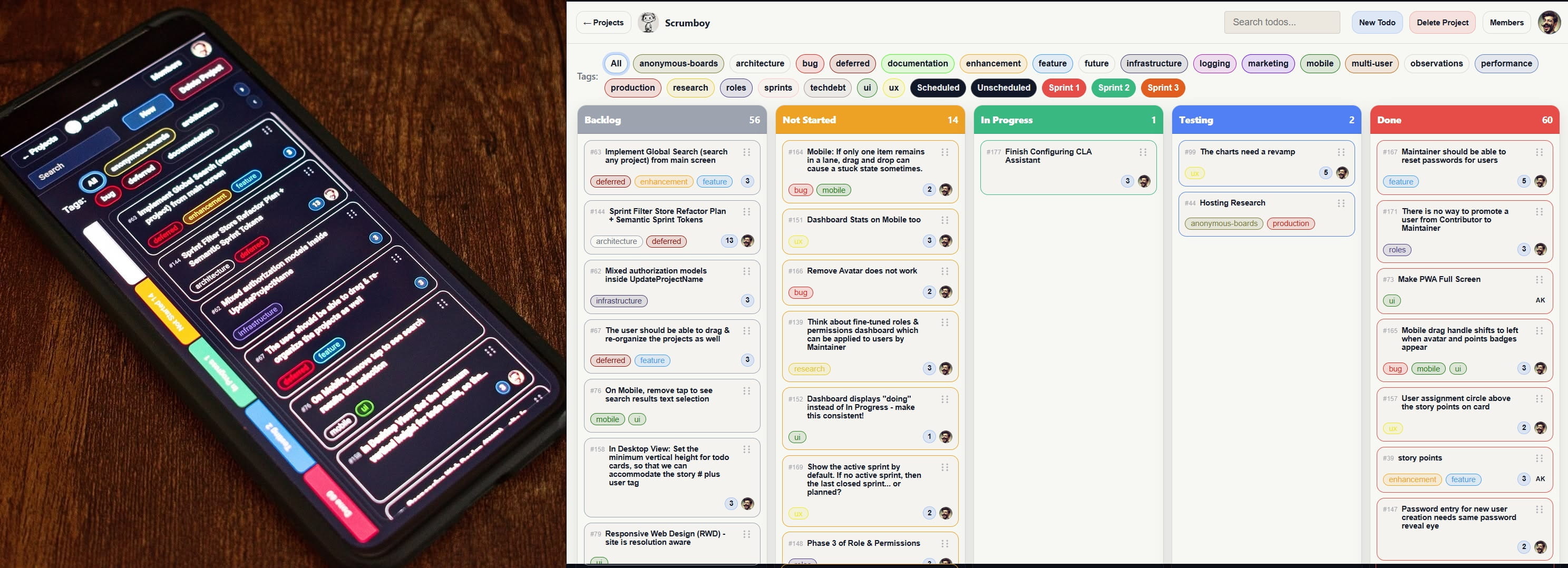
Table of contents
- Quick Start
- Optional Configuration
- Why Scrumboy?
- Who is this for?
- Modes
- Features
- Integrations & API Access
- Config
- Roles
- Export scope
- Import modes
- Code layout (reference)
- Documentation
- License and Contributions
Quick Start
Runs in seconds. No setup required.
No .env file, TLS certificates, or encryption key are required to start the app.
Run the official Docker image
Scrumboy is distributed as a container image on GitHub Container Registry:
ghcr.io/markrai/scrumboy:latest
Published images are multi-arch for linux/amd64 and linux/arm64; Docker pulls the variant that matches your host.
Docker run (named volume for persistent SQLite data under /data):
docker run -d \
  --name scrumboy \
  -p 127.0.0.1:8080:8080 \
  -v scrumboy-data:/data \
  ghcr.io/markrai/scrumboy:latest
The image defaults to DATA_DIR=/data and SQLITE_PATH=/data/app.db. Mount a volume or host directory on /data so the database survives container recreation.
Docker Compose (minimal example; save as docker-compose.yml):
services:
  scrumboy:
    image: ghcr.io/markrai/scrumboy:latest
    container_name: scrumboy
    ports:
      - "127.0.0.1:8080:8080"
    volumes:
      - ./data:/data
    restart: unless-stopped
docker compose up -dOpen http://localhost:8080.
Run the Windows executable
Windows users can download scrumboy-*-windows-amd64.exe from GitHub Releases. The matching .sha256 file is published beside it for checksum verification.
Put the exe in a dedicated writable folder before running it, for example %USERPROFILE%\Scrumboy. The exe starts a local Scrumboy server; open http://localhost:8080 after it starts.
Scrumboy creates runtime data under ./data by default. The default SQLite database is ./data/app.db, and SQLite may also create app.db-wal and app.db-shm while the server is running. The exe is single-file for distribution, but it is not "no runtime files ever."
Advanced users can set DATA_DIR to choose the runtime data directory and BIND_ADDR to choose the listen address or port.
Build locally from source
To build from a local clone instead of pulling the published image:
docker compose up --buildThe repository's docker-compose.yml uses build: . and maps ./data to /data.
Open http://localhost:8080.
Run from source
go run ./cmd/scrumboyOpen http://localhost:8080.
Optional Configuration
Environment variables
- The app does not automatically load
.envfiles. - On Linux/macOS, export variables manually (for example:
export SCRUMBOY_ENCRYPTION_KEY=...). - On Windows,
win_run_full.batandwin_run_anonymous.batmanagedata/scrumboy.envautomatically for local convenience. - Precedence on Windows is: existing process env var
SCRUMBOY_ENCRYPTION_KEY, thendata/scrumboy.env, then legacy rootscrumboy.env. - The canonical Windows-managed local file format is
SCRUMBOY_ENCRYPTION_KEY=<base64-32-byte-key>. - Windows helper scripts still accept legacy raw single-line key files for backward compatibility.
Encryption key for 2FA/password reset
SCRUMBOY_ENCRYPTION_KEYis not required for basic startup.- It becomes required for encrypted auth/security features, including:
- 2FA
- Password reset flows
- If an existing database already has 2FA-enabled users, startup fails without this key.
- The key is part of the same backup/restore unit as
data/app.db. Back them up together. - Do not regenerate or replace the key casually after encrypted auth/security data exists, or you can break access to 2FA/password-reset data.
- If a bad key is configured before any encrypted auth/security data exists, Scrumboy may warn and continue with 2FA setup/password reset disabled until you configure a valid key.
Generate a key with: openssl rand -base64 32
Example for Docker Compose secret injection:
services:
  scrumboy:
    environment:
      - SCRUMBOY_ENCRYPTION_KEY=${SCRUMBOY_ENCRYPTION_KEY}
Example for systemd secret injection:
[Service]
Environment="SCRUMBOY_ENCRYPTION_KEY=REPLACE_WITH_BASE64_32_BYTE_KEY"
In both cases, the deployment manager is injecting the environment variable. Scrumboy itself does not auto-load these files.
SMTP for self-service password reset (optional)
Optional SMTP lets users who already have a Scrumboy-local password request a reset email (Forgot your Scrumboy password?). You need a relay (SCRUMBOY_SMTP_*), SCRUMBOY_ENCRYPTION_KEY, a valid SCRUMBOY_PUBLIC_BASE_URL, and local authentication enabled. Owners can generate links only for users with a usable local password; SSO credential recovery belongs to the identity provider. Setup and troubleshooting: docs/smtp.md.
OIDC / SSO login (optional)
Optional OpenID Connect SSO with any standards-compliant IdP (Keycloak, Authentik, Auth0, Entra ID, etc.). Accounts may use a local password, SSO, or both. Local users connect SSO explicitly from Settings; SSO-only users can establish a local recovery password after fresh provider reauthentication. Matching email never silently links an identity, and users.email remains the canonical Scrumboy email. Local login stays available unless SCRUMBOY_OIDC_LOCAL_AUTH_DISABLED=true. See docs/oidc.md, SECURITY.md, docs/authentication-api.md, and docs/recovery.md.
Owner disaster recovery
If the identity provider is unavailable, a host operator can recover an existing owner's local password without starting the HTTP server or applying migrations:
./scrumboy recover-owner --email owner@example.comStop Scrumboy and back up the SQLite database/volume first. Container, bind-mount, named-volume, stdin automation, schema-compatibility, session-revocation, and local-auth-disabled instructions are in docs/recovery.md.
TLS / HTTPS (optional)
- TLS is optional.
- HTTPS is enabled only when both
SCRUMBOY_TLS_CERTandSCRUMBOY_TLS_KEYfiles exist. - Otherwise, the server runs on HTTP by default.
PWA / Web Push (optional)
Install the app from the browser for a standalone window and better mobile UX. Background assignment alerts use the Web Push API with VAPID keys on the server. When both keys are set, signed-in clients attempt to subscribe automatically (browser permission may be prompted). Docker users must pass the VAPID variables into the container environment and recreate the container after changes. Details, Docker verification steps, and subscriber contact semantics: docs/pwa.md.
Frontend build note
The Docker image and go run embed prebuilt assets under internal/httpapi/web/dist. If they are missing, build them:
cd internal/httpapi/web
npm install
npm run build
Then run docker compose up --build (local image build) or go run ./cmd/scrumboy again from the repository root.
Why Scrumboy?
Simplicity of a light Kanban, with the power of structured systems: Roles, sprints, audit trails & customizable workflows - without being locked into SaaS tools.
Who is this for?
- self-hosted & privacy-focused community
- small to medium-sized teams & solo builders
Modes
-
Full (
SCRUMBOY_MODE=full, default): Auth can be enabled. First user via bootstrap; then login/session. Backup/export, tags, multi-project. Projects can be user-owned (project_members) or anonymous (shareable by URL):/anon(or/temp) creates a throwaway board and redirects to/{slug}. -
Anonymous (
SCRUMBOY_MODE=anonymous): No auth. Landing at/; live deployment at: https://scrumboy.com/
Features
-
Custom Workflows: You can create any combination of workflow you want, per project, with user-defined "Done" lane.
-
Realtime SSE enabled boards for instant multi-user actions.
-
Webhooks (API-only, full mode): Register URLs per project so Scrumboy can POST JSON when subscribed domain events fire (e.g.
todo.assigned). For your own automations, not in-app or browser notifications. See Integrations. -
Customizable Tags: Users can inherit and customize tag colors.
-
Advanced filtering: Search todos based on text or tags.
-
Sprints: create, activate, close; sprint filter on board; default sprint weeks (1 or 2) per project.
-
Authentication & 2FA: TOTP supported when
SCRUMBOY_ENCRYPTION_KEYis set. -
Self-service password reset email (optional, requires SMTP +
SCRUMBOY_ENCRYPTION_KEY+SCRUMBOY_PUBLIC_BASE_URL): see docs/smtp.md. -
Audit trail: append-only
audit_eventstable; todo/member/project/link actions logged (see docs/audit_trail.md). -
Backup: export/import JSON; merge or replace; scope full or single project (see store backup logic).
-
PWA: Excellent UX for mobile users.
-
Multi-language Support: English, 简体中文, हिन्दी, Español (Latinoamérica), العربية, Français, বাংলা, Português (Brasil), Bahasa Indonesia, اردو, Русский, Deutsch, 日本語, Kiswahili, Tiếng Việt, Türkçe, 한국어, فارسی, ไทย, Italiano, Bahasa Melayu, Polski, and Українська.
-
Anonymous shareable boards can be created in both Full & Anonymous deployments.
-
VoiceFlow - deterministic voice commands (see docs/voiceflow.md).
-
Sticky-Note Wall - per-project scratchpad of draggable sticky notes on the board (see docs/wall.md).
-
Todo notes Markdown preview (optional) - markdown / preview tabs in the todo Notes field; optional Mermaid diagrams in fenced
```mermaidblocks in preview only (seeFAQ.md,docs/markdown&mermaid.md).
Integrations & API Access
Scrumboy supports API access tokens for automation, integrations, and programmatic MCP access (legacy HTTP and JSON-RPC - see below). Full MCP guide for developers and agents: docs/mcp.md.
You can create a token from the API and use it to call MCP endpoints directly - no browser session or cookies required.
Create a token (requires login session):
curl -b cookies.txt -X POST http://localhost:8080/api/me/tokens \
  -H "Content-Type: application/json" \
  -H "X-Scrumboy: 1" \
  -d '{"name":"cli"}'
Response includes a one-time token (starts with sb_).
Use it with MCP:
curl -X POST http://localhost:8080/mcp \
  -H "Content-Type: application/json" \
  -H "Authorization: Bearer sb_your_token_here" \
  -d '{"tool":"projects.list","input":{}}'
MCP (JSON-RPC) for AI agents
Scrumboy exposes a standards-based, JSON-only Streamable HTTP endpoint for native MCP clients such as Cursor and Claude Code.
Endpoint: POST /mcp/rpc
This is separate from the /mcp HTTP endpoint above and follows JSON-RPC 2.0 (initialize, tools/list, tools/call, etc.). See docs/mcp.md for tools, auth, response shapes, and examples; API.md for the full HTTP/MCP behavior reference.
Native clients must be configured directly with /mcp/rpc. It is the sole OAuth protected resource; /mcp remains the legacy Scrumboy {tool,input} API.
claude mcp add --transport http scrumboy https://scrumboy.example.com/mcp/rpcExample: initialize
curl -X POST http://localhost:8080/mcp/rpc \
  -H "Content-Type: application/json" \
  -H "Accept: application/json, text/event-stream" \
  -H "Authorization: Bearer sb_your_token_here" \
  -d '{"jsonrpc":"2.0","id":1,"method":"initialize","params":{"protocolVersion":"2025-11-25","capabilities":{},"clientInfo":{"name":"curl","version":"1"}}}'
Example: list tools
curl -X POST http://localhost:8080/mcp/rpc \
  -H "Content-Type: application/json" \
  -H "Accept: application/json, text/event-stream" \
  -H "MCP-Protocol-Version: 2025-11-25" \
  -H "Authorization: Bearer sb_your_token_here" \
  -d '{"jsonrpc":"2.0","id":2,"method":"tools/list","params":{}}'
Example: call a tool
curl -X POST http://localhost:8080/mcp/rpc \
  -H "Content-Type: application/json" \
  -H "Accept: application/json, text/event-stream" \
  -H "MCP-Protocol-Version: 2025-11-25" \
  -H "Authorization: Bearer sb_your_token_here" \
  -d '{
    "jsonrpc":"2.0",
    "id":3,
    "method":"tools/call",
    "params":{
      "name":"todos.create",
      "arguments":{
        "projectSlug":"my-project",
        "title":"Created via MCP"
      }
    }
  }'
Notes
- Compatible with MCP clients that support HTTP JSON-RPC to this URL.
- Some MCP clients expect stdio-based servers - those are not supported here.
/mcp/rpcaccepts a session cookie, a staticsb_…Bearer token, or a Scrumboy OAuth token bound to this exact resource./mcpaccepts cookies and static tokens only.- In full mode, unauthenticated
/mcp/rpcrequests receive an empty 401 with RFC 9728 protected-resource discovery metadata. - Compatible Codex/Claude-style agent workspaces that support local or manual
plugin loading can use the Scrumboy Board Operator plugin package in
plugins/scrumboy-board-operator. The package contains a focused Skill workflow guide; each harness still needs to be configured to load it.
This enables:
- CLI usage
- CI/CD automation
- AI agents and MCP clients (use
POST /mcp/rpcfor JSON-RPC;POST /mcpremains available for the legacy{ "tool", "input" }envelope) - Scripting/integrations without login flows
Webhooks (outbound HTTP)
Scrumboy can POST JSON to URLs you register when certain events occur. This is for server-side integrations (your script, gateway, queue worker, etc.). It does not add notifications inside the Scrumboy UI; live boards still update via SSE as before.
- Availability: Full mode only (endpoints are disabled in anonymous mode).
- Who can configure: Project maintainers, via the HTTP API only - there is no settings screen for webhooks yet.
- API:
POST /api/webhooks(create),GET /api/webhooks(list yours),DELETE /api/webhooks/{id}- same session cookie / CSRF header rules as other mutating/api/*calls. - Events: Subscribe to specific types (e.g.
todo.assigned) or*for all delivered types. The set may grow over time; unused types in your list are harmless. - Security: Optional per-webhook secret; when set, requests include an
X-Scrumboy-Signatureheader (sha256=HMAC of the raw JSON body). - Semantics: Best-effort delivery with retries on failure; not a durable external queue - design for idempotent receivers using the event
idin the JSON body.
Example create (replace cookie / project id / URL):
curl -b cookies.txt -X POST http://localhost:8080/api/webhooks \
  -H "Content-Type: application/json" \
  -H "X-Scrumboy: 1" \
  -d '{"projectId":1,"url":"https://example.com/scrumboy-hook","events":["todo.assigned"],"secret":"optional-shared-secret"}'
Config
Env vars and defaults are defined in internal/config/config.go. ResolveDataDir uses DATA_DIR and SQLITE_PATH as documented there.
None of these are required for basic startup.
| Variable | Default (from code) |
|---|---|
BIND_ADDR | :8080 |
DATA_DIR | ./data |
SQLITE_PATH | (empty; then $DATA_DIR/app.db) |
SQLITE_BUSY_TIMEOUT_MS | 30000 |
SQLITE_JOURNAL_MODE | WAL |
SQLITE_SYNCHRONOUS | FULL |
MAX_REQUEST_BODY_BYTES | 1048576 (1 MiB) |
SCRUMBOY_MODE | full (or anonymous) |
SCRUMBOY_ENCRYPTION_KEY | (empty) - Required for 2FA and password reset. Base64-encoded 32-byte key. Generate with openssl rand -base64 32. Without it, 2FA setup returns 503 and password-reset tokens cannot be issued. Back this key up with data/app.db; do not replace it casually once encrypted auth/security data exists. |
SCRUMBOY_TLS_CERT | ./cert.pem - TLS cert for HTTPS |
SCRUMBOY_TLS_KEY | ./key.pem - TLS key for HTTPS |
SCRUMBOY_INTRANET_IP | 192.168.1.250 - LAN IP to log for intranet access |
SCRUMBOY_VAPID_PUBLIC_KEY | (empty) - Web Push. VAPID public key (URL-safe base64). Required together with private key for PWA background assignment notifications and for post-login auto-subscribe in the SPA. |
SCRUMBOY_VAPID_PRIVATE_KEY | (empty) - VAPID private key (URL-safe base64). |
SCRUMBOY_VAPID_SUBSCRIBER | (empty) - Contact for VAPID JWT sub (not tied to IdP). Use a plain email (e.g. ops@example.com); the server adds mailto:. Or set a full mailto:... or https://... URL explicitly. If unset, a built-in default is used. |
SCRUMBOY_DEBUG_PUSH | (empty) - Set to 1 to log push send/prune on the server. |
SCRUMBOY_SMTP_HOST | (empty) - Self-service password reset. SMTP relay hostname. Required with From. |
SCRUMBOY_SMTP_PORT | 587 - Defaults to 587 when omitted. If explicitly set, must be 1–65535. |
SCRUMBOY_SMTP_USERNAME | (empty) - SMTP auth username; omit for relays allowing unauthenticated submission. |
SCRUMBOY_SMTP_PASSWORD | (empty) - SMTP auth password. Never logged. |
SCRUMBOY_SMTP_FROM | (empty) - Envelope + header From, e.g. Scrumboy <no-reply@example.com>. Required with Host. |
SCRUMBOY_SMTP_TLS_MODE | starttls (or implicit, none) - see docs/smtp.md. |
SCRUMBOY_SMTP_DEBUG | (empty) - Set to 1 to log SMTP send attempts (never credentials/body). |
SCRUMBOY_PUBLIC_BASE_URL | (empty) - Required for self-service password-reset email. Canonical public origin (e.g. https://scrumboy.example.com). Must be absolute http/https with hostname; no path, query, fragment, or userinfo. Missing or invalid → self-service emails disabled (generic API response only). Also used for admin-generated reset links and as the canonical OAuth discovery issuer when set. For OAuth, non-loopback issuers must be HTTPS; plain http is accepted only for loopback (localhost / 127.0.0.0/8 / ::1). See docs/smtp.md and docs/oauth.md. |
SCRUMBOY_TRUST_PROXY | (empty) - Set to 1/true/on/yes to honor X-Forwarded-For for auth/OAuth rate-limit IP keys and (for OAuth issuer discovery) trusted X-Forwarded-Proto / X-Forwarded-Host / CF-Visitor. Default off: use RemoteAddr only for IP keys. Enable only behind a reverse proxy that overwrites or strips client-supplied values for all of those headers — not only XFF. When enabled, OAuth issuer discovery requires either SCRUMBOY_PUBLIC_BASE_URL or a proxy-provided X-Forwarded-Host together with a forwarded HTTPS indication; X-Forwarded-Proto alone (or multi-value forwarded scheme/host fields) results in 503. |
docker-compose.yml overrides some of these (e.g. SQLITE_BUSY_TIMEOUT_MS=5000).
Roles
In full mode, access is governed by two separate role systems. System roles do not grant project access; project access comes only from project membership.
System roles (instance-wide)
| Role | Who has it | Allowed actions |
|---|---|---|
| Owner | Bootstrap (first) user; can be assigned by another owner | List all users; create users (admin-only API); update any user’s system role (owner/admin/user); delete users (except cannot delete the last owner). |
| Admin | Assigned by an owner | List all users; create users. Cannot change system roles or delete users. |
| User | Default for new users; assigned by owner | No system-level user management. Access to projects only via project membership. |
Project roles (per project)
A user must be a member of a project to access it; system role alone does not grant access.
| Role | View board & todos | Create/edit/move/delete todos | Edit body when assigned | Manage members | Delete project | Tag delete/color (project-scoped) |
|---|---|---|---|---|---|---|
| Maintainer | ✓ | ✓ | ✓ | ✓ | ✓ | ✓ (maintainer) |
| Contributor | ✓ | - | ✓ (body only) | - | - | - |
| Viewer | ✓ | - | - | - | - | - |
- View (board, backlog, burndown, charts, etc.): Any project role (Viewer or above).
- Create/edit/move/delete todos, assign, sprints: Maintainer only. Contributor cannot create, delete, move, or assign; cannot edit title, tags, sprint, or estimation.
- Edit body when assigned: Contributor can edit the body field only when the todo is assigned to them. Maintainer has full edit.
- Manage members (add/remove members, change role): Maintainer only.
- Delete project: Maintainer only.
- Delete/update tag (project-scoped tags): Maintainer only. User-owned tags: owner of the tag or maintainer in all projects where the tag is used.
- Create tags: Contributor or Maintainer.
Temporary/anonymous boards (shareable by URL, no auth) do not use project roles; anyone with the link can view and edit. New Todo and drag-and-drop are enabled for anonymous boards.
Export scope
- Full: All projects the user can access (full mode: projects where the user is a member, or temporary boards they created; anonymous mode: not applicable for full export).
- Single project: One board/project only (e.g. current board in anonymous mode).
Import modes
When importing a backup JSON, you choose how it is applied:
| Mode | Description |
|---|---|
| Replace | Replace all: delete every project in your current export scope, then create projects from the backup. Effect is “nuke and restore” so the instance matches the backup. Not available in anonymous mode. |
| Merge | Merge/update: for each project in the backup, match by slug. If a project with that slug exists (and you have access), update its todos, tags, and links to match the backup; otherwise create a new project. In anonymous mode, merge behaves like Create Copy (all projects are created as new). |
| Create copy | Create copy: create new projects for every project in the backup. Slugs are made unique (e.g. name-imported-2), so nothing is overwritten; you get duplicates. |
In anonymous mode, full-scope import is not allowed; you can only import into the current board (todos and tags are added to that board).
Code layout (reference)
cmd/scrumboy: main server entrypoint. Othercmd/*are utilities (tagcheck, tagrecover, dbquery, slugfix).internal/config: env-based config.internal/version: app and export format version.internal/db: SQLite open/options (PRAGMAs from config).internal/migrate: DB migrations.internal/store: data model and persistence (projects, todos, tags, auth, backup, ordering, memberships, audit, links, sprints, workflows, etc.).internal/httpapi: HTTP server, routing, auth cookies, SPA serve, embedded web FS.internal/httpapi/web: frontend (TS, CSS, HTML); built withnpm run buildininternal/httpapi/web; output underweb/distand embedded by server.
Invariants (e.g. canonical URL /{slug}, no UI links to /p/{id}) are enforced in code and tests; see internal/httpapi and internal/store for the authoritative behavior.
Documentation
- Architecture diagrams:
docs/diagrams/- Mermaid sources and self-contained viewer (serve-diagrams.batorpython serve.pyin that folder, then openhttp://127.0.0.1:8775/) - MCP (HTTP tools + JSON-RPC):
docs/mcp.md- tool catalog, auth, legacy vs/mcp/rpc, examples (agents & automation). See alsoAPI.mdfor exhaustive MCP HTTP detail. - OAuth 2.1 for MCP clients:
docs/oauth.md- resource discovery, Dynamic Client Registration, PKCE, and resource-bound authorize/token/revoke flows for native clients such as Cursor and Claude Code. - Remote MCP/OAuth release acceptance:
docs/mcp-oauth-acceptance.md- Vega/Keycloak evidence record plus Cursor, Claude Code, cookie/static, legacy, and negative-resource gates. - Agent plugin package:
plugins/scrumboy-board-operator- local/manual plugin metadata, board-operator Skill, and seed eval cases for MCP/Agoragentic agent workflows. - PWA / Web Push (VAPID):
docs/pwa.md- keys, subscriber contact, post-login auto-subscribe when VAPID is configured, Settings opt-out, tradeoffs. - Roles and permissions:
docs/roles_and_permissions.md- project roles, backend authorization, anonymous boards. - Audit trail:
docs/audit_trail.md- action vocabulary, event model, integration points.
License and Contributions
Scrumboy is licensed under the GNU Affero General Public License v3 (AGPL v3). See LICENSE for the full text.
Contributing: Contributors must sign the Contributor License Agreement (CLA) before contributions are accepted. See CONTRIBUTING.md for setup, build, and pull request guidelines.
Scrumboy is an independent open-source project and is not affiliated with, sponsored by, or endorsed by Scrum.org, Scrum Alliance, Inc., or any other organization associated with Scrum training or certification. Any reference to "scrum" is made solely to describe the project management methodology that the software is intended to support. We hope you will ❤️ it as much as we do!