CiteVQA: Benchmarking Evidence Attribution for Trustworthy Document Intelligence




If you like our project, please give us a star ⭐ on GitHub for the latest update.
🔎 Overview
CiteVQA is a document visual question answering benchmark for faithful evidence attribution. Unlike conventional DocVQA datasets that only score the final answer, CiteVQA requires a model to answer a question with evidence grounded in the source document at the element level. The benchmark is designed to evaluate whether a system can not only answer correctly, but also cite the right supporting region in long, real-world PDFs.
The dataset contains 1,897 questions built from 711 PDFs across 7 macro-domains and 30 sub-domains, with an average of 40.6 pages per document. It covers both English and Chinese documents, and includes single-document as well as multi-document settings.
The evaluation covers three dataset types:
- Single-Doc: Single-document question answering.
- Multi (1-Gold): Multi-document QA with exactly one gold document.
- Multi (N-Gold): Multi-document QA with multiple gold documents.
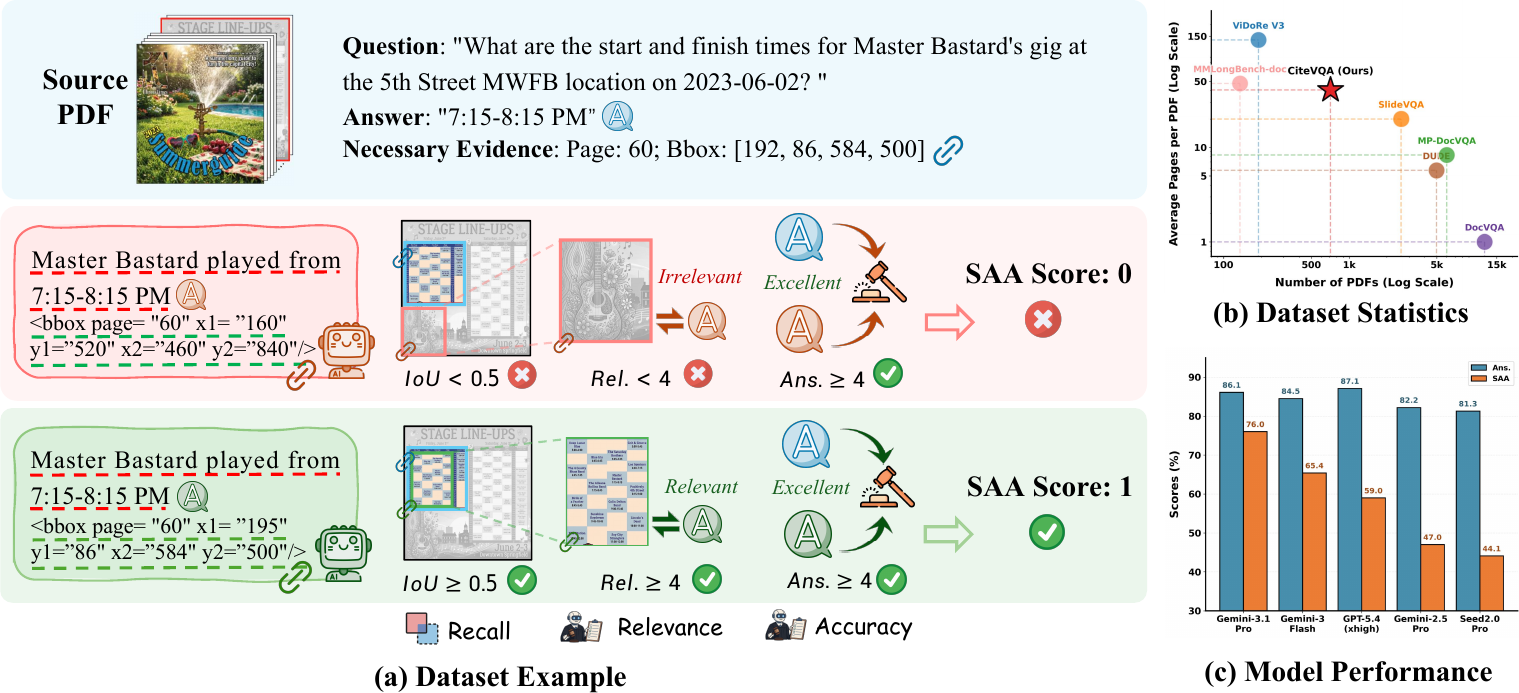
Overview of CiteVQA. Left: a prediction is counted as correct only when the answer is correct and the cited evidence region is both relevant and spatially aligned with the gold evidence under Strictly Attributed Accuracy (SAA). Right top: dataset statistics show that CiteVQA emphasizes long, realistic PDFs. Right bottom: existing MLLMs exhibit a substantial gap between answer accuracy and evidence-grounded accuracy.
✨ Highlights
- Joint answer-and-evidence evaluation: Evaluates both answer correctness and citation faithfulness.
- Element-level evidence: Structured gold evidence features bounding boxes, page, and document indices.
- Long-document setting: Focuses on multi-page PDFs with realistic lengths and complex layouts.
- Cross-domain and bilingual: Spans 7 domains, 30 sub-domains, and two languages (
en,zh). - Multi-document reasoning: Features cross-document questions that require evidence aggregation.
- Three evaluation settings: Supports
Single-Doc,Multi (1-Gold), andMulti (N-Gold).
⚙️ Setup
Install dependencies:
pip install -r requirements.txtOptional CJK font configuration for PDF rendering:
Expand font setup for Chinese PDFs
apt install fonts-noto-cjk poppler-data

cat > /etc/fonts/conf.d/99-pdf-cjk.conf << 'EOF'
<?xml version="1.0"?>
<!DOCTYPE fontconfig SYSTEM "fonts.dtd">
<fontconfig>
  <alias><family>STSong-Light</family><prefer><family>Noto Serif CJK SC</family></prefer></alias>
  <alias><family>STSong</family><prefer><family>Noto Serif CJK SC</family></prefer></alias>
  <alias><family>SimSun</family><prefer><family>Noto Serif CJK SC</family></prefer></alias>
  <alias><family>FangSong</family><prefer><family>Noto Serif CJK SC</family></prefer></alias>
  <alias><family>KaiTi</family><prefer><family>Noto Serif CJK SC</family></prefer></alias>
  <alias><family>SimHei</family><prefer><family>Noto Sans CJK SC</family></prefer></alias>
  <alias><family>Microsoft YaHei</family><prefer><family>Noto Sans CJK SC</family></prefer></alias>
</fontconfig>
EOF

fc-cache -f
📦 Data
From the repository root, you can fetch the benchmark files from Hugging Face into data/, then download the source PDFs:
pip install -U "huggingface_hub[cli]"
hf download opendatalab/CiteVQA --repo-type dataset --local-dir .
python data/download/download_pdfs.py --workers 16 --out data/pdf --csv data/download/pdf_source.csv
From the repository root, you can also fetch the benchmark files from ModelScope into data/, then download the source PDFs:
pip install -U modelscope
modelscope download --dataset OpenDataLab/CiteVQA --local_dir .
python data/download/download_pdfs.py --workers 16 --out data/pdf --csv data/download/pdf_source.csv
The PDF downloader reads data/download/pdf_source.csv and saves all files to data/pdf/.
If you run into dataset or download issues, jump to the Contact section.
Download Arguments
| Option | Default | Description |
|---|---|---|
--csv | pdf_source.csv | CSV file containing PDF URLs |
--out | pdf | Output directory |
--workers | 16 | Concurrent download workers |
--timeout | 120 | Timeout per file in seconds |
--retries | 3 | Retry count |
--no-skip | - | Re-download existing files |
🚀 Inference and Evaluation
bash run.sh provides a demo for evaluating GPT-5.4. Edit the API settings in run.sh, then run:
bash run.shReference workflow:
# API config
API_TYPE=openai
API_KEY=YOUR_API_KEY
BASE_URL=YOUR_BASE_URL

# Inference
python infer/run.py \
  --api ${API_TYPE} \
  --model MODEL_NAME \
  --base_url ${BASE_URL} \
  --api_key ${API_KEY} \
  --workers 4 \
  --out outputs/infer/MODEL_NAME.json

# Evaluation
python eval/run.py \
  --judge_api ${API_TYPE} \
  --judge_model JUDGE_MODEL_NAME \
  --judge_api_key ${API_KEY} \
  --base_url ${BASE_URL} \
  --input outputs/infer/MODEL_NAME.json \
  --out outputs/eval/MODEL_NAME.json \
  --workers 24

# Summary
python eval/summarize.py \
  --input outputs/eval/MODEL_NAME.json \
  --out_dir outputs/eval/MODEL_NAME
🧭 Inference Arguments
Inference Arguments
| Option | Required | Description |
|---|---|---|
--api | Yes | openai, genai, or anthropic |
--model | Yes | Model name |
--api_key | Yes | API key |
--base_url | No | API base URL |
--workers | No | Number of workers, default 4 |
--out | No | Output JSON path |
--benchmark | No | Benchmark path, default data/data_items.json |
--limit | No | Sample limit, 0 means all |
--max_pdf_mb | No | Compress PDFs larger than this size in MB |
📏 Evaluation Arguments
Evaluation Arguments
| Option | Required | Description |
|---|---|---|
--input | Yes | Inference output JSON |
--judge_api | No | Judge API type, default openai |
--judge_model | No | Judge model name, default gpt-4o |
--judge_api_key | Yes | Judge API key |
--base_url | No | API base URL |
--metrics | No | Metrics list, default recall,rel |
--workers | No | Number of workers |
--out | No | Output JSON path |
--limit | No | Sample limit |
🗂️ Repository Structure
CiteVQA/
├── data/
│   ├── validation/
│   │   └── CiteVQA.json         # Benchmark QA pairs
│   ├── pdf/                     # Downloaded PDFs
│   └── download/
│       ├── pdf_source.csv       # PDF metadata & URLs
│       └── download_pdfs.py     # PDF download script
├── infer/
│   └── run.py                   # Inference script
├── eval/
│   ├── run.py                   # Evaluation script
│   └── summarize.py             # Summary table generator
├── prompts/                     # System & user prompts
├── outputs/                     # Inference & evaluation outputs
├── requirements.txt
└── run.sh                       # Demo script
📊 Evaluation Metrics
| Metric | Meaning |
|---|---|
Recall | Whether predicted evidence overlaps with crucial ground-truth evidence |
Relevance (Rel.) | Whether the cited evidence semantically supports the answer |
Answer Correctness (Ans.) | Whether the answer is correct |
SAA | Strict Attributed Accuracy: answer and evidence must both be valid |
Page Recall | Whether the correct page is identified |
Precision / F1 | Precision and overlap quality of predicted evidence |
SAA is the core metric of CiteVQA.
🏆 Evaluation Result
We evaluated 20 state-of-the-art MLLMs on CiteVQA using a unified prompt template. The results show that faithful evidence attribution remains substantially harder than answer-only scoring.
- Best overall SAA:
Gemini-3.1-Pro-Previewreaches 76.0 SAA with 86.1 answer score. - Best answer accuracy:
GPT-5.4reaches 87.1 answer score, but its SAA drops to 59.0. - Best open-source model:
Qwen3-VL-235B-A22Breaches 22.5 SAA with 72.3 answer score. - Key finding: a large gap between
Ans.andSAAappears across models, highlighting the benchmark'sAttribution Hallucinationchallenge.
Full overall results:
| Model | Category | Rec. | Rel. | Ans. | SAA |
|---|---|---|---|---|---|
| Gemini-3.1-Pro-Preview | Closed-source MLLMs | 66.0 | 83.6 | 86.1 | 76.0 |
| Gemini-3-Flash-Preview | Closed-source MLLMs | 45.4 | 75.7 | 84.5 | 65.4 |
| GPT-5.4 | Closed-source MLLMs | 31.0 | 67.5 | 87.1 | 59.0 |
| Gemini-2.5-Pro | Closed-source MLLMs | 27.4 | 59.8 | 82.2 | 47.0 |
| Seed2.0-Pro | Closed-source MLLMs | 28.5 | 54.9 | 81.3 | 44.1 |
| GPT-5.2 | Closed-source MLLMs | 18.2 | 56.6 | 71.5 | 33.7 |
| Qwen3.6-Plus | Closed-source MLLMs | 7.7 | 25.0 | 85.9 | 17.5 |
| GLM-5V-Turbo | Closed-source MLLMs | 14.9 | 29.2 | 49.6 | 12.8 |
| Qwen3-VL-235B-A22B | Open-source Large MLLMs | 11.3 | 35.3 | 72.3 | 22.5 |
| Gemma-4-31B | Open-source Large MLLMs | 11.6 | 35.0 | 69.8 | 20.2 |
| Kimi-K2.5 | Open-source Large MLLMs | 6.2 | 26.8 | 74.3 | 19.1 |
| Qwen3.5-397B-A17B | Open-source Large MLLMs | 5.4 | 24.6 | 76.5 | 18.3 |
| Qwen3.5-27B | Open-source Large MLLMs | 5.3 | 25.3 | 75.6 | 17.3 |
| Qwen3-VL-32B | Open-source Large MLLMs | 6.6 | 30.5 | 72.3 | 17.3 |
| Qwen3.5-122B-A10B | Open-source Large MLLMs | 3.9 | 19.0 | 73.6 | 14.8 |
| Qwen3.5-9B | Open-source Small MLLMs | 1.6 | 14.7 | 65.0 | 11.1 |
| Qwen3.5-35B-A3B | Open-source Small MLLMs | 1.7 | 13.7 | 76.4 | 10.7 |
| Qwen3-VL-30B-A3B | Open-source Small MLLMs | 3.5 | 14.6 | 62.2 | 8.2 |
| Qwen3-VL-8B | Open-source Small MLLMs | 1.0 | 14.7 | 61.2 | 7.5 |
| Gemma-4-26B-A4B | Open-source Small MLLMs | 3.0 | 17.9 | 48.4 | 6.2 |
📬 Contact
Since the PDF sources are downloaded from external links, issues such as broken links or data accessibility problems may occur during download. If you encounter any download-related problems, please email wzr@stu.pku.edu.cn.
📚 Citation
@article{ma2026citevqa,
  title={CiteVQA: Benchmarking Evidence Attribution for Trustworthy Document Intelligence},
  author={Ma, Dongsheng and Li, Jiayu and Wang, Zhengren and Wang, Yijie and Kong, Jiahao and Zeng, Weijun and Xiao, Jutao and Yang, Jie and Zhang, Wentao and Wang, Bin and He, Conghui},
  journal={arXiv preprint arXiv:2605.12882},
  year={2026}
}
🙏 Acknowledgements
- MinerU for document parsing.
- ViDoRe V3 and other open-source datasets (SPIQA, MedQA, PubMedQA, MaintNorm, PolicyBench) for inspiring our benchmark construction.
📄 License
This project is licensed under the MIT License. See the LICENSE file for details.
©️ Copyright Notice
CiteVQA is provided for academic research and non-commercial use only. We fully respect the rights of original copyright holders. If any rights holder believes that the inclusion, indexing, or use of any relevant content in this benchmark is inappropriate, please contact OpenDataLab@pjlab.org.cn. We will verify the request and remove or update the relevant content when appropriate.