 PocketJS




Website · Playground · Documentation · Blog · Changelog
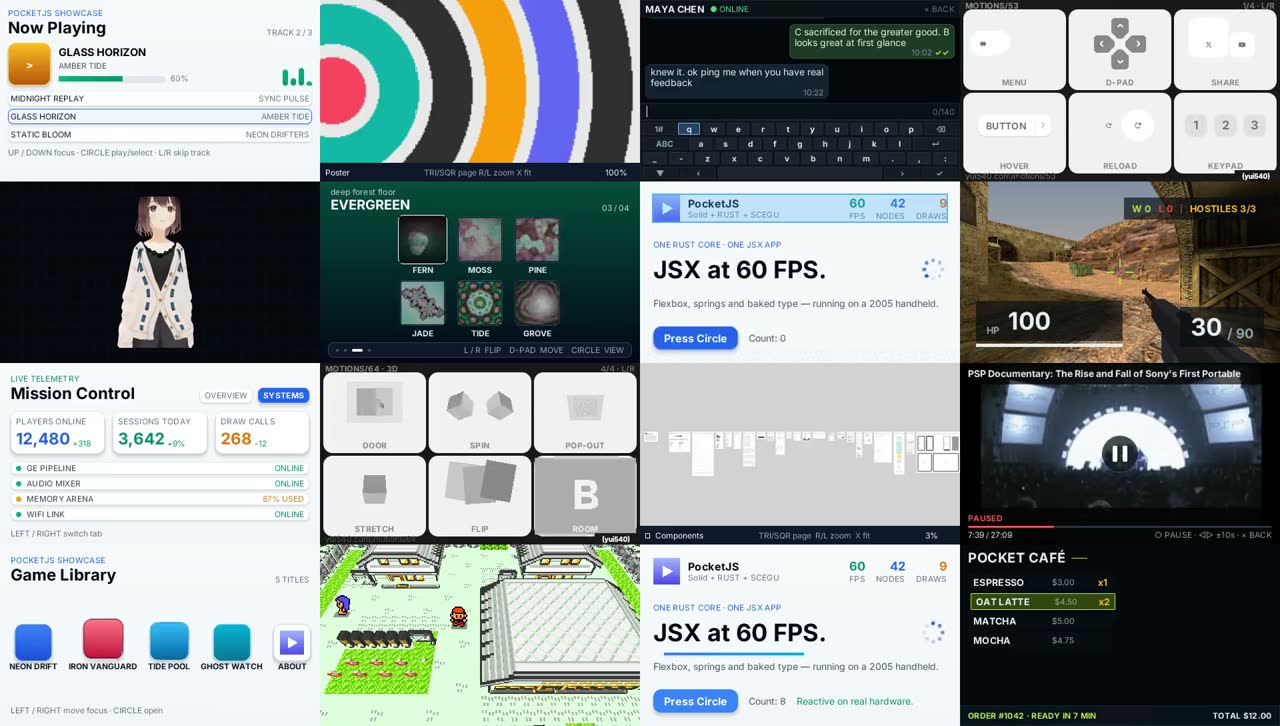
PocketJS is a portable application runtime that turns modern component code into native pixels across radically different hardware. Solid, Vue Vapor and Octane components compile to one native tree, and a QuickJS guest drives a Rust core that performs flexbox layout and draws every pixel in one thread inside one process. There is no DOM, no CSS engine and no WebView.
Contents
- Programming model
- Rendering and execution
- Performance
- Native modules
- Hardware support
- Applications
- Getting started
- Ahead-of-time compilation
- Repository layout
- Building and testing
- Documentation
Programming model
Frameworks
Three frameworks compile to the same native tree and run on the same QuickJS guest. The choice changes application code and nothing below it.
| Framework | State and lifecycle | Source forms |
|---|---|---|
| Solid | solid-js | JSX |
| Vue Vapor | vue | JSX and <script setup> single-file components |
| Octane | octane | Compiled hooks and JSX, with no virtual DOM |
Framework primitives are imported directly from solid-js, vue, or octane.
PocketJS owns the runtime, host components, lifecycle wiring, input, animation,
assets, and the native boundary.
import { createSignal, Show } from "solid-js";
import { mount } from "@pocketjs/framework/solid";
import { Text, View } from "@pocketjs/framework/solid/components";

function Counter() {
  const [count, setCount] = createSignal(0);

  return (
    <View class="w-full h-full flex-col items-center gap-4 p-4 bg-slate-50">
      <Text class="text-xl text-slate-950 font-bold">Count: {count()}</Text>
      <View
        class="px-4 py-2 rounded-xl shadow-md bg-blue-600 focus:bg-blue-500"
        focusable
        onPress={() => setCount(count() + 1)}
      >
        <Text class="text-base text-white font-bold">Press Circle</Text>
      </View>
      <Show when={count() > 3}>
        <Text class="text-sm text-emerald-600">Reactive on real hardware.</Text>
      </Show>
    </View>
  );
}

mount(() => <Counter />);
Styling
Class literals are compiled into a baked style table at build time. The runtime resolves a class attribute by lookup, so there is no CSS parser, cascade, specificity resolution, or reflow on the device. The accepted vocabulary is a fixed Tailwind subset, enumerated in Tailwind utilities.
Animation
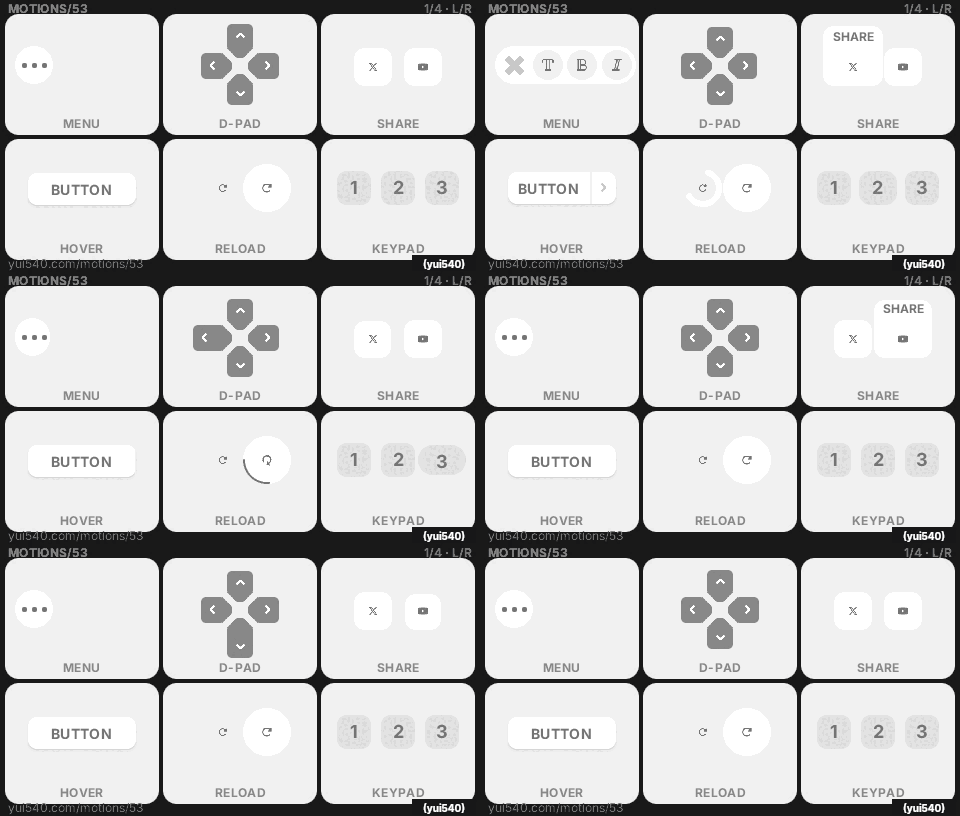
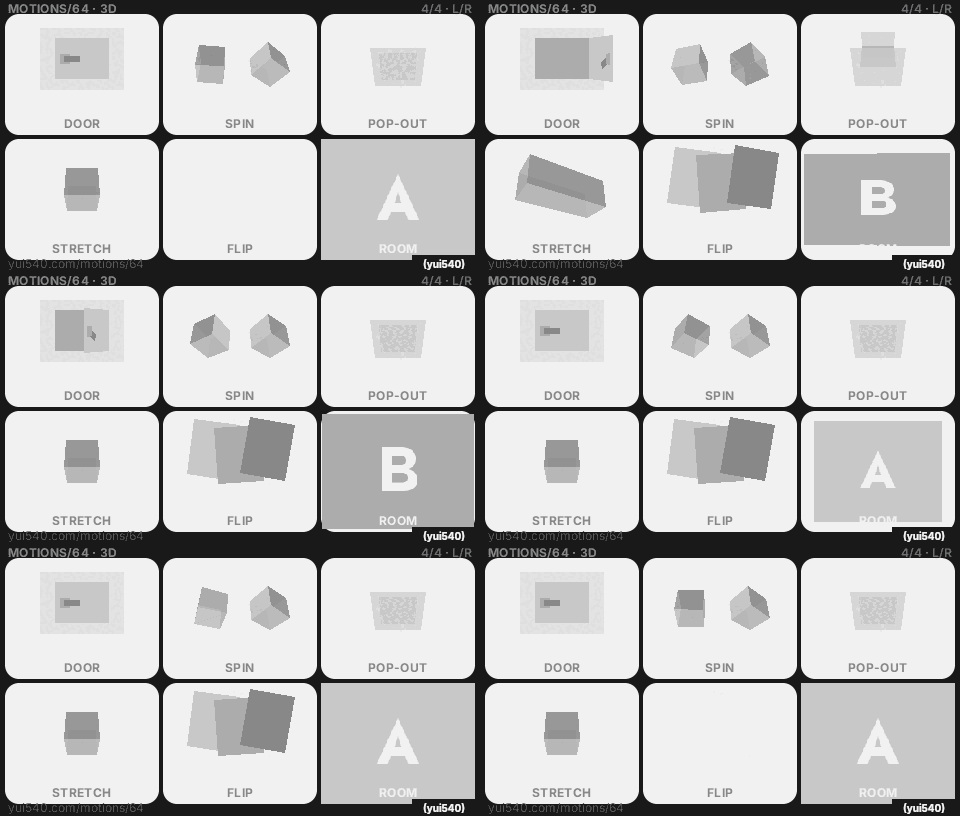
Keyframe timelines and spring curves are baked into the same style table and advanced by the Rust core on its own clock, so a screen can animate with no per-frame JavaScript. Motion Lab runs the yui540 studies in WebAssembly on pocketjs.dev and on the handheld they were written for.
| Baked keyframe timelines · (yui540) | 3D motion pipeline · (yui540) |
|---|---|
 |  |
Target admission
One bundle serves machines of different densities. An application declares its
viewport and required APIs in pocket.json, and a target profile must satisfy
that declaration before compilation and packaging proceed. Run from the
application directory:
pocket check --target psp     # ok  480x272 · text.glyphs.baked · input.buttons
pocket check --target vita    # ok  same bundle, density 2, no component edited
Rendering and execution
From component to pixel
The guest emits tree mutations; the core owns layout, the style table, and the draw list; a per-target backend submits that draw list through GE, GXM, Metal, wgpu, software rasterization, e-ink updates, or another declared host.
PocketJS · 1 thread, 1 process
  your component                        guest
  renderer adapter                      guest
  native tree                           core
  flexbox layout, baked style table     core
  drawlist                              core
  backend draw                          core
  → pixels

Browser or WebView · 4 threads, 2 processes
  your component                        main
  framework runtime, vdom diff          main
  dom mutation                          main
  cssom, cascade, specificity           main
  style recalculation                   main
  layout, reflow                        main
  paint records                         main
  commit the layer tree across threads
  layer tree, tiling compositor         compositor
  queue raster tasks, invalidations     compositor
  rasterization                         raster pool
  ipc to the gpu process, sync fences
  draw quads                            gpu
  present                               gpu
  → pixels
The frame contract
PocketJS makes time the frame counter. One frame(buttons) call is a
transaction that nothing outside it can interrupt, and nothing waits on a wall
clock, so tests run as fast as the CPU allows without changing the timing they
measure: a journey that takes six seconds in front of a user is a few dozen
frames in CI.
state n+1 = F(state n, input n)
pixels n = G(state n)- Effects land on frame boundaries. A network reply that arrives partway
through frame +3 is queued, not applied. It is delivered at the start of
frame +4, in FIFO order, before any application hook runs. There are no
microtask races and no mid-frame callbacks, and
after()replacessetTimeoutwith a deadline measured in frames. - An async task lands on the same frame every run. Driven by
requestAnimationFrameagainst a wall clock, one awaited confirmation lands on 22 different frames across 60 runs, and its timing assertion passes 9 times out of 60. On the frame clock it lands on frame 144 in every run, 60 out of 60. - History is a data structure. Tapes replay byte-for-byte, a session subsampled to 2 Hz is byte-identical to its 60 Hz counterpart, and forking a tape at frame 9 to splice in a different press produces a counterfactual world in 22 ms.
- Chaos mode verifies the floor, injecting real sleeps, allocation churn and forced GC between frames without moving the trace by one bit.
See also: The runtime that can't flake · Time-travel DevTools · Determinism
Performance
With no browser engine in the pipeline, the cost of a screen stays close to what the hardware can do. A complete application drawing an animated interface occupies 8 MB on a single 333 MHz core: a quarter of the PSP's 32 MB, one part in 1536 of a 12 GB iPhone 17 Pro Max, on a core clocked 13 times slower than an A19 Pro performance core at 4.26 GHz.
On a Sony PSP
One MIPS core at 333 MHz, 32 MB of RAM, measured against the 16.67 ms budget for 60 fps:
| Measurement | Result |
|---|---|
| OpenStrike frame budget | 2.2 ms of JavaScript, 8.4 ms of total CPU work, worst observed frame 9.7 ms |
| Hero demo, cost of a virtual DOM | Solid 15.15 ms · Vue Vapor 16.74 ms · Vue with a virtual DOM 90.75 ms |
| Hero demo, the three shipped frameworks | Solid 3.66 ms · Vue Vapor 3.61 ms · Octane 6.53 ms |
Seven samples per application. The two hero-demo rows come from separate runs with different toolchain versions, so each row is comparable internally but not against the other.
On a desktop
The same markdown editor shelled three ways on an Apple M3 Max
(full report, reproduced by
bun tools/bench-desktop.ts):
| Tauri v2 | Electron | ||
|---|---|---|---|
| Processes | 1 | 4 | 5 |
| Cold start to first painted frame | 149 ms | 380 ms | 301 ms |
| Idle resident memory | 83 MB | 193 MB | 382 MB |
| On disk | 10 MB | 9 MB | 242 MB |
With a document open and no input, the pocket build redraws about twice a second: the caret blinking, and nothing else. The report also records where the pocket build loses. Its storm CPU rises with document length, because the editor re-wraps the whole document through the QuickJS interpreter on every keystroke.
See also: Shipping OpenStrike · Pocket Character · Twice the pixels, zero forks · The first iPhone
Native modules
The runtime has a game engine's architecture, so a game and an application are built the same way. Cores are independent native modules, loaded the way a kernel loads drivers: an application takes the ones its content needs, and the rest never enters the build. Mounting a module widens what the program may ask for; it does not change how the program is written.
guest program · JavaScript, one frame at a time
  ui       tree, layout, draw, input, focus
  net      poll batches
  audio    pcm mixer
  strike   bsp, bots, hits
  voxel    chunks, meshing
See also: Core concepts · The runtime family · Pocket3D
Hardware support
PocketJS has booted on every operating system below, on the real machine. What changes between them is one native submission layer, never the application, and each row links to the post or pull request that brought it up. Keeping the hardware bootable is its own work, tracked in Pocket Museum.
| Operating system | Native submission layer | Receipt |
|---|---|---|
| PSP system software | MIPS, 32 MB | Introducing PocketJS |
| PS Vita system software | ARM, GXM | Twice the pixels, zero forks |
| iPhone OS 3.1.3 | ARMv6, GL ES 1.1 | The first iPhone |
| iOS 6.1.3 | ARMv7 | hosts/iphone4s |
| iOS 12.5.8 | arm64 | #278 |
| iOS, current | NativeScript host | #256 |
| macOS | Metal window and widget | #293 |
| Symbian Belle | Qt, GLES2 | Symbian wanted a frame function |
| Windows CE 6 | GDI framebuffer | From message pump to multitouch |
| BlackBerry 10.3 | QNX, native ELF | One square screen, two native stacks |
| Android 4.3 | BlackBerry runtime, JNI | #298 |
| PocketBook e-ink | inkview, partial refresh | #172 |
| ESP-IDF 6.0/6.1 | P4 PPA or S3 software RGB565 | ESP-IDF components |
| The browser | WebAssembly core | Playground |
Devices verified so far: Sony PSP (2004), PS Vita (2011), iPhone (2007), iPhone 4S (2011), iPod touch 6 (2015), Nokia E7 (2011), Meizu M8 (2009), BlackBerry Classic (2014), PocketBook reader (e-ink), ESP32-P4 devkit (microcontroller), and Mac (Apple silicon).
The authoritative host and target inventory is
contracts/spec/platforms.ts; each entry
records what has been verified and how. See
Platform contracts and the
Native contract.
Applications
PocketJS carries complete applications on the hardware listed above. Each row links to how it was built.
| Project | Scope |
|---|---|
| OpenStrike | A Counter-Strike-shaped shooter on 2004 hardware: BSP maps, bots, and a HUD written in Solid JSX, at 60 fps with 2.2 ms of JavaScript per frame |
| Pocket Voxel | A creature-RPG town rebuilt as a walking voxel diorama. Game state lives in the JS guest; logic runs at 60 Hz while presentation holds a locked 30 fps beat |
| Pocket Figma | A 14,430-node design file, cooked into streamed tile pyramids and panned with the analog nub at 60 fps on a handheld with 32 MB of RAM |
| Pocket Character | A rigged VRM companion in a transparent always-on-top window, rendering skinned 3D at 60 fps in one process and 118 MB, against 8 processes and 2184 MB for an Electron build of the same idea |
| Pocket YouTube | Search, thumbnails, playback and seeking on a console that predates streaming, where the network is a USB cable and a Mac companion performs the fetching |
| Pocket DevTools | Time-travel debugging over a USB cable at 2 bytes per frame. The inspector highlight is emitted by the core into the draw list, so it renders on the device, on every backend |
| Pocket Launcher | Whole-application lifecycle, target admission, frozen shots, and guest switching on PSP and Vita |
| Pocket Pi | A coding agent running inside the QuickJS guest environment, with no Node underneath |
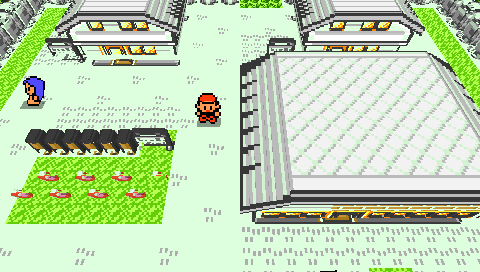
Pocket Voxel, captured on a PSP-2000: the flat Game Boy world standing up as geometry. The making-of story.
Getting started
The zero-install path is the online Playground. Local browser development requires Bun and Rust via rustup:
git clone https://github.com/pocket-stack/pocketjs
cd pocketjs
bun install
rustup target add wasm32-unknown-unknown
bun run dev                    # build WASM + the Hero app, then serve the browser host
The CLI operates inside a PocketJS checkout:
npm install -g @pocketjs/cli
pocket doctor                  # report missing host and target tooling
pocket setup                   # install the pinned web + PSP toolchain
pocket create my-app
pocket check --target psp --manifest apps/my-app/pocket.json
pocket build --target psp --manifest apps/my-app/pocket.json -- --release
Vita packaging additionally requires VitaSDK and the pinned Rust toolchain
documented in hosts/vita/README.md. Guest builds can
be packaged as inspectable, target-thinnable
.pocket files instead of per-port directories.
Ahead-of-time compilation
For machines that cannot host a JavaScript engine at all,
Pocket Vapor compiles a strict Vue Vapor subset ahead of
time into target-native C: .gba, .gb, .nes, ESP32 firmware, and Playdate
.pdx artifacts, with no JS engine, GC, or allocator on the device. It is a
separate compiler with its own target and board contracts, not a low-memory mode
for arbitrary PocketJS applications.
bun run vapor:dev             # run the component against the real Vue oracle in a browser
bun run vapor:test            # oracle + compiler + console parity suites
bun vapor/compiler/cli.ts vapor/examples/todo/todo.tsx --target gb
Compiler-derived demands are checked against a target or board profile before
lowering; see vapor/DESIGN.md.
Repository layout
| Path | Responsibility |
|---|---|
framework/ | Public framework APIs, renderers, components, input, lifecycle, and build-time styling |
engine/ | no_std UI core, render backends, native modules, Pocket3D, and platform-native crates |
contracts/ | Generated wire specs, capability registry, manifests, build plans, and package formats |
hosts/ | PSP, Vita, web, desktop, e-reader, phone, and MCU host integrations |
hosts/esp-idf/ | Composable package, QuickJS, UI, RGB565, PPA, and runner components for P4/S3 firmware |
vapor/ | Pocket Vapor compiler, oracle, board contracts, target runtimes, and parity harnesses |
apps/ | Framework demos and system applications used by the launcher and acceptance suites |
tools/ | Build, package, launcher, device, DevTools, benchmark, and release commands |
tests/ | Contract, compiler, simulation, emulator, package, and golden verification |
docs/ | Platform, runtime, determinism, DevTools, backend, and benchmark records |
Building and testing
Emulator journeys require their external toolchains:
bun run test                  # contracts, compiler, packages, sims, and host suites
bun run golden                # deterministic WASM/web frame goldens
bun run e2e                   # PPSSPP journey
bun run e2e:vita              # Vita3K native-density journey
bun run site:build            # docs, playground, Stage, and landing build
Documentation
| Topic | Reference |
|---|---|
| First application | Getting started |
| Frameworks, components, styling | Frameworks · Components · Styling |
| Runtime internals | Architecture · Core concepts · Native contract |
| Targets and packaging | Platform contracts · The .pocket platform |
| Debugging and verification | DevTools · Determinism |
| Runtimes beyond 2D UI | The runtime family · Pocket3D |
| Complete examples | apps/ · Blog |
Project
Pocket Lab is an independent, non-VC-backed organization built on this runtime, so that the joy of creating belongs to everyone. Development is funded by sponsors.
Attribution
The original motion studies are by yui540. PocketJS
accepts yui540's two stated conditions for continued use: Motion Lab carries the
requested (yui540) on-screen credit, and any other yui540 animation requires
separate permission before it is ported. The accepted scope and
capture-maintenance rules are recorded in
apps/motions/ATTRIBUTION.md.
License
PocketJS is MIT licensed. Inter is vendored under the OFL in
assets/fonts/.