
Give your Microduck a brain. Your Reachy Mini, your arm and your wheeled base too. Any LLM, one .duck file. 🦆🧠
quackd, pronounced “quacked”. The brain daemon Microduck was missing, named like its siblings robotd, mediad, padd and tofd. Since 0.4 it drives other small robots too.
Type a goal in a terminal, or just chat with it through Claude. Same rules either way.







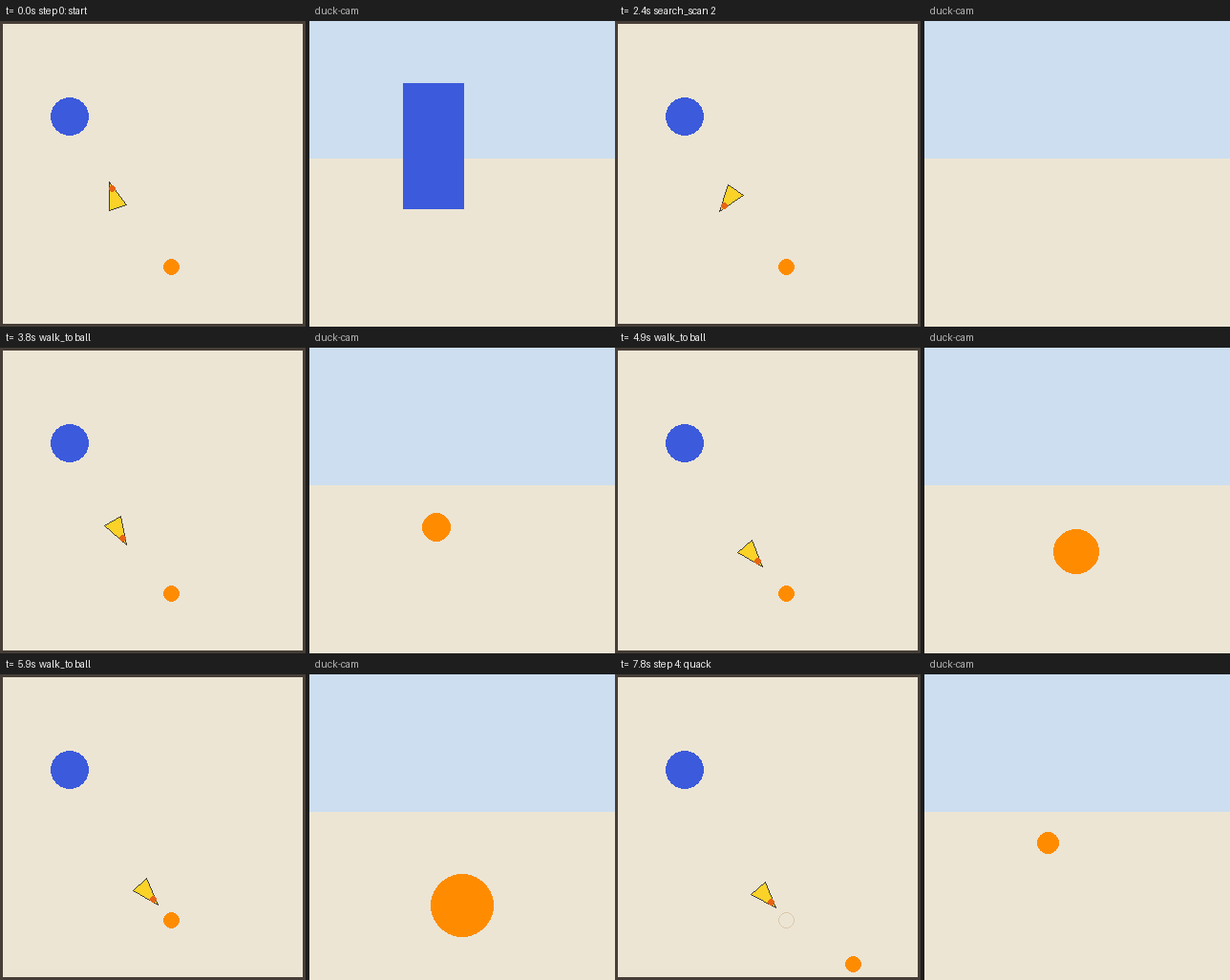
"Find the ball and kick it", in the bundled simulator, driven by the scripted pilot (no API key). Same verbs, same safety layer, same perception as a real model run. See docs/assets.
quackd connects a small robot to a large language model (Claude, OpenAI, Gemini, Grok, or an open source model running locally through llama.cpp, vLLM, Ollama or LM Studio). The first robot is the Microduck from Pollen Robotics, a biped that already knows how to walk, turn, kick, scoop something off the floor, look around and quack. Since 0.4 the same loop drives other bodies through adapters that declare what each can do: a Reachy Mini head, an SO-101 class arm through LeRobot and any wheeled base over rosbridge, the head in the bundled simulator or a mock, the arm and the base in a mock only, none on hardware. quackd is the missing layer that turns a request like "find the ball and kick it" into the right sequence of a robot's own skills, watches what happens, and keeps going until the job is done or it is clearly impossible.
You do not need a robot to try it. A bundled simulator runs on any laptop in seconds. Goals proven today, in that simulator, on 10 of 10 seeds with the scripted pilot and a ground truth check:
"Find the ball and kick it." · "Find the ball with your gaze and say where it is." (a Reachy Mini head, no legs) · "Split the search, the closest duck kicks." (a flock) · "The head spots, the duck kicks, the head judges." (two bodies, one contract)
Four more starters ship. hello-world is the smoke test (quack, one step, quack) and the scripted pilot completes it. patrol-and-quack, follow-me and fetch carry a strategy in their body written for a real model, and no pilot has completed one yet: the scripted pilot has no script for follow-me or fetch (it declares success after two steps without attempting the task), its patrol script runs to the budget on every seed, and no model run has been recorded.
Runs with a cloud model or with an open source model on your own machine (Ollama, vLLM, llama.cpp, LM Studio). The local path needs no API key.
Goals like "find my keys" or "pick up the trash" are where this is going, not what it does yet. The Microduck ships at Christmas 2026, Reachy Mini hardware exists today, and nothing here has run on real hardware, on any of the four adapters: every hardware backend is experimental or a stub, its upstream names read from upstream source, nothing verified end to end. The honest label for today is LLM driven, goal directed control of simulated robots: an early, working step toward a small robot you can simply talk to.
Try it in 60 seconds
uvx quackd run find-and-kick --provider fake                                        # no key: the scripted pilot
claude mcp add quackd -- uvx quackd serve-mcp --robot microduck:sim2d               # or just chat with it: "find the ball and kick it"
uvx quackd run reachy-spotter --provider fake                                       # another body: a Reachy Mini head, no legs, same loop
uvx --from "quackd[anthropic]" quackd run find-and-kick --provider anthropic --robot microduck:sim2d   # needs ANTHROPIC_API_KEY
uvx --from "quackd[openai]" quackd run find-and-kick --provider ollama --model qwen3:8b          # local model, no key
open runs/*/run.gif                                                                 # a GIF on the simulator, a transcript every time
Put keys in the environment or in a .env file (copy .env.example). quackd doctor tells you what is missing. Needs Python 3.11 or newer and uv, nothing else.
Why?
A modern small robot is not short of skills. The Microduck's onboard controllers already balance it, walk, kick, sit, stand up after a fall and scoop with its beak. A Reachy Mini head looks around and emotes, an arm picks with its own learned policy, a wheeled base drives. Each is the robot's own skill, trained, written or recorded, and each works without any help from an AI model. What the robot lacks is any idea of what those skills are for.
Traditional control:   walk forward, turn left, walk, look down, scoop, ...   (you plan every step)
This project:          "Pick up the ball."                                    (you state the goal)
Low level skills and high level goals are different layers. The robot knows the words, but it cannot hold a conversation. quackd is an open source attempt to connect the two layers, with an LLM doing the planning and the robot's own controllers doing the moving.
What is this?
The first robot. The Microduck is a 25 cm, 800 g biped shaped like a duck: fifteen small servos, a camera in its head, a depth sensor, a speaker, an onboard computer, and a set of learned behaviours (walk, kick, sit and stand, ground pick, roll, roller skate with clip on wheels) that run at 50 Hz on the robot itself. It is open source, costs about $399, and is deliberately small and friendly, the opposite of an intimidating humanoid. The bigger bet behind projects like this one is that useful robots at home or in an office will be small ones people actually enjoy having around.
The other bodies. Since 0.4 quackd also drives a Reachy Mini (a stationary expressive head from the same company, with a camera, a neck, two antennas and a speaker, hardware that exists today), an SO-101 class desktop arm through LeRobot, and any wheeled base that takes a Twist over rosbridge, each in a simulator or a mock so far, never on the real thing. Each is an adapter that describes itself in a manifest, and the verbs the model can be offered come from that manifest and nowhere else: a head is never offered kick, an arm is never offered move, and quackd validate --robot tells you which verbs a task needs that the body lacks before a run starts. All four, side by side, in Any small robot below.
This project. quackd (pronounced "quacked", named after the Microduck's daemons robotd, mediad, padd and friends) is an independent, unofficial brain for it, and since 0.4 for any small robot that has an adapter. It is a Python program that
- takes a goal in plain language, from a chat, a command line, or a
.ducktask file, - reads what a robot can do from its adapter's manifest, so the model only ever sees the verbs that manifest declares, and a verb outside it does not exist,
- asks an LLM, cloud or local, one step at a time, which of the robot's skills to use next,
- runs that skill on the robot (or the simulator), looks at the camera, and asks again,
- enforces a contract the model cannot talk its way out of: which skills are allowed, how many steps, when a human must say yes, when to abort.
It ships with a cartoon simulator so all of this can be developed and demoed before the hardware exists, and with an MCP server so Claude Code or Claude Desktop can drive one robot or a fleet interactively.
How it works (the simple version)
flowchart TD
    YOU["You<br/>“find the ball and kick it”"]
    LLM["LLM<br/>looks at the camera, the robot's state and the last result<br/>picks ONE of the robot's own skills (a verb) and its parameters"]
    Q["quackd<br/>checks the rules: allowed? budget left? needs confirmation?<br/>then runs the verb"]
    R["Robot or simulator<br/>executes the skill with its own controllers<br/>(walking, grasping and looking are not the LLM's job)"]
    O["quackd observes the result<br/>new camera frame, new state"]
    YOU --> LLM --> Q --> R --> O
    O -- "next verb, until done or impossible" --> LLM
The verbs the model can pick from are real, existing capabilities and nothing more. They come from the robot's manifest. A verb not in the manifest does not exist:
| Kind | Verbs | What they are |
|---|---|---|
| Core | observe report_state stop say move go_to search_scan approach_and | on any robot whose manifest satisfies their requirements (a camera, a twist intent, a sound intent). go_to and search_scan are plain Python over the camera, the steering loop, clamped to the speed limits the manifest names. On a body that can only look, search_scan sweeps the head |
| Microduck | sit stand stand_up kick grab gaze quack | one each per behaviour the robot ships with, each an intent the robot's own controllers execute |
| Reachy Mini | gaze express play_sound wake_up | a stationary head that looks, expresses and plays sounds. wake_up moves every joint, so it is confirm gated. The SDK has no text to speech, so say is voiced as the closest expression |
| LeRobot arm | move_joints gripper place pick | an SO-101 class arm. pick is one skill intent the arm's own learned policy executes, confirm gated and present only when a policy is loaded |
| rosbridge base | (core only) | a wheeled base over ROS 2. It gets move, stop and report_state, plus observe, go_to, search_scan and approach_and once an image topic is configured |
| Aliases | get_frame walk_to walk | the 0.3 names of observe, go_to and move. They keep working in every .duck file |
| Learned | (none yet) | v2: policies trained from LLM written rewards, registered like any other verb |
go_to (still spelled walk_to in the starter files) deserves a mention. It is a small closed loop written in plain Python that steers toward whatever the camera sees, ten times a second, without asking the model. The LLM says "go to the ball". It never has to say "turn 4° left". The same code steers a duck and a wheeled base (the rosbridge mock so far), clamped to each manifest's speed limits. On a head that cannot walk, go_to does not exist and search_scan sweeps the head instead of turning the body.
Example
The hero run above, from its transcript (runs/<timestamp>-find-and-kick/transcript.jsonl). This one is the scripted pilot, so model says so and usage is an estimate from character counts (no tokenizer). A real provider records the API's own counts.
{"kind": "llm",  "step": 0, "tool_calls": [{"name": "search_scan", "arguments": {"target": "ball"}}], "usage": {"input_tokens": 689, "output_tokens": 16}}
{"kind": "verb", "step": 1, "name": "search_scan", "ok": true, "summary": "ball found: ball at bearing 18° left ~0.58 m (after 4 turn steps)"}
{"kind": "llm",  "step": 1, "tool_calls": [{"name": "walk_to", "arguments": {"target": "ball", "stop_distance": 0.22}}]}
{"kind": "verb", "step": 2, "name": "walk_to", "canonical": "go_to", "ok": true, "summary": "reached the ball: ~0.22 m away, bearing +0°", "data": {"distance_m": 0.217, "ticks": 27}}
{"kind": "llm",  "step": 2, "tool_calls": [{"name": "kick", "arguments": {"leg": "right"}}]}
{"kind": "verb", "step": 3, "name": "kick", "ok": true, "summary": "kicked with right leg, ball moved 0.53 m"}
{"kind": "llm",  "step": 3, "tool_calls": [{"name": "quack", "arguments": {"text": "yay, got it!"}}]}
{"kind": "llm",  "step": 4, "tool_calls": [{"name": "declare_success", "arguments": {"reason": "ball displaced by the kick"}}]}
The same thing as a conversation, through MCP in Claude Code or Claude Desktop:
You: List the duck's verbs, then find the ball and kick it. Claude: (calls
robot_list_verbs,robot_observe,robot_run_verb("search_scan"),robot_run_verb("go_to"),robot_run_verb("kick"),robot_say) Done. The ball moved about half a metre.
The eight duck_* tools from 0.3 still work as aliases on the default robot and go away in 0.5.
What it can do today, and where it is going
Today (v0.4, simulator and mocks):
Two demos to run right now, both scripted, both 10 of 10 seeds: find-and-kick, one duck in the bundled simulator, and reachy-spots-duck-kicks, a Reachy Mini head that spots and judges while a Microduck kicks, two bodies under one contract.
- Run a goal end to end in the bundled 2D simulator with any of the ten
--providernames (four cloud, five local presets, and the scripted pilot).find-and-kicksucceeds on 10 of 10 seeds with the scripted pilot, in about 2 s of wall clock per run, with a GIF and a full transcript every time. - A vocabulary per body, built from its manifest: eight core verbs that a manifest may name only when the body has what they need (a camera for
observe, thetwistintent and mobility formove), plus each robot's own. Fifteen on the Microduck (eight core, seven of its own), nine on a Reachy Mini head, seven on a LeRobot arm with a camera and a pick policy (five with neither), seven on a wheeled base with a camera topic (three without). A strict.ducktask file format (v1 addsrequires,robotsandflock.roles) with a validator that checks a task against a robot's manifest, and a safety layer that enforces allowlists, budgets, confirmation gates, a heartbeat and a kill switch. - Drive a robot interactively from Claude Code or Claude Desktop over MCP, under the same rules.
serve-mcp --robotsfronts a fleet with one executor, budget and heartbeat per robot. - Local and open source models through Ollama, vLLM, llama.cpp, LM Studio or any OpenAI compatible server, with no API key, model discovery from the server, and a JSON text fallback for models that cannot call tools natively.
- Real model code paths for Claude, OpenAI, Gemini and Grok are implemented and tested offline. The hero GIF is the scripted pilot because this repo was built without an API key.
- Run a flock: multiple simulated robots coordinate over a message bus and a deterministic auction, each acting only through the verbs it already has. Two choreographies ship today,
flock-kick(ducks) andreachy-spots-duck-kicks(a head and a duck), both 10 of 10 seeds with the scripted pilots, and every message lands inflock.jsonl. - Drive other bodies. Robots are adapters that declare a manifest, and the verbs come from the manifest. Four adapters ship: the Microduck, a Reachy Mini head that runs
reachy-spotterin the simulator on 10 of 10 seeds, an SO-101 class arm through LeRobot and any wheeled base over rosbridge, the last two as offline mocks, each with an experimental backend (lerobot:real,rosbridge:ws) that has never run against its target.quackd list-adaptersshows them,quackd list-verbs --robotshows a body's vocabulary, andquackd validate --robottells you which verbs a task needs that a robot does not have. - Mix bodies in one flock. In
reachy-spots-duck-kicksa Reachy Mini head spots the ball and judges the kick from its own frames while a Microduck kicks, 10 of 10 seeds with the scripted pilots, with bids that carry a capability term so each robot only bids for a role its manifest can fill. - Find robots on the LAN with
quackd discoverandquackd announce(zeroconf, behindquackd[lan]), and carry a flock's messages over an MQTT broker as a library. Each was exercised once for real on one machine, never across two.
Going (see Roadmap): the five Microduck starter tasks on a real duck once it ships, a first run of reachy_mini:sdk, lerobot:real and rosbridge:ws on the bodies they target, upstream's WebSocket agent surface, and learned verbs, new skills trained from LLM written rewards that register as one more verb. Eventually, a small robot in a real room that you can ask to find, fetch, follow and check on things.
| Piece | Status |
|---|---|
sim2d bundled simulator (default) | ✅ 10 of 10 seeds on find-and-kick, GIF and transcript per run |
Manifests and core verbs (quackd list-adapters, quackd list-verbs --robot) | ✅ four adapters, eight core verbs that appear only where the manifest meets their requirements, speed limits from the manifest, manifest.schema.json generated and drift tested |
MCP server (quackd serve-mcp) | ✅ Claude Code and Claude Desktop, the Claude Code config checked against its docs (2026-08), no Claude Desktop session on record, fleets with --robots (six robot_* tools plus eight deprecated duck_* aliases, tested in process against the simulator and the mocks) |
| Providers: anthropic, openai, gemini, grok, fake | ✅ implemented, tested offline, real model hero recording pending an API key |
| Local models (Ollama, vLLM, llama.cpp, LM Studio, any OpenAI compatible server) | ✅ implemented and tested against the OpenAI wire format, 🧪 not yet exercised against a live server by us, transcripts welcome |
| Flock mode (multiple cooperating robots, sim2d) | ✅ deterministic auction and bus, one planner LLM call at most, ground truth checked in tests, 🧪 experimental and simulator only |
Real Microduck over JSON RPC (--robot microduck:jsonrpc) | 🧪 experimental, method names verified against upstream duck-ipc-proto v16, never run on hardware |
WebSocket agent gateway (--robot microduck:websocket) | ⏳ stub tracking upstream's draft (architecture.md §5.3) |
Reachy Mini adapter (--robot reachy_mini:sim2d, mock, sdk) | ✅ sim2d and mock, reachy-spotter 10 of 10 seeds, 🧪 sdk behind quackd[reachy] with every SDK name verified against a pinned commit and the 1.10.0 wheel, exercised with a fake client, never run on a robot (docs/adapters/reachy_mini.md) |
LeRobot adapter (--robot lerobot:mock, real) | ✅ mock, an SO-101 class arm with move_joints, gripper, place and pick as one skill intent (confirm gated, present only when a policy is available), 🧪 real behind quackd[lerobot] (Python 3.12 or newer) with every LeRobot name verified against a pinned commit, exercised with a fake arm and a fake policy, never run on an arm (docs/adapters/lerobot.md) |
rosbridge adapter (--robot rosbridge:mock, ws) | ✅ mock, a wheeled base with move, observe, go_to, search_scan and approach_and (on ws the camera verbs appear only when the address names an image topic), no deadman verified anywhere in the stack so quackd re-sends the Twist at 10 Hz and zeroes it on stop, 🧪 ws via roslibpy behind quackd[rosbridge] with every roslibpy, rosbridge and message name verified against pinned commits, exercised with fake topics, never run against a bridge (docs/adapters/rosbridge.md) |
| Heterogeneous flock (a Reachy Mini head and a Microduck, sim2d) | ✅ reachy-spots-duck-kicks 10 of 10 seeds, capability aware auction, the spotter judges from its own frames, ground truth vetoes, 🧪 simulator only |
LAN discovery (quackd discover, quackd announce, quackd[lan]) | ✅ record format and both commands on fakes in the suite, 🧪 real zeroconf exercised once on one Windows machine (a child process announced a mock manifest, the parent found it, digest matched), never between two machines (docs/lan.md) |
MQTT flock bus (MqttBus, library only) | ✅ every message kind, echo, duplicates and a full flock run on a fake broker, 🧪 all eight kinds once between two nodes through a local amqtt broker on one machine, never a flock across machines (no distributed clock yet) (docs/lan.md) |
| Learned verbs | 🗺️ v2, interface and docs only (docs/learned-verbs.md) |
Everything quackd assumes about each robot's API, and how sure we are: docs/adapter-status.md. quackd doctor prints the same lists for your machine. Adding a body of your own takes a manifest and a mock: docs/adapters.md, with the manifest fields in docs/manifest-spec.md.
Architecture
Three loops, three rates, three owners. The LLM decides what. The steering loop decides how to get there. The robot's own controllers do the moving: balance on a biped, a pick policy on an arm, the base's driver on a wheeled base.
| Loop | Rate | Where | Who |
|---|---|---|---|
| Reflexes | the body's own (50 Hz on the Microduck) | below quackd: robotd on a Microduck, the daemon of a Reachy Mini, the position controller of an arm, the driver of a base | the robot's own controllers: RL policies (ONNX) for balance, gait and stand up on the Microduck, a learned pick policy on the arm when one is loaded. quackd never touches this layer on any body |
| Steering | 10 Hz | quackd process | perception and composite verbs. go_to (still walk_to in the starter files) closes the approach loop from detections, and search_scan turns the body when the manifest lets it move, otherwise it sweeps the head |
| Deliberation | 0.2 to 1 Hz | LLM | reads a frame and the state, picks the next verb, judges the success criteria |
Since 0.4 the robot is an adapter that declares a manifest: what body it has, which intents and sensors, which verbs, what stops it. The registry, the tool list, the verbs a .duck may allow and the system prompt are built from that manifest when the robot connects. A verb that is not in it does not exist. The Microduck adapter wraps the four transports below unchanged. Reachy Mini, LeRobot and rosbridge go through the same loop, executor and contract (ADR-0017).
flowchart LR
    HUMAN["Human<br/>goal in plain language"]
    LLM["LLM<br/>Claude · OpenAI · Gemini · Grok · local (Ollama, vLLM, llama.cpp) · fake"]
    subgraph quackd
        LOOP["agent loop<br/>observe → think → enforce → act"]
        EXEC["safety executor<br/>allowlist · confirm gates · budgets · abort rules · heartbeat"]
        VERBS["verb registry<br/>built from the robot's manifest: core · the robot's own · aliases · learned (v2)"]
        PERC["perception<br/>frame → detections → “ball at bearing 18° left, ~0.6 m”"]
        ADAPTER["robot adapter<br/>microduck · reachy_mini · lerobot · rosbridge<br/>returns a manifest (embodiment, intents, sensors, verbs, limits, safety authority)<br/>sends intents, never motor writes<br/>backends: sim2d ✅ · mock ✅ · jsonrpc, sdk, real, ws 🧪 never run · websocket ⏳"]
    end
    ROBOT["Robot<br/>its own controllers: robotd at 50 Hz on a Microduck, the daemon on a Reachy Mini, the position controller and pick policy on an arm, the driver on a base"]
    SIM["sim2d and mocks<br/>cartoon world, duck cam and head cam, offline doubles for every adapter"]
    HUMAN --> LLM
    LLM -- "exactly one tool call per turn" --> LOOP
    LOOP --> EXEC --> VERBS --> ADAPTER
    ADAPTER -- "intents: twist, skill, gaze, sound, joint, gripper" --> ROBOT
    ADAPTER --> SIM
    ADAPTER -- "frame and state" --> PERC --> LOOP
    LOOP -- "observation: text and image" --> LLM
One turn, concretely.
sequenceDiagram
    participant L as LLM
    participant A as agent loop
    participant E as safety executor
    participant V as verb
    participant T as robot adapter
    participant P as perception
    Note over A,T: before the first turn, connect() returns the manifest<br/>and the verb registry is built from it
    A->>T: get_state, get_frame
    T-->>P: frame
    P-->>A: detections ("ball at bearing 12° left, ~0.8 m")
    A->>L: observation (text and image) plus the tool list
    L-->>A: exactly one tool call, e.g. go_to (alias walk_to)
    A->>E: run_verb("go_to", params)
    E->>E: allowlist, confirm, budget, abort rules, the manifest's preconditions, dry run
    E->>V: execute(ctx, params) with a timeout
    loop 10 Hz steering
        V->>T: get_frame, detect, send_intent(move)
    end
    V-->>E: VerbResult(ok, summary, data)
    E-->>A: result (written to the transcript)
    A->>L: next observation
Why predefined skills matter. The LLM never generates motor commands. Every built in verb is an intent the robot already understands: a velocity, a named skill (kick_left, ground_pick and sit_toggle on the Microduck, a recorded expression or wake_up on the Reachy Mini, pick as a LeRobot policy on the arm), a gaze target, a sound, a joint goal, a gripper command. The robot's own controllers do the physical part: on the Microduck, policies trained in microduck_rl, exported to ONNX, obs[61] → act[14] at 50 Hz, on the Reachy Mini the SDK's recorded moves, on the arm its own position controller or a LeRobot policy, on a base its driver. A slow or confused model degrades the task, never the balance, and where the robot has a deadman we verified (the Microduck's robotd does, none was found on the other three, so there quackd's own heartbeat and stop are the only stop authority) it stops itself when commands stall. The LLM names the skill, the body performs it.
Enforcement order. Executor.run_verb applies the contract in this order: abort flag, allowlist, parameter validation (errors go back to the model as feedback), confirm gate, budgets, machine enforced abort_when, preconditions, dry run, then execution with a timeout. Preconditions are named in the manifest and supplied by the adapter, the executor spells none. On the Microduck that means not fallen and standing, on the Reachy Mini motors enabled, on the LeRobot arm torque on or something held. Every result is written to the transcript and becomes the next observation.
Prompts. The system prompt opens with the robot's own one line introduction from its manifest (the duck, the head, the arm and the rosbridge base each describe themselves), then the contract in prose (allowed verbs, budgets, confirm list, success criteria, the enforced and advisory abort conditions, the persona) followed by the .duck body verbatim. Tools are JSON schema definitions generated from each verb's parameter model, plus declare_success(reason) and declare_failure(reason). The model must return exactly one tool call (tool_choice=any with parallel calls disabled on Claude, tool_choice=required on OpenAI and Grok, auto on the local presets unless QUACKD_TOOL_CHOICE says otherwise, mode=ANY on Gemini). Only the last two observations keep their images. For local models the prompt adds one line with the exact JSON shape to answer with if native tool calling is unavailable, and quackd parses that shape back into a verb. Everything is in quackd/agent/prompts.py.
Perception: features, not frames. The default detector is an HSV colour threshold, about 1 ms per frame, no model download. Bearing comes from horizontal position through the camera's focal length. Distance comes from apparent size. The simulator draws the ball in a known orange, so it works out of the box. For a real ball you tune one HSV range (FAQ). A YOLO detector is an optional extra. Composite verbs steer on these detections at 10 Hz and never wait for the model.
Talking to the robots. Each adapter speaks its body's own protocol and spells every upstream name in one upstream_api.py, tagged VERIFIED (read from upstream source, the three new ones at a pinned commit) or UNVERIFIED, and a test proves the unverified ones are only reachable from the experimental backends. The Microduck's robotd speaks JSON RPC 2.0, one object per line, over a unix socket: quackd sends robot.move as a notification every 100 ms while walking (the robot zeroes velocity if these stop, its deadman, kept on purpose), robot.do{skill}, robot.look, robot.sound{tag}, and polls robot.health every 500 ms as its heartbeat. The Reachy Mini is driven through the reachy-mini SDK, where stop is cancel_move and disable_motors is never sent. The arm goes through LeRobot with calibrate=False, refuses an uncalibrated arm, holds position on stop and never calls disable_torque itself (LeRobot's own disconnect() still lets the arm go limp at session end, by its default). The rosbridge base gets a geometry_msgs/msg/Twist through roslibpy, re-sent at 10 Hz and zeroed on stop, because no deadman was verified on that side. Every name is tabulated in docs/adapter-status.md, the three new bodies each have a page under docs/adapters/, and none of the four hardware backends (microduck:jsonrpc, reachy_mini:sdk, lerobot:real, rosbridge:ws) has been run against its real target by us.
Safety layer. Heartbeat failure means stop plus abort. Ctrl+C or q means stop plus abort. A verb timeout or exception means stop plus a failed result. --dry-run sends nothing. stop always means stop, never collapse: quackd never sends robot.relax to a Microduck, disable_motors to a Reachy Mini or disable_torque to an arm. What stops a body when quackd goes quiet differs, and each manifest declares it in safety_authority. On a Microduck the gamepad keeps authority and robotd zeroes velocity when intents stop. An arm holds its position. A Reachy Mini or a base over rosbridge has nothing native we verified, so there quackd's heartbeat and stop are the only authority. Details: docs/safety.md.
The full map, with a "why it exists" line per module: docs/architecture.md. Decisions and their reasons: docs/adr/.
Installation
Requirements: Python 3.11 or newer and uv. Windows, macOS and Linux. No GPU. The default install is about 250 MB (OpenCV is most of it). Provider SDKs, robot SDKs and the LAN libraries are optional extras, so uvx stays fast and the default install never imports a robot SDK. quackd[lerobot] needs Python 3.12 or newer.
uvx quackd --version                                   # nothing to install, uvx fetches it
uv pip install "quackd[anthropic]"                     # or: openai, gemini, grok, all, yolo, live
uv pip install "quackd[reachy]"                        # or: lerobot (Python 3.12+), rosbridge, lan (zeroconf and MQTT). Never imported by default
git clone https://github.com/rokbenko/quackd && cd quackd && uv sync --extra dev   # contributors
Usage
# a goal in plain language (bundled simulator, scripted pilot, no key needed)
uvx quackd run --goal "find the ball and kick it" --provider fake

# the same goal with Claude
uvx --from "quackd[anthropic]" quackd run --goal "find the ball and kick it" --provider anthropic

# a task file (eight ship with the package, the starter table below lists them)
uvx quackd run find-and-kick --provider fake --seed 3
Every run writes runs/<timestamp>-<name>/ (--runs-dir replaces runs/) with transcript.jsonl (every prompt, tool call, result and token count, plus the robot's manifest in run_start), the frames the model saw, summary.json, and run.gif on the simulator.
Cloud or local, same command.
| Provider | Extra | Key | Run |
|---|---|---|---|
| Claude | quackd[anthropic] | ANTHROPIC_API_KEY | uvx --from "quackd[anthropic]" quackd run find-and-kick --provider anthropic |
| OpenAI | quackd[openai] | OPENAI_API_KEY | uvx --from "quackd[openai]" quackd run find-and-kick --provider openai |
| Gemini | quackd[gemini] | GEMINI_API_KEY | uvx --from "quackd[gemini]" quackd run find-and-kick --provider gemini |
| Grok | quackd[grok] | XAI_API_KEY | uvx --from "quackd[grok]" quackd run find-and-kick --provider grok |
| fake (scripted) | none | none | uvx quackd run find-and-kick --provider fake |
| Ollama (local) | quackd[openai] | none | uvx --from "quackd[openai]" quackd run find-and-kick --provider ollama --model qwen3:8b |
| vLLM (local) | quackd[openai] | none | uvx --from "quackd[openai]" quackd run find-and-kick --provider vllm --model Qwen/Qwen3-8B |
| llama.cpp (local) | quackd[openai] | none | uvx --from "quackd[openai]" quackd run find-and-kick --provider llamacpp |
| LM Studio (local) | quackd[openai] | none | uvx --from "quackd[openai]" quackd run find-and-kick --provider lmstudio |
| any OpenAI compatible server | quackd[openai] | optional | uvx --from "quackd[openai]" quackd run find-and-kick --provider local --base-url http://host:8000/v1 |
The four cloud providers see the camera frame as an image. Local models get the text detections by default and the frame too with --vision. The scripted pilot only reads the detection summary. Local setup, tool calling flags per server and what to expect from small models: docs/local-llms.md.
| Command | What it does |
|---|---|
quackd run <duck> or quackd run --goal "..." | Run a task. --provider, --robot <adapter>:<backend>, --robots name=<adapter>:<backend>,... for a flock of mixed bodies, --address for a real robot, --model, --seed, --max-steps, --dry-run, --yes, --live, --gif-size, --flock N (2 to 4, sim2d). --transport X still works as --robot microduck:X, warns once, and is gone in 0.5 |
quackd validate ducks/*.duck | Check task files against the spec and a robot's manifest (--robot, repeatable, --robots for a fleet, or the file's own robots: if it has one). Exits 1 with field level errors such as requires kick, but reachy-01 (reachy-mini) does not provide it |
quackd serve-mcp | Expose a robot (--robot <adapter>:<backend>), or a fleet with --robots name=<adapter>:<backend>,..., as MCP tools over stdio. --duckfile starts with a contract loaded on the default robot, --yes allows confirm-gated verbs, --seed, --address, --dry-run |
quackd doctor | Keys, extras, adapters, local LLM servers, and every upstream assumption on this machine (--robot for one robot's manifest) |
quackd list-verbs | The vocabulary with parameters and safety classes (--robot for another robot) |
quackd list-adapters | The robot adapters this build knows, their backends and status |
quackd discover | The quackd robots answering on the LAN (zeroconf, needs quackd[lan]). --timeout seconds to listen, --json one object per robot. See docs/lan.md |
quackd announce --robot <adapter>:<backend> | Advertise a robot's identity on the LAN (a static manifest, no robot connection). --name sets the manifest id, --for seconds to stay announced, default until Ctrl+C |
quackd record <duck> | run pinned to microduck:sim2d (no --robot) that always writes a GIF. --seed defaults to 0 and gated verbs are auto accepted, as with --yes |
The .duck file
A task file is a contract plus instructions, deliberately shaped like a SKILL.md. The YAML frontmatter is enforced by quackd. The Markdown body is read by the model.
---
duck: 0
name: find-and-kick
description: Search the area for a ball, walk to it, kick it.
verbs:
  allow: [search_scan, walk_to, kick, quack, get_frame, stop]
  confirm: []                       # verbs that ask a human y/N first
budgets: {max_steps: 40, max_minutes: 5, max_llm_calls: 40}
success:
  - Ball displaced more than 0.3 m in sim, or human confirms the kick landed.
abort_when: [Battery below 15%, Same verb fails 3 times in a row]
persona: Determined and cheerful. Quack once when you succeed.
---
# Task
Find the ball and kick it.
## Strategy
1. `search_scan`. 2. `walk_to` the ball, stop ~0.25 m away. 3. `kick`. 4. Verify, and retry if it did not move.
That is a duck: 0 file, the contract since 0.1, and every bundled v0 file still parses. Since 0.4 a duck: 1 file can also say which body it is for and what it truly needs:
duck: 1
robots: microduck:sim2d                 # the default body, so `quackd run` needs no --robot (or one robot per flock member)
requires: [search_scan, walk_to, kick]  # the honest minimum a body must provide
quackd validate --robot checks requires against a robot's manifest before anything moves: quackd validate find-and-kick --robot reachy_mini:mock exits 1 with requires kick, but reachy-01 (reachy-mini) does not provide it. For a duck: 0 file the whole allowlist counts as required. Of the bundled starters only reachy-spotter and reachy-spots-duck-kicks are duck: 1, the Microduck ones keep their 0.3 spellings at duck: 0.
| Starter | Goal | Notes |
|---|---|---|
hello-world | quack, one step forward, quack | the smoke test |
find-and-kick | find the ball and kick it | the flagship, ground truth checked in tests |
patrol-and-quack | wander, quack twice on a person or pet | the scripted pilot quacks at the sighting but hits its budget on seeds 0 to 9, no pilot has completed it yet |
follow-me | keep a person in view and follow at 0.5 m | the scripted pilot has no strategy for it and declares success after two steps without a single walk_to, no real model run yet |
fetch | scoop the ball up and bring it back | experimental, the scoop is open loop and fails about 40 % of the time in sim, by design, and the scripted pilot has no strategy for it either, it declares success after two steps without a grab, no real model run yet |
flock-kick | multiple ducks split the search, the closest one kicks | flock mode, cooperation over a bus and an auction |
reachy-spotter | find the ball with your gaze and say where it is | Reachy Mini (--robot reachy_mini:sim2d is its default), a stationary head with no legs |
reachy-spots-duck-kicks | a Reachy Mini head spots the ball, a Microduck kicks it, the head judges the kick | heterogeneous flock, two bodies under one contract, the spotter judges and the world vetoes |
Full spec: docs/duck-spec.md. Add yours to ducks/.
Pilot it from Claude (MCP)
claude mcp add quackd -- uvx quackd serve-mcp --robot microduck:sim2dThen, in Claude Code or Claude Desktop: "List the duck's verbs, then find the ball and kick it." The same allowlists and budgets apply once you load a .duck, or start with --duckfile. Pass --robots duck=microduck:sim2d,reachy=reachy_mini:mock to front a fleet, with one executor, budget and heartbeat per robot. Simulated robots in a fleet each get their own world (a shared arena over MCP is future work), so for two bodies on one task use quackd run reachy-spots-duck-kicks. Config for both clients, the six robot_* tools, the eight duck_* aliases (deprecated, removed in 0.5), and a two minute script: docs/mcp.md.
Any small robot
Since 0.4 the Microduck is one body among several. A robot joins quackd as an adapter that answers one question, what is this body and what can it do, as a manifest: its embodiment, the intents its controllers accept (a velocity, a named skill, a gaze, a sound, a joint goal, a pose, a gripper), its sensors, the limits its verbs clamp to, who stops it when quackd goes quiet, and its verbs. The verb list the model sees is built from that manifest and nothing else, so a head is never offered kick, an arm is never offered move, and quackd validate --robot fails a .duck that needs a verb the body lacks before anything moves. Everything else (the loop, the executor, the contract, the MCP server, flocks) is shared.
--robot | Body | Verbs it gets | Runs today |
|---|---|---|---|
microduck:sim2d, mock, jsonrpc, websocket | the duck, a 25 cm biped | the eight core verbs plus sit stand stand_up kick grab gaze quack | ✅ sim2d and mock, 🧪 jsonrpc never run on a duck, ⏳ websocket |
reachy_mini:sim2d, mock, sdk | a stationary expressive head, no legs | observe report_state stop say search_scan (a head sweep) gaze express play_sound wake_up | ✅ sim2d and mock, 🧪 sdk never run on a robot |
lerobot:mock, real | an SO-101 class desktop arm | report_state stop move_joints gripper place, plus observe with a camera and pick with a policy (the mock has both) | ✅ mock, 🧪 real never run on an arm |
rosbridge:mock, ws | any wheeled base that takes a Twist | move stop report_state, plus observe go_to search_scan approach_and with a camera topic | ✅ mock, 🧪 ws never run against a bridge |
uvx quackd list-adapters                                                # the table above, for your build
uvx quackd list-verbs --robot reachy_mini:sim2d                         # a head's vocabulary
uvx quackd run reachy-spotter --provider fake                           # a head finds the ball with its gaze, 10 of 10 seeds
uvx quackd validate ducks/find-and-kick.duck --robot reachy_mini:mock   # exit 1: requires kick, but reachy-01 (reachy-mini) does not provide it
uvx quackd serve-mcp --robots duck=microduck:sim2d,arm=lerobot:mock     # a duck and an arm behind one MCP server
The three backends that need an SDK (reachy_mini:sdk, lerobot:real, rosbridge:ws) sit behind extras (quackd[reachy], quackd[lerobot], quackd[rosbridge]), import the SDK only on connect, spell every upstream name in one pinned upstream_api.py, and never use a body's go limp call as stop. Like microduck:jsonrpc, none of them has been run against its real target by us. Adding a body of your own takes a manifest and a mock, about a day: docs/adapters.md, the fields in docs/manifest-spec.md, what has and has not run in docs/adapter-status.md.
Flock mode (simulator)
Multiple simulated robots can work together. They talk to each other over a tiny message bus, divide up a job, and each contributes the skills it already has: walking, kicking, picking things up, looking around, quacking. The first choreography that ships is a kick: the flock splits the search for a ball, holds a quick auction, and the closest duck takes the shot.
uvx quackd run flock-kick --provider fake --seed 3
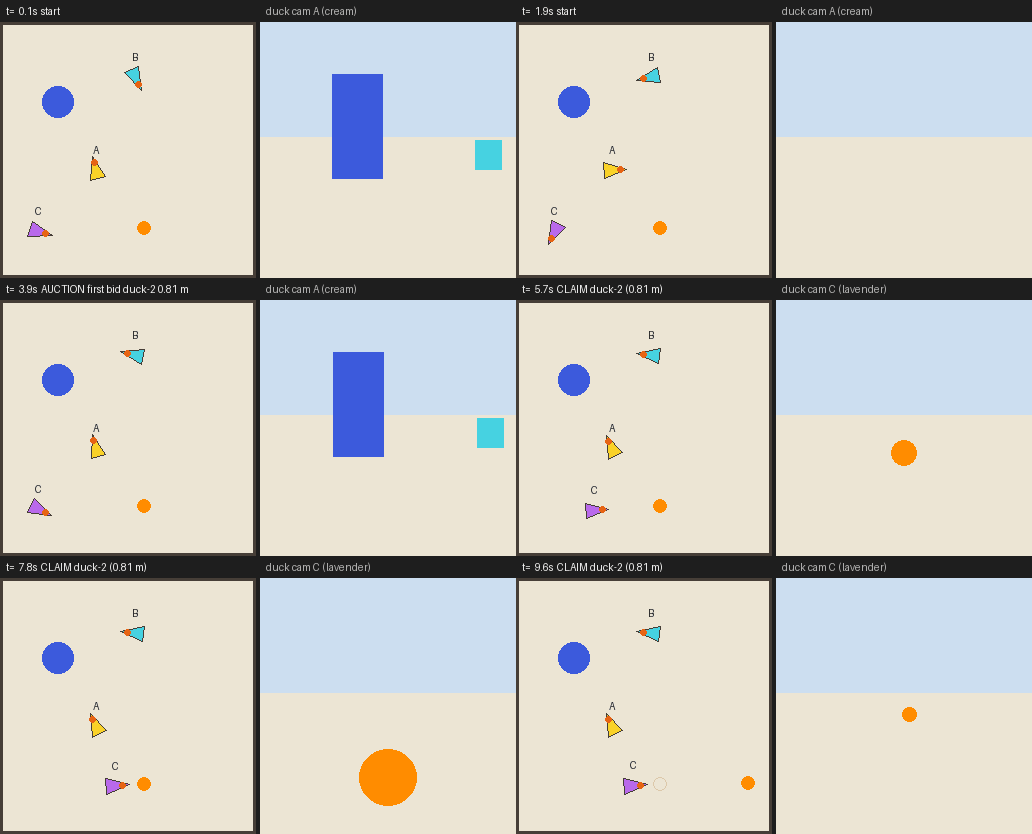
The first choreography: one flock, one auction, one kicker. Scripted planner, deterministic coordinator. Every message is in the transcript.
The interesting part is not the kick, it is the talking. The ducks coordinate over an in process bus with eight message kinds (TASK, BID, CLAIM, ROLE, HINT, VERDICT, HB and RESULT), every one logged in flock.jsonl, and a deterministic Contract Net auction decides which duck acts, from each duck's own camera distance estimate. Every action goes through verbs the duck already has, so the machinery is task agnostic and what a flock can do is bounded by its skills, not by the ball. The kick is simply the first choreography written on top: split the search, auction, one actor, with the target label configurable. The LLM contributes at most one planning call per run, and each duck still enforces the .duck contract on itself. The outcome is judged from sim ground truth, not from a model's claim. Add a flock: block to any .duck or pass --flock N (2 to 4 ducks), and give each named member its robot with robots: in a duck: 1 file or --robots <member>=<adapter>:<backend>,.... Simulator only for now (every member must be a sim2d backend), and the per duck pilots are deterministic rules, on purpose. Details: docs/flock.md.
The other headline demo, two robots under one contract. Since 0.4 a flock can mix bodies. In reachy-spots-duck-kicks a Reachy Mini head that can look but not walk and a Microduck that can walk and kick share one contract: bids carry a capability term, so each robot bids only for a role its manifest can fill, the head takes the spotter role and the duck the kicker role, the duck kicks and reports that it kicked, and the head judges from its own fresh frames whether the ball moved. Success needs the spotter's verdict and the simulator's ground truth to agree. Ten of ten seeds with the scripted pilots.
uvx quackd run reachy-spots-duck-kicks --provider fake --seed 3
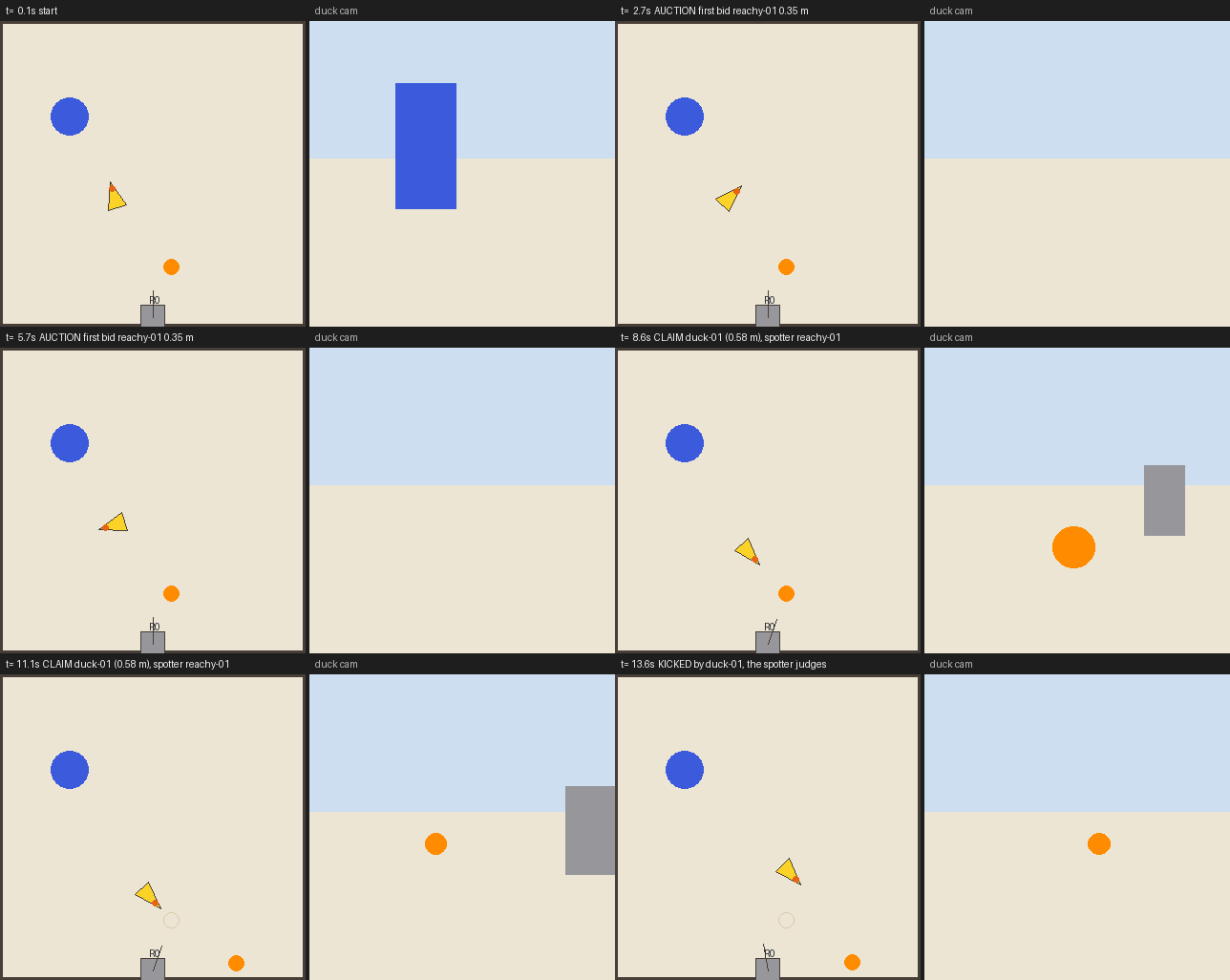
Two bodies, one contract. The head cannot walk and the duck cannot judge its own kick, so each does the half it can. Scripted pilots, deterministic coordinator, and the simulator's ground truth vetoes the verdict.
Configuration
| What | How |
|---|---|
| API keys | ANTHROPIC_API_KEY, OPENAI_API_KEY, GEMINI_API_KEY, XAI_API_KEY in the environment or a .env file (see .env.example) |
| Model | --model or QUACKD_MODEL. Defaults: claude-opus-5, gpt-5, gemini-2.5-pro, grok-4. The OpenAI, Gemini and Grok IDs are unverified, override them if yours differ |
| Claude reasoning effort | QUACKD_EFFORT (low to max, default medium). QUACKD_ANTHROPIC_FALLBACKS=0 disables server side refusal fallbacks |
| Local models | --provider ollama, vllm, llamacpp, lmstudio or local --base-url http://host:port/v1. No key. --model or the first served model. --vision sends frames. QUACKD_TOOL_CHOICE=auto, required or none for picky servers. See docs/local-llms.md |
| Robot | --robot <adapter>:<backend>, or a robots: line in the .duck, the flag wins. Default microduck:sim2d. quackd list-adapters lists the four that ship, quackd list-verbs --robot X what each can do |
| Determinism | --seed N makes a simulator run repeatable |
| Budgets | in the .duck. --max-steps overrides for one run |
| Human in the loop | verbs.confirm in the .duck prompts y/N. --yes auto accepts. MCP refuses gated verbs unless started with --yes |
| Dry run | --dry-run logs every intent and sends nothing |
| Real Microduck | --robot microduck:jsonrpc --address unix:///run/robotd.sock on the robot, or tcp://127.0.0.1:9870 after ssh -L 9870:/run/robotd.sock <robot> |
| Other real bodies | --robot reachy_mini:sdk --address reachy-mini.local:8000 (quackd[reachy]), --robot lerobot:real --address /dev/ttyACM0 (the arm's serial port, COM5 on Windows, quackd[lerobot], Python 3.12 or newer), --robot rosbridge:ws --address "ws://robot.local:9090?cmd_vel=/cmd_vel&odom=/odom&image=/camera/image/compressed" (quackd[rosbridge]). All three 🧪 like microduck:jsonrpc, none run against its target by us (docs/adapter-status.md) |
Performance
Measured on the simulator with the scripted pilot (no model latency): find-and-kick takes 3 to 8 verb steps, one model call each plus one to declare success, and under a second of loop wall clock per run across seeds 0 to 9 on a laptop (interpreter start and GIF rendering add a few seconds to the whole quackd run command), and simulated time runs as fast as the CPU allows. With a real model, each decision is one API call. The system prompt and the eight tool schemas together are about 5.7 k characters, roughly 1.5 to 2 k tokens by the usual characters per token rule of thumb, the per turn observation a few hundred characters (178 to 325 across those seeds), plus a 256 px PNG per observation for vision models, so a run is a handful of calls and the transcript records each provider's own usage per turn (the scripted pilot only estimates it from character counts). Model latency does not affect control: the steering loop runs at 10 Hz and the robot's own controllers (50 Hz on a Microduck) run regardless of how long the model thinks. That holds for local models too, where latency depends on your hardware and model size. The default install is about 250 MB, needs no GPU, and the simulator renders at 256 px (--gif-size for prettier GIFs).
Limitations
- The simulator is a cartoon on purpose. It tests the agent loop, not physics, and will not tell you whether a gait works.
- Nothing has run on a real robot of any kind.
microduck:jsonrpc,reachy_mini:sdk,lerobot:realandrosbridge:wsuse upstream names read from upstream source (the Reachy Mini, LeRobot and rosbridge names at pinned commits) and have only ever talked to fakes. On the Microduck, posture is inferred from the policy name (an assumption) and there is no camera snapshot over the socket yet. On the Reachy Mini the real camera is uncalibrated and there is no battery to enforce a battery abort against. On the arm,holdingis what was commanded, not sensed, loading a policy checkpoint is untested, and LeRobot's owndisconnect()releases torque at the end of a session by its default. On a rosbridge base there is no deadman we verified, so quackd's zero Twist is the only stop (docs/adapter-status.md). - The hero GIF is the scripted pilot, not an LLM, because this repository was built without an API key. The real model code paths are tested against stubbed SDK clients.
- Success is the model's own claim (
declare_success) on a solo run. In the simulator, tests also check ground truth, and a flock's success needs a member's kick report (or the spotter's verdict) and sim ground truth to agree: quackd vetoes a claimed kick the world did not record, and no model judges a flock at all. On hardware, the.duckbodies insist on verifying with a fresh frame. - No robot here has text to speech. The Microduck has seven duck sounds, so
quack("hello")andsaypick a tone. The Reachy Mini voicessayas its closest expressive sound and logs the text. The arm and the base have no voice, sosaydoes not exist on them. grabis open loop upstream and unreliable here on purpose.fetchsays so in its file.- A manifest can be smaller than the robot. The LeRobot arm's
realbackend claims no camera and nopickuntil it connects, and even thenpickappears only when a policy object was injected in code, never from the command line. A rosbridge base overwshas no camera verbs unless the address names an image topic. - Default model IDs for OpenAI, Gemini and Grok were not verified at release.
- Local model quality is unmeasured. The JSON text fallback and the one retry exist because small models often miss native tool calls. We have not run a live local server ourselves yet.
- Flock mode is simulator only, and two choreographies ship today (
flock-kick, where the closest duck acts on a target, andreachy-spots-duck-kicks, where a head spots and judges and a duck kicks), and 0.4 knows exactly two roles, spotter and kicker. The coordination machinery is general, the choreography library is not, yet. The per robot pilots are deterministic rules, the LLM contributes one planning call at most, separation uses sim ground truth, not perception, and two robots share no frame of reference on hardware: the spotter judges from its own frames, and the arena frame hints that choose the kicker's first turn exist only in the simulator. - LAN discovery and the MQTT bus have each been exercised once, on one machine. Nothing has crossed to a second machine, the MQTT bus is a library with no
--busflag, and a flock across machines also needs a clock across machines, which does not exist yet.
Why a task can refuse a body, whether two robots can share a task, and more: docs/faq.md.
Non goals for now, on purpose: no RL training or reward generation (that is v2, and only the registry hook exists), no features that require hardware (the real robot backends ship experimental and have never run: microduck:jsonrpc, reachy_mini:sdk, lerobot:real, rosbridge:ws), and no copying of Pollen Robotics assets, ever (no logos, no 3D meshes, no videos).
Roadmap
- Hardware: validated backends. The Microduck ships at Christmas 2026, so
jsonrpcagainst a realrobotdwaits for that, and thewebsocketstub waits for upstream to ship its WebSocket surface. A Reachy Mini, an SO-101 arm and a rosbridge base exist today, soreachy_mini:sdk,lerobot:realandrosbridge:wscan flip from 🧪 to ✅ sooner, one real run each: open an issue withquackd doctoroutput and the first lines oftranscript.jsonl(docs/adapter-status.md). - Flocks next: more choreographies from the verbs the ducks already have (a patrol that splits the area, a follow chain), a clock that crosses machines so the MQTT bus shipped in 0.4 (library only, docs/lan.md) can carry a flock across a room instead of a process, and hardware flocks once Microducks ship.
- More bodies: whichever robots people own. An adapter is a manifest and a mock, about a day (docs/adapters.md).
- Talk to it from anywhere: the MCP server speaks
stdiotoday, so it is a local subprocess of Claude Code or Claude Desktop. An HTTP or SSE transport would make it a remote connector, which is what a phone talks to. That needs a long lived process, a reachable address and auth the server does not have yet (docs/mcp.md). - v1: the five Microduck starter tasks on a real duck, on video.
- v2, learned verbs. LLM written rewards (Eureka and DrEureka style) train new policies in
microduck_rlthat register as one more verb. The registry hook exists today. The training loop does not.
Help wanted: a real model find-and-kick recording (one command, needs a key, see docs/assets), a transcript from a local model run on any server, a jsonrpc run against real hardware, verified default model IDs, and new .duck files.
Contributing
Add your .duck to ducks/. PRs welcome. That is the community funnel and the number we actually care about. Adding a verb to a robot is one function plus one manifest entry. Both are described in CONTRIBUTING.md, and design decisions live in docs/adr/. Tests run with no network and no keys: uv sync --extra dev && uv run pytest.
Safety
Run on the floor, not a table. Keep pets and kids clear of kick. On hardware the gamepad preempts remote control and robotd is the safety authority. quackd adds a heartbeat, a kill switch (Ctrl+C or q), allowlists, confirmation gates and budgets on top, see docs/safety.md. You are responsible for your robot.
Acknowledgements
They built the duck. quackd is the brain. Thanks to Pollen Robotics for microduck (the onboard daemon stack and its JSON RPC contract) and microduck_rl (the training stack behind the policies the robot runs), to the MCP Python SDK, and to the authors of DrEureka for the idea behind learned verbs. Community: the Pollen Robotics Discord linked from the upstream README.
quackd is an independent community project, not affiliated with or endorsed by Pollen Robotics or Hugging Face. "Microduck" is used nominatively to describe compatibility. No Pollen Robotics assets are distributed here.
Star history
License
Apache 2.0, like the upstream projects. Third party and asset licenses (including why the robot's CC BY NC SA meshes are never vendored) are in docs/licenses.md and NOTICE.