RVM — The Virtual Machine Built for the Agentic Age








Agents don't fit in VMs. They need something that understands how they think.
19 runtime and library crates, plus integration and benchmark packages. RVM automatically detects new Claude Code releases, runs its release workflow, and publishes nightly builds. See Releases | User Guide | pi.ruv.io
Part of the RuVector ecosystem. Uses RuVix kernel primitives and RVF package format. Designed for Cognitum Seed, Appliance, and future chip targets.
Traditional hypervisors were built for an era of static server workloads — long-running VMs with predictable resource needs. AI agents are different. They spawn in milliseconds, communicate in dense, shifting graphs, share context across trust boundaries, and die without warning. VMs are the wrong abstraction.
RVM replaces VMs with coherence domains — lightweight, graph-structured partitions whose isolation, scheduling, and memory placement are driven by how agents actually communicate. When two agents start talking more, RVM moves them closer. When trust drops, RVM splits them apart. Every mutation is proof-gated. Every action is witnessed. The system understands its own structure.
Agent swarm → [RVM Coherence Engine] → Optimal Placement → Witness Proof
                    ↑                                            │
                    └──── Agent Communication Graph ─────────────┘
                          (< 50µs adaptive re-partitioning)
No KVM. No Linux. No VMs. Bare-metal Rust. Built for agents.
Traditional VM:     VM₁  VM₂  VM₃  VM₄    (static, opaque boxes — agents don't fit)
                    ─────────────────────
RVM:                ┌─A──B─┐  ┌─C─┐  D    (dynamic, agent-driven domains)
                    │  ↔   │──│ ↔ │──↔    (edges = agent communication weight)
                    └──────┘  └───┘        (auto-split when trust or coupling changes)
What Agents Need vs What They Get
| What Agents Need | VMs / Containers | RVM |
|---|---|---|
| Sub-millisecond spawn | Seconds to boot | < 10µs partition switch |
| Dense, shifting comms graph | Static NIC-to-NIC | Graph-weighted CommEdges, auto-rebalanced |
| Shared context with isolation | All or nothing | Capability-gated shared memory, proof-checked |
| Per-agent fault containment | Whole-VM crash | F1–F4 graduated rollback, no reboot needed |
| Auditable every action | External log bolted on | 64-byte witness on every syscall, hash-chained |
| Hibernate and reconstruct | Kill and restart | Dormant tier → rebuilt from witness log |
| Run on 64KB MCUs | Needs gigabytes | Seed profile: 64KB–1MB, capability-enforced |
Why RVM?
Dynamic Re-isolation and Self-Healing Boundaries. Because RVM uses graph-theoretic mincut algorithms, it can dynamically restructure its isolation boundaries to match how workloads actually communicate. If an agent in one partition begins communicating heavily with an agent in another, RVM automatically triggers a partition split and migrates the agent to optimise placement — no manual configuration. No existing hypervisor can split or merge live partitions along a graph-theoretic cut boundary.
Memory Time Travel and Deep Forensics. Traditional virtual memory permanently overwrites state or blindly swaps it to disk. RVM stores dormant memory as a checkpoint combined with a delta-compressed witness trail. Any historical state can be perfectly rebuilt on demand — days or weeks later — because every privileged action is recorded in a tamper-evident, hash-chained witness log. External forensic tools can reconstruct past states to answer precise questions such as "which task mutated this vector store between 14:00 and 14:05 on Tuesday?"
Targeted Fault Rollback Without Global Reboots. When the kernel detects a coherence violation or memory corruption it does not crash. Instead it finds the last known-good checkpoint, replays the witness log, explicitly skips the mutation that caused the failure, and resumes from a corrected state (DC-14, failure classes F1–F3).
Deterministic Multi-Tenant Edge Orchestration. Existing edge orchestrators rely on Linux-based VMs or containers, inheriting scheduling unpredictability and no guarantee of bounded latency with provable isolation. RVM enables scenarios such as an autonomous vehicle where safety-critical sensor-fusion agents (Reflex mode, < 10 µs switch) are strictly isolated from low-priority infotainment agents, or a smart factory floor running hard real-time PLC control loops safely alongside ML inference agents.
High-Assurance Security on Extreme Microcontrollers. Through its Seed hardware profile (ADR-138), RVM brings capability-enforced isolation, proof-gated execution, and witness attestation to deeply constrained IoT devices with as little as 64 KB of RAM. Delivering this level of zero-trust, auditable security on microcontroller-class hardware is a novel capability not provided by any existing embedded operating system.
Architecture
+----------------------------------------------------------+
|                       rvm-kernel                         |
|                                                          |
|  +-----------+  +-----------+  +------------+            |
|  | rvm-boot  |  | rvm-sched |  | rvm-memory |            |
|  +-----+-----+  +-----+-----+  +------+-----+            |
|        |              |               |                   |
|  +-----+--------------+---------------+------+            |
|  |               rvm-partition               |            |
|  +-----+---------+-----------+----------+----+            |
|        |         |           |          |                 |
|  +-----+--+ +---+------+ +--+-----+ +--+--------+        |
|  | rvm-cap| |rvm-witness| |rvm-proof| |rvm-security|     |
|  +-----+--+ +---+------+ +--+-----+ +--+--------+        |
|        |         |           |          |                 |
|  +-----+---------+-----------+----------+----+            |
|  |               rvm-types                   |            |
|  +-----+-------------------------------------+            |
|        |                                                  |
|  +-----+--+  +----------+  +-------------+               |
|  | rvm-hal|  | rvm-wasm |  |rvm-coherence|               |
|  +--------+  +----------+  +-------------+               |
+----------------------------------------------------------+
Layer 4: Persistent State
         witness log │ compressed dormant memory │ RVF checkpoints
         ─────────────────────────────────────────────────────────
Layer 3: Execution Adapters
         bare partition │ WASM partition │ service adapter
         ─────────────────────────────────────────────────────────
Layer 2: Coherence Engine (OPTIONAL — DC-1)
         graph state │ mincut │ pressure scoring │ migration
         ─────────────────────────────────────────────────────────
Layer 1: RVM Core (Rust, no_std)
         partitions │ capabilities │ scheduler │ witnesses
         ─────────────────────────────────────────────────────────
Layer 0: Machine Entry (assembly, <500 LoC)
         reset vector │ trap handlers │ context switch
First-Class Kernel Objects
| Object | Purpose |
|---|---|
| Partition | Coherence domain container — unit of scheduling, isolation, and migration |
| Capability | Unforgeable authority token with 7 rights (READ, WRITE, GRANT, REVOKE, EXECUTE, PROVE, GRANT_ONCE) |
| Witness | 64-byte hash-chained audit record emitted by every privileged action |
| MemoryRegion | Typed, tiered, owned memory (Hot/Warm/Dormant/Cold) with move semantics |
| CommEdge | Inter-partition communication channel — weighted edge in the coherence graph |
| DeviceLease | Time-bounded, revocable hardware device access |
| CoherenceScore | Graph-derived locality and coupling metric |
| CutPressure | Isolation signal — high pressure triggers migration or split |
| RecoveryCheckpoint | State snapshot for rollback and reconstruction |
Crate Structure
| Crate | Purpose |
|---|---|
rvm-types | Foundation types: addresses, IDs, capabilities, witness records, coherence scores |
rvm-hal | Platform-agnostic hardware abstraction traits (MMU, timer, interrupts) |
rvm-cap | Capability-based access control with derivation trees and three-tier proof |
rvm-witness | Append-only witness trail with hash-chain integrity |
rvm-proof | Proof-gated state transitions (P1/P2/P3 tiers), TEE pipeline, cryptographic signers (Ed25519, HMAC-SHA256) |
rvm-partition | Partition lifecycle, split/merge, capability tables, communication edges |
rvm-sched | Coherence-weighted 2-signal scheduler (deadline urgency + cut pressure) |
rvm-memory | Guest physical address space management with tiered placement |
rvm-coherence | Unified coherence engine: graph, mincut, scoring, pressure, adaptive, pluggable backends, edge decay |
rvm-boot | Deterministic 7-phase boot sequence with witness gating |
rvm-wasm | Optional WebAssembly guest runtime |
rvm-security | Unified security gate: capability check + proof verification + witness log |
rvm-kernel | Full integration: coherence engine, IPC→graph feeding, scheduler, split/merge, security gates, tier management |
rvm-gpu | GPU compute subsystem: device, context, kernel, buffer, queue, budget (optional, feature-gated) |
rvm-rvf | RVF loader for RVForge packages: manifest verification, per-segment verification, capability mapping, identity preservation (ADR-155) |
rvm-anchor | Verifies external evaluation receipts and anchors their commitments into the RVM witness chain (ADR-156) |
rvm-host | Per-OS adapters and isolation mechanisms: picks the strongest available isolation, places the agent, spawns it |
rvm-launch | Instance lifecycle over the adapters: inspect, verify, run, suspend, resume, checkpoint, witness, terminate (ADR-289) |
rvm-context | Capability-governed ruv:// names, immutable RVF revisions, CAS aliases, progressive views, and epoch receipts (ADR-157) |
rvm-context-service | Encrypted REDB persistence, exact-scope RuVector retrieval, receipt draining, canonical RVF compilation, and TLS/MCP/CLI hosting (ADR-158) |
Dependency Graph
rvm-types (foundation, no deps)
    ├── rvm-hal
    ├── rvm-cap
    ├── rvm-witness
    ├── rvm-proof ← rvm-cap + rvm-witness
    ├── rvm-partition ← rvm-hal + rvm-cap + rvm-witness
    ├── rvm-sched ← rvm-partition + rvm-witness
    ├── rvm-memory
    ├── rvm-coherence ← rvm-partition + rvm-sched [OPTIONAL]
    ├── rvm-boot ← rvm-hal + rvm-partition + rvm-witness + rvm-sched + rvm-memory
    ├── rvm-wasm ← rvm-partition + rvm-cap + rvm-witness [OPTIONAL]
    ├── rvm-security ← rvm-witness
    ├── rvm-gpu
    ├── rvm-rvf ← rvm-cap + rvm-witness
    ├── rvm-anchor ← rvm-witness
    ├── rvm-host ← rvm-cap + rvm-witness + rvm-partition + rvm-wasm + rvm-rvf
    ├── rvm-launch ← rvm-witness + rvm-wasm + rvm-rvf + rvm-host
    ├── rvm-context ← rvm-cap + rvm-witness + rvm-proof + rvm-rvf
    └── rvm-kernel ← rvm-hal + rvm-cap + rvm-witness + rvm-proof +
                     rvm-partition + rvm-sched + rvm-memory + rvm-coherence +
                     rvm-boot + rvm-wasm + rvm-security + rvm-gpu
Build
# Check (no_std by default)
cargo check

# Run workspace library tests
cargo test --workspace --lib

# Run Criterion benchmarks
cargo bench

# Build with std support
cargo check --features std

# Cross-compile for AArch64 bare-metal
rustup target add aarch64-unknown-none
make build    # or: cargo build --target aarch64-unknown-none -p rvm-kernel --release

# Boot on QEMU (requires qemu-system-aarch64)
make run      # boots at 0x4000_0000, PL011 UART output
Design Constraints (ADR-132 through ADR-140)
| ID | Constraint | Status |
|---|---|---|
| DC-1 | Coherence engine is optional; system degrades gracefully | Implemented — adaptive engine, static fallback |
| DC-2 | MinCut budget: 50 µs per epoch | Implemented — Stoer-Wagner with iteration budget, ~331ns measured |
| DC-3 | Capabilities are unforgeable, monotonically attenuated | Implemented — constant-time P1, 4096-nonce ring |
| DC-4 | 2-signal priority: deadline_urgency + cut_pressure_boost | Implemented |
| DC-5 | Three systems cleanly separated (kernel + coherence + agents) | Enforced — feature-gated |
| DC-6 | Degraded mode when coherence unavailable | Implemented — enter/exit with witnesses, scheduler zeroes CutPressure |
| DC-7 | Migration timeout enforcement (100 ms) | Implemented — MigrationTracker with auto-abort |
| DC-8 | Capabilities follow objects during partition split | Implemented — scored region assignment |
| DC-9 | Coherence score range [0.0, 1.0] as fixed-point | Implemented — u16 basis points |
| DC-10 | Epoch-based witness batching (no per-switch records) | Implemented |
| DC-11 | Merge requires coherence above threshold + adjacency + resources | Implemented — 3-check validation |
| DC-12 | Max 256 physical VMIDs, multiplexed for >256 partitions | Implemented |
| DC-13 | WASM is optional; native bare partitions are first class | Enforced |
| DC-14 | Failure classes: transient, recoverable, permanent, catastrophic | Implemented — F1-F4 with escalation |
| DC-15 | All types are no_std, forbid(unsafe_code), deny(missing_docs) | Enforced |
Benchmarks (All ADR Targets Exceeded)
| Operation | ADR Target | Measured | Ratio |
|---|---|---|---|
| Witness emit | < 500 ns | ~17 ns | 29x faster |
| P1 capability verify | < 1 µs | < 1 ns | >1000x faster |
| P2 proof pipeline | < 100 µs | ~996 ns | 100x faster |
| Partition switch (stub) | < 10 µs | ~6 ns | 1600x faster |
| MinCut 16-node | < 50 µs | ~331 ns | 150x faster |
| Coherence score (16-node) | budgeted | ~84 ns | — |
| Buddy alloc/free cycle | fast | ~184 ns | — |
| FNV-1a hash (64 bytes) | fast | ~28 ns | — |
| Security gate P1 | fast | ~17 ns | — |
| Witness chain verify (64 records) | fast | ~892 ns | — |
| GPU context create | < 20 ns | ~2.2 ns | 9x faster |
| GPU launch config validate | < 10 ns | ~0.26 ns | 38x faster |
| GPU queue enqueue | < 30 ns | ~0.26 ns | 115x faster |
| GPU budget reset | < 10 ns | ~1.0 ns | 10x faster |
Run cargo bench for full criterion results with HTML reports.
Implementation Status
The numeric counts below are the repository's legacy documented snapshot, not release evidence for this change. Newer crates are listed without invented counts; use the current CI run for authoritative test results. ADR-157 keeps its acceptance evidence marked planned until that run is attached.
| Crate | Tests | Key Features |
|---|---|---|
rvm-types | ~40 types | 64-byte WitnessRecord (compile-time asserted), ~40 ActionKind variants, 34 error variants |
rvm-hal | 16 | AArch64 EL2: stage-2 page tables, PL011 UART, GICv2, ARM generic timer |
rvm-cap | 40 | Constant-time P1, nonce ring (4096 + watermark), P3 derivation chain verification, epoch revocation |
rvm-witness | 29 | SHA-256 hash chain (FNV-1a fallback), HMAC-SHA256 signing, 16MB ring buffer, StrictSigner, RLE-compressed replay |
rvm-proof | 45 | Proof engine, context builder, constant-time P2 (all 6 rules), P3 deep verification (SHA-256 + Merkle + WitnessSigner), TEE pipeline, Ed25519/HMAC-SHA256/DualHmac signers |
rvm-partition | 86 | Lifecycle state machine, IPC message queues, device leases, scored split/merge, remove() |
rvm-sched | 49 | 2-signal priority, SMP coordinator, VMID-aware switch, SwitchContext::init(), degraded fallback |
rvm-memory | 110 | Buddy allocator with coalescing, 4-tier management, LZ4-style RLE compression, reconstruction |
rvm-coherence | 59 | Unified coherence engine, pluggable MinCut/Coherence backends, edge decay, bridge to ruvector |
rvm-boot | 26 | 7-phase measured boot, attestation digest, HAL init, entry point |
rvm-wasm | 33 | 7-state agent lifecycle, HostContext trait, section parser (13 section types), migration |
rvm-rvf | — | Full-container identity, structural and segment checks, capability mapping, verified-package boundary |
rvm-anchor | — | External receipt verification and domain-separated witness anchoring |
rvm-security | 45 | Unified security gate (P1/P2/P3), SignedSecurityGate with per-link signature verification, input validation, attestation chain, DMA budget |
rvm-host | — | Isolation selection and placement for verified RVF packages |
rvm-launch | — | Verified instance lifecycle, checkpoint lineage, and witnessed refusals |
rvm-context | — | Strict ruv:// parser, live capability scopes, immutable RVF objects, CAS aliases, views, and epoch receipts |
rvm-kernel | 62 | Full integration: IPC→coherence, scheduler, split/merge, security gates, degraded mode, device leases, tier mgmt |
rvm-gpu | 65 | Device/context/kernel/buffer/queue management, 4-dimensional budget, coherence acceleration configs |
| Integration | 48 | 17 e2e scenarios: agent lifecycle, split pressure, memory tiers, cap chain, boot timing |
| Benchmarks | 21 | Criterion benchmarks for all performance-critical paths |
| Legacy documented total | 945 | Excludes rows marked —; consult current CI for pass/fail evidence |
Security Audit Results
11 findings from formal security review, 8 fixed in code:
| Severity | Finding | Status |
|---|---|---|
| Critical | P1 timing side channel | Fixed — constant-time bitmask |
| High | Revocation didn't invalidate descendants | Fixed — iterative subtree sync |
| High | Cross-partition host memory overlap | Fixed — global overlap check |
| Medium | Generation counter wrap aliasing | Fixed — skip gen 0 |
| Medium | next_id overflow | Fixed — checked_add |
| Medium | Recursive revoke stack overflow | Fixed — iterative stack |
| Medium | Incomplete merge preconditions | Fixed — full validation |
| Low | Terminated agent slots never freed | Fixed — set None |
| Medium | Nonce ring too small (64) | Fixed — upgraded to 4096 + watermark |
| Medium | TOCTOU in quota check | Fixed — atomic check_and_record |
| Low | NullSigner always-true | Fixed — StrictSigner + deprecation |
🔍 RVM vs State of the Art (12 differences)
| RVM | KVM/Firecracker | seL4 | Theseus OS | |
|---|---|---|---|---|
| Primary abstraction | Coherence domains (graph-partitioned) | Virtual machines | Processes + capabilities | Cells (intralingual) |
| Isolation driver | Dynamic mincut + cut pressure | Hardware EPT/NPT | Formal verification + caps | Rust type system |
| Scheduling signal | Structural coherence (graph metrics) | CPU time / fairness | Priority / round-robin | Cooperative |
| Memory model | 4-tier reconstructable (Hot/Warm/Dormant/Cold) | Demand paging | Untyped memory + retype | Single address space |
| Audit trail | Witness-native (64B hash-chained records) | External logging | Not built-in | Not built-in |
| Mutation control | Proof-gated (3-layer: P1/P2/P3) | Unix permissions | Capability tokens | Rust ownership |
| Partition operations | Live split/merge along graph cuts | Not supported | Not supported | Not supported |
| Linux dependency | None — bare-metal | Yes (KVM is a kernel module) | None | None |
| Language | 95-99% Rust, <500 LoC assembly | C | C + Isabelle/HOL proofs | Rust |
| Target | Edge, IoT, agents | Cloud servers | Safety-critical | Research |
| Boot time | < 250ms to first witness | ~125ms (Firecracker) | Varies | N/A |
| Partition switch | < 10µs | ~2-5µs (VM exit) | ~0.5-1µs (IPC) | N/A (no isolation) |
✨ 6 Novel Capabilities (No Prior Art)
1. Kernel-Level Graph Control Loop
No existing OS uses spectral graph coherence metrics as a scheduling signal. RVM's coherence engine runs mincut algorithms in the kernel's scheduling loop — graph structure directly drives where computation runs, when partitions split, and which memory stays resident.
2. Reconstructable Memory ("Memory Time Travel")
RVM explicitly rejects demand paging. Dormant memory is stored as witness checkpoint + delta compression, not raw bytes. The system can deterministically reconstruct any historical state from the witness log.
3. Proof-Gated Infrastructure
Every state mutation requires a valid proof token verified through a three-tier system: P1 capability (<1µs), P2 policy (<100µs), P3 deep derivation chain verification (walks tree to root, validates ancestor integrity + epoch monotonicity).
4. Witness-Native OS
Every privileged action emits a fixed 64-byte, SHA-256 hash-chained record with HMAC-SHA256 signatures. Tamper-evident by construction. Full deterministic replay from any checkpoint.
5. Live Partition Split/Merge
Partitions split along graph-theoretic cut boundaries and merge when coherence rises. Capabilities follow ownership (DC-8), regions use weighted scoring (DC-9), merges require 7 preconditions (DC-11).
6. Edge Security on 64KB RAM
Capability-based isolation, proof-gated execution, and witness attestation on microcontroller-class hardware (Cortex-M/R, 64KB RAM).
🎯 Success Criteria (v1)
| # | Criterion | Target |
|---|---|---|
| 1 | Workspace runtime crates preserve their declared no_std and safe-Rust policies | CI gate |
| 2 | Cold boot to first witness | < 250ms on Appliance hardware |
| 3 | Hot partition switch | < 10 microseconds |
| 4 | Witness record is exactly 64 bytes, cache-line aligned | Compile-time asserted |
| 5 | Capability derivation depth bounded at 8 levels | Enforced |
| 6 | EMA coherence filter operates without floating-point | Implemented |
| 7 | Boot sequence is deterministic and witness-gated | Implemented |
| 8 | Remote memory traffic reduction ≥ 20% vs naive placement | Target |
| 9 | Fault recovery without global reboot (F1–F3) | Target |
🏗️ Implementation Phases
Phase 1: Foundation (M0-M1) — "Can it boot and isolate?"
- M0: Bare-metal Rust boot on QEMU AArch64 virt. Reset → EL2 → serial → MMU → first witness.
- M1: Partition + capability model. Create, destroy, switch. Simple deadline scheduler.
Phase 2: Differentiation (M2-M3) — "Can it prove and witness?"
- M2: Witness logging (64-byte chained records) + P1/P2 proof verifier.
- M3: 2-signal scheduler (deadline + cut_pressure). Flow + Reflex modes. Zero-copy IPC.
Phase 3: Innovation (M4-M5) — "Can it think about coherence?"
- M4: Dynamic mincut integration (DC-2 budget). Live coherence graph. Migration triggers.
- M5: Memory tier management. Reconstruction from dormant state.
Phase 4: Expansion (M6-M7) — "Can agents run on it?"
- M6: WASM agent runtime adapter. Agent lifecycle.
- M7: Seed/Appliance hardware bring-up. All success criteria.
🔐 Security Model
Capability-Based Authority. All access controlled through unforgeable kernel-resident tokens. No ambient authority. Seven rights with monotonic attenuation.
Proof-Gated Mutation. No memory remap, device mapping, migration, or partition merge without a valid proof token. Three tiers with strict latency budgets.
Witness-Native Audit. 64-byte records for every mutating operation. Hash-chained for tamper evidence. Deterministic replay from checkpoint + witness log.
Failure Classification. F1 (agent restart) → F2 (partition reconstruct) → F3 (memory rollback) → F4 (kernel reboot). Each escalation witnessed.
GPU Compute Support (ADR-144)
Overview
RVM provides capability-gated, proof-verified, witness-logged GPU compute access for partitions. GPU support is feature-gated — zero cost when disabled.
Quick Start
// Enable in Cargo.toml
// rvm-kernel = { features = ["gpu"] }

use rvm_kernel::gpu::{
    context::GpuContext,
    kernel::LaunchConfig,
    budget::GpuBudget,
    queue::{GpuQueue, QueueCommand},
    buffer::{GpuBuffer, BufferUsage},
    GpuTier, GpuStatus,
};
use rvm_types::PartitionId;

// Create a GPU context for a partition
let budget = GpuBudget::new(
    1_000_000_000,  // 1 second compute budget
    512 * 1024 * 1024,  // 512 MB memory
    1_000_000_000,  // 1 GB transfer budget
    1000,  // max 1000 kernel launches per epoch
);
let ctx = GpuContext::new(PartitionId::new(1), 0, budget);

// Configure a kernel launch (3D workgroups)
let config = LaunchConfig {
    workgroups: [64, 64, 1],      // 64x64 workgroups
    workgroup_size: [256, 1, 1],  // 256 threads each
    shared_memory_bytes: 16384,    // 16 KB shared memory
    timeout_ns: 100_000_000,       // 100ms timeout
};
assert!(config.validate().is_ok());
println!("Total threads: {}", config.total_threads()); // 1,048,576

// Create and manage GPU buffers
let buffer = GpuBuffer {
    id: BufferId::new(1),
    partition_id: PartitionId::new(1),
    size_bytes: 1024 * 1024,  // 1 MB
    usage: BufferUsage::Storage,
    host_mapped: false,
};
Backends
| Backend | Feature Flag | Platform | Use Case |
|---|---|---|---|
| CUDA | cuda | NVIDIA GPUs | ML inference, HPC |
| WebGPU | webgpu | Cross-platform | Portable compute |
| Metal | metal | Apple Silicon | macOS/iOS acceleration |
| OpenCL | opencl | Any GPU | Legacy hardware |
| Vulkan | vulkan | Any GPU | Low-level compute |
| WASM SIMD | wasm-simd | CPU only | Seed profile fallback |
Architecture
WASM Agent ──→ HostFunction::GpuLaunch ──→ SecurityGate ──→ GpuContext ──→ GPU
                                              │
                              CapRights::EXECUTE + WRITE
                              DmaBudget check
                              WitnessRecord emission
Security Model
- Capability-gated: requires
EXECUTE | WRITErights on device - IOMMU isolated: per-partition GPU page tables
- DMA budgeted: bytes transferred per epoch
- Witnessed: every kernel launch, transfer, and allocation logged
- Timeout enforced: kernel execution deadline (100ms default)
- Budget enforcement: 4 dimensions — compute time, memory, transfers, launches
Coherence Engine Acceleration
MinCut and scoring algorithms can be offloaded to GPU:
use rvm_gpu::accel::{GpuMinCutConfig, GpuScoringConfig};

let mincut_cfg = GpuMinCutConfig {
    max_nodes: 32,
    budget_iterations: 31,
    use_gpu: true,
};

let scoring_cfg = GpuScoringConfig {
    max_partitions: 256,
    use_gpu: true,
};
Source
GPU compute is powered by cuda-rust-wasm (source), providing CUDA→Rust transpilation with WebGPU/Metal/Vulkan backends. Full source available in the cuda-wasm/ submodule.
See ADR-144 for the complete architecture decision record.
🖥️ Target Platforms
| Platform | Profile | RAM | Coherence Engine | WASM |
|---|---|---|---|---|
| Seed | Tiny, persistent, event-driven | 64KB–1MB | No (DC-1) | Optional |
| Appliance | Edge hub, deterministic orchestration | 1–32GB | Yes (full) | Yes |
| Chip | Future Cognitum silicon | Tile-local | Hardware-assisted | Yes |
📚 ADR References
| ADR | Topic |
|---|---|
| ADR-132 | RVM top-level architecture and 15 design constraints |
| ADR-133 | Partition object model and split/merge semantics |
| ADR-134 | Witness schema and log format (64-byte records) |
| ADR-135 | Three-tier proof system (P1/P2/P3) |
| ADR-136 | Memory hierarchy and reconstruction |
| ADR-137 | Bare-metal boot sequence |
| ADR-138 | Seed hardware bring-up |
| ADR-139 | Appliance deployment model |
| ADR-140 | Agent runtime adapter |
| ADR-141 | Coherence engine kernel integration and runtime pipeline |
| ADR-142 | TEE-backed cryptographic verification (SHA-256, Ed25519, HMAC-SHA256, TEE pipeline) |
| ADR-143 | Nightly verified release pipeline |
| ADR-144 | GPU compute support via cuda-rust-wasm |
| ADR-145 | IPC protocol semantics |
| ADR-146 | SMP scheduling model |
| ADR-147 | Hardware abstraction layer contract |
| ADR-148 | Error model and recovery state machine |
| ADR-149 | RVF integration for RVM |
| ADR-150 | Device lease lifecycle protocol |
| ADR-151 | GPU witness event registry |
| ADR-152 | GPU MinCut correctness model |
| ADR-153 | Multi-node mesh protocol |
| ADR-154 | Formal verification roadmap |
| ADR-155 | RVF execution contract for RVForge packages |
| ADR-156 | External receipt anchoring into the witness chain |
| ADR-157 | Capability-governed ruv:// context namespace |
| ADR-158 | Durable hosted ruv:// context service |
🔧 Development
Prerequisites
- Rust 1.77+ with
aarch64-unknown-nonetarget - QEMU 8.0+ (for AArch64 virt machine emulation)
rustup target add aarch64-unknown-none
brew install qemu  # macOS
Project Conventions
#![no_std]everywhere — the kernel runs on bare metal#![forbid(unsafe_code)]where possible;unsafeblocks audited and commented#![deny(missing_docs)]— every public API documented- Move semantics for memory ownership (
OwnedRegion<P>is non-copyable) - Const generics for fixed-size structures (no heap allocation in kernel paths)
- Every state mutation emits a witness record
📖 User Guide & Tutorial
Quick Start (5 Minutes)
# 1. Clone and verify (--recurse-submodules pulls ruvector + rudevolution)
git clone --recurse-submodules https://github.com/ruvnet/rvm.git && cd rvm
cargo test --workspace --lib    # Run the current workspace library suite

# 2. Run benchmarks
cargo bench -p rvm-benches      # Criterion benchmark suite

# 3. Build for bare metal
rustup target add aarch64-unknown-none
cargo install cargo-binutils && rustup component add llvm-tools
make build                      # AArch64 release binary

# 4. Boot in QEMU
brew install qemu               # macOS (or apt install qemu-system-aarch64)
make run                        # Boots at 0x4000_0000, PL011 UART output

# 5. Use as a library
# Add to Cargo.toml: rvm-kernel = { path = "crates/rvm-kernel" }
use rvm_kernel::{
types, hal, cap, witness, proof, partition,
sched, memory, coherence, boot, wasm, security,
};Full User Guide
The userguide/ directory contains 16 numbered chapters covering
the kernel, artifact, and governed-context subsystems:
| Chapter | Topic |
|---|---|
| 01 Quick Start | Build, test, and boot in 5 minutes |
| 02 Core Concepts | Partitions, capabilities, witnesses, proofs, coherence |
| 03 Architecture | Layer diagram, data flow, boot sequence, feature flags |
| 04 Crate Reference | Workspace crate types, APIs, and dependencies |
| 05 Capabilities & Proofs | 7 rights, delegation trees, 3 proof tiers, TEE |
| 06 Witness & Audit | 64-byte records, hash chains, signing, querying |
| 07 Partitions & Scheduling | Lifecycle, IPC, split/merge, 2-signal scheduler |
| 08 Memory Model | 4 tiers, buddy allocator, reconstruction |
| 09 WASM Agents | Module validation, 7-state lifecycle, migration |
| 10 Security | 3-stage gate, attestation, audit results |
| 11 Performance | Benchmark methodology, build profiles, tuning |
| 12 Bare Metal | Linker script, QEMU, measured boot, Seed/Appliance |
| 13 Advanced & Exotic | 6 novel capabilities, fault rollback, RuVector |
| 14 Troubleshooting | 12 categories of common issues |
| 15 Glossary | 60+ terms with cross-references |
16 Governed ruv:// Context | Canonical names, capabilities, immutable RVF revisions, CAS aliases, views, and receipts |
| Cross-Reference | Concept index, API finder, "I want to..." tasks |
🔌 MCP Documentation Tools
RVM ships with an MCP (Model Context Protocol) server and CLI for AI-assisted documentation search and navigation.
Installation
cd userguide/mcp
npm install && npm run build
Register with Claude Code
claude mcp add rvm-docs -- node /path/to/rvm/userguide/mcp/dist/index.jsMCP Tools (6 tools)
| Tool | Description | Example |
|---|---|---|
docs_search | Full-text keyword search across all docs | { "query": "witness chain" } |
docs_navigate | Browse table of contents or read a chapter | { "chapter": "05" } |
docs_xref | Find all cross-references for a concept | { "concept": "coherence" } |
docs_glossary | Look up a term definition | { "term": "partition" } |
docs_api | Find documentation for an RVM type/function | { "symbol": "SecurityGate" } |
docs_howto | Task-oriented "I want to..." search | { "task": "build rvm" } |
CLI Usage
cd userguide/mcp
node dist/cli.js search "capability"      # Full-text search
node dist/cli.js nav                       # Table of contents
node dist/cli.js nav 05                    # Read chapter 05
node dist/cli.js xref "witness"            # Cross-references
node dist/cli.js glossary "partition"       # Term lookup
node dist/cli.js api "CapToken"            # API documentation
node dist/cli.js howto "build rvm"         # Task-oriented guide
Shorthand Aliases
node dist/cli.js s "proof"    # search
node dist/cli.js n 03         # navigate
node dist/cli.js x "memory"   # xref
node dist/cli.js g "EMA"      # glossary
node dist/cli.js a "verify"   # api
node dist/cli.js h "deploy"   # howto
Governed ruv:// Context
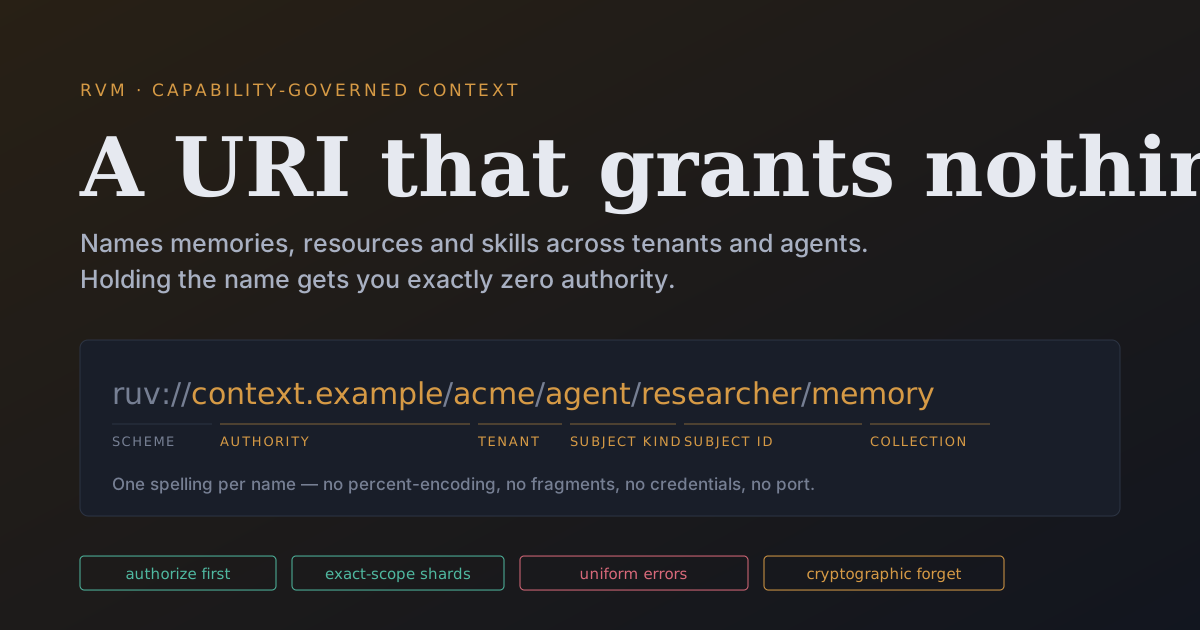
→ Read the illustrated guide — why ambient authority breaks down for agents, how the namespace works, and how to wire it up.
In plain terms
Almost every system decides access the same way: you name a thing, the system works out who you are, then it decides. Your authority is ambient — it surrounds your identity and applies to anything you can name. Unix permissions work like this. So do database row filters and most role-based access layers.
That has a failure mode with a name and a sixty-year history: the confused deputy. Something holding more authority than its caller gets talked into spending that authority on the caller's behalf. It isn't compromised and isn't buggy in any local sense — it simply can't tell which of its powers the request was entitled to, because the request only carried a name, and anyone can write a name down.
Agents make this sharp. An agent is a deputy: it holds tools, credentials, and memory, and it takes instructions from text it just retrieved — text someone else may have authored. If naming a resource is enough to reach it, then any string that reaches the model is a possible instruction to reach it.
ruv:// separates the two things ambient systems fuse:
- The name is inert. A
ruv://URI is just an address. Parsing one grants nothing. Resolving a skill does not execute it. You can paste one in a ticket without leaking access. - The right arrives separately. A capability handle is handed over deliberately, can be narrowed on the way, and can be revoked. It never travels in the URI and never appears in ordinary logs.
- The check happens first. Authorization and its witness record run before the resolver or the search index is touched — not after, and not as a filter on results.
So an agent that talks itself into naming another tenant's memory gets nothing back. Not an empty filtered result — nothing, from a backend that was never asked.
| Instead of | Which fails because | ruv:// |
|---|---|---|
| A token in the URL | The URL is the credential — it leaks via logs, referrers, screenshots | Handles never appear in the URI |
| Checking the ACL after lookup | Existence leaks through timing and errors that differ by cause | Authorization precedes the resolver; four causes return one identical error |
WHERE tenant_id = ? | One forgotten clause is a breach; every query still traverses everyone's data | A separate physical index per scope — isolation is a different file, not a filter |
| Path-prefix tenancy | /project silently captures /project-archive | Segment-wise matching; text prefixes are never used |
| Soft-deleting a row | The bytes remain and "deleted" is a flag anything can ignore | Destroy the per-object key; the ciphertext becomes noise for everyone |
The contract
rvm-context adds a canonical logical namespace for resources, memories, and
skills while keeping authority in live RVM capabilities:
# Mutable, human-friendly alias
ruv://context.example/acme/agent/researcher/skills/web-search?view=overview

# Immutable citation to the complete RVF bytes
ruv://context.example/acme/agent/researcher/skills/web-search?rev=sha256:aaaaaaaaaaaaaaaaaaaaaaaaaaaaaaaaaaaaaaaaaaaaaaaaaaaaaaaaaaaaaaaa&view=content| Property | Contract |
|---|---|
| Identity | A pinned revision is SHA-256 over the complete RVF byte stream |
| Authority | Capability handle and exact namespace grant travel out of band; a URI never grants access |
| Retrieval boundary | Authorization and its witness record occur before resolver access or search enumeration |
| Mutation | Pinned bytes are immutable; versionless aliases advance by full-snapshot compare-and-swap |
| Representation | Abstract, overview, and content views are digest-bound through a profile in the existing RVF PROFILE segment |
| Execution | Reading a skill never executes it; EXECUTE requires a pinned URI and returns a permit for the verified launch path |
| Audit durability | Contiguous RVM witness ranges are signed as epoch receipts and committed through the existing RVF WITNESS segment |
The implementation takes inspiration from OpenViking's unified hierarchy and
progressive context patterns, but it is an independent RVM-native design and
does not copy OpenViking code. ruv:// is a logical identifier, not a network
transport or a registered public URI scheme.
The hosted adapter adds encrypted durable storage, an exact-scope RuVector active index, receipt persistence with backpressure, deterministic RVF compilation, TLS-only HTTP, MCP, and a certificate-validating CLI. HTTPS and MCP share one dispatcher, so canonical URI parsing and authorization behavior are identical on both surfaces. The bundled local key provider is development-only; production deployments inject their KMS and replica/cache purge providers.
See the user guide, ADR-157, and ADR-158 for the grammar, threat model, durable service boundary, recovery behavior, and acceptance evidence.
RuVector Integration
The full RuVector ecosystem is available via the ruvector/ submodule. See Integration Map for detailed path references.
| Crate | Submodule Path | Role in RVM |
|---|---|---|
ruvector-mincut | ruvector/crates/ruvector-mincut/ | Partition placement and isolation decisions |
ruvector-sparsifier | ruvector/crates/ruvector-sparsifier/ | Compressed shadow graph for Laplacian operations |
ruvector-solver | ruvector/crates/ruvector-solver/ | Effective resistance → coherence scores |
ruvector-coherence | ruvector/crates/ruvector-coherence/ | Spectral coherence tracking |
ruvix | ruvector/crates/ruvix/ | Kernel primitives (Task, Capability, Region, Queue, Timer, Proof) |
rvf | ruvector/crates/rvf/ | Package format for boot images, checkpoints, and cold storage |
RVF Package Ecosystem (22 crates)
| Crate | Path | Purpose |
|---|---|---|
rvf-types | ruvector/crates/rvf/rvf-types/ | Core types, manifest, vectors |
rvf-crypto | ruvector/crates/rvf/rvf-crypto/ | Cryptographic signing/verification |
rvf-index | ruvector/crates/rvf/rvf-index/ | HNSW vector indexing |
rvf-kernel | ruvector/crates/rvf/rvf-kernel/ | Kernel-level RVF integration |
rvf-runtime | ruvector/crates/rvf/rvf-runtime/ | Runtime execution environment |
rvf-wasm | ruvector/crates/rvf/rvf-wasm/ | WASM runtime for RVF containers |
rvf-quant | ruvector/crates/rvf/rvf-quant/ | Quantization for memory reduction |
rvf-federation | ruvector/crates/rvf/rvf-federation/ | Federated distribution |
Related ADRs & Research
| Resource | Path |
|---|---|
| Core architecture | ruvector/docs/adr/ADR-001-ruvector-core-architecture.md |
| Coherence engine | ruvector/docs/adr/ADR-014-coherence-engine.md |
| Memory management | ruvector/docs/adr/ADR-006-memory-management.md |
| Security review | ruvector/docs/adr/ADR-007-security-review-technical-debt.md |
| Architecture docs | ruvector/docs/architecture/ |
| Benchmarks | ruvector/docs/benchmarks/ |
RVForge Integration
One signed agent artifact, one identity, wherever it runs.
RVForge (@ruvector/rvforge)
authors, verifies, signs, and publishes a canonical .rvf agent container;
RVM is the execution side of that contract. An illustrated walkthrough of the
whole path — authoring a signed artifact through running it under the
capability gate — is at
https://ruvnet.github.io/RuVector/rvforge/.
Three crates carry that contract here: rvm-rvf verifies the package and maps
its capabilities, rvm-host decides what it runs inside, and rvm-launch
drives one execution through its lifecycle.
agent.rvf ──[RVForge: author · sign · publish]──→ registry + bundles
     │
     ├──[rvm-rvf:    verify → map capabilities → witness]──→ rvm-cap rights
     ├──[rvm-host:   pick isolation → place → spawn]
     └──[rvm-launch: run · suspend · resume · checkpoint · terminate]
Implemented here
| Property | How |
|---|---|
| Identity preserved | rvfIdentity (SHA-256 of the canonical RVF) read and carried, never re-minted |
| Verify before load | Root manifest verified before executable memory is allocated; every segment verified before it loads |
| Nothing runs unverified | Instance::create takes a VerifiedPackage whose only constructor rejects a failed report — there is no path from a failed verify to a running instance |
| Inspection ≠ execution | inspect and verify read headers, hash payloads and check signatures without mapping a segment or resolving an entry point — safe to point at hostile artifacts |
| Nothing undeclared | 15 capability classes, default-deny, mapped total into rvm-cap |
| Refusal, not degradation | An unsupported capability class is a witnessed refusal, never a silent partial start |
| Illegal transitions are errors | The lifecycle state machine permits nothing outside its table, and each refusal is witnessed before it is returned |
| State binds to lineage | A checkpoint carries the base RVF identity it was produced under; restoring against a different base is refused (ADR-288 §4) |
| Auditable results | Every verification outcome — pass or fail — emits a witness record |
| Policy-gated sizes | Segment size limits come from signed policy; rvm-wasm's 1 MB MAX_MODULE_SIZE remains the executor-side backstop |
Not yet in this repo — rvm-ffi and rvm-node (the embedding surfaces
that let Tauri and @ruvector/rvforge drive RVM directly), and streaming WASM
validation to replace the fixed module limit. Bare-metal outputs
(Agent.rvm.img and friends) remain roadmap. Hosted mode is
os-sandbox+wasm and is never described as bare-metal partition isolation.
The rvm-rvf crate owns the boundary between the format and the machine —
manifest reading, signature and hash verification, segment resolution, version
rejection, capability mapping, and identity preservation. Forge consults the
published compatibility matrix and
refuses to build combinations RVM has not validated; RVM independently refuses
incompatible RVFs at load. Both gates are required — packages outlive matrix
revisions.
See ADR-155 for the decision record and RVForge Integration Map for the crate-by-crate division of responsibility and roadmap.
Related
ruvnet/LatentMesh — a research prototype for
causally-verified latent agent communication. Its
ADR-008
names RVM as the intended capability-ceiling enforcer for latent execution,
mirroring how RVM already enforces authority ceilings for code. Design-stage:
not yet wired to a live RVM runtime.
License
Licensed under either of:
- Apache License, Version 2.0 (LICENSE-APACHE or http://www.apache.org/licenses/LICENSE-2.0)
- MIT License (LICENSE-MIT or http://opensource.org/licenses/MIT)
at your option.