STACK-X0 — Polymarket Crypto Up/Down Bot
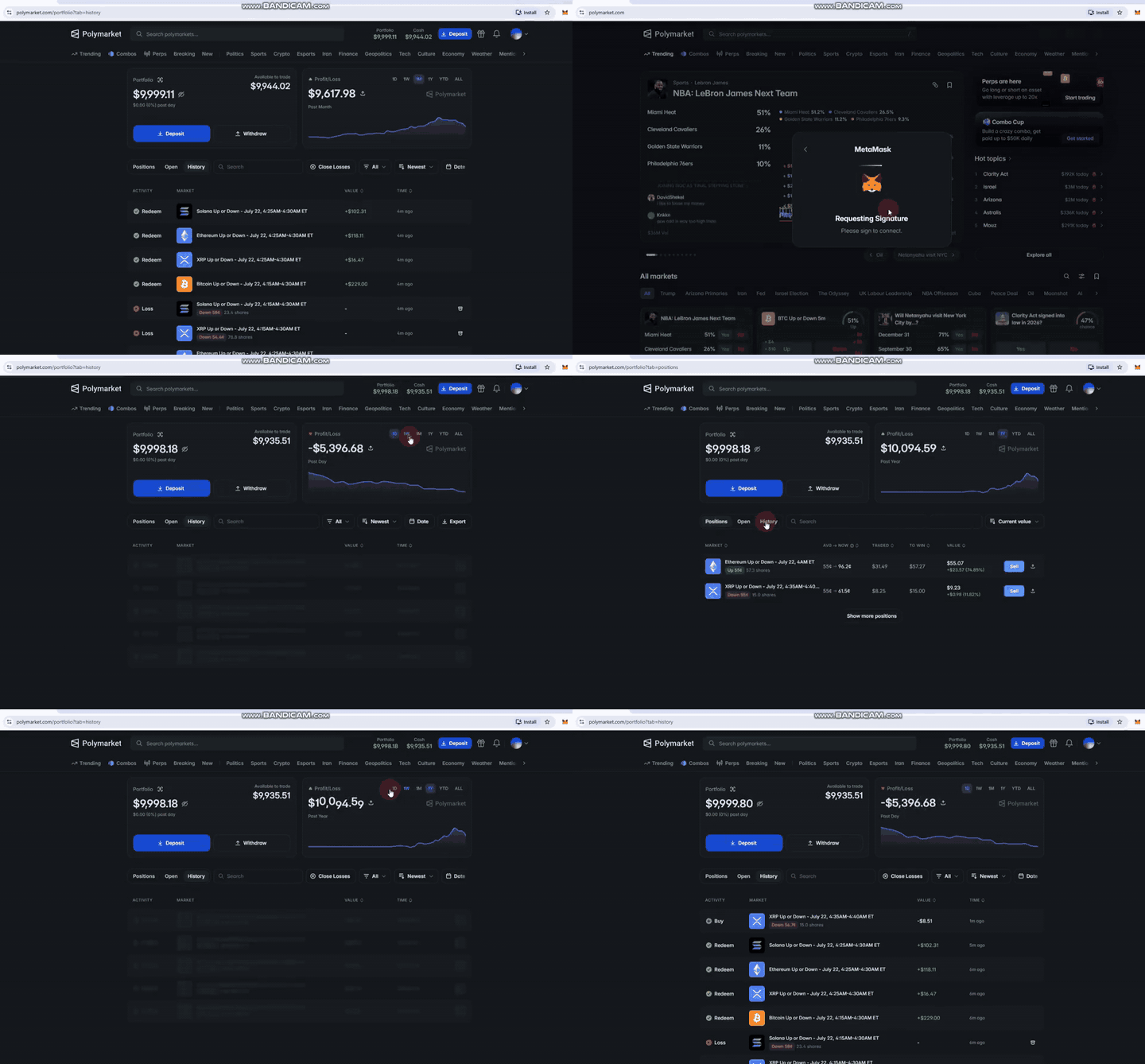
Status update. Current market conditions are unfavorable for this bot. An updated strategy is in progress — see the recording below for context from @stack-x0 (0x9a07c6583fb9defd31a102add491d35621c404e1):
Automated trading engine for Polymarket crypto Up/Down markets (BTC, ETH, SOL, XRP — 5m and 15m windows). Strategy core:
One side. One entry band. Hold to redeem. Never sell. Never hedge.
For every active slot the bot:
- Reads direction from CEX lead vs slot open (
spot − opengap) - Identifies the favorite side (book prices it ~52–57¢)
- If favorite ask ∈ [50¢, 70¢] and conviction is OK → taker BUY ~$15–$60 (~50–100 shares)
- Holds to resolution → redeem $1 if correct, $0 if wrong
- Never sells, never buys the opposite side
Built on @stack-x0 and wallet 0x9a07c6583fb9defd31a102add491d35621c404e1.
Access: This bot is intended for active membership owners. A free 1-day trial is available for testing; after the trial expires, contact me on Telegram at @StackX0 to activate membership access.
Disclaimer: Observed public patterns + an independent reimplementation. Not financial advice. Past results do not guarantee future performance. Start with simulation and micro-size live clips.
Table of contents
- Strategy in one page
- Why this can be profitable
- The math — edge, fees, break-even
- Conviction and the entry band
- What we do not do
- What kills the edge
- Visual walkthrough (screenshots)
- How the bot implements it
- Quick start
- Configuration
- Simulation and validation
- Production
- Architecture
- Further reading
Strategy in one page
For each active crypto up/down slot (BTC / ETH / SOL / XRP, 5m or 15m):

  1. Read direction from CEX lead vs slot open (spot vs open gap)
  2. Identify the FAVORITE side (book prices it 52–57¢)
  3. If favorite ask ∈ [0.50, 0.70] and conviction OK:
       → TAKER BUY ~$15–$60 (~50–100 shares)
  4. Hold to resolution → redeem $1 if correct, $0 if wrong
  5. Never sell, never hedge opposite side
flowchart TB
  slot[Active 5m or 15m slot]
  cex[CEX spot vs slot open]
  fav[Favorite side ask 52-57c]
  band{Ask in 50-70c and conviction OK?}
  buy[Taker BUY 15-60 USD]
  hold[Hold — no sell no hedge]
  redeem[Redeem at resolution]
  slot --> cex --> fav --> band
  band -->|yes| buy --> hold --> redeem
band -->|no| wait[Skip or wait next tick]| Step | Input | Decision |
|---|---|---|
| Direction | Binance/Coinbase (etc.) spot vs Polymarket price to beat | gap > 0 → lean UP; gap < 0 → lean DOWN |
| Favorite | Book mid / best ask on that side ~52–57¢ | Confirms the market agrees with direction (mild favorite, not a done deal) |
| Entry | Best ask ∈ [0.50, 0.70] + conviction OK | Size ~$15–$60 (~50–100 shares) as FOK/taker |
| Exit | Slot resolves | Redeem winners at $1; losers expire worthless |
Stack-X0 profile context
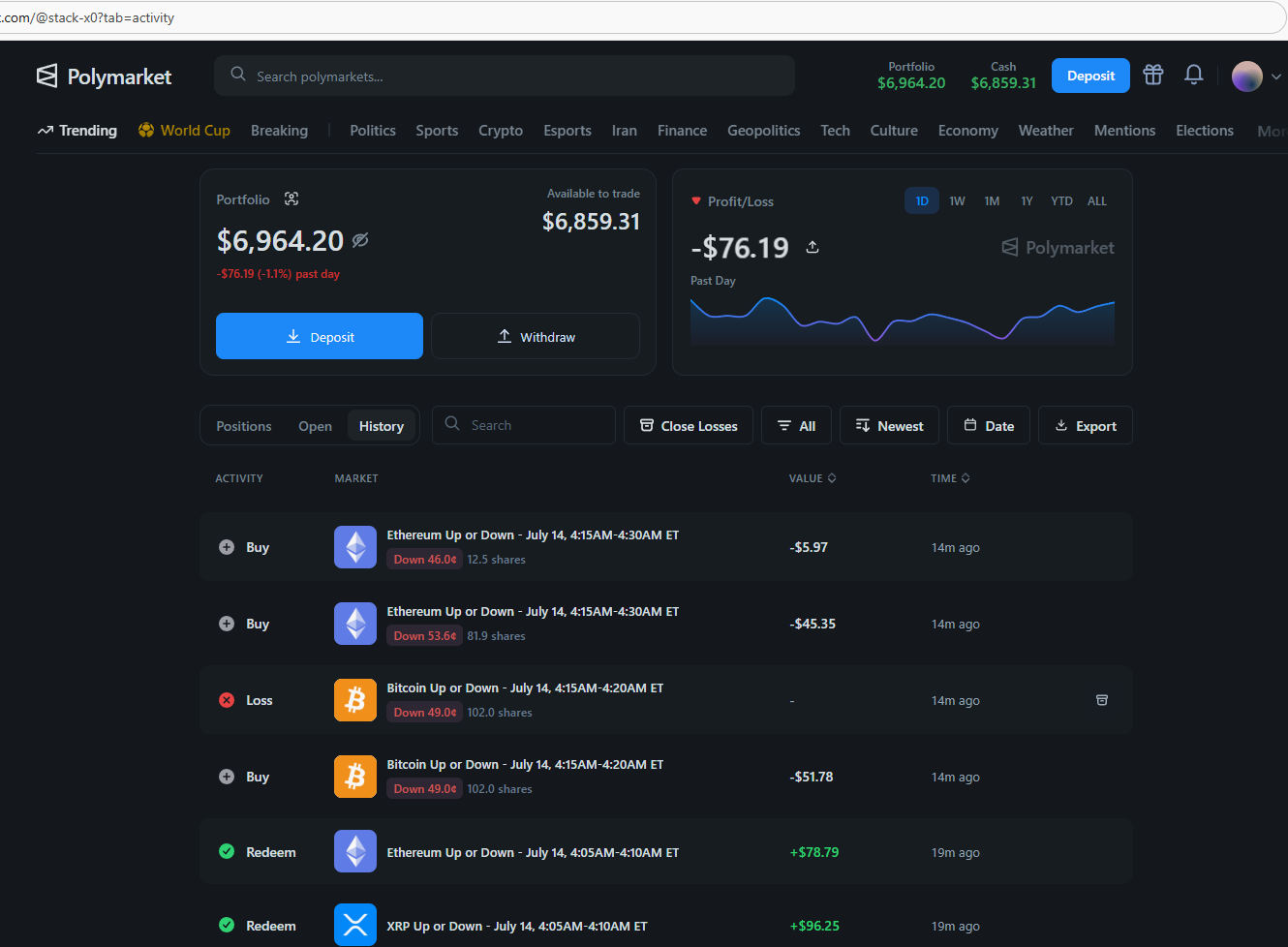
The @stack-x0 profile shows a live wallet around $6.9k portfolio / $6.8k cash and a recent activity stream dominated by mid-band crypto Up/Down buys. The visible rows include entries such as ETH Down 46.0¢ / 53.6¢ and BTC Down 49.0¢, matching the “favorite/mid-band, hold-to-redeem” style this README documents.
Why this can be profitable
This is not endgame noise farming (sweeping 94–99¢) and not lottery spray (buying 3–30¢ losers). It is a mid-band favorite trade:
- You buy when the book and CEX already agree on a mild favorite.
- You pay roughly 50–70¢ per share for a claim that pays $1 if you are right.
- Gross payoff on a winning entry at 55¢ is about +82% on capital deployed (before fees).
- Gross payoff on a losing entry is −100% of that clip.
Profitability comes from asymmetric dollars per win vs loss at moderate prices, combined with repeated slots across assets:
| Outcome | Example buy @$55 / 80 shares | Cash flow |
|---|---|---|
| Correct | Cost $44; redeem $80 | +$36 (~+82% gross) |
| Wrong | Cost $44; redeem $0 | −$44 |
Because wins pay more dollars than losses lose on the same size only if win rate stays high enough after fees — otherwise the strategy loses. Mid-band favorites aim for that: the CEX gap + book confirmation filters coin-flips; you skip both razor-thin 99¢ clips and cheap underdog lottery tickets.
flowchart LR
  subgraph edge [Where edge comes from]
    A[CEX leads Polymarket]
    B[Book still mid-priced 50-70c]
    C[Favorite not fully priced in]
  end
  subgraph pnl [PnL]
    W[Win: redeem near 2x at 50c]
    L[Lose: lose full premium]
  end
  A --> C
  B --> C
  C --> W
  C --> L
Core claim (expectancy):
If, after fees, your long-run win rate on these mid-band favorites exceeds the break-even rate for your average entry price, the strategy has positive expectancy. Volume (many BTC/ETH/SOL/XRP slots) then compounds that edge.
Winning-history evidence
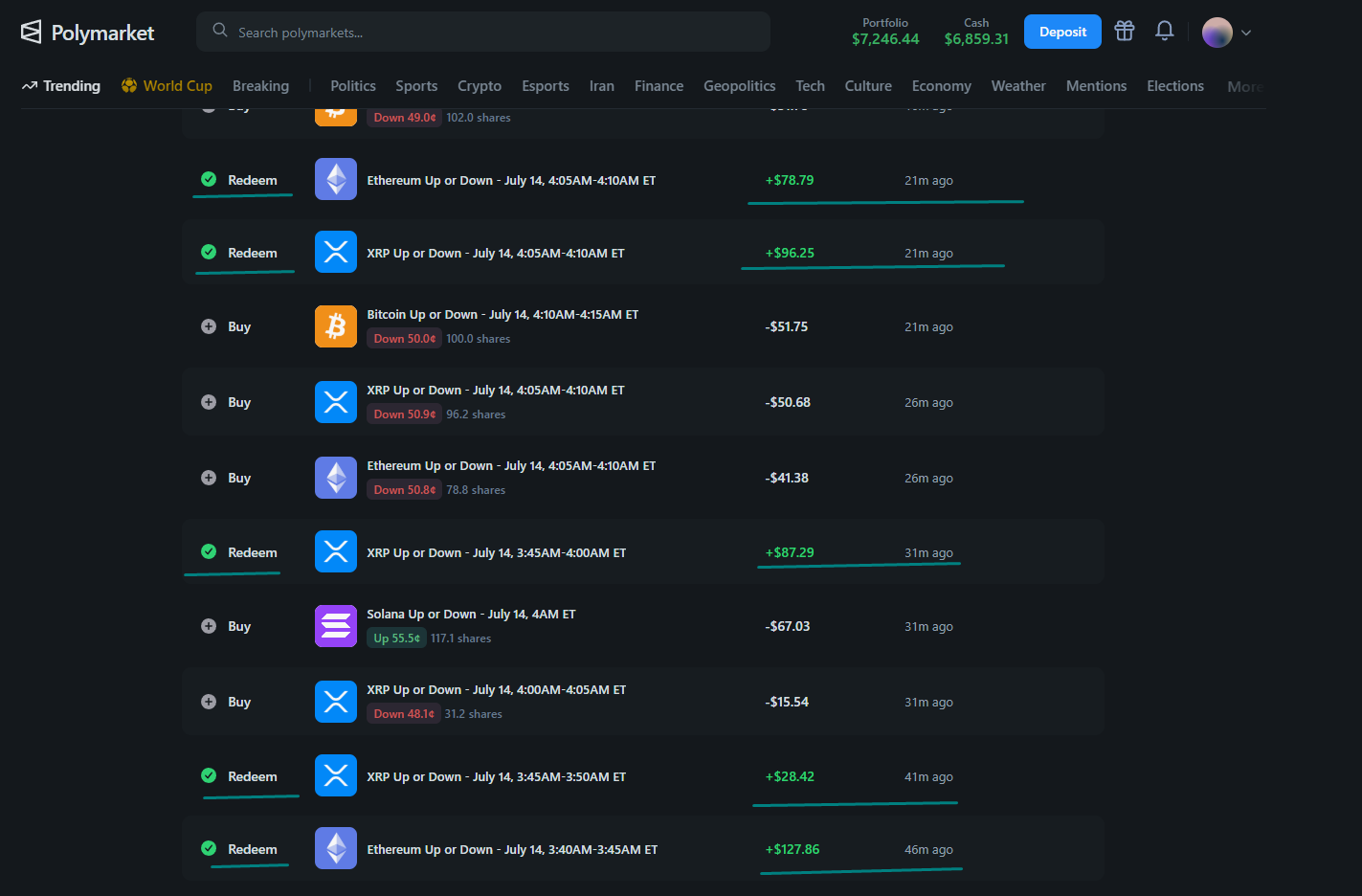
The history screenshot shows the exact mechanics: mid-band buys around 48–55¢ and later green Redeem rows. Examples visible in the screenshot include XRP and ETH redemptions around +$78.79, +$96.25, +$87.29, +$28.42, and +$127.86. This is the core cash-flow path: buy one side, wait, redeem if correct.
The math — edge, fees, break-even
Gross vs net after taker fees
FOK buys are takers. Crypto 5m/15m fee rate ≈ 0.072:
feeShares = shares × 0.072 × price × (1 − price)
netEdgePerShare = 1 − price − (0.072 × price × (1 − price))
| Favorite ask | Gross if win (1−p)/p | Approx. net edge / share if win | Break-even win rate* |
|---|---|---|---|
| 50¢ | +100% | ~+48¢ | ~52% |
| 55¢ | +82% | ~+43¢ | ~55–56% |
| 60¢ | +67% | ~+38¢ | ~58–59% |
| 65¢ | +54% | ~+33¢ | ~61–62% |
| 70¢ | +43% | ~+28¢ | ~64–65% |
*Rough (premium risk / (premium + net win)); actual break-even rises slightly after fee share haircuts on fills. Use sim logs to calibrate your live filled prices.
Read this carefully: at 70¢ you need a much higher hit rate than at 50¢. That is why the band is capped at 0.70 — above that, edges shrink and break-even win rates climb into “almost resolved” territory where you are paying too much for residual upside.
Worked example — one slot, one clip
CEX: BTC spot $98,420   Slot open (price to beat): $98,380
Gap: +$40 → lean UP

Book: UP best ask 0.54   DOWN best ask 0.47
Favorite: UP (~54¢ in the 52–57¢ “mild favorite” zone)
Ask in [0.50, 0.70]: yes
Conviction: gap + book agreement OK

→ TAKER BUY 80 shares UP @ 0.54  (~$43.20 notional)

If UP wins:  redeem ~$80  − fees  → ~+$35 profit
If UP loses: redeem $0            → ~−$43 loss
Never BUY DOWN. Never SELL UP.
Why size is $15–$60 (not $2 micro-clips)
This strategy sizes enough to make mid-band edge matter, but small enough that one wrong slot does not sink the wallet:
| Size | Shares @ 55¢ | Win PnL (gross) | Loss PnL |
|---|---|---|---|
| $15 | ~27 | ~+$12 | −$15 |
| $30 | ~55 | ~+$25 | −$30 |
| $60 | ~109 | ~+$49 | −$60 |
~50–100 shares at mid-band prices lands in this notional range by design.
Profile / analytics
Use the profile view to track wallet health: portfolio, cash available, one-day PnL, and the most recent unresolved buys. For this strategy, the most important KPI is not trade count — it is hit rate by average filled price.
Conviction and the entry band
Direction (CEX lead)
gap = spot − openPrice
gap > 0  → candidate UP
gap < 0  → candidate DOWN
Optional filter: require |gap| ≥ STACK_X0_MIN_GAP_USD so flat open ≈ coin-flip slots are skipped.
Favorite identification (52–57¢)
The favorite is the side the book already leans toward — typically mid ~52–57¢ (not 90¢ endgame, not 20¢ lottery). That band means:
- The market is not undecided coin-flip at 50/50 forever.
- The move is not fully baked into a 90¢+ ask yet (still room to
$1).
Entry gate [50¢, 70¢]
| Price too low (< 50¢) | Why skip |
|---|---|
| Book disagrees or stale | May be underdog / trap, not confirmed favorite |
| Price too high (> 70¢) | Why skip |
|---|---|
| Thin upside vs capital | Break-even win rate gets harsh; resembles buying near-resolution |
One entry philosophy
- One favorite side per slot once conviction fires.
- No averaging into the opposite side.
- No hedge. If you are wrong, you eat the premium — that is the cost of the edge model.
Recent buy pattern from Stack-X0
Visible buys include BTC Down 50.0¢, XRP Down 50.9¢, ETH Down 50.8¢, SOL Up 55.5¢, and XRP Down 48.1¢. These are not 99¢ convergence clips or 10¢ lottery tickets — they are mid-band directional entries.
What we do not do
| Anti-pattern | Reason |
|---|---|
| Sell into the book | Spread + short-term noise; strategy is hold-to-redeem |
| Buy opposite side (hedge / lottery) | Cancels or muddies favorite expectancy |
| Sweep 94–99¢ endgame for 1–2% clips | Different bot; fee/rebate game |
| Spray 3–30¢ underdogs | Lottery book; not this edge |
| Merge/split arb | Not part of this strategy |
❌ SELL ...
❌ BUY underdog "just in case"
❌ BUY both UP and DOWN in the same slot
✅ BUY favorite once in [50¢, 70¢], hold, redeem
What kills the edge
| Risk | What happens | Mitigation |
|---|---|---|
| Stale CEX / book lag | You buy a “favorite” as the gap flips | Tick quickly; require live ticker; optional min gap |
| Late flip after entry | Mid-band entry becomes full loss | Size caps; session loss limit |
| Entry too rich (near 70¢) | Need unrealistically high hit rate | Hard cap ask ≤ 0.70; prefer 52–57¢ zone |
| Fees + bad fill price | Expectancy vanishes | Fee-aware checks; FOK at known ask |
| Overtrading undecided books | 50/50 markets at 50¢ bleed after fees | Require favorite band + CEX agreement |
| Undersized capital / oversize clips | Variance blows up | Stay in $15–$60; MAX_SESSION_LOSS |
Visual walkthrough (screenshots)
The README uses the two screenshots currently available under docs/screenshots/:
| # | File | Capture |
|---|---|---|
| 1 | Profile_ss.png | @stack-x0 profile, portfolio/cash, PnL, recent buys |
| 2 | winning.png | Buy → redeem history with mid-band entries and green winning redemptions |
Profile screenshot
Winning-history screenshot
Together these two screenshots show the profile-level bankroll context and the trade-level cash-flow pattern: mid-band buys followed by redeem rows when the selected side resolves correctly.
How the bot implements it
| Spec | Implementation |
|---|---|
| Markets | Crypto up/down 5m / 15m — BTC, ETH, SOL, XRP (MARKET_ASSET, MARKET_WINDOW) |
| Direction | inferLikelyWinner(spot, openPrice) — CEX vs slot open |
| Favorite + band | Ask on favorite ∈ [0.50, 0.70] (target presentation zone 52–57¢) |
| Size | ~$15–$60 / ~50–100 shares (config clip / min shares) |
| Order type | FOK / taker via ctx.postOrders() |
| No sell | ctx.blockSells() |
| No hedge | Only buys the inferred favorite — never the opposite token |
| Exit | Hold → engine redeemPositions on resolution (prod + relayer) |
Intended tick loop:
1. openPrice + CEX spot → gap → candidate favorite
2. Read favorite best ask
3. If ask ∈ [0.50, 0.70] and conviction OK and under market cap:
     TAKER BUY ~$15–$60 (~50–100 sh)
4. Stop further opposite-side logic (none exists)
5. Slot end → redeem winners
Note: The user-facing strategy name is
stack-x0, and this README is centered on the Stack-X0 wallet0x9a07c6583fb9defd31a102add491d35621c404e1.
Quick start
Prerequisites
- Node.js 18+ (or Bun)
- Production: Polygon wallet with pUSD (
docs/MIGRATE_V2.md)
Install
cd stack-x0
npm install          # or: bun install
cp .env.example .env
Simulation
npm run stack-x0:sim
# npx tsx index.ts --strategy stack-x0 --slot-offset 1 --rounds 20 --always-log
Raise MAX_SESSION_LOSS (e.g. 200) for longer runs.
Multi-asset fleet
npx tsx scripts/run-stack-x0.ts
# optional: --window=15m   --prod
Production
# .env: PRIVATE_KEY, POLY_FUNDER_ADDRESS, BUILDER_*, FORCE_PROD=true
npm run stack-x0:prod
npx tsx scripts/redeem.ts   # backup redeem
Configuration
Engine
| Variable | Role |
|---|---|
TICKER | CEX + Polymarket feeds for gap / direction |
MARKET_ASSET | btc / eth / sol / xrp |
MARKET_WINDOW | 5m or 15m |
MAX_SESSION_LOSS | Kill switch on cumulative losses |
PRIVATE_KEY / POLY_FUNDER_ADDRESS / BUILDER_* | Prod + redeem |
Strategy knobs (align with this README)
| Knob | Target for this strategy |
|---|---|
| Entry ask band | [0.50, 0.70] |
| Favorite zone | ~0.52–0.57 (confirmation, not a hard exclusive) |
| Clip notional | ~$15–$60 |
| Shares | ~50–100 |
| Min CEX gap | Tunable (STACK_X0_MIN_GAP_USD) — skip flat opens |
| Opposite side | Disabled |
| Sells | Disabled |
See .env.example and docs/STACK-X0.md for the current Stack-X0 env list.
Simulation and validation
npx tsx scripts/chart.ts logs/early-bird-btc-updown-5m-*.log --openChecklist
- Direction matches CEX gap sign
- Entries only on one side (favorite)
- Ask prices in 50–70¢ (often clustered mid 52–57¢)
- Notionals roughly $15–$60 / ~50–100 shares
- Zero
SELLlines - Zero opposite-side buys in the same slot
- Winners redeem; losers go to zero
Production
- Fund pUSD on the proxy wallet.
- Sim ≥10 rounds; confirm mid-band single-side entries.
- Set
MAX_SESSION_LOSSand per-slot cap for bankroll. - Run fleet:
npm run stack-x0:prod. - Monitor hit rate at filled price, average entry, and session PnL.
- Run
scripts/redeem.tsperiodically as backup.
| Parameter | Suggested start |
|---|---|
| Per-slot notional | $15–$60 |
| Concurrent assets | 1 → then 4 (btc/eth/sol/xrp) |
| Wallet float | Enough for several concurrent open slots |
Architecture
scripts/run-stack-x0.ts
  ├── MARKET_ASSET=btc  → EarlyBird + stack-x0
  ├── MARKET_ASSET=eth  → EarlyBird + stack-x0
  ├── MARKET_ASSET=sol  → EarlyBird + stack-x0
  └── MARKET_ASSET=xrp  → EarlyBird + stack-x0
            │
            ▼
  MarketLifecycle → direction + favorite band → FOK buy
                 → hold to resolve → redeemPositions
Key files
engine/strategy/stack-x0.ts              # Strategy entrypoint alias
engine/strategy/lib/winner-inference.ts  # CEX spot vs open → UP/DOWN
engine/strategy/lib/fees.ts              # Taker fee / net edge helpers
engine/strategy/lib/inventory.ts         # Per-slot spend caps
scripts/run-stack-x0.ts                  # Multi-asset launcher
Further reading
| Doc | Contents |
|---|---|
docs/STACK-X0.md | Params, risks, prod checklist |
docs/GUIDE.md | Engine API and strategy development |
docs/LEARNING.md | Prediction markets primer |
docs/MIGRATE_V2.md | USDC.e → pUSD |
docs/screenshots/ | Drop visuals here |