Running a 28.9M parameter LLM on a microcontroller
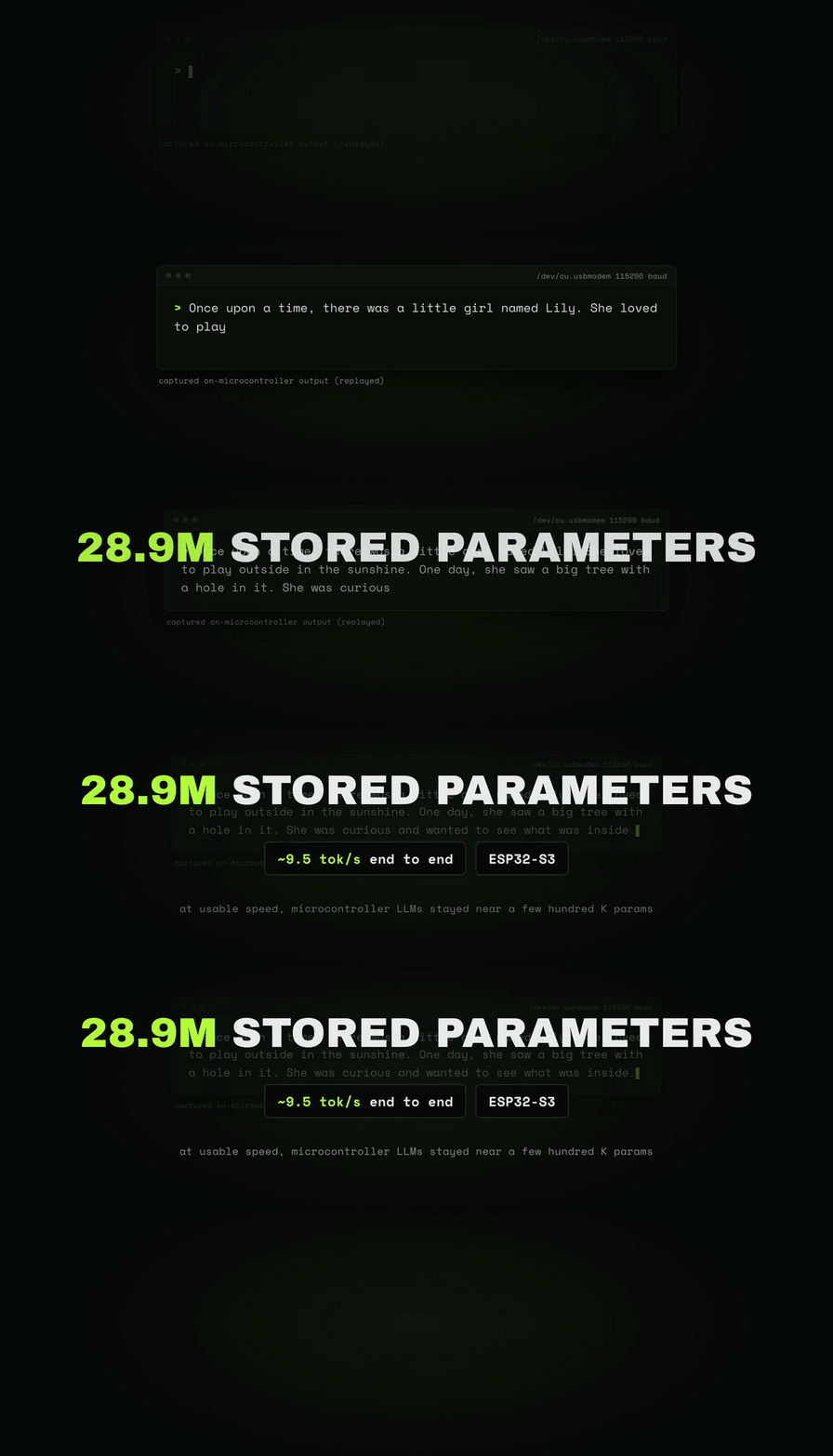
This is a 28.9 million parameter language model that generates text on an ESP32-S3 microcontroller. It runs on the chip itself, with nothing sent to a server, and it displays generated text at 9.88 tokens per second on a small screen wired to the chip. It fits because most of the model lives in flash instead of RAM, using Per-Layer Embeddings, an idea from Google's Gemma 3n.
The same chip also runs a port of part of the fruit fly connectome: 48,311 neurons and 9.46 million connections from a real fly brain, escaping a spider on screen. See Porting part of the fruit fly connectome to ESP32.
The numbers
| Parameters | 28.9M stored (25M of them in a flash lookup table) |
| Chip | ESP32-S3, 512KB SRAM, 8MB PSRAM and 16MB flash |
| Speed | 9.88 tok/s end to end, 94.9 ms/token of compute |
| Connectivity | none, everything runs on the device |
| Model size | 14.9MB at 4-bit |
Why it is hard, and how it fits anyway
A microcontroller has very little fast memory. The ESP32-S3 gives you 512KB of SRAM, and only the values touched many times per token can live there: activations and norm weights. The dense core and output head, scanned once per position, sit in PSRAM. What is left is the embedding tables, and their size is what normally decides how big a model can be.
In this model, most parameters sit in an embedding table, which the model reads from rather than computes on. So that 25-million-parameter table stays in slow flash, and only the few rows each token needs are pulled from it, about 450 bytes. Most of the model is therefore never loaded to run it: it sits in flash and is sampled a little at a time.
That idea is Google's Per-Layer Embeddings, from Gemma 3n. Here it runs on the memory layout of a microcontroller instead of a phone or a GPU.
Each tier holds whatever is read at its own frequency:
  SRAM  (fast, tiny)   activations and norm weights, touched many times a token
  PSRAM (medium)       the core and output head, read once per position
  FLASH (huge, slow)   the 25M-param table, about 6 rows read per token (~450 B)
What it does, and what it does not
The model was trained on TinyStories, so it writes short, simple stories and mostly keeps them coherent. It will not answer questions, follow instructions, write code, or know facts. That limit comes from the small part of the model that does the reasoning, and the memory trick does not change it. What is interesting here is the architecture, fitting a large model onto a tiny chip, rather than what a 28.9 million parameter model can say.
Porting part of the fruit fly connectome to ESP32
This is a port of part of a real brain to the same board. It holds 48,311 neurons and 9,462,135 connections from the male fruit fly connectome, MaleCNS v1.0, with the synaptic contact count of every connection kept exactly. The graph is 13.5MiB compressed in flash, and every simulation step goes through all of its connections, on both cores with the chip's SIMD instructions.
It is only part of the brain because the whole nervous system does not fit: the smallest lossless encoding we found is 24.49MiB, against about 14MiB of flash left for it. Why only part of it.
The numbers
| Neurons | 48,311: central brain, visual projection and descending |
| Connections | 9,462,135, carrying 49,481,754 synaptic contacts |
| Graph size | 13.5MiB compressed in flash, blocks cached in PSRAM |
| Decisions | a new decision about every 1.7 s |
| Trained | nothing: the demo reads the fly's own escape neurons |
Escaping a spider, with nothing trained
To show that it computes something, it escapes a spider on the OLED. The spider's growing size drives the fly's own looming detectors, LC4 and LPLC2, on the side it comes from. When the escape neurons on that side get active enough, including DNp01, the giant fiber that makes a real fly jump, the fly leaps away from that side.
No model was trained for this. The port ships a small text file naming those input and output neurons and one threshold; the behavior comes from the fly's own wiring. I checked it first: stimulating the looming detectors activates those escape neurons 30 to 100 times more than random visual neurons do, and ranking all 1,316 descending neurons by specificity puts the known escape neurons on top.
It is a selected part of the nervous system, not the whole fly: what is ported,
what is left out and how it runs is in
docs/fly-connectome/.
Run it yourself
Models
- Barista - espresso question answering
- TinyStories - story generation
- Fly - fruit fly connectome escaping a spider
Commands
Download and deployment are separate operations: one reaches the network, the other touches the board.
scripts/fetch_model.sh barista   # download, verify, install into artifacts/
scripts/deploy.sh barista        # generate headers, run gates, compile, flash
tinystories and fly take the same two commands. Each requires the model to
be named, because the board holds one at a time and deploying replaces it.
fetch_model.sh checks the inference assets against a SHA-256 and byte size
pinned in the script, and cross-checks the release's own metadata.json against
those same pins. It installs nothing unless every check passes, so a failed
download leaves what you already have untouched. deploy.sh downloads no model:
it works from whatever is already in artifacts/<model>/. It does run two of its
header tools through uv, which fetches one pinned wheel the first time on a
machine that has never cached it.
The firmware details and the boot output to expect live in
firmware/esp32_barista/README.md,
firmware/esp32_tinystories/README.md and
firmware/esp32_fly/README.md. The reusable
architecture is in src/; the training, ablation and quantization code that
reproduces the published numbers is in research/tinystories/, and the tools
that find a circuit in the fly graph and export it are in research/fly/. The
language model's full method, its ablations and its on-chip measurements are
written up in RESULTS.md; the fly's measurements are in
firmware/esp32_fly/README.md.
Credit
TinyStories is the dataset this trains on: short synthetic stories simple enough that a small model can still learn to write coherently (Ronen Eldan and Yuanzhi Li, Microsoft Research, arXiv:2305.07759). The other half is Per-Layer Embeddings, Google's design from Gemma 3n, which is what lets a big model fit on a small chip.
Andrej Karpathy's llama2.c is the reference for training a small language model and running it in plain C.
The fly graph comes from MaleCNS v1.0, the male Drosophila central nervous system
connectome by the FlyEM Project at HHMI Janelia, the University of Cambridge, the
MRC Laboratory of Molecular Biology and Google Research, used under CC BY 4.0.
What was selected and changed is in
docs/fly-connectome/ATTRIBUTION.md.
Measurements
Detailed measurements and ablations are documented in RESULTS.md.