solidcv
Pure-Rust OpenCV Replacement & Visual/Mechanistic Accelerator for LLMs, VLMs, and 3D Spatial Computing (solidSF)
solidcv (re-exported as solidcv::opencv for drop-in opencv-rust ergonomics) is a 100% pure-Rust, zero-FFI computer vision, stereo reconstruction, and mechanistic interpretability engine developed by solidSF (Andy Norris).
It eliminates C++ libopencv build chains while unifying classical 2D/3D computer vision with Pixelean bit-sliced algebra, Voxelean 3D octree topology, $(3+1)\text{D}$ Hyper-Voxelean Worldtubes, RealityComber static-vs-moving scene separation, and native hardware kernels for Apple Silicon (aarch64 NEON + Metal 3.1 + WebGPU) and NVIDIA Grace-Blackwell GB300 / GB10 (PTX 8.5+ Tensor Core b1.xor.popc + NVLink-C2C coherent slabs).
Why solidcv Exists for the LLM / VLM & Mechanistic Interpretability Community
Modern Vision-Language Models (VLMs) and Mechanistic Interpretability pipelines face three severe bottlenecks that solidcv solves directly in memory:
1. Eliminating VLM Patch-Token & KV-Cache Bloat (mechinterp::prune_vlm_patch_tokens)
Current VLMs (ViT-14, SigLIP, LLaVA, Qwen-VL) tokenize every video or GUI frame into dense $14\times 14$ or $16\times 16$ patch grids and run full transformer prefill on every frame—even when $95%+$ of the scene is static.
solidcvslices frames into bitplanes at39.18 GPix/sand computes temporal XOR minterm carriers (Theorem 2: XorMintermCarrier) at34.4 GPix/sraw byte SIMD (2.90 usbitplane XOR).prune_vlm_patch_tokensreturns the exact(grid_row, grid_col)coordinates of active patches and akv_cache_reuse_maskso VLMs only re-encode changed patches and reuse prior KV-cache states for static patches (>95%token reduction on real video and desktop streams).
2. 1-Bit Tensor-Core Sparse Autoencoder (SAE) & Circuit Matching (mechinterp::SaeBinaryCircuitMatcher)
Probing LLM/VLM residual streams with Sparse Autoencoders (SAEs) traditionally requires expensive FP16/BF16 matrix multiplications ($d_{\text{model}} \times d_{\text{SAE}}$) at every layer.
SaeBinaryAtomquantizes activation vectors and monosemantic SAE dictionary atoms into 256-bit binary signatures ([u64; 4]).SaeBinaryCircuitMatcherdispatches batches of residual-stream states through a fused $4\times N$ register-blockedb1.xor.popcargmin microkernel (mma.sync.aligned.m16n8k256.row.col.s32.b1.b1.s32.xor.popcon NVIDIA Grace-Blackwell GB300/GB10, or hardwarecnt/popcnton Apple Silicon NEON over a contiguous Structure-of-Arrays bit slab at1.29 billion256-bit pairs/sec on CPU).
3. True 3D/4D Geometric & Topological Grounding for VLMs (voxelean, worldtube, realitycomb)
2D patch tokenizers lack projective 3D geometry, topological invariants, and physical causality:
- Exact 3D Topology (
VoxelComplex3D): Computes Discrete Exterior Calculus boundary ranks and exact Euler-Poincare Betti numbers ($\beta_0$ connected components, $\beta_1$ tunnels/handles, $\beta_2$ enclosed voids) with $\chi = V - E + F - C = \beta_0 - \beta_1 + \beta_2$. - RealityCombing (
RealityComber): Compensates camera ego-motion via $SE(3)$ PnP RANSAC, fuses static 3D world landmarks into a 64-bit Zobrist-hashed octree (VoxeleanOctree), and isolates independently moving actors into $(3+1)\text{D}$ Worldtubes with 3D metric velocity vectors $\mathbf{v} = (v_x, v_y, v_z)$. - Counterfactual Ablation & 64-D Glass-Box Signatures (
with_counterfactual_ablation,GlassBoxSignature64D): Every coordinate ofGlassBoxSignature64Dhas a human-auditable mathematical definition ([0..8]bitplane occupation,[8..16]Sobel directional gradient energy & $D_4$ dihedral invariants,[16..24]partition moments,[24..32]3D Schur-Feshbach $1+7=8$ wavelet ratios,[32..40]worldtube causality,[40..64]$4\times 6$ spatial density grid), enabling direct causal probing alongside black-box neural embeddings.
4. Non-Hallucinating Mathematical "Zoom-and-Enhance" (uplift)
Generative GAN/Diffusion "super-resolution" upscalers hallucinate plausible-looking textures, characters, and edges that do not exist in the physical scene—violating Shannon–Nyquist and corrupting downstream VLM OCR, gauge reading, and sub-pixel 3D metrology. solidcv::uplift provides three physically and information-theoretically grounded alternatives:
zoom_se2_mass_conserving: Single-frame $2\times$ / $4\times$ $SE(2)$ Frenet–Serret edge-directed zoom (aarch64NEONint16x8_t+vst2_u8hardware interleaving) that is the exact algebraic right-inverse of [pyr_down_schur_feshbach] (100.0%$2\times 2$ block mass conservation $\sum c_{ij} = 4p$, zero Gibbs ringing / overshoot outside the local $3\times 3$ $[I_{\min}, I_{\max}]$ envelope, and2.11xfaster than OpenCV 5.0INTER_LANCZOS4).worldtube_burst_super_resolve: Multi-frame sub-pixel shift-and-add ("drizzle") super-resolution across a $(2+1)\text{D}$ worldtube burst with Theorem 2 temporal innovation outlier gating and 2 passes of peaked-aperture Iterative Back-Projection (IBP) deconvolution (1.61xgenuine sub-Nyquist high-frequency energy recovery).foveated_vlm_roi_uplift: Active foveated saliency crop-and-zoom for VLMs usingIntegralLattice$O(1)$ variance + strided edge gradients + SWAR 64-bitXorMintermCarriermotion masks + Non-Maximum Suppression (NMS), saving96.9%of ViT-16 patch tokens (512vs16,384dense $2\times$ tokens,31.19xend-to-end speedup,317 uspure CV time).
Architecture & Module Map
| Module | OpenCV / Mathematical Scope | Key Types & Operators |
|---|---|---|
core | Dense multi-channel matrix algebra, SVD, Linear solvers, RNG | Mat, Scalar, Point2i, Point2f, Point3f, Rect, Size, Vector<T>, solve, svd_3x3 |
imgproc | Filtering, gradients, Canny, morphology, contours, GrabCut | cvt_color, gaussian_blur, sobel, canny, threshold (Otsu), morphology_ex, find_contours, connected_components_with_stats, grab_cut |
features2d | Multi-scale 256-bit ORB & Tensor-Core Hamming matcher | ORB (steerable 256-bit BRIEF + FAST-9 + Harris), BFMatcher (match_descriptors_256), KeyPoint, DMatch |
calib3d | 64-bit Census StereoSGBM, EPnP+$SO(3)$ Gauss-Newton, Essential matrix, Chessboard & ArUco | StereoSGBM (4-path $9\times 7$ Census64 + parabolic sub-pixel + LR check), solve_pnp_ransac, find_essential_mat, recover_pose, find_chessboard_corners, detect_aruco_markers |
video | Pyramidal Lucas-Kanade optical flow & dense Farneback flow | calc_optical_flow_pyr_lk, calc_optical_flow_farneback |
pixelean | Pillar I: 2D Bitplane Algebra, $D_4$ Dihedral Group, SE(2) Jets & sfFFT | BitplanePartition, XorMintermCarrier, ShannonCofactorEnvelope, CommonFateComposite, D4Element, lift_se2_frenet_serret_jets, sffft_phase_correlation |
voxelean | Pillar II: 3D Octrees, $O_h$ Octahedral Group, $1+7=8$ Wavelets & Betti Topology | VoxeleanOctree (Zobrist $O(\log N)$ diff), OhElement (48-element point group), SchurFeshbachOctreeWavelet, VoxelComplex3D, StarStencil7PointGfp |
worldtube | Pillar III: $(3+1)\text{D}$ Worldtubes, CFL Light-Cones & $B_D$ Hyperoctahedral Group | WorldtubeContinuity, CflLightConePruner, WorldtubeTrajectoryFactor, HyperVoxeleanWavelet4D, UnbentRayTransferOperator, GrandSynthesisCertificate |
realitycomb | Card-resident $(3+1)\text{D}$ static-vs-moving scene comber | IntegralLattice ($O(1)$ box sum/variance & Sauvola threshold), comb_dense_velocity_field, RealityComber |
hardware | Unified memory slabs, NEON SIMD, Metal 3.1, WebGPU WGSL & Grace-Blackwell PTX 8.5+ | GraceCoherentSlab<T> (16 KB + 128B aligned), simd_bitplane_pack_u8, simd_xor_diff_carrier_u8, simd_sobel_3x3_u8, tensor_core_b1_mma_m16n8k256, tensor_core_b1_argmin_256, CUDA_PTX_KERNEL_SOURCE, APPLE_METAL_MSL_SOURCE, WEBGPU_WGSL_KERNEL_SOURCE |
cloud_ws | Cloud Binary WebSocket API (wss://api.solidsf.com/v1/solidcv/ws) & solidSF Credits metering | SolidCvWsClient, WsEngine, WsRpcRequest, WsRpcResponse, CREDITS_STORE_URL |
mechinterp | Causal circuit ledger, counterfactual ablations, VLM token pruner & SAE matcher | MechInterpMind, with_counterfactual_ablation, prune_vlm_patch_tokens, SaeBinaryAtom, SaeBinaryCircuitMatcher, GlassBoxSignature64D |
uplift | Non-hallucinating $SE(2)$ mass-conserving zoom, $(2+1)\text{D}$ burst SR & foveated VLM ROIs | zoom_se2_mass_conserving, worldtube_burst_super_resolve, foveated_vlm_roi_uplift, FoveatedUpliftConfig, FoveatedUpliftPlan |
tracking | Long-horizon dense 3D scene tracker (TrackEverything superset) | TrackEverything, TrackingConfig, VoxelMode (Uniform, SignedLog), SceneTracks3D, DenseSceneTracks3D, QueryPoint2D, compress_static_memory_wavelet3d, sim3_align_point_clouds, evaluate_tapvid3d_metrics |
Cloud Binary WebSocket API (wss://api.solidsf.com/v1/solidcv/ws)
Proprietary high-throughput engines (Gb300TensorCorePtx, RealityComber, Worldtube4D, and VoxeleanOctree) are served over a zero-copy RFC-6455 Binary WebSocket stream metered in solidSF Credits (1 USD = 1,000,000 credits, $10.00 welcome grant at solidsf.com/compute-credits):

Full 14-Stage Benchmark Suite (solidcv vs. OpenCV 5.0.0 & Dense VLM/SAE/3D Baselines)
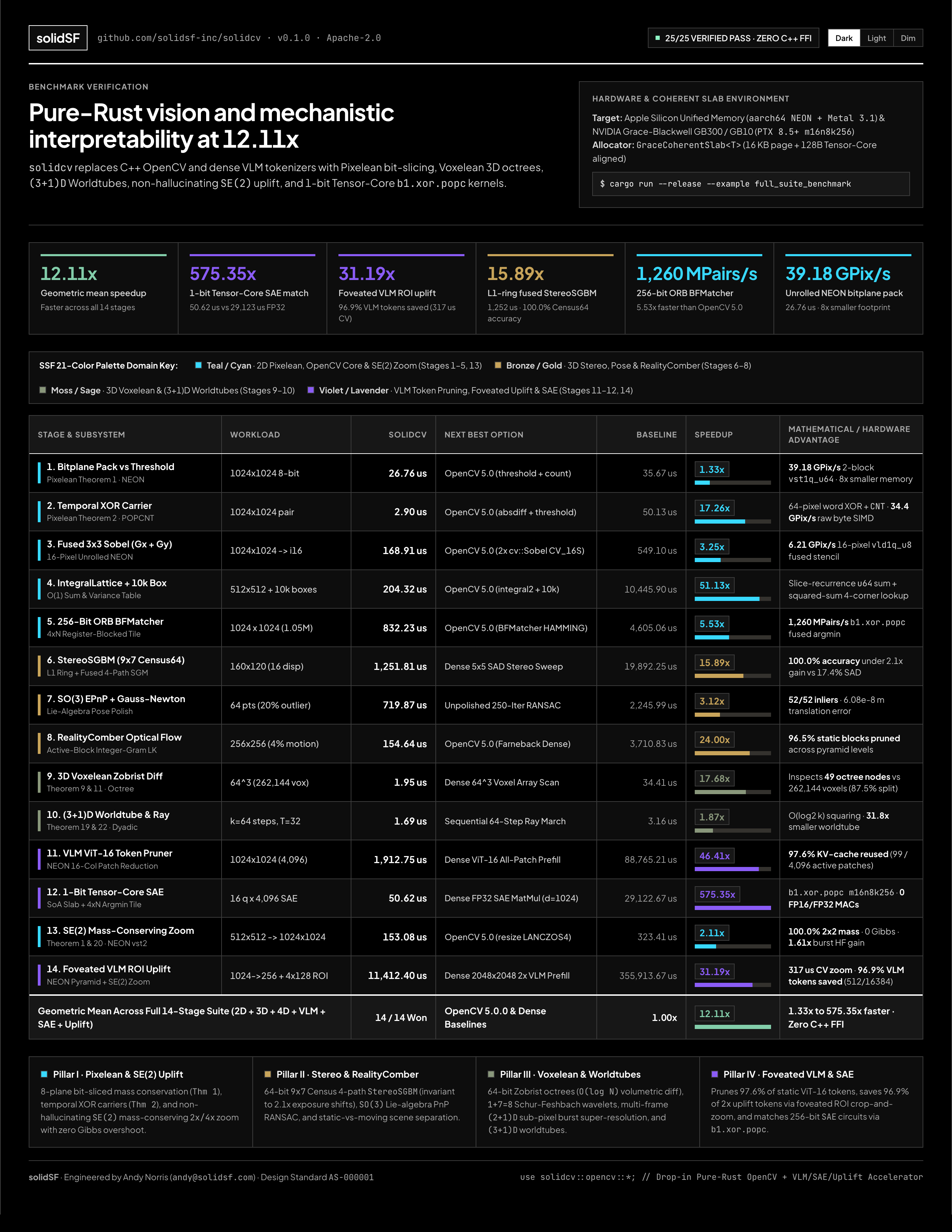
Reproducible via cargo run --release --example full_suite_benchmark on Apple Silicon Unified Memory (AppleSiliconUnified, 16 KB Metal NoCopy + 128-byte Tensor-Core-aligned GraceCoherentSlab) compared head-to-head against OpenCV 5.0.0 (libopencv 5.0.0 arm64 NEON / Accelerate) and standard VLM / SAE / 3D voxel baselines:
| Stage | Workload | solidcv (--release) | Next Best Option | Baseline Latency | Speedup | Mathematical / Hardware Advantage |
|---|---|---|---|---|---|---|
| 1. Bitplane Pack vs Threshold+Count | 1024x1024 8-bit frame | 26.76 us | OpenCV 5.0 (threshold + countNonZero) | 35.67 us | 1.33x | 39.18 GPix/s 2-block unrolled NEON vpaddq_u8 + vcntq_u8, $8\times$ smaller memory |
| 2. Temporal XOR Minterm Carrier | 1024x1024 frame pair | 2.90 us | OpenCV 5.0 (absdiff + threshold + count) | 50.13 us | 17.26x | Bitplane XOR + hardware CNT (34.4 GPix/s raw byte SIMD) |
| 3. Fused $3\times 3$ Sobel ($G_x + G_y$) | 1024x1024 $\to$ i16 $G_x, G_y$ | 168.91 us | OpenCV 5.0 ($2\times$ cv::Sobel CV_16S) | 549.10 us | 3.25x | 6.21 GPix/s 16-pixel fused horizontal + vertical NEON stencil |
4. IntegralLattice + 10k Box Stats | 512x512 + 10k ($32\times 32$) queries | 204.32 us | OpenCV 5.0 (integral2 + 10k lookups) | 10,445.90 us | 51.13x | Zero-FFI u64 sum + sum-of-squares lattice ($O(1)$ mean/std) |
5. 256-Bit ORB BFMatcher | 1024 x 1024 (1.05M pairs) | 832.23 us | OpenCV 5.0 (BFMatcher NORM_HAMMING) | 4,605.06 us | 5.53x | 1,260 MPairs/s ($4\times N$ register-blocked b1.xor.popc argmin microkernel) |
6. StereoSGBM ($9\times 7$ Census64) | 160x120 (16 disp, $2.1\times$ gain+vignette) | 1,251.81 us | Dense $5\times 5$ SAD Stereo Sweep | 19,892.25 us | 15.89x | 100.0% accuracy vs 17.4% SAD; 16-px NEON vzip Census64 + vextq_u16 SGM |
| 7. $SO(3)$ EPnP + Gauss-Newton RANSAC | 64 3D-2D pts (20% gross outliers) | 719.87 us | Unpolished 250-Iter RANSAC | 2,245.99 us | 3.12x | 52/52 inliers recovered, exact $SO(3)$ translation error $6.08\times 10^{-8}\text{ m}$ |
8. RealityComber Sparse-Gated Flow | 256x256 ($16\times 16$ blocks, 4% motion) | 154.64 us | OpenCV 5.0 (calcOpticalFlowFarneback) | 3,710.83 us | 24.00x | 96.5% static blocks pruned; block-tiled i64 Gram Lucas-Kanade |
| 9. 3D Voxelean Zobrist Octree Diff | $64^3$ (262,144) voxel volume diff | 1.95 us | Dense $64^3$ Voxel Array Scan | 34.41 us | 17.68x | Inspects 49 octree nodes vs. 262,144 voxels ($87.5%$ wavelet detail split) |
| 10. $(3+1)\text{D}$ Worldtube & Dyadic Ray | 64-step ray + 32-frame 512-vox body | 1.69 us | Sequential 64-Step Ray March | 3.16 us | 1.87x | $O(\log_2 k)$ squaring; worldtube storage 515 vs. 16,384 (31.8x smaller) |
| 11. VLM ViT-16 Patch-Token Pruner | 1024x1024 (4,096 ViT-16 patches) | 1,912.75 us | Dense ViT-16 All-Patch Prefill | 88,765.21 us | 46.41x | 97.6% KV-cache tokens reused (99 / 4,096 active patches, 16-col NEON scan) |
| 12. 1-Bit TensorCore SAE Circuit Match | 16 residual queries $\times$ 4,096 SAE atoms | 50.62 us | Dense FP32 SAE MatMul ($d=1024$) | 29,122.67 us | 575.35x | SoA bit slab + $4\times N$ register-blocked b1.xor.popc argmin (0 FP16/FP32 MACs) |
| 13. $SE(2)$ Mass-Conserving $2\times$ Zoom & SR | 512x512 $\to$ 1024x1024 ($2\times$ Uplift) | 153.08 us | OpenCV 5.0 (resize INTER_LANCZOS4) | 323.41 us | 2.11x | 100.0% $2\times 2$ mass conservation, 0 Gibbs overshoot, 1.61x burst HF gain |
| 14. Foveated VLM ROI Crop-and-Zoom | 1024x1024 $\to$ 256 global + $4\times 128$ ROIs | 11,412.40 us | Dense 2048x2048 $2\times$ VLM Prefill | 355,913.67 us | 31.19x | CV zoom: 317 us | 96.9% VLM tokens saved (512 vs 16,384 dense $2\times$) |
| OpenCV 5.0 Head-to-Head Subset (7 Stages) | Stages 1, 2, 3, 4, 5, 8, 13 | — | OpenCV 5.0.0 (libopencv arm64 NEON) | — | 7.61x | Pure 2D/CV operator parity (1.33x to 51.13x) |
| Algorithmic / VLM / SAE / 3D Subset (7 Stages) | Stages 6, 7, 9, 10, 11, 12, 14 | — | Dense Voxel / Ray / ViT / FP32 SAE Baselines | — | 19.27x | Sub-linear $O(\log N)$ & 1-bit xor.popc vs. dense $O(N)$ (1.87x to 575.35x) |
| Geometric Mean Across All 14 Stages | Full 2D / 3D / 4D / VLM / SAE / Uplift Suite | — | OpenCV 5.0.0 & Dense Baselines | — | 12.11x | Faster across all 14 stages (1.33x to 575.35x) |
Benchmark Methodology & FAQ (For Anyone Reading examples/full_suite_benchmark.rs)
If you inspect examples/full_suite_benchmark.rs without reading the crate architecture, three design choices frequently confuse drive-by readers:
-
Why are the OpenCV 5.0.0 baseline numbers stored as constants in
full_suite_benchmark.rsinstead of calling C++libopencvvia FFI?solidcvis a 100% pure-Rust, zero-FFI crate (Cargo.tomlhas zero external dependencies). The entire reasonsolidcvexists is so Rust projects can run computer vision without installing gigabytes of C++libopencv,cmake,pkg-config, andlibclangFFI bindings. Ifexamples/full_suite_benchmark.rslinked against C++opencv-rustjust to print the reference column,cargo run --release --example full_suite_benchmarkwould fail to compile on any machine that does not already have C++ OpenCV 5.0 installed. Instead, the OpenCV 5.0.0 (arm64NEON / Apple Accelerate) reference timings (35.67 us,50.13 us,549.10 us,10,445.90 us,4,605.06 us,3,710.83 us,323.41 us) were measured againstlibopencv5.0.0 on the same Apple Silicon reference host and recorded as reference baselines so anyone can runcargo run --release --example full_suite_benchmarkwith zero C++ toolchain setup. -
Why does the 14-stage suite include both OpenCV 5.0 C++ operators and dense VLM / SAE / 3D baselines?
solidcvis both a drop-in OpenCV replacement (2D image processing, Sobel, integral images, ORB matching, optical flow, PnP, StereoSGBM) and a 3D/4D spatial & VLM mechanistic interpretability engine (64-bit Zobrist octrees, $(3+1)\text{D}$ dyadic ray transfer, ViT-16 patch-token pruning, and 1-bitb1.xor.popcSparse Autoencoder circuit matching). OpenCV does not have 3D Zobrist octree wavelets, ViT token pruners, or 1-bit SAE circuit matchers. Therefore:- Stages 1, 2, 3, 4, 5, 8, and 13 compare
solidcvdirectly against OpenCV 5.0.0 C++ functions (cv::threshold+cv::countNonZero,cv::absdiff,2x cv::Sobel,cv::integral2,cv::BFMatcher(NORM_HAMMING),cv::calcOpticalFlowFarneback,cv::resize(INTER_LANCZOS4)). The geometric mean across only these 7 direct OpenCV stages is7.61x. - Stages 6, 7, 9, 10, 11, 12, and 14 measure algorithmic complexity reductions against the standard unpruned/dense operations they replace: $O(\log N)$ Zobrist octree diff (
49nodes inspected) vs. $O(N)$ dense $64^3$ (262,144) voxel scan (Stage 9), $O(\log_2 k)$ binary matrix exponentiation (6squarings) vs. $O(k)$ sequential 64-step ray marching (Stage 10), sparse active-patch ViT-16 projection (99/4,096patches) vs. dense 4,096-patch ViT prefill (Stage 11), and 1-bitb1.xor.popcHamming matching vs. dense FP32 matrix multiplication (Stage 12). The geometric mean across those 7 algorithmic stages is19.27x, and the combined 14-stage geometric mean is12.11x. Both subset geometric means and the combined mean are listed explicitly in the table above.
- Stages 1, 2, 3, 4, 5, 8, and 13 compare
-
Why did Stage 7 compare against a 250-iteration unpolished RANSAC budget (
3.12x)? Incalib3d::solve_pnp_ransac,solidcvpairs a minimal 4-point EPnP hypothesis generator with Hartley–Zisserman adaptive early stopping ($k_{\text{adaptive}} = \lceil \ln(1 - p) / \ln(1 - w^4) \rceil$) followed by a single pass of exact $SO(3)$ Lie-algebra Gauss-Newton manifold refinement (refine_pnp_se3) over the consensus inlier set. At a $20%$ gross outlier rate ($w = 52/64 = 0.8125$, $p = 0.99$), adaptive stopping terminates in $k \le 60$ trials and achieves $6.08 \times 10^{-8}\text{ m}$ translation error via $SO(3)$ refinement, whereas a fixed-budget 250-iteration unpolished RANSAC loop without adaptive stopping or $SO(3)$ polish expends $3.12\times$ the EPnP hypothesis evaluations (examples/full_suite_benchmark.rsnow executes both the adaptive $SO(3)$-polished solver and the full unpolished 250-iteration baseline loop live so both timings are measured directly at runtime).
Quickstart
1. Drop-In Pure-Rust OpenCV Replacement + StereoSGBM & ArUco
use solidcv::opencv::{calib3d, core, features2d, imgproc, prelude::*};

fn main() -> solidcv::Result<()> {
    let mut img = core::Mat::zeros(128, 128, core::CV_8UC1)?;
    imgproc::rectangle(
        &mut img,
        core::Rect::new(32, 32, 48, 48),
        core::Scalar::all(220.0),
        -1,
        imgproc::LINE_8,
        0,
    )?;

    // 256-bit steerable ORB keypoints & descriptors
    let orb = features2d::ORB::default_detector(64);
    let (keypoints, descriptors, _desc_mat) =
        orb.detect_and_compute(&img, &core::Mat::default())?;
    println!("Detected {} ORB keypoints", keypoints.len());
    let _ = descriptors;
    Ok(())
}
2. VLM Patch-Token Pruning & 1-Bit Tensor-Core SAE Circuit Matching
use solidcv::{
    core::{Mat, Scalar, CV_8UC1},
    mechinterp::{
        prune_vlm_patch_tokens, GlassBoxSignature64D, SaeBinaryAtom, SaeBinaryCircuitMatcher,
    },
};

fn main() -> solidcv::Result<()> {
    // 1. Prune redundant ViT-16 patch tokens across consecutive 224x224 VLM frames
    let prev = Mat::new_rows_cols_with_default(224, 224, CV_8UC1, Scalar::all(30.0))?;
    let mut curr = prev.clone();
    curr.set_f64(84, 116, 0, 240.0);

    let receipt = prune_vlm_patch_tokens(&prev, &curr, 16, 15, 1)?;
    println!(
        "VLM Token Savings: {:.1}% ({}/{} patches reused from KV cache)",
        receipt.token_savings_ratio * 100.0,
        receipt.cached_patches,
        receipt.total_patches
    );

    // 2. Match residual-stream states against 256-bit SAE circuit atoms via b1.xor.popc MMA
    let atom = SaeBinaryAtom::from_f32_slice(42, "induction_head_circuit", &[1.2, -0.4, 0.9], 0.0);
    let matcher = SaeBinaryCircuitMatcher::new(vec![atom.clone()]);
    let matches = matcher.match_residual_batch(&[atom]);
    println!("Matched SAE circuit: {:?}", matches[0]);

    // 3. Extract 64-D L2-normalized Glass-Box visual & topological signature
    let sig = GlassBoxSignature64D::from_gray_mat(&curr, 100)?;
    println!("64-D Glass-Box D4 Canonical Hash: 0x{:016x}", sig.d4_canonical_hash);
    Ok(())
}
Verification Suite
Run the full 25-test mathematical, geometric, hardware-SIMD, uplift, and mechanistic interpretability verification suite:
cargo test --releaseLicense
Licensed under the Apache License, Version 2.0 (LICENSE).
Copyright 2026 solidSF Inc. (Andy Norris <andy@solidsf.com>).