Antigravity
Cross-IDE repository knowledge engine for grounded codebase Q&A.
ag-refresh builds the repository knowledge base. ag-ask routes questions to
the right module context with source evidence. Plugins, CLI commands, and MCP are
delivery channels around that core workflow.
Language: English | 中文 | Español










Why Antigravity?
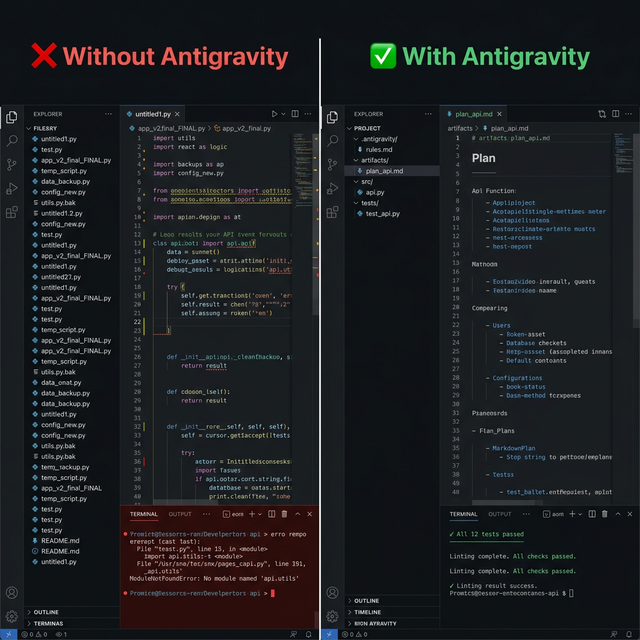
An AI Agent's capability ceiling = the quality of context it can read.
The engine is the core: ag-refresh deploys a multi-agent cluster that autonomously reads your code — each module gets its own Agent that generates a knowledge doc. ag-ask routes questions to the right Agent, grounded in real code with file paths and line numbers.
Instead of handing Claude Code / Codex a repo-wide grep and making it hunt on its own, give it a ChatGPT for your repository.
Benchmarked head-to-head against Codex CLI and Claude Code on 36 questions across 3 real-world Python codebases (fastapi, requests, sqlmodel) — Antigravity 99% on factual lookups, 97% on audit/security, 2.1× faster than Codex on factual. See eval below.
Traditional approach:              Antigravity approach:
  CLAUDE.md = 5000 lines of docs     Claude Code calls ask_project("how does auth work?")
  Agent reads it all, forgets most   Router → ModuleAgent reads actual source, returns exact answer
  Hallucination rate stays high      Grounded in real code, file paths, and git history
| Problem | Without Antigravity | With Antigravity |
|---|---|---|
| Agent forgets coding style | Repeats the same corrections | Reads .antigravity/conventions.md — gets it right the first time |
| Onboarding a new codebase | Agent guesses at architecture | ag-refresh → ModuleAgents self-learn each module |
| Switching between IDEs | Different rules everywhere | One .antigravity/ folder — every IDE reads it |
| Asking "how does X work?" | Agent reads random files | ask_project MCP → Router routes to the responsible ModuleAgent |
Architecture is files + a live Q&A engine, not plugins. Portable across any IDE, any LLM, zero vendor lock-in.
Slash Commands
Same four slash commands ship to both Claude Code and Codex CLI. Claude namespaces them as /antigravity:<name>; Codex auto-discovers commands/ and surfaces the bare /<name> form. No retraining — same flow on both hosts.
| Claude Code | Codex CLI | Purpose |
|---|---|---|
/antigravity:ag-setup | /ag-setup | First-time setup — pick LLM provider, write .env |
/antigravity:ag-refresh [quick] | /ag-refresh [quick] | Build / incrementally refresh the project knowledge base |
/antigravity:ag-ask <question> | /ag-ask <question> | Routed Q&A on the current codebase |
/antigravity:ag-init <name> | /ag-init <name> | Scaffold a new multi-agent repo from this template |
A typical first session is ag-setup → ag-refresh → ag-ask. Details below.
ag-setup — first-time configuration
Run this once per project, right after installing the plugin. Interactive picker for the LLM provider (OpenAI / DeepSeek / Groq / 阿里灵积 / NVIDIA NIM / Ollama local / any OpenAI-compatible endpoint), then writes .env to the project root with OPENAI_BASE_URL, OPENAI_API_KEY, OPENAI_MODEL, AG_ASK_TIMEOUT_SECONDS. Also ensures .env is in .gitignore. Skip it if you already have a working .env.
# Claude Code
/antigravity:ag-setup

# Codex CLI
/ag-setup
ag-refresh — build / refresh the knowledge base
Deploys the multi-agent cluster to read your code: each module gets its own Agent that produces a knowledge doc under .antigravity/agents/*.md, plus a map.md routing index. Run after install, after significant code changes, or when ag-ask returns stale answers. The first refresh auto-creates .antigravity/ — no separate init step needed. Pass quick for an incremental update, failed-only to rerun only previously failed modules.
# Claude Code
/antigravity:ag-refresh
/antigravity:ag-refresh quick

# Codex CLI
/ag-refresh
/ag-refresh quick
Time: a few minutes for small repos, longer for large ones. Requires ag-setup to have completed.
ag-ask — routed Q&A on the codebase
The main reason this plugin exists. Routes your question to the right ModuleAgent (and GitAgent / GitNexus when applicable), then returns an answer grounded in actual source with file paths and line numbers. Use it before manually grepping or reading files — it's faster and more accurate. Good question shapes: "where is X defined/handled?", "why was Y done this way?", "how does the auth flow work?", "what depends on module Z?".
# Claude Code
/antigravity:ag-ask "How does authentication work?"

# Codex CLI
/ag-ask "How does authentication work?"
Requires a knowledge base — if you see "no index" or empty answers, run ag-refresh first.
ag-init — scaffold a new multi-agent repo
Creates a new project from the Antigravity template. Two modes: quick (fast scaffold, clean copy) and full (adds runtime profile, .env, mission file, sandbox config, optional git init). This is for starting a new repo — you do not need it before ag-refresh on an existing project.
# Claude Code
/antigravity:ag-init my-agent
/antigravity:ag-init my-agent full

# Codex CLI
/ag-init my-agent
/ag-init my-agent full
The plugin also bundles the
agent-repo-initskill (the same backend thatag-initinvokes — Codex / Claude can also match it by description) and the optionalag-mcpMCP server (ask_project+refresh_project) for tool-style integration.
Support Matrix
| Layer | Channels | Contract |
|---|---|---|
| Native plugins | Claude Code, Codex CLI | Bundled slash commands for ag-setup, ag-refresh, ag-ask, and ag-init. |
| Compatible IDEs | Cursor, Windsurf, Gemini CLI, VS Code + Copilot, Cline, Aider | Use shared context files, the ag/ag-* CLI entrypoints, or an MCP client. |
| Advanced tool integration | ag-mcp | Exposes ask_project and refresh_project for hosts that can call MCP tools. |
| Workspace bootstrapping | ag-init, ag init | Starts a new repo or injects portable agent context into an existing one. |
The native plugins are the first-class install path today. Other environments are supported through the same repository knowledge artifacts rather than separate host-specific plugin packages.
Quick Start
Option A — Plugin install for Claude Code / Codex CLI
# Claude Code (auto-installs the Python engine CLI on first session via SessionStart hook)
/plugin marketplace add study8677/antigravity-workspace-template
/plugin install antigravity@antigravity
/antigravity:ag-setup            # interactive: pick LLM provider, paste API key, writes .env
/antigravity:ag-refresh          # runs ag-refresh directly; first refresh auto-creates .antigravity/
/antigravity:ag-ask "How does this project work?"  # runs ag-ask directly

# Codex CLI (install the engine manually first; Codex hooks are not yet supported)
pipx install "git+https://github.com/study8677/antigravity-workspace-template.git#subdirectory=engine"
codex plugin marketplace add study8677/antigravity-workspace-template
/ag-setup                        # same flow, no antigravity: prefix in Codex
/ag-refresh
/ag-ask "How does this project work?"
Codex CLI auto-discovers slash commands from the plugin's commands/ directory, so the same four commands work without the antigravity: namespace prefix (/ag-setup, /ag-refresh, /ag-ask, /ag-init). The raw CLI calls (ag-refresh --workspace ., ag-ask "..." --workspace .) also still work. If your Codex build supports MCP and you want tool-style integration, register ag-mcp --workspace <project> separately.
After install + setup you get ag-ask <question>, ag-refresh, and ag-init <name> slash commands in both hosts. MCP remains optional (ask_project + refresh_project) via ag-mcp; see docs/examples/antigravity.mcp.json. See INSTALL.md for details and troubleshooting.
Option B — Manual install: engine + CLI via pip
# 1. Install engine + CLI
pip install "git+https://github.com/study8677/antigravity-workspace-template.git#subdirectory=cli"
pip install "git+https://github.com/study8677/antigravity-workspace-template.git#subdirectory=engine"

# 2. Configure .env with any OpenAI-compatible API key
cd my-project
cat > .env <<EOF
OPENAI_BASE_URL=https://your-endpoint/v1
OPENAI_API_KEY=your-key
OPENAI_MODEL=your-model
AG_ASK_TIMEOUT_SECONDS=120
EOF

# 3. Build knowledge base (ModuleAgents self-learn each module)
ag-refresh --workspace .

# 4. Ask anything
ag-ask "How does auth work in this project?"

# 5. (Optional) Register as MCP server for Claude Code
claude mcp add antigravity ag-mcp -- --workspace $(pwd)
Option C — Context files only (any IDE, no LLM needed)
pip install git+https://github.com/study8677/antigravity-workspace-template.git#subdirectory=cli
ag init my-project && cd my-project
# IDE entry files bootstrap into AGENTS.md; dynamic knowledge is in .antigravity/
Features at a Glance
  ag init             Inject context files into any project (--force to overwrite)
       │
       ▼
  .antigravity/       Shared knowledge base — every IDE reads from here
       │
       ├──► ag-refresh     Dynamic multi-agent self-learning → module knowledge docs + structure map
       ├──► ag-ask         Router → ModuleAgent Q&A with live code evidence
       └──► ag-mcp         Optional MCP server → IDE tool integration
Dynamic Multi-Agent Cluster — During ag-refresh, the engine uses smart functional grouping: files are grouped by import relationships, directory co-location, and filename prefixes. Source code is pre-loaded directly into agent context (no tool calls needed), and build artifacts are automatically filtered out. Each sub-agent analyzes ~30K tokens of focused, functionally related code in a single LLM call and outputs a comprehensive Markdown knowledge document (agents/*.md). For large modules, multiple sub-agents run in parallel — each produces its own agent.md (no merging, no information loss). A Map Agent reads all agent docs and generates map.md — a routing index. During ag-ask, Router reads map.md to select relevant modules, then feeds their agent docs to answer agents. For structural questions (call chains, dependencies, impact analysis), the Router automatically queries GitNexus code graph for precise relationships. Fully language-agnostic — module detection uses pure directory structure, code analysis is done entirely by LLMs. Works with any programming language.
GitAgent — A dedicated agent for analyzing git history — understands who changed what and why.
GitNexus Graph Enrichment (optional) — Install GitNexus to auto-unlock graph-enriched answers. The Router LLM decides when a question needs structural analysis (call chains, dependencies, impact) and queries GitNexus automatically — combining precise graph data with semantic understanding from agent docs.
NLPM Audit Feedback — This repository has benefited from NLPM, a natural-language programming linter for Claude Code plugins, skills, and agent definitions by xiaolai. Its audit helped identify useful improvements in skill frontmatter and dependency hygiene.
CLI Commands
| Command | What it does | LLM needed? |
|---|---|---|
ag init <dir> | Inject cognitive architecture templates | No |
ag init <dir> --force | Re-inject, overwriting existing files | No |
ag refresh --workspace <dir> | CLI convenience wrapper around the knowledge-hub refresh pipeline | Yes |
ag ask "question" --workspace <dir> | CLI convenience wrapper around the routed project Q&A flow | Yes |
ag-refresh | Multi-agent self-learning of codebase, generates module knowledge docs + conventions.md + structure.md | Yes |
ag-ask "question" | Router → ModuleAgent/GitAgent routed Q&A | Yes |
ag-mcp --workspace <dir> | Start MCP server — exposes ask_project + refresh_project to Claude Code | Yes |
ag report "message" | Log a finding to .antigravity/memory/ | No |
ag log-decision "what" "why" | Log an architectural decision | No |
ag ask / ag refresh are available when both cli/ and engine/ are installed. ag-ask / ag-refresh are the engine-only entrypoints.
Two Packages, One Workflow
antigravity-workspace-template/
├── cli/                     # ag CLI — lightweight, pip-installable
│   └── templates/           # .cursorrules, CLAUDE.md, .antigravity/, ...
└── engine/                  # Multi-agent engine + Knowledge Hub
    └── antigravity_engine/
        ├── _cli_entry.py    # ag-ask / ag-refresh / ag-mcp + python -m dispatch
        ├── config.py        # Pydantic configuration
        ├── hub/             # ★ Core: multi-agent cluster
        │   ├── agents.py    #   Router + ModuleAgent + GitAgent
        │   ├── contracts.py #   Pydantic models: claims, evidence, refresh status
        │   ├── ask_pipeline.py    # agent.md + graph-enriched ask
        │   ├── refresh_pipeline.py # LLM-driven refresh → agents/*.md + map.md
        │   ├── ask_tools.py
        │   ├── scanner.py   #   multi-language project scanning
        │   ├── module_grouping.py # smart functional file grouping
        │   ├── structure.py
        │   ├── knowledge_graph.py
        │   ├── retrieval_graph.py
        │   └── mcp_server.py
        ├── mcp_client.py    # MCP consumer (connects external tools)
        ├── memory.py        # Persistent interaction memory
        ├── tools/           # MCP query tools + extensions
        ├── skills/          # Skill loader
        └── sandbox/         # Code execution (local / microsandbox)
CLI (pip install .../cli) — Zero LLM deps. Injects templates, logs reports & decisions offline.
Engine (pip install .../engine) — Repository knowledge runtime. Powers ag-ask, ag-refresh, ag-mcp. Uses the OpenAI-compatible endpoint written by ag-setup (OpenAI, DeepSeek, Groq, DashScope, NVIDIA NIM, Ollama, or custom).
New skill packaging updates:
engine/antigravity_engine/skills/graph-retrieval/— graph-oriented retrieval tools for structure and call-path reasoning.engine/antigravity_engine/skills/knowledge-layer/— project knowledge-layer tools for semantic context consolidation.
# Install both for full experience
pip install "git+https://...#subdirectory=cli"
pip install "git+https://...#subdirectory=engine"
For local work on this repository itself:
python3 -m venv venv
source venv/bin/activate
pip install -e ./cli -e './engine[dev]'
pytest engine/tests cli/tests
How It Works
1. ag init — Inject context files
ag init my-project
# Already initialized? Use --force to overwrite:
ag init my-project --force
Creates AGENTS.md (authoritative behavior rules), IDE bootstrap files (.cursorrules, CLAUDE.md, .windsurfrules, .clinerules, .github/copilot-instructions.md), and .antigravity/ dynamic context files.
2. ag-refresh — Multi-agent self-learning
ag-refresh --workspace my-project
9-step pipeline:
- Scan codebase (languages, frameworks, structure)
- Multi-agent pipeline generates
conventions.md - Generate
structure.md— language-agnostic file tree with line counts - Build knowledge graph (
knowledge_graph.json+ mermaid) - Write document/data/media indexes
- LLM full-context analysis — group files by import graph + directory + prefix, pre-load into context (~30K tokens per sub-agent), filter out build artifacts. Each sub-agent reads the full source code and outputs a comprehensive Markdown knowledge document (
agents/*.md). Large modules get multiple agent docs (one per group, no merging). Global API concurrency control prevents rate-limiting. Fully language-agnostic — works with any programming language. - RefreshGitAgent analyzes git history, generates
_git_insights.md - Map Agent reads all agent docs → generates
map.md(module routing index with descriptions and key topics) - GitNexus indexing (optional) — runs
gitnexus analyzeto build a Tree-sitter code graph (16 languages, call chains, dependencies). Auto-skipped if GitNexus is not installed.
3. ag-ask — Router-based Q&A
ag-ask "How does auth work in this project?"
The ask pipeline uses a dual-path architecture:
- Semantic path: Router reads
map.md→ selects modules → readsagents/*.md→ LLM answers with code references. Multiple agent docs are read in parallel, then a Synthesizer combines answers. - Graph path (automatic): Router LLM decides if the question needs structural analysis → queries GitNexus for call chains, dependencies, or impact → injects graph data into the answer context. Silently skipped if GitNexus is not installed.
Falls back to the legacy Router → ModuleAgent/GitAgent swarm when agent docs are not yet generated.
IDE Compatibility
Architecture is encoded in files — any agent that reads project files benefits:
| IDE | Config File |
|---|---|
| Cursor | .cursorrules |
| Claude Code | CLAUDE.md |
| Windsurf | .windsurfrules |
| VS Code + Copilot | .github/copilot-instructions.md |
| Gemini CLI / Codex | AGENTS.md |
| Cline | .clinerules |
| Google Antigravity | .antigravity/rules.md |
All are generated by ag init: AGENTS.md is the single behavioral rulebook, IDE-specific files are thin bootstraps, and .antigravity/ stores shared dynamic project context.
Advanced Features
MCP Server — Give Claude Code a ChatGPT for your codebase
Instead of reading hundreds of documentation files, Claude Code can call ask_project as a live tool — backed by a dynamic multi-agent cluster: Router routes questions to the right ModuleAgent, returning grounded answers with file paths and line numbers.
Setup:
# Install engine
pip install "git+https://github.com/study8677/antigravity-workspace-template.git#subdirectory=engine"

# Refresh knowledge base first (ModuleAgents self-learn each module)
ag-refresh --workspace /path/to/project

# Register as MCP server in Claude Code
claude mcp add antigravity ag-mcp -- --workspace /path/to/project
Tools exposed to Claude Code:
| Tool | What it does |
|---|---|
ask_project(question) | Router → ModuleAgent/GitAgent answers codebase questions. Returns file paths + line numbers. |
refresh_project(quick?) | Rebuild knowledge base after significant changes. ModuleAgents re-learn the code. |
Dynamic Multi-Agent Cluster — Module-level self-learning + intelligent routing
The engine's core is a dynamically created Agent cluster per code module:
 ag-refresh:                                 ag-ask:

 For each module:                            Router (reads map.md)
 ┌ Group files by import graph                 ├── GRAPH: no → read agents/*.md → LLM answer
 ├ Pre-load ~30K tokens per sub-agent          └── GRAPH: yes → query GitNexus graph
 ├ Filter out build artifacts                        → graph data + agents/*.md → LLM answer
 ├ Sub-agents → Markdown agent docs
 ├ agents/{module}.md (or /group_N.md)
 ├ Map Agent → map.md
 └ GitNexus analyze (optional)
Key innovations:
- LLM as analyzer: No AST parsing or regex — source code is fed directly to LLMs for analysis. Works with any programming language out of the box.
- Smart grouping: Files grouped by import relationships, directory co-location, and filename prefixes. Build artifacts automatically filtered out. Hard character limit (800K) prevents context overflow.
- No information loss: Large modules produce multiple
agent.mdfiles (one per group) — no merging or compression. Duringag-ask, multiple agent docs are read by parallel LLM calls, then a Synthesizer combines answers. - Graph-enriched answers: Router LLM automatically decides when a question needs structural data (call chains, dependencies, impact) and queries GitNexus. Combines precise graph relationships with semantic understanding.
- Global API concurrency control:
AG_API_CONCURRENCYlimits total simultaneous LLM calls across all modules, preventing rate-limiting. - Language-agnostic module detection: Pure directory structure — no
__init__.pyor any language-specific marker required.
# ModuleAgents self-learn your codebase
ag-refresh

# Only scan files changed since last refresh
ag-refresh --quick

# Router intelligently routes to the right ModuleAgent
ag-ask "What testing patterns does this project use?"

# Log findings and decisions (no LLM needed)
ag report "Auth module needs refactoring"
ag log-decision "Use PostgreSQL" "Team has deep expertise"
Works with the provider selected by ag-setup through an OpenAI-compatible endpoint. Powered by OpenAI Agent SDK + LiteLLM.
MCP Integration (Consumer) — Let agents call external tools
MCPClientManager lets your agents connect to external MCP servers (GitHub, databases, etc.), auto-discovering and registering tools.
// mcp_servers.json
{
  "servers": [
    {
      "name": "github",
      "transport": "stdio",
      "command": "npx",
      "args": ["-y", "@modelcontextprotocol/server-github"],
      "enabled": true
    }
  ]
}
Set MCP_ENABLED=true in .env to make configured servers available, and set
AG_ALLOW_MCP=true only when you want ag-ask to auto-connect those external
servers. Stdio MCP servers inherit process environment plus configured env
values, so treat enabled servers as local-permission code.
GitNexus Graph Enrichment — Automatic structural intelligence for ask queries
GitNexus builds a code knowledge graph using Tree-sitter AST parsing (16 languages). When installed, Antigravity integrates it at two levels:
1. Refresh-time indexing — ag-refresh automatically runs gitnexus analyze (Step 9) to build/update the code graph. Skipped silently if GitNexus is not installed.
2. Ask-time graph enrichment — The Router LLM decides whether a question needs structural analysis:
- "What does the auth module do?" →
GRAPH: no→ pure agent.md answer - "Who calls handleLogin?" →
GRAPH: yes→ queries GitNexus → graph data + agent.md → enriched answer
User: "What functions call the send method in gateway?"

Router: MODULES: gateway, tests_gateway | GRAPH: yes
  → GitNexus query returns call chains with confidence scores
  → Agent docs provide semantic context (what each caller does)
  → Combined answer: precise call chain + file paths + line numbers + purpose
| Capability | What it provides |
|---|---|
gitnexus_query | Hybrid search (BM25 + semantic) — execution flows, not just files |
gitnexus_context | 360-degree symbol view: callers, callees, references, definition |
gitnexus_impact | Blast radius analysis — what breaks if you change a symbol? |
Note: GitNexus is NOT bundled with Antigravity. It requires separate installation via npm (
npm install -g gitnexus). Antigravity works fully without it — when not installed, all graph features are silently skipped with zero overhead.
How to enable:
# 1. Install GitNexus (requires Node.js)
npm install -g gitnexus

# 2. Refresh (auto-indexes the code graph)
ag-refresh --workspace my-project

# 3. Ask — graph enrichment is automatic
ag-ask "Who calls the send method in gateway adapters?"
# Router decides: GRAPH: yes → queries GitNexus → enriched answer
Sandbox — Configurable code execution environment
| Variable | Default | Options |
|---|---|---|
SANDBOX_TYPE | local | local · microsandbox |
SANDBOX_TIMEOUT_SEC | 30 | seconds |
AG_RETRIEVAL_MODE | compact | off · compact · full |
The default sandbox is for trusted local workspaces, not untrusted code
isolation. Retrieval graph files redact common secrets before writing to disk,
but full mode can still preserve source snippets. See
Sandbox docs.
Head-to-Head Eval: Antigravity vs Codex CLI vs Claude Code (2026-05-09)
Asymmetric benchmark on three real-world Python codebases — fastapi/fastapi,
psf/requests, fastapi/sqlmodel — asking each tool the same 36 questions
across three difficulty bands. All three tools used gpt-5.5 with high
reasoning effort; Codex and Claude had full read access to the workspace.
Codex was the grader (4-axis 0–3 rubric, scores verified against actual source).
| Question type | Antigravity | Codex CLI | Claude Code |
|---|---|---|---|
| 15 factual lookups | 179/180 (99%) | 179/180 (99%) | 178/180 (99%) |
| 12 synthesis (project / arch tour) | 116/144 (81%) | 144/144 (100%) | 136/144 (94%) |
| 9 audit / security | 105/108 (97%) | 104/108 (96%) | 98/108 (91%) |
Combined factual + audit (24 cells): Antigravity 284/288, Codex 283/288, Claude 276/288. Antigravity edges out both — at lower latency than Codex on every single question.
Latency (mean wall-clock per question, same proxy):
| Question type | Antigravity | Codex | Claude |
|---|---|---|---|
| Factual | 56s | 119s | 42s |
| Audit | 160s | 177s | 100s |
Antigravity is 2.1× faster than Codex on factual and on par with Codex on audit, while matching or beating it on correctness. Claude is fastest on audit but loses 7 percentage points of correctness.
What changed in this repo to get there. Two engine fixes landed during the benchmark, both committed in this branch:
_ask_with_agent_mdnow surfaces project-level docs (conventions.md,module_registry.md,map.md,structure.md) into its answer prompts. Removes the “module knowledge does not include project-wide conventions” refusal pattern.- The structured-facts answer agents now have
search_code,read_file,list_directory,read_file_metadata,search_by_typebound at runtime, so the LLM can grep and read actual source instead of paraphrasing the KG.
Full report (data, methodology, per-cell tables, caveats):
artifacts/benchmark-2026-05-09/REPORT.md.
Documentation
| 🇬🇧 English | docs/en/ |
| 🇨🇳 中文 | docs/zh/ |
| 🇪🇸 Español | docs/es/ |
Contributing
Ideas are contributions too! Open an issue to report bugs, suggest features, or propose architecture.
Contributors
 ⭐ Lling0000 Major Contributor · Creative suggestions · Project administrator · Project ideation & feedback |
 Alexander Daza Sandbox MVP · OpenSpec workflows · Technical analysis docs · PHILOSOPHY |
 Chen Yi First CLI prototype · 753-line refactor · DummyClient extraction · Quick-start docs |
 Subham Sangwan Dynamic tool & context loading (#4) · Multi-agent swarm protocol (#3) |
 shuofengzhang Memory context window fix · MCP shutdown graceful handling (#28) |
 goodmorning10 Enhanced ag ask context loading — added CONTEXT.md, AGENTS.md, and memory/*.md as context sources (#29)
|
 Abhigyan Patwari GitNexus — code knowledge graph natively integrated into ag ask for symbol search, call graphs, and impact analysis
|
 BBear0115 Skill packaging & KG retrieval enhancements · Multi-language README sync (#30) |
 SunkenCost ag clean command · __main__ entry-point guard (#37)
|
 Aravindh Balaji Unified instruction surface around AGENTS.md (#41)
|
 xiaolai NLPM audit feedback · Skill frontmatter fixes · Dependency hygiene review (#51, #52, #53) |
Star History
License
MIT License. See LICENSE for details.